Inception of Low-Temperature Lead Glazing
Northern potters in Shaanxi and Henan refine Han-Wei lead glazing to successfully produce early two-color and tri-color mortuary vessels.
Tang Dynasty (唐朝) · HISTORICAL EVENT
唐三彩兴盛
The Flourishing of Tang Sancai Ceramics (唐三彩兴盛), spanning roughly from 650 to 755 CE (from the reign of Emperor Gaozong to the Kaiyuan and Tianbao eras of Emperor Xuanzong), represents a glorious epoch of ceramic craftsmanship and mortuary culture in the Tang Dynasty. Fabricated from fine kaolinitic white clays and fired twice through an initial high-temperature biscuit bake and a secondary low-temperature glaze firing, Tang Sancai utilized lead oxides as…
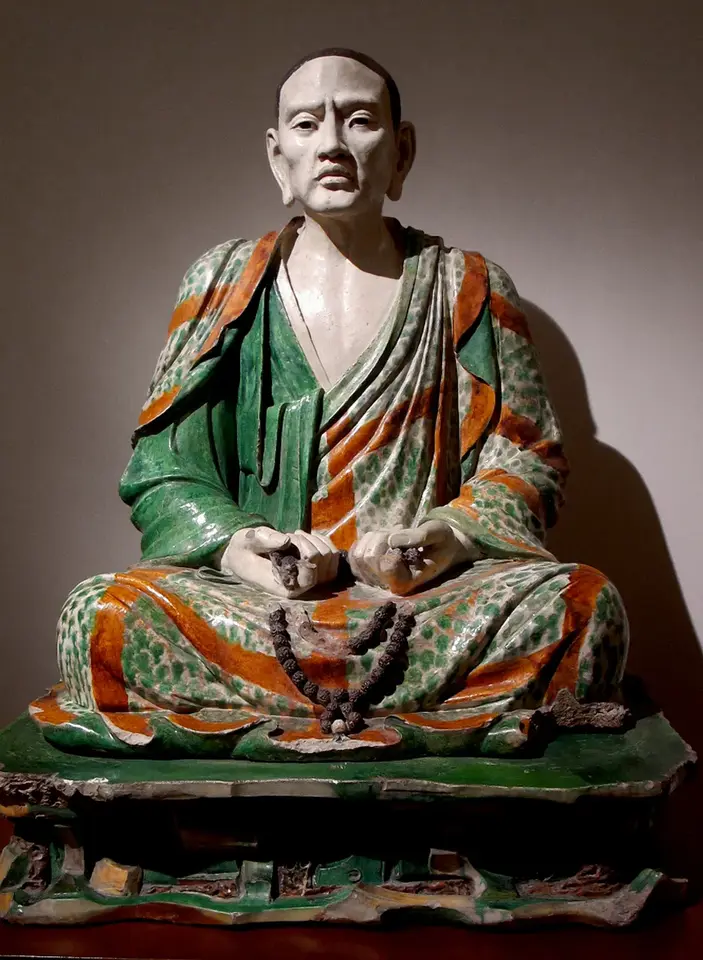
The Flourishing of Tang Sancai Ceramics (唐三彩兴盛), spanning roughly from 650 to 755 CE (from the reign of Emperor Gaozong to the Kaiyuan and Tianbao eras of Emperor Xuanzong), represents a glorious epoch of ceramic craftsmanship and mortuary culture in the Tang Dynasty. Fabricated from fine kaolinitic white clays and fired twice through an initial high-temperature biscuit bake and a secondary low-temperature glaze firing, Tang Sancai utilized lead oxides as a flux alongside metal colorants including iron, copper, cobalt, and manganese. Under kiln reduction and fusion, these minerals melted into flowing, intermingling glazes of amber, green, creamy white, cobalt blue, and aubergine, creating a fluid and opulent surface aesthetic. Amidst the supreme political stability, agrarian prosperity, and burgeoning cosmopolitan wealth of the High Tang, imperial princes, noble clans, and high officials indulged in lavish mortuary display, commissioning vast suites of tri-color glazed figurines and vessels to flaunt ancestral status and wealth. Ceramic complexes such as the Huangye Kiln in Gongxian (Henan) and the Huangbao Kiln in Tongchuan (Shaanxi) attained unmatched sophistication, sculpting spirited warhorses, music-bearing Bactrian camels, plump court dames, exotic Sogdian merchants, and fierce Buddhist lokapala guardians. Although the devastating An Lushan Rebellion ended this golden age, the technological innovations and artistic spirit of Tang Sancai permanently enriched Chinese ceramic history, directly influencing Song Sancai, Liao Sancai, and foreign glazed wares across East and West Asia.
Northern potters in Shaanxi and Henan refine Han-Wei lead glazing to successfully produce early two-color and tri-color mortuary vessels.
The imperial manufacturing bureau incorporates polychrome glazed wares into official burial regulations, commissioning kilns to serve the nobility.
Following Wu Zetian's establishment of the Wu Zhou capital at Luoyang, Gongxian kilns master large-scale sculptural firing and introduce rare cobalt blue glazes.
Crown Prince Yide and Princess Yongtai are reinterred with thousands of peerless Sancai guardians, equestrians, and court ladies.
Dynamic glaze-flowing techniques reach their zenith; music-bearing camels, Sogdian merchant figurines, and plump court ladies become iconic symbols of High Tang culture.
Aristocratic mortuary expenditure reaches unprecedented heights; merchant caravans carry Sancai vessels along the maritime and overland Silk Roads to West Asia and Japan.
Rebel forces sack Luoyang and Chang'an, devastating kiln sites across northern China and precipitating the swift collapse of elite Sancai mortuary culture.
Following the pacification campaigns of Emperor Taizong and the governance of the Zhenguan era, the Tang Empire entered decades of continuous demographic growth and economic accumulation. Under Emperor Gaozong, Empress Wu Zetian, and the zenith of Emperor Xuanzong's Kaiyuan reign, agricultural granaries overflowed and interregional commerce expanded exponentially. The twin capitals of Chang'an and Luoyang evolved into bustling global metropolises boasting over a million inhabitants each. Aristocratic clans and wealthy civil-military officials engaged in luxurious recreational pursuits, including polo matches, imperial hunts, lavish banquets, and the collection of fine steeds and foreign entertainers. This triumphant, outward-looking social atmosphere demanded an opulent, polychromatic material medium that could embody the empire's pride and aesthetic vigor.
In medieval Chinese society, the scale of funeral corteges and the quantity of grave goods (mingqi) served as paramount public indices of a lineage's political rank and economic prominence. Although the imperial court promulgated statutory restrictions in the Tanglü Shuyi (Code of Tang with Commentary) and Da Tang Kaiyuan Li (Ritual Code of the Kaiyuan Era) limiting the number and size of figurines according to administrative rank, aristocratic families routinely breached these boundaries in ostentatious displays of competitive consumption. Funeral processions wound through city thoroughfares with hundreds of glazed figurines and model architectural pavilions paraded before admiring onlookers. Because low-temperature lead-glazed earthenware was far more affordable than cast bronze, silver, or jade, yet displayed vastly richer hues and larger sculptural scales than contemporary celadon or white porcelain, it emerged as the primary status symbol within elite tombs.
The rise of Tang Sancai was underpinned by long ceramic technological evolution tracing back to Han lead-glazed pottery and the polychrome slipped figures of the Northern Wei and Northern Qi dynasties. Tang potters mastered two-stage firing techniques, employing purer kaolin clays that sustained higher initial kiln temperatures and produced pristine white biscuit bodies. Crucially, the expansion of the Silk Road facilitated the importation of rare smalt and cobalt mineral ores from Central and Western Asia. When dissolved into lead glazes, cobalt yielded an electrifying, deep sapphire blue. The inclusion of cobalt blue elevated Tang Sancai from simple two-color utilitarian earthenware into an ultra-luxurious, internationally admired art form.
The inception of Tang Sancai occurred during the Yonghui and Xianqing eras of Emperor Gaozong (650s CE). Previously, northern mortuary figures were predominantly painted unglazed gray or red earthenware. Supervised by the Zhenguan Bureau under the Directorate for Imperial Manufactures, potters at Gongxian and near Chang'an began experimenting with low-temperature lead glazes. Excavations from satellite tombs at Emperor Taizong's Zhaoling Mausoleum and aristocratic graves near Luoyang dating to the 660s and 670s have yielded early two-color (amber and green) vessels and modest figurines exhibiting nascent glaze flow.
During the reign of Wu Zetian and her Wu Zhou Dynasty (684–705 CE), when Luoyang was designated the "Divine Capital" and imperial construction expanded rapidly, the demand for grave goods surged. Ceramic workshops overcame structural limitations to craft larger statuary, introducing tall warrior guards, civil officials, and court attendants into tombs. It was also during this period that cobalt blue was first introduced into the glaze palette of elite Luoyang burials, signaling that Tang Sancai had completed its foundational evolution and entered its mature phase.
In this developmental era, potters standardized the dual-firing protocol. Raw kaolin with low iron content was pulverized, elutriated, molded, and air-dried before entering the kiln for an initial bisque firing at temperatures exceeding one thousand degrees Celsius. After cooling, artisans applied translucent lead silicate glazes compounded with copper, iron, cobalt, or manganese colorants. The wares were then returned to the kiln for a second firing at approximately eight hundred degrees Celsius. At this heat, the lead flux liquefied, allowing the vibrant metallic pigments to cascade across the contours of the clay body, creating accidental streaks and luminous tonal variations.
During the Kaiyuan and Tianbao eras of Emperor Xuanzong (713–755 CE), Tang Sancai production reached its historical zenith in both volume and sculptural virtuosity. The Huangye Kiln in Gongxian served as the primary ceramic supplier for Luoyang, establishing sprawling hillside workshops alongside the Huangye River. Meanwhile, the Huangbao Kiln in Tongchuan and urban kilns in western Chang'an mass-produced figurines and vessels for the imperial capital, while workshops in Hebei's Xing Kiln and Cizhou districts contributed regional variants.
Artisans demonstrated astonishing versatility, combining wheel-throwing, press-molding, carved applique, and two-piece hollow assemblage. Utilitarian vessels proliferated, including double-dragon amphorae, phoenix-headed ewers, three-legged dishes, multilegged inkstones, and globular jars. Even more striking was the statuary: monumental guardian lokapalas exceeded 1.5 meters in height, complete with roaring dragon crests, bulging eyes, and contorted demons beneath their armored feet; civil officials stood dignified in layered robes; and riders on horseback were rendered with anatomical precision.
Archeological excavations at the Huangye Kiln revealed strata several meters deep, containing thousands of pottery molds, refractory saggers, triangular stilts, and discarded glazed shards. The Huangye clay was exceptionally pure, fine-grained, and white, producing a creamy, lustrous glaze that showcased cobalt blue with singular brilliance. In contrast, the Huangbao Kiln in Shaanxi made abundant use of local buff clays to produce monumental cavalry figures and military commanders, demonstrating the advanced division of labor across the High Tang ceramic industry.
The thematic repertoire of High Tang Sancai stands as a vivid testament to the open, multicultural character of the empire. Foreign motifs were omnipresent. Hundreds of figurines depict Sogdian merchants, Persian emissaries, Turkish warriors, and Central Asian grooms with high-bridged noses, deep-set eyes, thick beards, pointed felt caps, and double-breasted robes.
The famous "Camel with Musicians" unearthed in Xi'an exemplifies this synthesis. A magnificent two-humped Bactrian camel carries an arched wooden platform draped with an ornate Persian carpet; perched upon it, seven male musicians and a female vocalist perform upon flutes, pipas, harps, and clappers, evoking the exotic melodies of Central Asia that captivated the Tang court. Simultaneously, depictions of women transformed from the slender silhouettes of early Tang into the voluptuous, graceful damsels of the Kaiyuan era, dressed in flowing robes with towering coiffures, radiating ease and dignity.
Equally renowned were Sancai horses, representing the peak of ancient Chinese animal sculpture. Tang military dominance depended upon vast pastures in Hexi and Longyou, making equestrian culture a national obsession. Potters sculpted steeds with small heads, muscular necks, rounded croups, and taut legs, their ears pinned back in alert attentiveness. Manes were cropped into elegant crenellations or single plumes, while saddles and saddle-cloths were decorated with molded florets and pearl medallions, draped in intermingling amber and emerald glazes that immortalized the majestic spirit of Tang battle chargers.
Beyond steeds and camels, Tang Sancai created a comprehensive miniature universe of daily life. Artisans fashioned intricate architectural models of aristocratic manors, multistory pavilions, waterside gazebos, courtyards, granaries, wells, mills, and animal pens. Accompanied by figurines of maids, jugglers, acrobats, and barnyard livestock, these mortuary assemblages constituted a complete three-dimensional panorama of High Tang society.
Excavations across Shaanxi and Henan prove that top-tier Sancai artifacts were strictly correlated with imperial favor and aristocratic status. The finest masterpieces have been unearthed from satellite burials surrounding the Qianling Mausoleum of Emperor Gaozong and Wu Zetian, as well as the royal cemeteries on Mount Mang near Luoyang.
In the tombs of Crown Prince Yide (Li Chongrun), Princess Yongtai (Li Xianhui), and Crown Prince Zhanghuai (Li Xian)—all reburied with regal honors in 706 CE—archaeologists discovered thousands of breathtaking Sancai sculptures. Yide's tomb contained gilt-accented lokapala guardians and armed cavalry guards reflecting imperial funeral honors, while Princess Yongtai's tomb yielded delicate tripods and graceful maiden figures whose glazes resembled melting jade. These official discoveries confirmed that Sancai was central to imperial mortuary liturgy.
Tombs of officials and nobles revealed strict gradations in figurine counts, with high ministers entitled to dozens of glazed models placed methodically within tomb corridors and niches. These miniature retinues served not only as supernatural escorts for the deceased in the afterlife, but also as the centerpiece of public display during funeral corteges, cementing Tang Sancai's role as a vital political and ritual commodity.
The prestige of Tang Sancai resonated far beyond the borders of the Middle Kingdom, carried across terrestrial caravan paths and maritime sea lanes. Sancai shards have been excavated from Fustat (Old Cairo) in Egypt, Samarra in Iraq, Nishapur in Iran, and various Levantine sites. In East Asia, significant quantities of Sancai vessels have been recovered from the imperial capitals of Heijokyo (Nara) and Heiankyo (Kyoto) in Japan, as well as Gyeongju, the capital of Silla in Korea.
This exotic glazed ware stimulated immediate imitation abroad. In Japan, imperial aristocrats preserved Tang Sancai treasures in the Shosoin repository at Todai-ji while native craftsmen formulated their own lead glazes to create "Nara Sancai." Korean potters developed "Silla Sancai," and Islamic kilns across Mesopotamia and Persia adopted the streaked green-and-yellow splash technique to fashion "Persian Sancai." The flourishing of Tang Sancai thus catalyzed the first trans-Eurasian revolution in polychrome glazed ceramics.
The blossoming of Tang Sancai shattered the traditional hegemony of monochrome celadon and white porcelain, fusing vibrant chemical glazes with monumental ceramic sculpture. By utilizing the liquid properties of lead silicate at 800 degrees Celsius, artisans allowed amber, emerald, and cobalt glazes to blend effortlessly across contoured clay surfaces, achieving an organic, shimmering beauty unmatched in antiquity.
Preserved within sealed subterranean chambers, Tang Sancai provides an extraordinarily detailed snapshot of medieval Chinese life. From high-piled hairstyles and silk dresses to nomadic saddles, foreign facial features, and classical architectural joinery, Sancai sculptures encapsulate the political, military, economic, and religious dimensions of the High Tang, functioning as a complete sculptural encyclopedia of 8th-century Eurasia.
The artistic momentum of Tang Sancai endured long after the dynasty's collapse. Northern Song potters developed refined "Song Sancai" for urban pillow and architectural decoration, while the Khitan Liao Dynasty created robust "Liao Sancai" suited to pastoral traditions. In later centuries, Ming-Qing "Susancai" and wucai enameled porcelains drew directly upon its lead-glaze technology. Internationally, Japan's Nara Sancai, Korea's Silla Sancai, and Islamic lead-splashed wares demonstrate the epochal global impact of Tang polychrome ceramics.
Classical Chinese records and contemporary art historians unite in celebrating Tang Sancai as a supreme cultural achievement. In the New Book of Tang, the Zhenguan Bureau is recorded as overseeing imperial ceramics "to furnish the needs of imperial mausoleums," recognizing Sancai as a critical component of state liturgy. Although scholar Du You criticized the reckless burial extravagance of the Kaiyuan and Tianbao eras in his Tongdian, his accounts confirm the pervasive obsession with these magnificent grave wares across the empire.
In modern archaeology, the accidental rediscovery of Tang Sancai during the 1905 construction of the Longhai Railway near Luoyang astonished scholars like Wang Guowei and Luo Zhenyu. British ceramic historian R. L. Hobson observed that the sculptural vigor, expressive modeling, and brilliant fluid glazes of Tang Sancai represent one of the most astonishing triumphs in the history of world ceramic art.