Inception of Two-Stage Firing
Potters in Shaanxi and Henan establish the dual-firing protocol using white biscuit bodies and secondary lead glazing.
Tang Dynasty (唐朝) · HISTORICAL EVENT
唐三彩烧造与发展
The Firing and Evolution of Tang Sancai Ceramics (唐三彩烧造与发展), extending from 650 to 907 CE (from the reign of Emperor Gaozong to the fall of the Tang Dynasty), marks an epochal technological transition in Chinese ceramic history from monochrome glazes to polychromatic fluid glazing. Rather than literally referring to three colors, Tang Sancai designates a sophisticated low-temperature lead-glazed earthenware produced through a standardized two-stage…
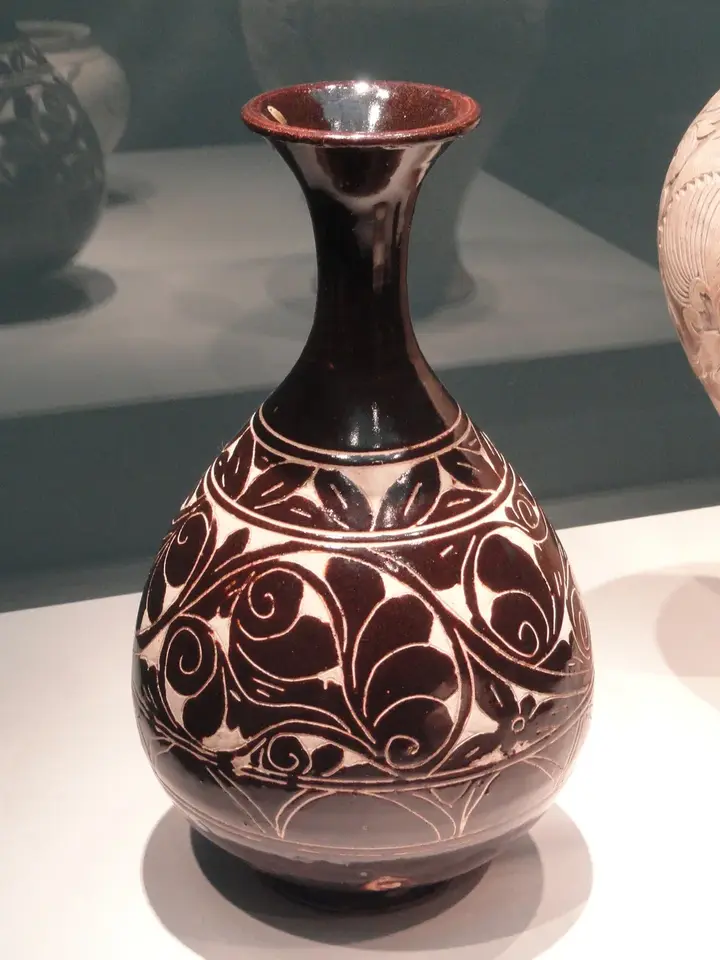
The Firing and Evolution of Tang Sancai Ceramics (唐三彩烧造与发展), extending from 650 to 907 CE (from the reign of Emperor Gaozong to the fall of the Tang Dynasty), marks an epochal technological transition in Chinese ceramic history from monochrome glazes to polychromatic fluid glazing. Rather than literally referring to three colors, Tang Sancai designates a sophisticated low-temperature lead-glazed earthenware produced through a standardized two-stage thermal cycle. Finely elutriated kaolin or white refractory clay was first baked at high temperatures exceeding 1000 degrees Celsius to form a solid biscuit body. Artisans then applied transparent glazes fluxed with lead oxide and pigmented with mineral colorants such as iron, copper, cobalt, and manganese, before executing a secondary glaze firing at approximately 800 degrees Celsius. During the second thermal cycle, the liquefying lead glaze acted as an active flux, permitting the amber, green, white, sapphire blue, aubergine, and brownish pigments to dissolve, intermingle, and flow organically across the contours of the vessel. Tang potters resolved complex structural challenges concerning the drying, jointing, and firing shrinkage of monumental statuary, establishing sprawling production centers at the Huangye Kiln in Gongxian (Henan) and the Huangbao Kiln in Tongchuan (Shaanxi). Having progressed through early Tang experimentation, High Tang sculptural perfection, and middle-to-late Tang functional adaptation to secular wares, this technology provided the foundational matrix for Song, Liao, Jin, and Ming-Qing multi-colored glazes and influenced ceramic traditions across medieval Eurasia.
Potters in Shaanxi and Henan establish the dual-firing protocol using white biscuit bodies and secondary lead glazing.
Zhenguan Bureau standardizes piece-mold techniques and hollow structural ribs, mastering large-scale figure firing.
Silk Road cobalt ores are incorporated into lead-silicate flux at Gongxian, establishing the polychromatic palette.
Kiln complexes reach their technological summit, mass-producing lokapala guardians and steeds supported by specialized saggers and spurs.
Sacking of the twin capitals interrupts official kiln operations, terminating monumental mortuary statuary production.
Craftsmen apply lead glazing to ceramic headrests, ewers, and scholar's wares, dispersing technology to regional kilns like Qionglai.
Collapse of the Tang Dynasty transfers lead-glaze expertise to the Five Dynasties, giving rise to Liao, Song, and Jin Sancai.
The ancestry of low-temperature lead-glazed earthenware traces back to the middle and late Western Han Dynasty. Han potters discovered that lead oxide (huangdan) operated as a powerful flux, enabling silica to fuse into an even, glassy vitreous film at relatively modest temperatures between 700 and 800 degrees Celsius. Using copper oxide as a primary colorant, they successfully produced radiant green-glazed mortuary pottery. By the Northern Dynasties, agricultural compendia such as Jia Sixie's Qimin Yaoshu recorded extensive empirical knowledge regarding clay levigation and kiln firing schedules, while Northern Qi artisans experimented with yellow and green glazes applied over white slips. However, Han and Wei lead wares were restricted to monochrome green or amber, suffered from friable, porous clay bodies that easily flaked, and lacked control over multi-metallic co-firing, creating a demand for systemic technological advancement.
With the imperial reunification of the Sui and Tang dynasties, official supervision of industrial handicrafts became highly institutionalized. The Da Tang Liudian records that the Directorate for Imperial Manufactures oversaw the Zhenguan Bureau, which was charged with supervising ceramic manufacture, managing clay resources, and supplying funeral goods (mingqi) for imperial mausoleums. This centralized bureaucratic framework facilitated the standardized procurement of superior white clays, fostered interregional exchange of technical formulas, and concentrated masonry expertise for large kilns, providing essential structural support for the scale and sophistication of Tang Sancai production.
The chromatic breakthrough of Tang Sancai was grounded in an empirical understanding of metallic colorants under oxidizing kiln conditions. Tang craftsmen established that iron oxides produced tones ranging from pale straw-yellow to dark amber-red; copper ores (malachite) yielded vivid emerald greens; and manganese ores contributed rich aubergine purples. Most dramatically, the overland Silk Road facilitated the introduction of high-grade smalt and cobalt ores from Central and Western Asia. In a lead glaze matrix, cobalt produced a deep, jewel-like sapphire blue. This integration of foreign mineral colorants completed the polychromatic palette of Tang Sancai.
Tang Sancai demanded pristine clay bodies capable of supporting bright translucent glazes without discoloration. Artisans abandoned ordinary alluvial clays, mining secondary kaolin deposits and white refractory fireclays situated along the northern foothills. Raw clays underwent extended outdoor weathering, crushing, water levigation, sedimentation, and fine filtration to remove coarse sand, iron nodules, and organic residues, resulting in plastic, iron-deficient white clays.
For monumental statuary, Tang craftsmen engineered sophisticated structural solutions. While small tableware was thrown on potter's wheels, intricate figurines of warriors, camels, and steeds were fabricated through sectional press-molding, hand modeling, and liquid-slip jointing. Artisans carved master models in fired clay to cast two-part piece molds, pressed plastic clay into the mold halves, joined the seams with thick slip, and hand-finished eyes, mane locks, and drapery. For guardian lokapalas exceeding 1.5 meters, potters integrated internal clay ribs and punctured hollow cavities with concealed vent holes to equalize internal kiln pressures, preventing cracking, deformation, or thermal collapse during firing.
The definitive technical foundation of Tang Sancai was the two-stage firing cycle. Unfired pieces underwent weeks of controlled indoor air-drying to eliminate structural moisture, after which they were stacked into kilns for an initial bisque firing at temperatures between 1000 and 1100 degrees Celsius. This high-temperature cycle sintered the kaolin into a durable, dense white biscuit body possessing optimal porosity for glaze absorption.
Once cooled, the bisque ware entered the glazing stage. The base glaze consisted of powdered quartz and limestone fluxed with up to fifty percent lead oxide. Artisans applied formulated pigments using dipping, pouring, dripping, brushing, and spotting techniques, deliberately leaving the faces and hands of figures unglazed for subsequent mineral pigment painting (kailian). The glazed ware was then placed inside muffle structures within horseshoe-shaped or dome-shaped kilns for secondary firing at approximately 800 degrees Celsius. Under this thermal regime, the lead flux melted into a fluid glass, prompting the iron, copper, cobalt, and manganese oxides to diffuse across the biscuit surface, creating accidental blending and luminous tonal gradients.
As technology matured, two premier ceramic complexes emerged as the twin pillars of Tang Sancai production. The Huangye Kiln in Gongxian (Henan), situated along the Huangye River, served as the primary supplier for the Eastern Capital Luoyang. Benefiting from exceptionally pure local kaolin beds, Huangye Sancai featured fine-textured, porcelain-like white biscuit bodies and pioneered the industrial application of imported cobalt blue glazes on large imperial vessels.
Simultaneously, the Huangbao Kiln in Tongchuan (Shaanxi) served the metropolitan requirements of Chang'an. Utilizing local buff-white refractory clays, Huangbao potters excelled in monumental hollow-core statuary, producing armored lokapala warriors, civil dignitaries, and battle steeds with rigorous anatomical realism. Both kiln complexes adopted specialized firing furniture, including refractory clay tripods, spur-pads, and ring supports, which eliminated glaze adhesion between vessels and kiln floors and drastically elevated production yields.
Mastery over kiln atmospheres was essential to prevent carbon spotting and glaze discoloration. To separate the fluid lead glaze from kiln soot and flying ash, potters developed dedicated refractory saggers and three-pronged spurs (sancha zhishaojia). By resting vessels on minimal contact points on their unglazed foot-rims, artisans minimized glaze scarring while maintaining absolute physical stability during the firing process.
Furthermore, structural modifications to downdraft horseshoe kilns ensured a steady recirculation of hot gases, sustaining a stable oxidizing atmosphere. Experienced kiln masters judged internal temperatures through sight-holes by observing the luminous color shift of the flames from cherry-red to bright yellow. Upon reaching the critical 800-degree threshold, they sealed the stokeholes to initiate a gradual cooling curve, freezing the descending glazes in place to produce thick, jewel-like vitreous surfaces.
Over time, Tang Sancai decoration advanced from accidental glaze-flowing toward meticulous surface ornamentation. High Tang potters adapted the textile wax-resist dyeing technique (laxie) to ceramic bodies. Artisans brushed molten wax across the white biscuit to delineate floral rosettes, pearl borders, or flying birds before dipping the piece in monochrome glaze. When fired, the wax volatilized, leaving unglazed white designs that could be spotted with contrasting colors, yielding crisp reserve patterns.
Concurrently, mold-impressed applique and incising techniques gained wide currency. Potters pressed clay sprigs of lion masks, rosettes, and foreign hunting scenes into small molds, adhering them onto vessel shoulders and bellies. These raised relief edges effectively channeled the descending lead glazes, accumulating pigments within recesses and producing three-dimensional relief effects of striking sculptural depth.
Twentieth-century archaeology provided definitive empirical proof regarding the chronological evolution of Tang Sancai kilns. Extensive excavations at Huangye in Gongxian, Huangbao in Tongchuan, the Xing Kiln sites at Neiqiu, and kilns in western Chang'an uncovered thousands of stratified kiln wasters, ceramic molds, stilts, and biscuit trial pieces. These stratigraphic sequences verified the transition from early Tang two-color wares to the cobalt-rich palettes of the Kaiyuan era, followed by middle Tang stamped wares.
Typological evolutions closely tracked changes in kiln structures and clay plasticity. Early flat-bottomed dishes, inkstones, and phoenix-headed ewers gave way to Kaiyuan globular jars, double-dragon amphorae, and octagonal bottles, transitioning in the middle Tang toward utilitarian headrests and water droppers. Each typological shift demonstrated the exceptional capacity of Tang craftsmen to synthesize engineering mechanics, material chemistry, and functional utility.
The outbreak of the An Lushan Rebellion in 755 CE devastated northern metropolitan society, shattered the aristocratic burial economy, and halted the production of grand mortuary statuary. Imperial edicts strictly proscribed funeral ostentation, ending the era of monumental tomb figures.
Nevertheless, Sancai technology survived by adapting to commercial markets. Middle and late Tang potters redirected lead-glaze techniques toward utilitarian tableware and scholar's objects. Regional kilns such as the Qionglai Kiln in Sichuan and the Hunyuan Kiln in Shanxi emerged to meet private demand. Production focused on ceramic headrests, water droppers, ewers, and stamped dishes, shifting from spontaneous fluid glazes toward controlled incised motifs and stamped medallions, setting the trajectory for the ceramic industries of the Song and Jin dynasties.
The technological evolution of Tang Sancai transcended the boundaries of ancient monochrome glazing, achieving the coexistence of iron, copper, cobalt, and manganese colorants on a single vessel. The systematic protocol of kaolin biscuit firing at 1000 degrees Celsius followed by secondary lead-glaze fusion at 800 degrees Celsius established a major milestone in world ceramic chemistry, achieving unprecedented stability, brightness, and sculptural expressiveness.
Following the Tang Dynasty, the technical DNA of Tang Sancai branched across East Asian ceramic industries. Khitan craftsmen absorbed these formulas to create robust "Liao Sancai" vessels; Northern Song potters developed intricate sgraffito and stamped "Song Sancai" headrests; Jin and Cizhou kilns wedded polychrome glazes to underglaze painting; and the Ming-Qing imperial kilns at Jingdezhen built upon these lead flux foundations to devise celebrated "Susancai" and wucai enameled porcelains.
Tang Sancai manufacturing secrets diffused rapidly across Eurasia via trade and diplomatic tribute. Japanese envoys carried glaze recipes to Nara, sparking the production of "Nara Sancai," Japan's earliest glazed ceramic; Silla potters founded "Silla Sancai" in Korea; and Abbasid artisans in Mesopotamia developed lead-fluxed splashed wares to emulate Tang fluid glazes. Tang ceramic technology thus stood at the center of medieval trans-Eurasian material exchange.
Standard dynastic histories and contemporary ceramic scientists celebrate Tang Sancai as an outstanding material achievement. The New Book of Tang recorded the Zhenguan Bureau's mission to craft vessels for the empire, highlighting the state's role in coordinating ceramic innovation. In the Ming Dynasty, scholar Gao Lian praised early lead glazes in his Zunsheng Bajian, noting their iridescent, rainbow-like fluidity.
In modern ceramic archaeology, pioneer Chen Wanli characterized Tang Sancai as a monumental leap forward that combined sculptural modeling, relief stamping, and pyrotechnic chemistry. Materials scientists have confirmed that Tang potters exhibited sophisticated empirical control over clay thermal expansion coefficients and glaze viscosity, cementing Tang Sancai as a triumph of medieval industrial science.