Wang Xianzhi's Insurrection at Changyuan
Disaffected salt merchant Wang Xianzhi raised an insurrection at Changyuan, joined the following year by Huang Chao, initiating widespread rural unrest and warlord mobilization.
Tang Dynasty (唐朝) · HISTORICAL EVENT
唐末藩镇兵力扩张
The Military Expansion of Warlord Circuits in the Late Tang (874–907, from Wang Xianzhi's uprising in the first year of Qianfu to Zhu Wen's usurpation in the fourth year of Tianyou) was a monumental historical event in which the late Tang military-administrative system mutated into rampant local warlord armies that ultimately consumed the central throne. Following the An Lushan Rebellion, the Tang court had maintained precarious rule through four regional…
The Military Expansion of Warlord Circuits in the Late Tang (874–907, from Wang Xianzhi's uprising in the first year of Qianfu to Zhu Wen's usurpation in the fourth year of Tianyou) was a monumental historical event in which the late Tang military-administrative system mutated into rampant local warlord armies that ultimately consumed the central throne. Following the An Lushan Rebellion, the Tang court had maintained precarious rule through four regional circuit types: Heshuo autonomous, Central Plains containment, frontier defense, and Southeast fiscal supply. In 874, widespread peasant rebellions under Wang Xianzhi and Huang Chao swept across Henan and the Yangtze valley, leading to the capture of Luoyang and Chang'an and the total collapse of imperial authority. Desperate to restore order, the court indiscriminately conferred regional military governorships upon local warlords and rebel turncoats. Governors seized local revenues, conscripted bankrupt peasants, and expanded private guard units into tens of thousands of personal retainers and adopted-son retinues. Following Huang Chao's defeat, super-warlords Zhu Wen, Li Keyong, and Li Maozhen waged ruthless wars of annexation, reducing the emperor to a powerless captive. In 907, Zhu Wen established the Later Liang Dynasty, concluding the military expansion of the circuits with the fall of the Tang and ushering in the Five Dynasties and Ten Kingdoms.
Disaffected salt merchant Wang Xianzhi raised an insurrection at Changyuan, joined the following year by Huang Chao, initiating widespread rural unrest and warlord mobilization.
Huang Chao captured both imperial capitals; Emperor Xizong fled to Chengdu, resulting in the collapse of central governance and the Shence Imperial Guard.
Rebel general Zhu Wen defected to the Tang at Tongzhou, received the name Zhu Quanzhong, and was appointed Military Commissioner of Xuanwu.
Shatuo chieftain Li Keyong commanded northern cavalry to drive Huang Chao from Chang'an, establishing Hedong as the preeminent northern military command.
Zhu Wen attempted to murder Li Keyong during a celebratory banquet at Bianzhou, igniting a four-decade feud between Xuanwu and Hedong.
Grand Chancellor Zhang Jun led the central Shence Guard against Li Keyong, suffering total annihilation at Yindi Pass and stripping the throne of its final direct army.
Fengxiang warlord Li Maozhen seized Chang'an and murdered Grand Chancellor Wei Zhaodu, forcing Emperor Zhaozong to flee into the mountains as a hostage.
Palace eunuchs fled with Emperor Zhaozong to Fengxiang; Zhu Wen laid siege to the city for over a year until Li Maozhen surrendered the monarch and slaughtered the eunuchs.
Zhu Wen forced the court to relocate to Luoyang, dismantled Chang'an's imperial palaces, and murdered Emperor Zhaozong, enthroning the child Emperor Aidi.
Zhu Wen executed more than thirty aristocratic ministers at Baima Post and threw their bodies into the Yellow River, eradicating the medieval scholar-clan elite.
Zhu Wen forced Emperor Aidi to abdicate and founded the Later Liang, extinguishing the Tang Dynasty and beginning the Five Dynasties and Ten Kingdoms era.
During the High Tang, extensive aristocratic land engrossment undermined the Equal-Field distribution system, causing the complete disintegration of the self-sustaining Fubing militia. Confronted by vast frontiers and aggressive nomadic neighbors, Emperor Xuanzong instituted mercenary recruitment across the borders during the Kaiyuan and Tianbao eras, establishing ten frontier military commissionerships including Anxi, Beiting, Hexi, Shuofang, and Fanyang. Military commissioners progressively consolidated armed command, civilian administration, and fiscal grain collection. In 755 (Tianbao Year 14), An Lushan, who simultaneously commanded Fanyang, Pinglu, and Hedong, launched his cataclysmic rebellion, nearly destroying the empire.
To extinguish the insurrection, Emperors Suzong and Daizong transplanted the frontier military command structure into the imperial interior, establishing military circuits along the Yellow River and throughout the southern heartland to intercept rebel armies. Although this emergency decentralization crushed the rebellion, it permanently relocated armed power from the palace court to provincial garrisons.
Following the suppression of An Lushan, the Tang Empire did not immediately disintegrate, but maintained stability for more than a century through a delicate geopolitical balance. Historians divide mid-to-late Tang circuits into four distinct categories: first, the Heshuo Autonomous Circuits (Youzhou, Weibo, Chengde), where governorships passed hereditarily from father to son and revenues were withheld from the court; second, the Central Plains Containment Circuits (Xuanwu, Zhongwu, Wuning, Zhaoyi), heavily garrisoned at canal junctions to shield Guanzhong and check Heshuo; third, the Frontier Defense Circuits (Shuofang, Hedong, Zhenwu), guarding against northern nomadic confederations; and fourth, the Southeast Fiscal Circuits (Zhedong, Zhexi, Huainan, Jiangxi), militarily compliant territories that provided crucial grain and tribute to Chang'an.
This interlocking structure allowed the imperial center to exploit southern wealth and the elite Shence Imperial Guard to repeatedly suppress rebellions. During the Yuanhe era of Emperor Xianzong, central campaigns pacified Liu Pi in Xichuan, Li Qi in Zhenhai, Wu Yuanji in Huaxi, and Li Shidao in Ziqing, achieving a brief restoration. However, when mutinies broke out in Lulong and Chengde in 821 (Changqing Year 1), the exhausted court could no longer finance endless campaigns, tacitly accepting provincial hereditary autonomy.
Under Emperors Yizong and Xizong, court governance deteriorated rapidly. Palace eunuchs such as Tian Lingzi monopolized the Shence army, sold government offices, and ran rampant with extortion. In the countryside, landlord consolidation combined with severe droughts and locust plagues to render millions of bankrupt peasants homeless and starving. In 874 (Qianfu Year 1), salt merchant Wang Xianzhi raised an insurrection at Changyuan, followed closely by Huang Chao at Yuanju. Operating as highly mobile insurgent forces, the rebels stormed through Shandong, Henan, the Huai valley, Jiangnan, and Lingnan, severing the southeastern economic lifeline of the court.
In 880 (Guangming Year 1), Huang Chao broke through the Tongguan mountain pass and occupied Chang'an, forcing Emperor Xizong to flee to Chengdu. Huang Chao proclaimed the Great Qi Dynasty in the imperial capital, tearing away the facade of central supremacy. Stranded in Sichuan, the court abandoned all institutional restraint, issuing urgent proclamations for regional armies to relieve the throne and conferring military governorships upon all armed factions willing to fight.
Between 881 (Zhonghe Year 1) and 884 (Zhonghe Year 4), the institutional checks governing provincial commands collapsed completely. Confronted by the occupation of Chang'an, Emperor Xizong and his privy council not only commanded existing governors to mobilize, but indiscriminately granted military titles to local militia leaders, bandit chiefs, and rebel defectors. The imperial court distributed tallies of authority so freely that dozens of ordinary county districts were elevated to autonomous military circuits overnight.
Any local commander who mustered several thousand armed followers could declare himself acting military governor under the pretext of aiding the sovereign and extort formal imperial confirmation. Huang Chao's subordinate commander Zhu Wen defected to the Tang in 882; an overjoyed Emperor Xizong bestowed upon him the name Zhu Quanzhong (Zhu Completely Loyal) and promoted him to Military Commissioner of Xuanwu at Bianzhou. Similarly, Shatuo nomadic chieftain Li Keyong answered the imperial summons and was rewarded with the command of Hedong at Taiyuan. This desperate surrender of sovereign prerogative transformed the state bureaucracy into an auction block where military muscle determined legitimate title.
To survive amidst violent regional competition, regional governors pursued aggressive troop expansions. Historically, circuit forces had been partitioned into Headquarters Command Troops (Yabing, stationed at the provincial seat), Outlying Garrison Troops (stationed across secondary prefectures), and local town militias. In the late Tang, governors relied almost exclusively on immediate household guards, swelling Headquarters Command units from several hundred men into tens of thousands of personal retainers.
These private guards were primarily recruited from bankrupt peasants, urban vagrants, and highway brigands who viewed soldiering purely as a mercenary livelihood. Bound by no dynastic loyalty, their sole allegiance belonged to commanders who distributed rewards. In Weibo, governors Luo Hongxin and Luo Shaowei found themselves held hostage by the hereditary Weibo Headquarters Guard. Bound by generational intermarriage, the soldiers revolted whenever a governor attempted to reduce bonuses or enforce strict discipline, murdering commanders and acclaiming their own favorites. This culture of military insolence infected garrisons throughout the empire.
To maintain discipline and ensure absolute personal devotion among their officers, late Tang warlords universally adopted the practice of fictitious kinship, creating personal armies of adopted sons. At Taiyuan, Hedong governor Li Keyong adopted dozens of the fiercest warriors, bestowing the imperial Li surname and establishing the legendary Thirteen Governors and the Retainer Army (Yier Jun). Renowned generals such as Li Siyuan, Li Cunshen, and Li Cunxiao spearheaded shock cavalry attacks. Clad in black armor, they were dubbed the Black Crow Army, representing the most lethal cavalry force of the era.
In the Central Plains, Xuanwu governor Zhu Wen adopted numerous commanders, including Zhu Youwen and Zhu Yougong, to oversee his vanguard regiments. Zhu Wen also implemented the brutal squad decimation military law: whenever a company commander perished in combat, all surviving soldiers within his squad were put to death. This combination of familial adoption and collective execution tied soldiers irrevocably to the warlord's private ambitions, completing the transition of military circuits into feudal warlord enterprises.
Following the pacification of Huang Chao, Emperor Xizong returned to Chang'an in 885, but the Central Plains had devolved into a gladiatorial arena. Operating from Bianzhou (Kaifeng), an economic hub where the Grand Canal converged with northern highways, Zhu Wen leveraged his tactical acumen and administrative focus to wage relentless wars of annexation against his neighbors.
Zhu Wen allied with the Zhongwu circuit to crush the marauding remnants of Qin Zongquan in Caizhou; he then launched multiple campaigns eastward against the brothers Zhu Xuan of Tianping and Zhu Jin of Taining. Advancing southward, he overwhelmed Wuning at Xuzhou and forced the submission of Ganhua and Yicheng. Within a decade, Zhu Wen annexed dozens of prefectures, expanding the Xuanwu army to hundreds of thousands of combatants and creating elite shock brigades including the Longzhi, Luoyan, and Luodiao regiments, establishing himself as the premier warlord of northern China.
In the northern frontier, Shatuo leader Li Keyong constructed a formidable military realm based at Taiyuan. In 884 (Zhonghe Year 4), after assisting in the recovery of Chang'an, Li Keyong marched through Bianzhou, where Zhu Wen hosted a lavish banquet in his honor at the Shangyuan Relay Station. Offended by Li Keyong's drunken arrogance, Zhu Wen attempted to assassinate him by setting fire to the station. Li Keyong escaped under cover of a thunderstorm with the help of his devoted guards, sparking an irreconcilable feud that triggered four decades of war between Xuanwu and Hedong.
Employing his formidable nomadic cavalry, Li Keyong seized Zhaoyi at Luzhou, coerced Wang Rong of Chengde and Luo Hongxin of Weibo into temporary submission, defeated Helian Duo at Datong, and secured northern frontier garrisons. By linking Hedong with the northern marches, Li Keyong mobilized over one hundred thousand elite cavalrymen. His continuous warfare against Zhu Wen across southern Hebei left the countryside devastated and strewn with unburied dead.
Simultaneously, the Guanzhong region fell under the armed domination of Li Maozhen of Fengxiang and Wang Xingyu of Binning. Originally a common infantryman, Li Maozhen rose to the governorship of Fengxiang through battlefield valor and expanded his army to tens of thousands. Treating the imperial court as a domestic vassal, he terrorized Chang'an. In 890 (Dashun Year 1), Emperor Zhaozong attempted to assert imperial primacy by ordering Grand Chancellor Zhang Jun to lead the Shence Imperial Guard against Li Keyong. The campaign ended in catastrophic defeat at Yindi Pass, wiping out the only direct strike force remaining under the throne.
Following this disaster, Li Maozhen acted without restraint. In 895 (Ganning Year 2), Li Maozhen and Wang Xingyu marched their troops into Chang'an, assassinated Grand Chancellors Wei Zhaodu and Li Xi, and forced Emperor Zhaozong to flee into the Zhongnan Mountains. In 896, Li Maozhen threatened the capital once more, driving the emperor to seek refuge in Huazhou under local warlord Han Jian. The last remnants of the imperial guards were systematically massacred, leaving the emperor completely defenceless and reducing the Son of Heaven to a hostage traded between rival warlords.
Beyond the three principal northern factions, ambitious commanders turned periphery provinces into sovereign bastions. In Youzhou, Liu Rengong expelled the Li Kuangwei family and amassed an army of over one hundred thousand men across Hebei, repelling the Khitans while extorting neighboring Weibo. Along the Yangtze, Yang Xingmi destroyed the mutinous armies of Sun Ru and Bi Shiduo to establish the Huainan circuit, repelling Zhu Wen's southward invasions and laying the foundations of the Southern Tang state. In Zhejiang, Qian Liu raised the Eight Garrison elite troops to unify eastern and western Zhejiang, founding the Wuyue Kingdom. In Sichuan, Wang Jian crushed rival eunuchs and generals to annex the entirety of Sichuan and southern Shaanxi, establishing the Former Shu Kingdom. By the turn of the century, regional commanders operated as sovereign monarchs, fracturing the empire into a dozen de facto states.
In 900 (Guanghua Year 3), palace eunuchs led by Liu Jishu staged a coup and imprisoned Emperor Zhaozong, an action quickly reversed by Chancellor Cui Yin through reliance on Zhu Wen's troops. Seeking to eliminate the eunuchs permanently, Cui Yin invited Zhu Wen into the capital. In 901 (Tianfu Year 1), terrified eunuchs abducted Emperor Zhaozong and fled to Li Maozhen in Fengxiang. Zhu Wen immediately laid siege to Fengxiang with an army of hundreds of thousands for over a year. Amidst famine and cannibalism, Li Maozhen surrendered, executed over seventy leading eunuchs, and surrendered the emperor to Zhu Wen.
In 903, Zhu Wen escorted Emperor Zhaozong back to Chang'an, where he massacred hundreds of remaining palace eunuchs, terminating two centuries of eunuch court domination while binding the throne entirely to his will. In 904 (Tianyou Year 1), Zhu Wen forced Emperor Zhaozong to relocate the capital to Luoyang, systematically dismantling Chang'an's palaces, temples, and civilian residences and floating the timber down the Wei and Yellow rivers, reducing the historic metropolis to rubble. In the eighth month, Zhu Wen dispatched assassins to murder Emperor Zhaozong in Luoyang and enthroned the thirteen-year-old Emperor Aidi.
In the sixth month of 905 (Tianyou Year 2), incited by advisors Liu Can and Li Zhen, Zhu Wen orchestrated the execution of more than thirty prominent aristocratic ministers at Baima Post on the Yellow River, including Pei Shu and Dugu Sun. Declaring that these aristocrats had long considered themselves a pure stream and deserved to be turned into a muddy one, their corpses were thrown into the Yellow River. This act extinguished the ancient aristocratic and civil bureaucratic elite of imperial China.
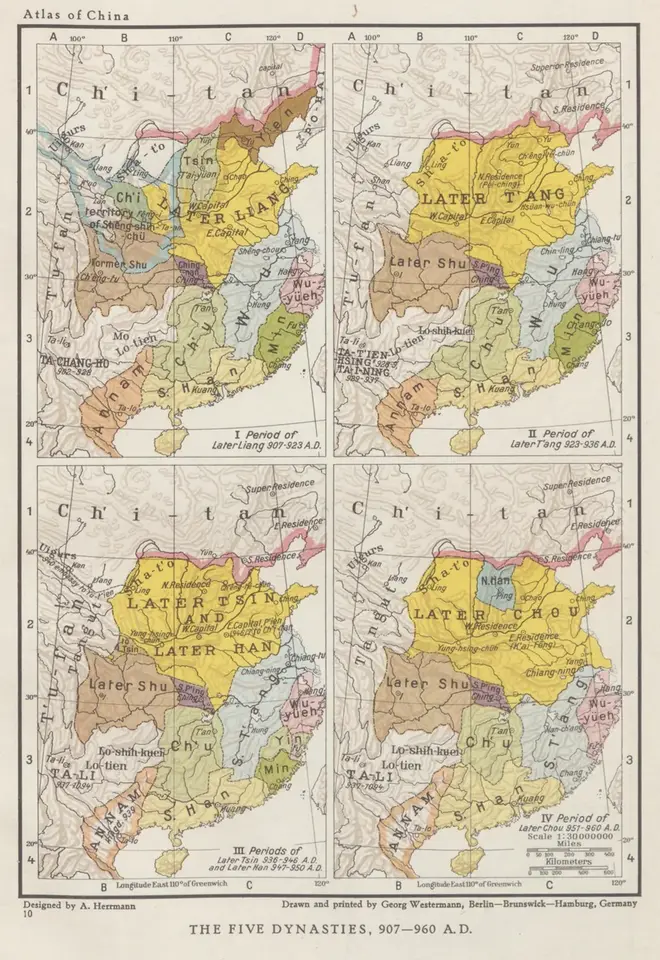
With all central opposition and civil institutions annihilated, Zhu Wen moved to claim supreme power. In the fourth month of 907 (Tianyou Year 4), Zhu Wen compelled Emperor Aidi to abdicate, inaugurating the Later Liang Dynasty at Kaifeng and bringing the 289-year-old Tang Dynasty to an official end.
However, Zhu Wen's ascension failed to bring reunification. Li Keyong in Taiyuan, Yang Wo in Huainan, Li Maozhen in Fengxiang, and Wang Jian in Sichuan refused to recognize the usurpation, retaining the Tang reign era or declaring independent dynasties. The expansion of late Tang military power thus culminated in the disintegration of China into the bloody mosaic of the Five Dynasties and Ten Kingdoms.
The primary outcome of the military expansion was the absolute destruction of Tang central authority. Disastrous campaigns against Hedong and the successive occupations of Chang'an by Li Maozhen and Zhu Wen dismantled the Shence Imperial Guard. The Son of Heaven was reduced to a powerless prize claimed by competing generals. Imperial revenue streams vanished, and central decrees ceased to carry authority beyond the capital's immediate gates, reducing the imperial institution to a meaningless title.
Decades of continuous campaigns across the Central Plains and Guanzhong produced catastrophic depopulation, the collapse of hydraulic agriculture, and the ruin of inter-regional trade routes. Crucially, Zhu Wen's massacre of aristocratic ministers at Baima Post, combined with the plunder of great families by local armies, extinguished the medieval aristocratic elite that had dominated Chinese government and society since the Han and Six Dynasties. This paved the way for the rise of commoner scholar-officials and civilian bureaucracy in subsequent dynasties.
The proliferation of regional armies directly created the Five Dynasties and Ten Kingdoms. The five successive northern regimes (Later Liang, Later Tang, Later Jin, Later Han, and Later Zhou) were direct continuations of the Xuanwu and Hedong military commands. Similarly, southern kingdoms such as Wu, Southern Tang, Wuyue, and Former Shu grew directly from late Tang provincial commands. Warlords governed through brute martial force under the principle that the throne belonged simply to whoever possessed the strongest armies. This militaristic culture persisted until the founding of the Song Dynasty, when Emperor Taizu instituted civilian institutional reforms to resolve the two-century scourge of military warlordism.
Historians across centuries have reflected with sorrow on the warlord expansion that brought about the fall of the Tang Dynasty. The appraisal in the Old Book of Tang remarks: "Emperor Xizong encountered chaos and loss; sovereign authority shifted to palace eunuchs while armies rose in provincial circuits. Feudal lords grew rebellious and the court fell weak, casting the Central Plains into ruin. Though loyal subjects existed, how could they arrest this catastrophic fall?"
In the New Book of Tang's Treatise on the Military, Northern Song historian Ouyang Xiu analyzed: "In the beginning of Tang, soldiers remained tied to agriculture through the Fubing system; subsequently, the militia decayed and mercenary forces arose, breeding insolent troops that could not be checked. Following Huang Chao's rebellion, military circuits monopolized arms and passed power down hereditarily. The sovereign could no longer command them, and the empire inevitably fell into pieces." In his Twenty-Two Historical Notes, Qing scholar Zhao Yi wrote under the heading The Tyranny of the Military Circuits: "In the late Tang, circuits not only defied the court, but were internally held hostage by their own headquarters guards. Soldiers expelled commanders when arrogant, while weak governors were enslaved by their troops. Zhu Wen and Li Keyong arose from this chaos, until the realm spiraled beyond salvation." Modern historians recognize that the late Tang military expansion represented the agonizing culmination of China's transition from the medieval aristocratic period to early modern civil society, clearing away obsolete feudal orders at immense human cost.