Yeon Gaesomun's Coup d'Etat
Yeon Gaesomun assassinated King Yeongnyu and over a hundred ministers, installed King Bojang, and seized military dictatorship.
Tang Dynasty (唐朝) · HISTORICAL EVENT
唐灭高句丽之战
The Tang Conquest of Goguryeo (644–668, from the eighteenth year of Zhenguan under Emperor Taizong to the first year of Zongzhang under Emperor Gaozong) was a landmark 24-year war of unification spanning two imperial reigns that resulted in the complete destruction of the Northeast Asian powerhouse Goguryeo. Since the Sui Dynasty, Goguryeo had exploited mountain fortresses and subzero winters to repeatedly defeat imperial armies, killing hundreds of…
The Tang Conquest of Goguryeo (644–668, from the eighteenth year of Zhenguan under Emperor Taizong to the first year of Zongzhang under Emperor Gaozong) was a landmark 24-year war of unification spanning two imperial reigns that resulted in the complete destruction of the Northeast Asian powerhouse Goguryeo. Since the Sui Dynasty, Goguryeo had exploited mountain fortresses and subzero winters to repeatedly defeat imperial armies, killing hundreds of thousands of Sui soldiers. In the early Tang, Goguryeo dictator Yeon Gaesomun assassinated his king, allied with Baekje to invade Tang vassal Silla, and blockaded tributary sea routes. Emperor Taizong led a personal expedition in 645, winning the Battle of Mount Zhubi, but winter forced an orderly withdrawal, shifting Tang strategy to multi-year amphibious attrition raids. After ascending the throne, Emperor Gaozong pursued a flank-severing grand strategy, conquering Baekje across the Yellow Sea in 660. Following Yeon Gaesomun's death in 666, his sons engaged in fratricidal civil war, prompting eldest son Yeon Namsaeng to surrender to the Tang. Emperor Gaozong commissioned Grand Chancellor Li Ji to lead hundreds of thousands of troops across the Yalu River, while Xue Rengui secured major victories at Xincheng and Mount Jin. In 668, allied land and naval forces stormed Pyongyang, capturing King Bojang and ending the kingdom. Tang absorbed all 176 fortresses, establishing the Andong Protectorate-General and resolving China's northern frontier crisis.
Yeon Gaesomun assassinated King Yeongnyu and over a hundred ministers, installed King Bojang, and seized military dictatorship.
Following attacks on Silla, Emperor Taizong mobilized naval fleets under Zhang Liang and northern land armies under Li Ji for a two-pronged campaign.
Li Ji captured Gaimou, Zhang Liang seized Bisha, and Emperor Taizong stormed Liaodong Fortress, breaching the frontier line.
Taizong encircled 150,000 relief troops; Xue Rengui charged in white armor, killing twenty thousand and compelling Gao Yanshou to surrender.
Protracted sieges at Anshi Fortress and early winter blizzards prompted Emperor Taizong to execute an orderly withdrawal.
Tang commanders Niu Jinda and Li Ji launched repeated naval raids against coastal fortresses, exhausting Goguryeo's economy.
General Su Dingfang crossed the Yellow Sea to conquer Baekje, dismantling Goguryeo's southern ally and establishing an operational base.
Yeon Gaesomun died; sons Namsaeng and Namgeon clashed violently, prompting Namsaeng to surrender to the Tang.
Li Ji launched a major invasion; Xue Rengui routed enemy armies at Mount Jin, killing 50,000 men and securing Xincheng.
Xue Rengui captured Buyeo with three thousand horsemen, prompting forty towns to surrender; Li Ji crossed the Yalu River.
Coalition armies encircled Pyongyang; monk Sinseong opened the gates, King Bojang surrendered, and Goguryeo fell after 705 years.
Tang established nine area commanderies and forty-two prefectures with the Andong Protectorate-General seated at Pyongyang under Xue Rengui.
Beginning in the fourth century CE, after Goguryeo transferred its capital to Pyongyang and expanded westward across the fertile Liaodong plains, its thousand-li defensive wall and network of mountain redoubts posed an acute strategic threat to northern China. During the Daye era of the Sui Dynasty, Emperor Yang launched three catastrophic invasions that collapsed under bitter winters, overextended supply chains, and tactical failures. Hundreds of thousands of Chinese soldiers died in Liaodong, where Goguryeo piled their skulls into triumphal bone towers. This ruinous expenditure of manpower and treasury sparked nationwide uprisings that brought about the demise of the Sui Dynasty.
Following the founding of the Tang Dynasty, Emperors Gaozu and Taizong pacified the Turks, Xueyantuo, and Western Regions oasis kingdoms. In 631 (Zhenguan Year 5), Emperor Taizong dispatched imperial envoys to Liaodong to collect and bury the remains of fallen Sui soldiers and demolish the victory towers. Thoroughly alarmed, King Yeongnyu of Goguryeo mobilized labor to construct a thousand-li frontier wall from Buyeo to the Yellow Sea. This protracted standoff transformed the recovery of Liaodong into an inescapable dynastic objective.
Throughout his early reign, King Yeongnyu maintained diplomatic tribute missions with Chang'an, seeking to avert confrontation. However, hardline military nobles feared growing Tang influence. In the tenth month of 642 (Zhenguan Year 16), Eastern Provincial Lord Yeon Gaesomun staged a bloody coup d'etat, butchering King Yeongnyu and more than one hundred ministers. He enthroned the king's nephew King Bojang as a figurehead, appointing himself supreme military dictator.
Yeon Gaesomun abandoned all conciliation, forging an offensive coalition with Baekje to overrun Silla, capturing dozens of fortresses and severing Silla's maritime access to the Tang court. In 643 (Zhenguan Year 17), Queen Seondeok of Silla sent urgent appeals to Chang'an. Emperor Taizong dispatched emissaries ordering an immediate ceasefire, which Yeon Gaesomun contemptuously rejected while sending secret envoys to incite the northern Xueyantuo Khaganate. Recognizing that regional balance had collapsed, Emperor Taizong committed the Tang Empire to war.
Following Yeon Gaesomun's defiance in 643, Emperor Taizong recognized that frontal sieges against mountain redoubts were hazardous and required coordinated pincer operations. In the seventh month of 644 (Zhenguan Year 18), Taizong issued a mobilization edict, marshaling naval architects across Jiangnan and elite cavalries from Guanzhong.
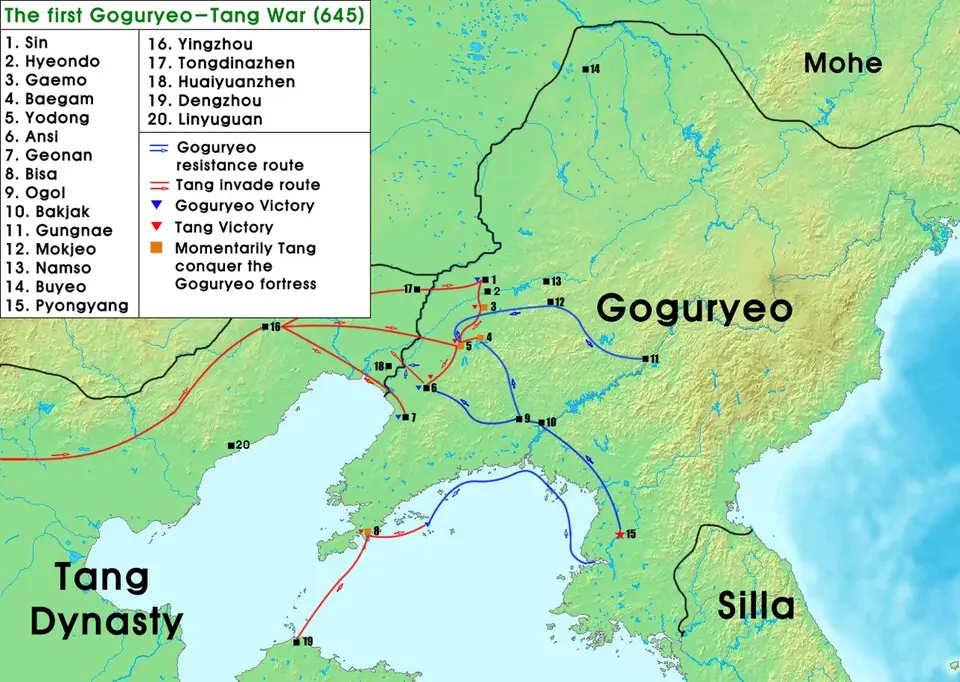
Taizong appointed Minister of Justice Zhang Liang as Commander-in-Chief of the Pyongyang Circuit, commanding 40,000 naval troops and 500 warships from Laizhou across the Yellow Sea toward Pyongyang. He named Grand Chancellor Li Ji as Commander-in-Chief of the Liaodong Circuit with Prince of Jiangxia Li Daozong as deputy, leading 60,000 northern cavalry and infantry alongside allied Qidan and Mohe horsemen across the Liao River. Taizong personally marshaled the imperial central guard at Luoyang, launching a coordinated campaign.
In the fourth month of 645 (Zhenguan Year 19), Li Ji's forces reached the frontier, crossed the flooded Liao River at Tongding, and launched surprise assaults against northern defensive garrisons. On the twenty-sixth day of the fourth month, Li Ji and Li Daozong assaulted Gaimou Fortress (modern Fushun), deploying mobile towers and scaling ladders to storm the battlements by evening. Tang troops captured twenty thousand defenders and over one hundred thousand bushels of grain, converting the bastion into Gai Prefecture and securing an advanced operational bridgehead in Liaodong.
Concurrently, Zhang Liang's amphibious fleet sailed across the Yellow Sea, reaching Bisha Fortress on the southern tip of the Liaodong Peninsula (modern Dalian). Bisha was flanked by sheer sea cliffs with only a single narrow western gate. Deputy Commander Cheng Mingzhen launched a daring nighttime escalade. Elite Tang commandos scaled the cliffs with daggers clenched between their teeth, breached the parapets at dawn, and slaughtered eight thousand defenders, disorienting Goguryeo regional commands.
On the eighth day of the fifth month, Li Ji advanced against Liaodong Fortress (modern Liaoyang), the primary stronghold that had defied Sui armies for decades. Goguryeo marshaled 40,000 cavalry and infantry to relieve the city. Li Daozong led four thousand elite horsemen in a fierce holding charge until Li Ji enveloped the relieving column, inflicting severe casualties. On the seventeenth day, Emperor Taizong arrived at the siege camp with the imperial main body, dramatically lifting troop morale.
Tang engineers unleashed a barrage of massive catapults that pounded the ramparts and defensive towers with boulders. When southerly gales swept over the fortress, Taizong directed swift commandos to scale assault ladders and set fire to the wooden observation towers. Fanned by the winds, flames consumed the citadel, enabling Tang troops to scale the breaches. Tang forces killed ten thousand defenders and captured fourteen thousand soldiers and forty thousand civilians, seizing the principal military hub of Liaodong. Advancing rapidly, Tang besieged Baiyan Fortress, where governor Sun Daiyin surrendered the city out of dread over Liaodong's fate.
On the twentieth day of the sixth month, the main Tang army marched south to invest Anshi Fortress (modern Haicheng). Northern Commander Gao Yanshou and Southern Commander Gao Huizhen advanced with 150,000 elite Goguryeo and Mohe troops, encamping along four hills over a forty-li front. Outnumbered, Emperor Taizong devised a decisive tactical ambush: Li Ji deployed 15,000 infantry on the western slopes to bait the enemy into a frontal charge, while General Zhangsun Wuji led 11,000 shock troops through hidden defiles to encircle the enemy rear, and Taizong held 4,000 cavalry on the crest.
At dawn on the twenty-second, Gao Yanshou charged Li Ji's lines. As the melee intensified, Taizong waved the imperial standard from the mountain summit. Zhangsun Wuji's hidden columns slammed into the enemy rear while Taizong's cavalry plunged down into the center. A young soldier named Xue Rengui, clad in distinctive white armor and wielding a halberd, charged into the fray, cutting down enemy officers and routing every opposing squad. Tang soldiers roared in triumph and enveloped the field, killing over twenty thousand enemy troops. Gao Yanshou and Gao Huizhen surrendered with 36,800 survivors in the Battle of Mount Zhubi.
Despite the crushing triumph at Mount Zhubi, Anshi Fortress resisted fiercely under its commander Yang Manchun. Perched on sheer bluffs, the fortress held out against relentless assaults. Li Daozong spent sixty days conscripting tens of thousands of laborers to construct a towering earthen ramp overlooking the walls, where vicious skirmishes erupted daily.
In late September, torrential rains undermined the earthworks, causing the ramp to collapse onto the city wall and create a breach. Officer Fu Fu'ai neglected his guard post, allowing hundreds of Goguryeo commandos to swarm out and seize the mound. Simultaneously, subarctic winter arrived early across Liaodong. Bitter blizzards froze rivers and withered forage, threatening logistical collapse. Recalling the disaster of the Sui Dynasty, Taizong ordered an orderly withdrawal on the eighteenth day of the ninth month. Before departing, Taizong bestowed one hundred bolts of silk upon Yang Manchun in tribute to his unyielding loyalty, concluding the opening phase of the war.
The ultimate military success of the Tang campaigns derived from an unprecedented amphibious logistical network. Beginning in 643, Emperor Taizong ordered shipyards established across Laizhou, Dengzhou, and the Yangtze delta, constructing hundreds of sea-going warships. The navy established forward maritime replenishment stations throughout the southern Liaodong islands and Dalian Bay.
Over one million bushels of grain collected from Jiangnan were shipped through the Grand Canal directly to Laizhou, where transport fleets ferried provisions to the mouths of the Yalu and Taedong rivers. This supply pipeline bypassed the vulnerable, muddy defiles of the Liaoxi corridor. Concurrently, heavy stone-throwing catapults and multi-bolt ballistas were mounted directly on ship decks and mobile field carriages, providing overwhelming artillery support for amphibious beachheads.
Following the retreat from Anshi, Emperor Taizong altered his campaign doctrine from massive frontal sieges to continuous naval and border raids designed to disrupt agricultural cycles and exhaust enemy garrisons. Between 647 and 648, generals Niu Jinda, Li Ji, and Lai Ji launched rapid seaborne incursions, sacking coastal bastions including Shicheng and Jili. Following Taizong's death in 649, Emperor Gaozong maintained this strategy of economic and military exhaustion.
Emperor Gaozong executed an ambitious geopolitical encirclement. Accepting counsel from Silla and Liu Rengui, Gaozong struck Goguryeo's southern ally Baekje. In 660, Su Dingfang commanded 130,000 amphibious troops to destroy the Kingdom of Baekje. In 663, Liu Rengui crushed a forty-thousand-man Japanese rescue fleet at the Battle of Baekgang, sinking four hundred warships. With Baekje reorganized into Tang commanderies, the empire gained a permanent operational platform on the southern peninsula, locking Goguryeo into a dual-front maritime and overland vise.
Capitalizing on Baekje's fall, Emperor Gaozong launched major multi-pronged offensives in 661 (Longshuo Year 1). Su Dingfang was appointed Commander of the Pyongyang Circuit to lead southern fleets, while General Qibi Heli was named Commander of the Liaodong Circuit alongside Xiao Siye, mobilizing thirty-five divisional armies to strike from the north.
In the eighth month of 661, Qibi Heli advanced to the northern banks of the frozen Yalu River, where Yeon Gaesomun had deployed his son Yeon Namgeon with tens of thousands of elite troops along the river bluffs. Exploiting the newly formed thin ice at night, Qibi Heli led his Tiele nomadic cavalry across the frozen river in a surprise charge. The shock assault shattered the defensive perimeter, routing the defenders and killing over thirty thousand men. This victory shattered Goguryeo's river defenses, opening the approaches to Pyongyang.
In early 666 (Qianfeng Year 1), dictator Yeon Gaesomun died of illness after ruling with an iron fist for over two decades. His demise triggered an immediate struggle for power among his sons. Eldest son Yeon Namsaeng succeeded him as supreme minister and departed to inspect northern river fortresses, leaving younger brothers Yeon Namgeon and Yeon Namsan in Pyongyang. Treacherous courtiers sowed mutual paranoia, prompting Namgeon to stage a palace coup, seize the capital guards, and order his brother's execution.
Yeon Namsaeng fled to Gungnae Fortress (modern Ji'an), where he was besieged by his brothers. Facing death, Namsaeng dispatched his son Quan Xiancheng across the mountains to surrender and request Tang military intervention. The fratricidal struggle fractured Goguryeo's defensive network, presenting Emperor Gaozong with the opportunity for a final offensive.
In the sixth month of 666, Emperor Gaozong dispatched Generals Pang Tongshan and Gao Kan into Liaodong to extract Yeon Namsaeng. When intercepted by Namgeon's field armies, Xue Rengui launched a daring flank attack that routed the blocking forces. In the twelfth month, Gaozong appointed seventy-three-year-old Grand Chancellor Li Ji as Commander-in-Chief of the Liaodong Circuit, with Qibi Heli, Pang Tongshan, and Xue Rengui leading twenty divisional armies totaling over two hundred thousand troops.
In the ninth month of 667, Li Ji stormed the northern gateway of Xincheng (modern Fushun North), assigning Xue Rengui to hold the fortress. When Goguryeo forces attempted a nighttime assault, Xue Rengui counterattacked, killing hundreds of attackers. Subsequently, Gao Kan was engaged by a hundred-thousand-man Goguryeo army near Mount Jin. Xue Rengui spearheaded a heavy cavalry charge from high ground that shattered the enemy formations, slaughtering over fifty thousand combatants in the Battle of Mount Jin. Exploiting this victory, Xue Rengui captured Nansu and Mudi with only three thousand light horsemen, linking up with Li Ji along the northern banks of the Yalu River.
In the spring of 668 (Zongzhang Year 1), Li Ji detached forces to strike the northeastern stronghold of Buyeo (modern Siping). Rejecting calls to await reinforcements, Xue Rengui advanced with three thousand shock troops, routed the garrison, and killed over ten thousand men to take the fortress. Following Buyeo's fall, forty neighboring mountain fortresses surrendered without resistance.
With the northern flank pacified, Li Ji forced the crossing of the Yalu River, advancing two hundred li to storm Daxing Fortress. In the eighth month, Li Ji's northern columns reached the outskirts of Pyongyang, uniting with Liu Rengui's naval fleet advancing up the Taedong River from Baekje and 50,000 Silla troops marching from the south. The allied armies encircled the capital with siege ramparts.
Within Pyongyang, food supplies were exhausted. In the ninth month, King Bojang dispatched his youngest son Yeon Namsan with ninety-eight nobles bearing white flags to surrender. However, Yeon Namgeon barricaded himself inside the inner citadel, mounting suicidal sorties against the siege works.
On the twelfth day of the ninth month, inner citadel commander and Buddhist monk Sinseong sent secret emissaries to Li Ji offering to open the gates. Five days later, Sinseong opened the inner portals, allowing Tang infantry and cavalry to swarm into the citadel with torches and swords. Seeing all hope lost, Yeon Namgeon attempted suicide with a dagger but was disarmed and captured. The Kingdom of Goguryeo, which had endured for 705 years (37 BCE–668 CE), was extinguished.
The conquest eliminated a seventy-year strategic threat to northern China. Goguryeo's 176 fortresses and 697,000 households were integrated into the Tang Empire. The territory was reorganized into nine area commanderies, forty-two prefectures, and one hundred counties, governed by the Protectorate-General to Pacify the East (Andong Duhufu) seated at Pyongyang with Xue Rengui commanding a twenty-thousand-man permanent garrison.
To forestall insurrections, the Tang relocated more than thirty thousand households of Goguryeo nobility, military elites, and wealthy clans into interior provinces across Jiangnan and Guanzhong, integrating the population into Chinese society.
The extinction of Goguryeo dissolved the ancient Three Kingdoms framework. Baekje and Goguryeo were eliminated, while Silla consolidated control over territories south of the Taedong River following the Silla-Tang War. The vast expanse north of the Yalu River returned to Chinese dynastic administration.
The campaign established Tang political suzerainty throughout Northeast Asia. Japanese courts, Mohe tribes, and northern nomadic confederations acknowledged imperial supremacy, cementing the Chinese tributary system and the East Asian cultural sphere for centuries.
Dynastic historians have celebrated the Tang conquest of Goguryeo. The appraisal in the Old Book of Tang states: "Goguryeo inflicted catastrophic losses upon the Sui, defying all attempts at subjugation. Emperor Gaozong fulfilled the vision of his predecessor, pacifying Liaodong and incorporating all under heaven; no monarch in antiquity accomplished greater glory."
In the Comprehensive Mirror in Aid of Governance, Northern Song historian Sima Guang remarked: "Emperor Taizong was master of strategy yet withdrew from Anshi not from lack of bravery, but because terrain and seasons were adverse. Emperor Gaozong severed its arm by subduing Baekje first, exploited fraternal strife, and directed Li Ji and Xue Rengui straight to Pyongyang, demonstrating the art of turning circumstances to victory." Modern historians regard the twenty-four-year campaign as a masterpiece of ancient siege engineering, combined naval-land logistics, and geopolitical strategy that altered the course of East Asian history.