Qu Wentai Pays Homage at Chang'an
King Qu Wentai of Gaochang traveled to Chang'an to pay homage to Emperor Taizong, receiving imperial honors and confirming tributary status.
Tang Dynasty (唐朝) · HISTORICAL EVENT
唐灭高昌之战
The Tang Conquest of Gaochang (639–640, from the twelfth month of Zhenguan Year 13 to the eighth month of Zhenguan Year 14 under Emperor Taizong) was a decisive western expedition that reopened the Silk Road and marked a strategic turning point in imperial Chinese administration of the Western Regions. Situated within the Turpan Basin, Gaochang commanded the vital throat of east-west trade. Although King Qu Wentai initially paid tribute at Chang'an, he…
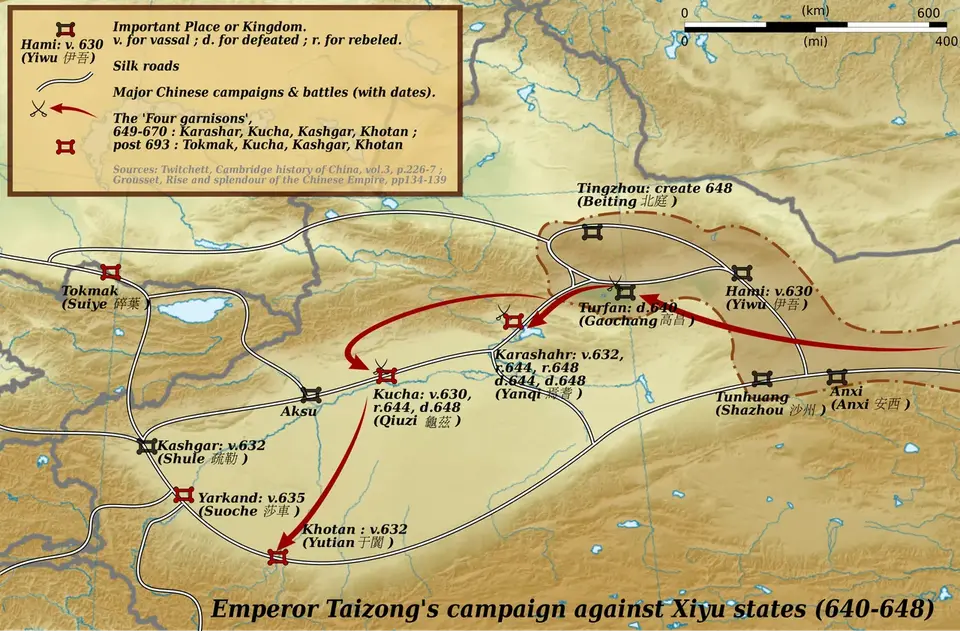
The Tang Conquest of Gaochang (639–640, from the twelfth month of Zhenguan Year 13 to the eighth month of Zhenguan Year 14 under Emperor Taizong) was a decisive western expedition that reopened the Silk Road and marked a strategic turning point in imperial Chinese administration of the Western Regions. Situated within the Turpan Basin, Gaochang commanded the vital throat of east-west trade. Although King Qu Wentai initially paid tribute at Chang'an, he subsequently aligned with the Western Tujue Khaganate, arbitrarily intercepting tributary envoys, extorting merchants, and attacking the Tang vassal state of Yanqi. Qu Wentai assumed that separated by seven thousand li and two thousand li of waterless desert, imperial armies could never mount a major invasion. In the winter of 639, Emperor Taizong appointed Minister of Personnel Hou Junji as Commander-in-Chief of the Jiaohe Circuit, leading tens of thousands of elite cavalry across the desert. Reaching the Turpan oasis by surprise, Tang forces induced the sudden death of Qu Wentai from terror. Hou Junji stormed Tiandi Fortress, surrounded the capital with massive siege towers and catapults, and scared off Western Tujue relief forces. In 640, King Qu Zhisheng surrendered, ending the kingdom. Tang established Xi Prefecture and founded the Anxi Protectorate-General at Jiaohe, anchoring two centuries of imperial governance over Central Asia.
King Qu Wentai of Gaochang traveled to Chang'an to pay homage to Emperor Taizong, receiving imperial honors and confirming tributary status.
Qu Wentai allied with Western Tujue, annexed five fortresses of Tang vassal Yanqi, and severed Silk Road tributary access.
Emperor Taizong issued an imperial edict appointing Hou Junji Commander-in-Chief of the Jiaohe Circuit to lead a punitive invasion across the desert.
Tang advance forces crossed two thousand li of desert to appear at Qikou; Qu Wentai died of apoplexy from terror, and Qu Zhisheng succeeded him.
Hou Junji paused the advance at Liugu to allow the people of Gaochang to complete the royal funeral, winning broad local respect.
Tang forces stormed Tiandi Fortress, captured seven thousand defenders, and encircled Gaochang with thirty-meter siege towers.
Western Tujue relief armies fled west; King Qu Zhisheng opened the gates and surrendered Gaochang, ending the dynasty.
Tang converted Gaochang into Xi Prefecture and established the Protectorate-General to Pacify the West (Anxi Duhufu) at Jiaohe Fortress.
Hou Junji presented King Qu Zhisheng and noble captives before Emperor Taizong at the Taiji Hall; Taizong pardoned them and granted noble titles.
Occupying the fertile oasis depression of the Turpan Basin, Gaochang commanded both the northern and central routes of the overland Silk Road. In the late Northern and Southern Dynasties, Qu Jia established the Qu royal house, preserving Han legal institutions, administrative structures, and Confucian learning over several generations. During the collapse of the Sui Dynasty, Gaochang submitted to the northern nomadic hegemony of the Eastern and Western Tujue.
In 630 (Zhenguan Year 4), after Emperor Taizong crushed the Eastern Tujue Khaganate, King Qu Wentai traveled in person to Chang'an to offer tribute. Emperor Taizong received him with royal hospitality, conferring the title Duke of Bian and granting imperial princess status to his consort. For a time, Gaochang and the Tang maintained close tributary ties.
However, as the Western Tujue Khaganate revived its power under Yipi Duolu Khagan, commanding hundreds of thousands of nomadic horsemen north of the Tianshan Mountains, Qu Wentai wavered. Convinced that Tang power was too remote to project force across the desert, he renounced his Tang alliance and subordinated his kingdom to the Western Tujue. Gaochang established frontier blockades, detaining Tang imperial envoys and confiscating caravans from Kucha, Khotan, and Yanqi traveling to Chang'an.
In 632 (Zhenguan Year 6), the King of Yanqi requested permission from the Tang court to open the alternative Dahai Dao route bypassing Gaochang to reach China directly. Emperor Taizong granted the petition. Enraged by the loss of commercial transit tolls, Qu Wentai launched a punitive invasion against Yanqi, sacking five fortresses, destroying agricultural lands, and enslaving ten thousand inhabitants. Concurrently, Gaochang threatened to attack the Xueyantuo Khaganate in the northern steppes, directly challenging the Pax Sinica established by the Tang in Central Asia.
Confronted by Gaochang's defiance, Emperor Taizong dispatched imperial emissaries with admonitory edicts, summoning Qu Wentai to Chang'an to account for his actions. Relying on desert barriers, Qu Wentai refused to appear, declaring that predatory birds soar through the heavens while pheasants hide in the brush, each living in their own domain without interference. Addressing his councilors, Qu Wentai boasted: "The Great Tang lies seven thousand li away, separated by two thousand li of burning shifting sands with neither water nor grass. If Tang marches against us, their horses will starve and their men will perish; with thirty thousand troops holding our narrow passes, we will crush them at our leisure, backed by our Western Tujue allies."
In the twelfth month of 639 (Zhenguan Year 13), Emperor Taizong overcame court objections and authorized an expedition. He appointed Minister of Personnel Hou Junji as Commander-in-Chief of the Jiaohe Circuit, Left Guard General Xue Wanjun and Left Militant Guard General Qibi Heli as deputy commanders, marshaling tens of thousands of Guanzhong infantry and cavalry alongside allied Tiele and Turkic nomadic horsemen.
Setting out from Chang'an, Hou Junji crossed the Hexi Corridor, exited the Jade Gate, and marched west. In midwinter, biting gales swept over the Gobi Desert, obscuring the sun. Tang expeditionary columns traversed two thousand li of barren sand dunes without natural water sources. Hou Junji enforced strict discipline, organized well-digging detachments, and preserved cohesion across the desert expanse.
In the fifth month of 640 (Zhenguan Year 14), Tang advance scouts emerged without warning at Qikou (modern Shanshan) on the eastern threshold of the Turpan Basin. Gaochang frontier patrols sighted thousands of Tang war standards and fled in panic. Qu Wentai, who had insisted that Tang armies could never cross the desert, was overcome by shock. Realizing that the kingdom was doomed, he succumbed to acute terror and died suddenly of apoplexy. His son Qu Zhisheng was hurriedly crowned amid nationwide panic.
Marching westward to Liugu (near modern Lukeqin), Tang scouts reported that the population of Gaochang was gathered to observe royal funerary rites for Qu Wentai and that city garrisons were depleted. Several generals urged an immediate assault to capture the towns by surprise.
Hou Junji refused to take advantage of national tragedy, proclaiming: "The King of Gaochang was treacherous, and I have led imperial troops to punish his crimes under the sovereign's mandate. To attack a people while they are mourning at their king's tomb is the conduct of bandits, not the righteous standard of the Son of Heaven!" Hou Junji halted the army until the mourning rituals concluded. Hearing of this restraint, the people of Gaochang were deeply moved, and their will to resist dissipated.
Once the burial concluded, Hou Junji advanced against Tiandi Fortress (modern Shanshan), the primary eastern bulwark of Gaochang. The fortress was defended by deep ditches and stone ramparts. After sending envoys demanding surrender to no avail, Hou Junji ordered his troops to fill the moats with earthbags and deploy giant stone-throwing catapults day and night.
Tang forces breached the outer ramparts and stormed the fortress, capturing over seven thousand soldiers and civilians. Advancing onward, Hou Junji encircled the capital of Gaochang. He commanded his engineers to construct thirty-meter-tall wooden siege towers (chao che) mounted with observation platforms and expert archers. From these towers, Tang scouts monitored every military deployment inside the capital, while heavy catapults shattered inner parapets, forcing defenders into underground tunnels.
King Qu Zhisheng's final hope lay with the Western Tujue garrison stationed at Khanbaliq Fort (modern Jimusa'er) under Prince Ashina Tong'eshe. Gaochang had dispatched emissaries promising vast fortunes in gold and silk for relief armies.
However, General Qibi Heli led nomadic cavalry on wide reconnaissance sweeps around the Tianshan passes. Astounded by the speed with which Tang captured Tiandi Fortress and terrified by Tang siege machinery, the Western Tujue commander broke camp and fled thousands of li westward into the mountains, deserting Gaochang. Isolated and starving, with Tang assault ladders leaning against the crumbling battlements, Qu Zhisheng opened the city gates and surrendered on the eighth day of the eighth month of 640.
The campaign concluded with a swift victory for the Tang Empire. The Qu Dynasty, which had governed Gaochang for 140 years, was abolished. Tang forces annexed three commanderies, five counties, and twenty-two fortresses, registering 8,046 households, 37,700 individuals, and 4,300 horses.
Departing from the conventional policy of indirect tributary rule, Emperor Taizong annexed the region directly into the imperial provincial hierarchy. Gaochang was reorganized into Xi Prefecture, with its seat at Gaochang city, governing Qianshu and Jiaohe counties. Ting Prefecture was founded at Khanbaliq Fort. Most significantly, on the twenty-first day of the eighth month of 640, the Tang established the Protectorate-General to Pacify the West (Anxi Duhufu) at Jiaohe Fortress (modern Turpan), placing all territories south of the Tianshan Mountains under direct imperial oversight.
The fall of Gaochang eliminated the primary bottleneck impeding east-west trade. Caravan routes were secured, enabling uninterrupted trade and diplomatic travel between Chang'an and Central Asia, Persia, and the Mediterranean world.
Moreover, the conquest shattered the belief among Central Asian kingdoms that desert barriers shielded them from imperial retribution. Witnessing the rapid fall of Gaochang, city-states including Yanqi, Kucha, Khotan, and Kashgar submitted to Tang suzerainty, enabling the empire to create the legendary Four Garrisons of Anxi and project its hegemony over Central Asia for two centuries.
Dynastic historians praised the Tang conquest of Gaochang as a masterstroke of grand strategy. The appraisal in the Old Book of Tang states: "Gaochang was isolated beyond shifting sands; Qu Wentai acted with reckless malice. Hou Junji crossed wilderness as though crossing streams and plucked citadels like weeds, establishing a protectorate to pacify the realm and compelling all western tribes to submit."
In the Comprehensive Mirror in Aid of Governance, Northern Song historian Sima Guang observed: "Emperor Taizong's acquisition of Gaochang was not merely to chastise insolence, but a farsighted strategy to open western routes and secure the Gansu corridor. Though many ministers opposed the campaign on grounds of distance, Taizong executed it resolutely, converting regions beyond the Jade Gate into internal provinces—a truly grand conception." Modern historians recognize the conquest of Gaochang as a prime example of ancient long-range desert logistics and administrative integration that permanently shaped the territorial integrity of China.