Tang Court Authorizes the Expedition
Emperor Gaozong appointed Su Dingfang Commander-in-Chief of the Shenqiu Circuit with Liu Boying as deputy, marshaling 130,000 amphibious troops at Laizhou to strike Baekje.
Tang Dynasty (唐朝) · HISTORICAL EVENT
唐灭百济
The Tang Conquest of Baekje (660, from the third to the eleventh month of Xianqing Year 5 of Emperor Gaozong) was a landmark trans-maritime campaign conducted jointly by the Tang Empire and Silla to extinguish the Kingdom of Baekje in the southwestern Korean Peninsula. From the mid-seventh century, Baekje relied on military backing from Goguryeo and Yamato Japan to aggressively attack Tang vassal state Silla, seizing dozens of border fortresses and…
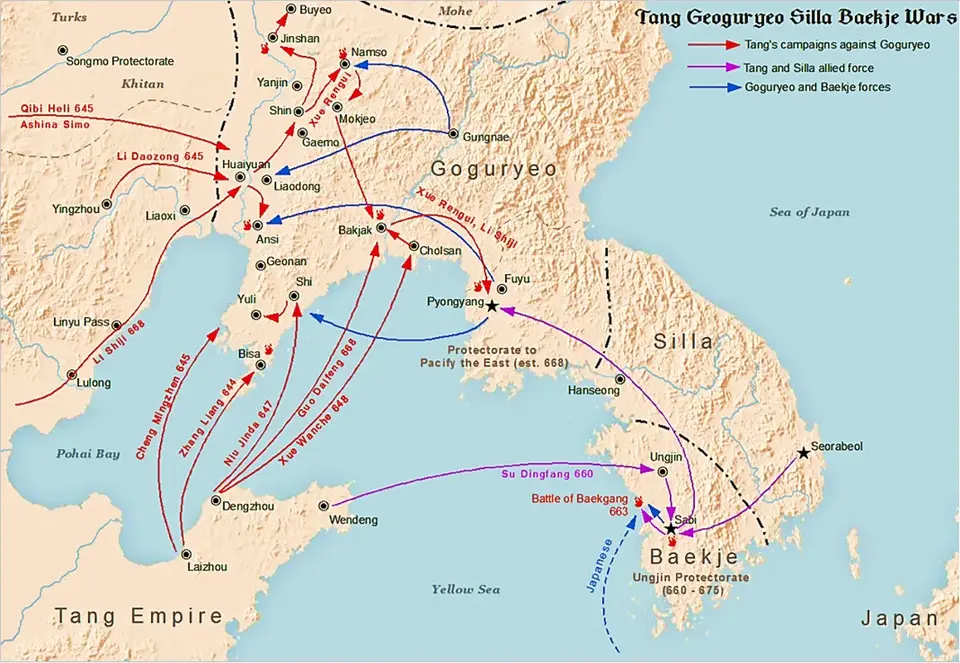
The Tang Conquest of Baekje (660, from the third to the eleventh month of Xianqing Year 5 of Emperor Gaozong) was a landmark trans-maritime campaign conducted jointly by the Tang Empire and Silla to extinguish the Kingdom of Baekje in the southwestern Korean Peninsula. From the mid-seventh century, Baekje relied on military backing from Goguryeo and Yamato Japan to aggressively attack Tang vassal state Silla, seizing dozens of border fortresses and blockading Silla's maritime tributary routes across the Yellow Sea. King Muyeol of Silla (Kim Chunchu) traveled in person to Chang'an to implore military intervention. Concluding from previous Liaodong campaigns that frontal sieges against Goguryeo were costly and protracted, Emperor Gaozong and his council adopted the grand strategy of subduing Baekje first to sever Goguryeo's southern flank. In 660, Emperor Gaozong commissioned General Su Dingfang as Commander-in-Chief of the Shenqiu Circuit, leading 130,000 naval and infantry forces across the sea from Shandong while 50,000 Silla troops advanced from the east. Tang armies broke enemy positions at the Ungjin River estuary, Silla forces crushed Baekje general Gyebaek at Hwangsanbeol, and coalition forces encircled the capital Sabi in the eighth month, compelling King Uija to surrender. Tang absorbed Baekje's thirty-seven commanderies and over two hundred fortresses, establishing five Area Commanderies, including Ungjin, and radically reordering Northeast Asian geopolitics.
Emperor Gaozong appointed Su Dingfang Commander-in-Chief of the Shenqiu Circuit with Liu Boying as deputy, marshaling 130,000 amphibious troops at Laizhou to strike Baekje.
Emperor Gaozong named King Muyeol of Silla Commander of the Yuyi Circuit, directing Kim Yu-sin to lead 50,000 troops westward across the Sobaek Mountains.
Su Dingfang launched thousands of transports from Chengshantou, braving Yellow Sea waves to traverse the open waters toward the peninsula.
Tang fleets arrived at the mouth of the Ungjin River; Su Dingfang led an assault on coastal positions, routing the defenders and clearing the river passage.
Silla general Kim Yu-sin engaged Baekje general Gyebaek at Hwangsanbeol; inspired by youth Gwanchang's sacrifice, Silla wiped out the five-thousand-man suicide unit.
Su Dingfang routed Baekje's primary field army outside Sabi, killing over ten thousand men; King Uija fled north to Ungjin while Buyeo Tae claimed the throne.
Royal prince Buyeo Munsa surrendered to Tang lines; Su Dingfang stormed the ramparts, forcing Buyeo Tae to open the gates and yield the royal capital.
Ungjin commanders captured King Uija and Crown Prince Hyo to surrender to Tang forces, bringing all two hundred Baekje fortresses under imperial authority.
The Tang divided Baekje territory into Ungjin, Mahan, Dongmyeong, Geumryeon, and Deog'an Area Commanderies, appointing indigenous chieftains as local administrators.
Su Dingfang presented King Uija, royal princes, and fifty-eight grandees at the Zetian Gate in Luoyang; Emperor Gaozong pardoned them and granted them residences.
During the mid-seventh century, the Korean Peninsula remained locked in triangular conflict among Goguryeo, Baekje, and Silla. Situated across fertile agricultural plains in the southwest, Baekje bordered Goguryeo to the north and Silla to the east. Although King Uija earned early domestic praise for filiality, his foreign policy sought to escape isolation by forging an offensive military alliance with northern rival Goguryeo and cultivating diplomatic tribute ties with Yamato Japan, creating a formidable encirclement against Silla.
Beginning in 642 (Zhenguan Year 16), Baekje armies invaded eastern territories, capturing Daye Castle and over forty Silla strongholds. Hemmed into the southeastern corner of the peninsula, Silla faced national extinction. Furthermore, Baekje fleets blockaded the maritime corridors linking Silla to Dengzhou and Chang'an, severing Silla's tributary missions to the Tang court.
Caught between Goguryeo and Baekje, Silla viewed imperial intervention by the Tang court as its sole salvation. In 648 (Zhenguan Year 22), Queen Jindeok dispatched high minister Kim Chunchu and his son Kim Beopmin to Chang'an. Submitting humble memorials to Emperor Taizong, Kim Chunchu requested imperial armies and pledged complete adoption of Tang court dress, calendar eras, and legal codes.
Although Emperor Taizong's Liaodong campaign had achieved major tactical victories at Mount Zhubi, subfreezing winters and resilient defensive bastions prevented total conquest. Strategic advisors, including Liu Rengui, recognized that Goguryeo's supply lines through northern mountains were prohibitively long. They advocated that destroying Baekje first would sever Goguryeo's flank and allow naval logistics to sustain a pincer assault. Emperor Gaozong and his ministers embraced this strategy, resolving to launch an amphibious operation against Baekje to secure a southern operational base.
In the second month of 660 (Xianqing Year 5), Baekje and Goguryeo renewed offensive drives against Silla borders, prompting urgent petitions from Kim Chunchu. Emperor Gaozong ordered a decisive maritime counteroffensive. On the tenth day of the third month, he appointed the accomplished general Su Dingfang as Commander-in-Chief of the Shenqiu Circuit and Liu Boying as Deputy Commander, marshaling 130,000 naval and land forces at Laizhou and Chengshantou on the Shandong Peninsula.
Concurrently, Emperor Gaozong named King Muyeol (Kim Chunchu) as Commander of the Yuyi Circuit, directing 50,000 Silla troops across the Sobaek mountain passes to link up with Su Dingfang's amphibious fleet outside the Baekje capital Sabi by the tenth day of the seventh month. A large-scale amphibious campaign across the Yellow Sea was underway.
On the twenty-first day of the sixth month of 660, Su Dingfang hoisted sails and set out from Chengshantou with thousands of transports and 130,000 combatants, crossing the Yellow Sea. On the ninth day of the seventh month, the massive armada reached the mouth of the Ungjin River (the Geum River estuary). King Uija had neglected defense preparations, dismissing candid counsel. Panicked by the arrival of the Tang fleet, the Baekje court belatedly deployed troops along the mountain ridges flanking the river mouth, hoping to bottle up the fleet in the narrow coastal shoals.
Recognizing the value of tactical speed, Su Dingfang directed vanguard vessels to surge forward on the rising tide. Baekje defenders fired barrages of arrows from elevated ridges. Su Dingfang led heavily armored infantry ashore under covering missile fire, breaching coastal earthworks. In brutal hand-to-hand combat, Tang forces killed thousands of defenders and routed the remainder. Su Dingfang organized his amphibious armada and sailed upriver toward Sabi with sails unfurled and war drums echoing along the banks.
As Tang ships forced the river mouth, Silla general Kim Yu-sin marched 50,000 infantry and cavalry westward through the mountains. Baekje general Gyebaek recognized that the nation faced mortal peril. Before departing, he executed his wife and children to eliminate all worldly ties, swearing to his five thousand suicide volunteers that they would die on the field rather than live as slaves. Gyebaek entrenched his forces along the narrow mountain defile of Hwangsanbeol (modern Nonsan).
Between the ninth and tenth days of the seventh month, Kim Yu-sin launched four successive assaults against Hwangsanbeol. Fighting with fanatical desperation from higher ground, Gyebaek's men repulsed every charge, shaking Silla morale. At this juncture, Silla aristocratic youth Gwanchang, a sixteen-year-old warrior, rode alone twice into the Baekje ranks before being captured. Gyebaek admired his courage and sent his severed head back to the Silla camp. Deeply moved, Silla forces rallied in furious vengeance, overwhelming the defensive perimeter and killing Gyebaek and all five thousand defenders. Having eliminated Baekje's only mobile reserve, Silla raced onward toward Sabi.
On the twelfth day of the seventh month, Su Dingfang's army advanced to within twenty li of the outer ramparts of Sabi. Baekje gathered several tens of thousands of garrison troops in a desperate field deployment. Su Dingfang enveloped both flanks with cavalry while heavy infantry smashed the enemy center, slaughtering over ten thousand defenders. The remnants fled inside the walls of Sabi, where Su Dingfang deployed siege towers and stone-throwing catapults for an assault.
Recognizing that the capital was doomed, King Uija slipped out of Sabi under cover of darkness on the night of the thirteenth with Crown Prince Buyeo Hyo, fleeing north to the fortified redoubt of Ungjin Fortress (modern Gongju). In Sabi, the king's second son, Buyeo Tae, proclaimed himself king and prepared to defend the citadel.
Buyeo Tae's sudden assumption of the crown provoked internal factional distrust. Crown Prince Hyo's son, Buyeo Munsa, suspected his uncle's motives, arguing that if the rightful monarch was still alive, Buyeo Tae's usurpation would invite wholesale slaughter once Tang breached the gates. Munsa lowered himself from the ramparts and surrendered to the Tang lines. Witnessing royal defection, court officials and soldiers abandoned their posts and climbed down the walls in droves.
Seeing the defensive perimeter disintegrate, Su Dingfang ordered a general escalade. Vanguard Tang troops battered down the outer gates and hoisted the imperial dragon standard over the palace parapets. Isolated and deserted, Buyeo Tae opened the gates and surrendered the inner citadel. On the eighteenth day of the seventh month, Kim Yu-sin's 50,000 Silla troops arrived at Sabi, completing the junction of coalition forces.
With the capital fallen, Su Dingfang dispatched detachments to surround Ungjin Fortress. Realizing resistance was futile, garrison commander Yeseik revolted, bound King Uija and Crown Prince Buyeo Hyo, and opened the fortress gates to surrender.
With this surrender, the Kingdom of Baekje, which had endured for 678 years (18 BCE–660 CE), came to an end. All five provinces, thirty-seven commanderies, two hundred fortresses, and 760,000 households were brought under Tang administrative control. Su Dingfang maintained strict army discipline, sealed royal granaries and archives, and prohibited looting, reassuring the local populace.
The expedition ended with a total victory for the Tang-Silla coalition. The Baekje kingdom, which had flourished for nearly seven centuries, was eradicated. King Uija, along with fifty-eight members of the royal family and court elite, was escorted to the eastern capital of Luoyang and presented before Emperor Gaozong. Exercising imperial benevolence, Gaozong pardoned King Uija and his retinue, bestowing aristocratic titles and residences in Luoyang.
Administratively, the Tang reorganized Baekje into five Area Commanderies: Ungjin, Mahan, Dongmyeong, Geumryeon, and Deog'an, subdivided into prefectures and counties. Local chieftains were commissioned as prefects and governors, supported by a permanent garrison of 10,000 Tang soldiers stationed at Sabi under Generals Wang Wendu and Liu Renyuan.
The destruction of Baekje fundamentally reshaped the balance of power across Northeast Asia. Goguryeo lost its steadfast southern ally, leaving its southern border entirely exposed to coordinated offensives by Tang naval forces and Silla infantry, fulfilling the Tang objective of severing Goguryeo's right arm.
Furthermore, Baekje's fall removed the bridgehead through which Yamato Japan projected military influence onto the continent. When Baekje loyalists under Gwisil Boksin launched a restoration uprising with the assistance of a 40,000-man Yamato army, the Tang navy crushed the allied fleet at the Battle of Baekgang in 663, burning four hundred Japanese warships and establishing China's paramount authority in East Asia for centuries.
Dynastic historians have held the Tang conquest of Baekje in high esteem. The appraisal in the Old Book of Tang states: "Su Dingfang swept across ten thousand li, clearing northern deserts and binding eastern barbarians and western tribes. He invaded Baekje, captured its monarch, and established imperial glory beyond the sea; what ancient commander could surpass him?"
In the Comprehensive Mirror in Aid of Governance, Northern Song historian Sima Guang remarked: "Emperor Gaozong inherited the momentum of the Zhenguan reign, employing Su Dingfang to cross the sea and pluck Baekje like fruit from a pocket. This success was born not merely of battlefield bravery, but of comprehensive imperial planning and profound geopolitical insight." Modern military historians regard the campaign as a classic ancient amphibious landing and combined-arms operation, showcasing the naval architecture, maritime logistics, and strategic coordination of the High Tang Empire.