Forced Relocation and Destruction of Chang'an
Zhu Wen petitioned to transfer the capital to Luoyang and commanded the complete demolition of Chang'an, transporting lumber via the Wei River and reducing the metropolis to ruins.
Tang Dynasty (唐朝) · HISTORICAL EVENT
唐长安陷落与末世哀帝
The Fall of Chang'an and Emperor Aidi of Tang (唐长安陷落与末世哀帝) marked the catastrophic conclusion of the Tang Dynasty and the dramatic collapse of classical Chinese imperial geopolitics. In the first month of 904 (Tianyou 1), the dominant warlord Zhu Wen forced Emperor Zhaozong to relocate the imperial capital to Luoyang. Concurrently, Zhu Wen ordered the comprehensive destruction of Chang'an, dismantling palaces, administrative offices, and civilian…
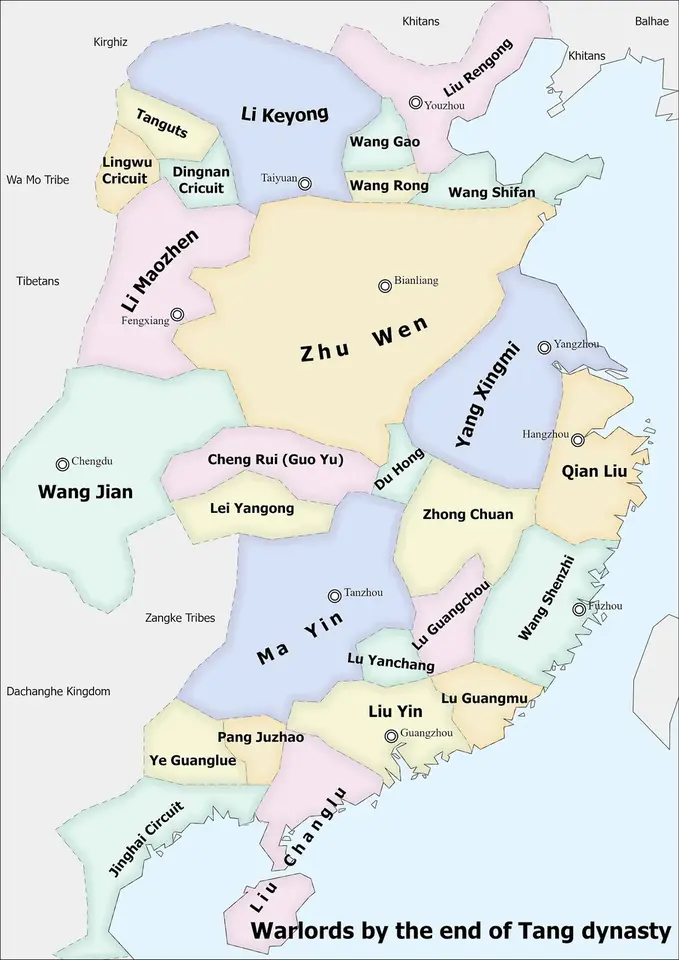
The Fall of Chang'an and Emperor Aidi of Tang (唐长安陷落与末世哀帝) marked the catastrophic conclusion of the Tang Dynasty and the dramatic collapse of classical Chinese imperial geopolitics. In the first month of 904 (Tianyou 1), the dominant warlord Zhu Wen forced Emperor Zhaozong to relocate the imperial capital to Luoyang. Concurrently, Zhu Wen ordered the comprehensive destruction of Chang'an, dismantling palaces, administrative offices, and civilian residences to float the timber eastward down the Wei and Yellow rivers, reducing the three-hundred-year-old imperial metropolis to desolate ruins. In August 904, Zhu Wen dispatched military assassins led by Jiang Xuanhui and Shi Tai to murder Emperor Zhaozong in the Jiaodian Palace in Luoyang, enthroning the thirteen-year-old ninth imperial son, Li Zhu, as Emperor Aidi. The following year, Zhu Wen orchestrated the horrific Baima Post Massacre, executing over thirty distinguished high-ranking aristocrats and court ministers and casting their bodies into the Yellow River. In April 907, Zhu Wen compelled Emperor Aidi to abdicate, establishing the Later Liang Dynasty and terminating the 289-year rule of the Tang Dynasty. Emperor Aidi was demoted to Prince of Jiyin and poisoned to death the following year. This watershed event eliminated the medieval aristocratic oligarchy and inaugurated the warlord-dominated turmoil of the Five Dynasties and Ten Kingdoms period.
Zhu Wen petitioned to transfer the capital to Luoyang and commanded the complete demolition of Chang'an, transporting lumber via the Wei River and reducing the metropolis to ruins.
Zhu Wen dispatched Jiang Xuanhui and Shi Tai to assassinate Emperor Zhaozong in the Jiaodian Palace and enthroned the thirteen-year-old Li Zhu as Emperor Aidi.
Zhu Wen lured nine elder princes of Emperor Zhaozong to a banquet at Jiuqu Pond in Luoyang, strangling them and casting their remains into the water.
Prompted by Li Zhen, Zhu Wen executed over thirty high-ranking court ministers at Baima Post and threw their bodies into the Yellow River, eliminating the aristocratic bureaucracy.
Zhu Wen's operatives strangled Empress Dowager He in the Luoyang palace compound, eliminating the young emperor's last protective ally.
Emperor Aidi issued an edict abdicating the throne to Zhu Wen, who ascended the throne as Emperor Taizu of Later Liang, officially terminating the Tang Dynasty.
Zhu Wen dispatched agents to poison the deposed seventeen-year-old Emperor Aidi in Caozhou, conferring upon him the posthumous title of Emperor Ai.
Following the suppression of the Huang Chao Rebellion, the central authority of the Tang Dynasty was reduced to a hollow facade. The Guanzhong heartland became an active battleground for regional military commissioners, primarily Zhu Wen of Xuanwu, Li Keyong of Hedong, and Li Maozhen of Fengxiang. Although Emperor Zhaozong attempted to rebuild central authority upon ascending the throne, successive military failures decimated the imperial household armies.
In 900, the eunuch faction led by Liu Jishu staged a coup and imprisoned Emperor Zhaozong. Although Prime Minister Cui Yin secured loyalist forces to restore the emperor, eunuch Han Quanhui seized Emperor Zhaozong in 901 and fled to Li Maozhen in Fengxiang. Zhu Wen besieged Fengxiang for nearly three years under the pretext of rescuing the monarch. Overcome by starvation, Li Maozhen decapitated the eunuchs and delivered the emperor to Zhu Wen. Upon escorting the emperor back to Chang'an, Zhu Wen slaughtered hundreds of palace eunuchs and assumed absolute dominion over imperial affairs.
In 903, Emperor Zhaozong and Cui Yin secretly schemed to recruit imperial guards to liberate themselves from Zhu Wen's stranglehold. Discovering the plot, Zhu Wen swiftly executed Cui Yin and his allies in early 904. Zhu Wen's primary base lay in Bianzhou (modern Kaifeng, Henan), and the Guanzhong region was vulnerable to encirclement by Li Maozhen in the west and Li Keyong in the northeast.
Advisers Li Zhen and Jiang Xuanhui urged Zhu Wen to transfer the imperial seat to Luoyang, which lay within Xuanwu's direct military sphere. To irrevocably sever the Tang ruling house from its northwestern elite networks and prevent any restoration in the old imperial heartland, Zhu Wen resolved to raze Chang'an to the ground, guaranteeing that the Guanzhong region could no longer support an independent political regime.
In the first month of 904, Zhu Wen formally petitioned the court to relocate the capital to Luoyang. He immediately mobilized vast contingents of Xuanwu troops and Guanzhong laborers to execute the wholesale dismantling of Chang'an. Great halls, imperial pavilions in the Daming Palace, Taiji Palace, and Xingqing Palace, along with state ministries and residential wards, were stripped bare of timber, pillars, and rafters.
Tens of thousands of monumental wooden beams were launched into the waterways, floating along the Wei River into the Yellow River to supply construction materials for Luoyang. Chang'an was enveloped in smoke and dust as imperial soldiers forcibly drove urban households eastward. Multitudes of civilian families were uprooted, and counteless weak and aged citizens perished from exposure and starvation along the transit corridors. The greatest metropolis of the medieval world was reduced to shattered foundations and desolate rubble.
Emperor Zhaozong traveled under heavy military escort toward Shan Prefecture. Along the way, Guanzhong residents lined the roads weeping and shouting imperial salutations, prompting the weeping emperor to lament that he was no longer fit to be their lord. Upon arriving in Luoyang, Zhu Wen purged all imperial attendants, chamberlains, and bodyguards, replacing them with trusted Xuanwu agents, effectively transforming the monarch into an isolated captive.
Despite Emperor Zhaozong's complete submission and bestowal of titles upon Zhu Wen's subordinates, the warlord resolved to eliminate the reigning emperor before embarking on a campaign against Hedong. Fearing that loyalist factions might orchestrate an uprising in Luoyang while he was absent, Zhu Wen's confidants Liu Can and Jiang Xuanhui urged decisive action.
On the night of August 11, 904, Zhu Wen ordered Commander Jiang Xuanhui and military officers Shi Tai and Li E to lead armed assassins into the imperial compound. Feigning an urgent midnight dispatch, the assassins penetrated the inner Jiaodian Palace and cut down imperial attendants. Hearing the commotion, Emperor Zhaozong leapt from his couch and desperately ran around an interior pillar, but Shi Tai caught up and stabbed him to death at the age of thirty-eight.
Following the murder, Jiang Xuanhui forged an imperial decree from Empress He announcing that the emperor had died of sudden illness and enthroning his thirteen-year-old son, Li Zhu, as Emperor Aidi. To deflect widespread condemnation, Zhu Wen executed Li E as a scapegoat, arrived in Luoyang weeping conspicuously before the court, and posed as an outraged loyalist restoring order.
With Emperor Aidi on the throne, state administration fell entirely into the hands of Zhu Wen and his ideological henchmen, notably Li Zhen. Zhu Wen sought formal dynastic transition through abdication, but he remained wary of the inherited prestige and moral opposition of classical aristocratic families who regarded warlords as barbaric usurpers. Li Zhen, who had repeatedly failed the imperial examinations and harbored bitter resentment against highborn clans, ardently promoted the physical extermination of the court aristocracy.
In February 905, Zhu Wen hosted a banquet at the Jiuqu Pond in Luoyang, where he ambushed and strangled nine elder sons of Emperor Zhaozong, throwing their corpses into the water to eliminate imperial contenders. In June 905, Zhu Wen ordered the arrest of more than thirty prominent aristocratic court officials, including former chief ministers Pei Shu, Dugu Sun, Cui Yuan, and Lu Yi. The captive statesmen were escorted to Baima Post in Hua Prefecture.
On the night of July 5, 905, Xuanwu executioners put the entire group of thirty ministers to the sword. Li Zhen famously urged Zhu Wen that these haughty figures who prided themselves on being the pure stream should be cast into the muddy Yellow River. Zhu Wen laughed and assented, having the executed ministers' bodies dumped into the turbulent currents. The massacre effectively obliterated the hereditary bureaucratic nobility of the Tang Dynasty.
Following the slaughter at Baima Post, the central government existed purely as a ceremonial instrument for Zhu Wen's usurpation. In December 905, Zhu Wen had Empress Dowager He strangled to remove Emperor Aidi's sole remaining familial protector. Zhu Wen subsequently assumed the titles of Chancellor, General Director of State Affairs, and King of Liang, receiving the Nine Bestowals.
In March 907, under coercion from treacherous chancellors Zhang Ce and Xue Yiju, the sixteen-year-old Emperor Aidi promulgated an imperial edict formally abdicating the imperial throne and surrendering the state seals to Zhu Wen. On April 13, 907, Zhu Wen mounted the imperial platform at Xuanwu Tower in Luoyang, proclaimed the founding of the Later Liang Dynasty, changed the reign title to Kaiping, and established Bianzhou as the eastern capital.
The Tang Dynasty, having endured for 289 years across twenty-one monarchs, reached its absolute end. The deposed Emperor Aidi was demoted to Prince of Jiyin and confined in Caozhou. In February 908, Zhu Wen dispatched secret emissaries to Caozhou to poison the seventeen-year-old youth with venomous wine, posthumously designating him Emperor Ai.
The wholesale razing of Chang'an not only leveled imperial architectural monuments accumulated over three centuries, but also irreparably wrecked the municipal infrastructure and water distribution systems of the Guanzhong basin. Consequently, Jingzhao Prefecture lost its physical capacity to serve as the imperial capital of a unified Chinese realm.
The consecutive murders of Emperor Zhaozong, Empress Dowager He, the imperial princes, and thirty leading statesmen wiped out the administrative and genealogical nucleus of the Tang dynasty. Emperor Aidi's forced abdication formally brought the golden age of classical Tang civilization to an abrupt close.
The ruination of Chang'an cemented a permanent eastward and southward shift of China's geopolitical gravity. The millennia-long tradition of governing the empire from the Guanzhong stronghold, established in Western Zhou and consolidated during Qin and Han, was permanently dissolved in favor of the central plains around Luoyang and Kaifeng, and increasingly the Yangtze delta.
The Baima Post Massacre permanently shattered the aristocratic clan system that had dominated Chinese politics since the Northern and Southern Dynasties, paving the way for the rise of a meritocratic scholar-official class during the subsequent Song Dynasty. Meanwhile, Zhu Wen's violent seizure of power established a precedent of warlord usurpation that perpetuated decades of relentless warfare throughout the Five Dynasties and Ten Kingdoms era.