Frontier Command Assignment
Following the Yanmen siege, Emperor Yang appoints Li Yuan to pacify Shanxi and govern Taiyuan.
Tang Dynasty (唐朝) · HISTORICAL EVENT
太原起兵
The Taiyuan Uprising was a decisive military insurrection launched in 617 at Jinyang by Li Yuan, Duke of Tang and garrison commander of Taiyuan, alongside his second son Li Shimin. Amidst the collapse of the Sui Dynasty caused by Emperor Yang's disastrous Goguryeo campaigns and excessive labor conscription, Li Yuan exploited his aristocratic status and regional military authority. Encouraged by key advisors including Pei Ji and Liu Wenjing, Li Yuan…
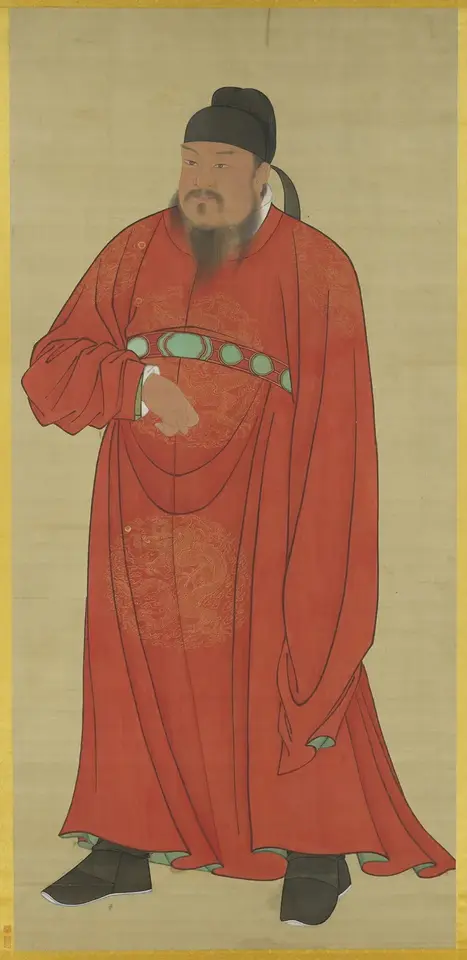
The Taiyuan Uprising was a decisive military insurrection launched in 617 at Jinyang by Li Yuan, Duke of Tang and garrison commander of Taiyuan, alongside his second son Li Shimin. Amidst the collapse of the Sui Dynasty caused by Emperor Yang's disastrous Goguryeo campaigns and excessive labor conscription, Li Yuan exploited his aristocratic status and regional military authority. Encouraged by key advisors including Pei Ji and Liu Wenjing, Li Yuan recruited elite volunteers under the pretext of border defense, eliminated loyalist imperial supervisors Wang Wei and Gao Junya, and secured his northern frontier through a strategic alliance with the Eastern Tujue. Marching southward with thirty thousand soldiers, the Tang army crushed the imperial garrison at the Battle of Huoyi, crossed the Yellow River, and captured the western capital Daxing City. This lightning campaign culminated in Li Yuan ascending the throne in 618 as Emperor Gaozu, inaugurating the Tang Dynasty.
Following the Yanmen siege, Emperor Yang appoints Li Yuan to pacify Shanxi and govern Taiyuan.
Confronting threats from Liu Wuzhou, Li Shimin and Pei Ji convince Li Yuan to recruit private volunteers.
Liu Zhenghui accuses Wang Wei and Gao Junya of treason; Li Yuan executes them and consolidates power.
Liu Wenjing secures cavalry alliances with Eastern Tujue; Li Yuan establishes the Grand General Headquarters.
Li Shimin outmaneuvers Song Laosheng at Huoyi, clearing the southern corridor toward the Yellow River.
Tang forces seize Daxing City and enthrone Yang You, setting the stage for the formal establishment of the Tang Dynasty in 618.
In the late Daye era, the tyrannical governance of Emperor Yang brought the Sui Dynasty to the verge of ruin. The emperor launched three consecutive, ruinous military expeditions against Goguryeo, which squandered the empire's wealth and cost hundreds of thousands of conscripted lives. Concurrently, grandiose infrastructure projects—including the extensive Grand Canal network and the eastern capital of Luoyang—ravaged agrarian productivity across northern China, causing widespread famine. From 611 onwards, widespread peasant rebellions erupted across the Central Plains, while regional magnates and military commanders carved out autonomous strongholds.
Shanxi stood as a precarious northern frontier bastion. Bandit coalitions and peasant armies contested control of southern Shanxi, while military commander Liu Wuzhou in Mayi aligned with the Eastern Turkic Khaganate, killed his imperial superior, and threatened Taiyuan from the north. In 615, Emperor Yang himself was encircled by Shibi Khagan at Yanmen and narrowly escaped disaster, destroying the central government's prestige. Seeking to stabilize the strategic northern frontier, Emperor Yang appointed Li Yuan, the aristocratic Duke of Tang from the Guanlong nobility, as garrison commander of Taiyuan in early 617.
Taiyuan, historically known as Jinyang, was an impregnable stronghold protected by Mount Taihang to the east and the Fen River valley to the south. The city housed expansive imperial storehouses containing vast reserves of weaponry, iron, and grain accumulated during Emperor Yang's reign. Li Yuan enjoyed broad respect among northern aristocrats and military commanders. His ambitious second son, Li Shimin, foresaw the inevitable collapse of the Sui Dynasty and actively plotted an armed rebellion to restore order.
To compel his cautious father into rebellion, Li Shimin allied with Jinyang palace intendant Pei Ji and county magistrate Liu Wenjing. Pei Ji secretly arranged for imperial palace concubines to serve Li Yuan during private banquets. Afterward, Pei Ji confronted Li Yuan, pointing out that consorting with imperial concubines was an act of treason punishable by death. With the empire engulfed in civil war, Pei Ji argued that rising in rebellion was the only path to survival. Recognizing the irreversible shift in dynastic fortune, Li Yuan resolved to launch the uprising.
In April 617, rebel commander Liu Wuzhou seized the Fenyang imperial palace and threatened Taiyuan. Li Shimin and Liu Wenjing seized upon this border crisis as a legitimate pretext to recruit private troops, ostensibly to defend Jinyang against Turkic incursions. Elite volunteers and wandering warriors flocked to the city, organized rapidly under trusted lieutenants Zhangsun Shunde and Liu Hongji. Within days, Li Yuan assembled over ten thousand combat-ready soldiers.
However, two imperial deputies stationed in Taiyuan—deputy commander Wang Wei and military officer Gao Junya—harbored deep suspicions regarding Li Yuan's unauthorized mobilization. The deputies conspired to assassinate Li Yuan during a public sacrificial ceremony at the Jin Shrine. Alerted to the plot, Li Shimin and Liu Wenjing moved decisively to eliminate their internal adversaries.
On June 5, 617, as Li Yuan held court, military administrator Liu Zhenghui abruptly entered and presented a formal accusation charging Wang Wei and Gao Junya with secretly colluding with the Turks to betray Taiyuan. Li Yuan ordered the immediate arrest of the two officials. When a large Turkic raiding party coincidentally appeared outside the city walls, Li Yuan employed deceptive open-gate strategies to frighten them away, then used the incident as conclusive proof of Wang and Gao's complicity. Li Yuan executed both imperial loyalists, thereby removing all domestic opposition and consolidating total civil and military authority in Taiyuan.
To secure his northern flank and acquire elite cavalry for a southward march, Li Yuan dispatched Liu Wenjing on an urgent diplomatic mission to Shibi Khagan of the Eastern Turkic Khaganate. Liu Wenjing adopted pragmatic diplomatic rhetoric, declaring that Li Yuan's forces intended solely to remove the tyrannical emperor and stabilize China. In exchange for military assistance, Li Yuan promised that captured gold, silk, and captives from Chang'an would be transferred to the Turks, while the Tang would retain territorial sovereignty. Delighted by these generous terms, Shibi Khagan concluded a mutual alliance, dispatching over one thousand cavalry mounts and five hundred elite Turkic horsemen to reinforce the Tang forces.
In July 617, Li Yuan officially established the Grand General Headquarters in Jinyang, designating himself as Grand General. He opened imperial granaries to relieve starving civilians, appointed his eldest son Li Jiancheng and second son Li Shimin as grand commanders of the left and right armies, and elevated Emperor Yang to Supreme Emperor while declaring loyalty to the legitimate imperial house.
On August 10, Li Yuan led an army of thirty thousand troops southward toward Chang'an. Near Huoyi, torrential summer rains flooded roadways and cut off supplies, while seasoned Sui general Song Laosheng barred the mountain passes with twenty thousand veteran troops. When senior officers urged a retreat to Taiyuan, Li Shimin and Li Jiancheng wept bitterly before Li Yuan, passionately arguing that retreat would dismantle their army's morale and that taking the Guanzhong basin before rival warlords was vital to imperial destiny. Persuaded by their resolve, Li Yuan ordered the advance to resume.
On September 8, following the clearing of the rains, Li Shimin executed an ingenious tactical deception, leading a cavalry detachment to lure Song Laosheng out from behind his fortifications. Overconfident, Song deployed his entire force outside Huoyi. While Li Yuan and Li Jiancheng absorbed the frontal assault, Li Shimin led cavalry around the mountain flank, severing the enemy's retreat and shouting that the Sui commander had fallen. The Sui lines collapsed in panic, Song Laosheng was slain attempting to re-enter the gates, and Huoyi fell to the Tang.
Following the victory at Huoyi, the Tang army advanced down the Fen River valley, capturing Linfen and Jiangjun with minimal resistance. In October, Li Yuan crossed the Yellow River at Longmen. In the Guanzhong heartland, Li Yuan's daughter, Princess Pingyang, alongside her husband Chai Shao, had mobilized tens of thousands of local insurgents who integrated seamlessly into the expanding Tang army. By November, an army of over two hundred thousand encircled the imperial capital Daxing City. After a brief siege, Tang forces entered the capital, enforcing strict discipline and protecting civilians. Li Yuan enthroned Emperor Yang's young grandson Yang You as Emperor Gong, assuming the titles of Prince of Tang and Grand Chancellor. In June 618, following news of Emperor Yang's assassination at Jiangdu, Emperor Gong abdicated to Li Yuan, who ascended the throne as Emperor Gaozu, officially founding the Tang Dynasty.
The Taiyuan Uprising decisively accelerated the fall of the Sui Dynasty. Within six months, Li Yuan's forces traversed the rugged Shanxi corridor, captured the political capital of Daxing, and seized the fertile Guanzhong basin with minimal societal destruction. This rapid campaign secured the extensive administrative archives, aristocratic manpower, and strategic fortresses of the western capital.
Politically, Li Yuan's strategy of initially honoring the Sui imperial house while governing as Grand Chancellor facilitated a peaceful institutional transition. By accommodating Guanlong elites and imperial bureaucrats, the Tang regime preserved administrative continuity, culminating in a smooth transfer of power upon Li Yuan's formal ascension in 618.
Geopolitically, the campaign established a robust dual-anchor defense system centered on Taiyuan and Guanzhong. Shielded by the natural barriers of the Qinling Mountains and the Yellow River, and supplied by abundant agricultural grain and northern cavalry, the new Tang state enjoyed insurmountable strategic superiority, enabling Li Shimin to defeat competing warlords and achieve the total reunification of China.
Traditional historians regard the Taiyuan Uprising as the glorious founding moment of the Tang Dynasty. Sima Guang in the Comprehensive Mirror for Aid in Governance lauded Li Yuan's political prudence and Li Shimin's battlefield brilliance.
Philosopher Wang Fuzhi highlighted that Li Yuan's uprising differed fundamentally from standard warlord insurrections: by maintaining ethical legitimacy, forming pragmatic external alliances, and pacifying Guanzhong without senseless slaughter, Li Yuan established an enduring model of dynastic renewal.
Modern historians emphasize that the uprising reflected a deliberate consensus among the medieval aristocratic elite to re-establish centralized order amidst imperial anarchy. Through exceptional strategic foresight, disciplined military organization, and astute diplomacy, the leaders of the Taiyuan Uprising transformed a local military mutiny into the foundation of China's most celebrated imperial golden age.