Outbreak of Jintian Uprising
Hong Xiuquan proclaims the Taiping Heavenly Kingdom in Guangxi, launching the nationwide war.
Qing Dynasty (清朝) · HISTORICAL EVENT
太平天国起义
The Taiping Rebellion was a catastrophic civil war and agrarian revolutionary upheaval waged between 1851 and 1864 in southern and central China. Precipitated by domestic decay, famine, and European imperialist economic encroachment following the First Opium War, village schoolteacher Hong Xiuquan synthesized unorthodox Christian millenarian teachings with ancient Chinese egalitarian ideals to found the God Worshipping Society. Mobilizing impoverished…
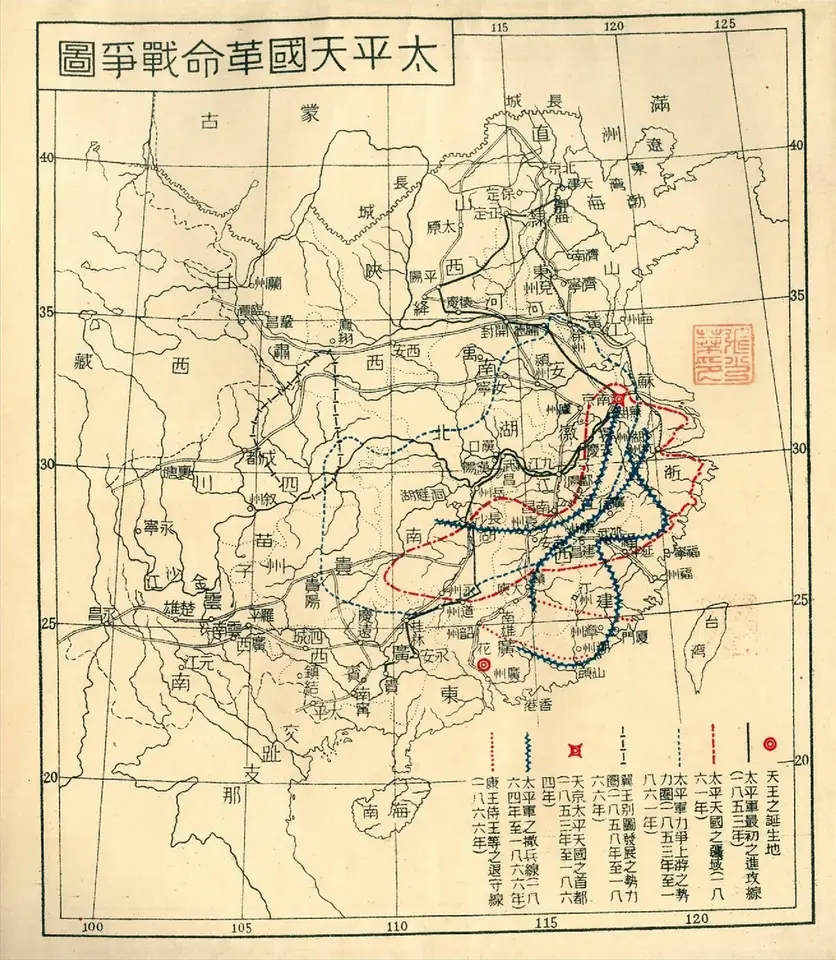
The Taiping Rebellion was a catastrophic civil war and agrarian revolutionary upheaval waged between 1851 and 1864 in southern and central China. Precipitated by domestic decay, famine, and European imperialist economic encroachment following the First Opium War, village schoolteacher Hong Xiuquan synthesized unorthodox Christian millenarian teachings with ancient Chinese egalitarian ideals to found the God Worshipping Society. Mobilizing impoverished Hakka miners and displaced peasants, Hong declared the Jintian Uprising in Guangxi in January 1851, establishing the Taiping Heavenly Kingdom. Sweeping down the Yangtze River, the Taipings captured Nanjing in 1853, designating it their heavenly capital of Tianjing and enacting radical social legislation including the Land System of the Heavenly Dynasty. Despite severe internal bloodshed during the 1856 Tianjing Incident, commanders Chen Yucheng and Li Xiucheng sustained the resistance until the Xiang Army, supported by Western mercenaries, captured Tianjing in July 1864. The conflict cost tens of millions of lives, permanently transforming late Qing imperial governance.
Hong Xiuquan proclaims the Taiping Heavenly Kingdom in Guangxi, launching the nationwide war.
The Taipings capture Yong'an, establishing five regional kings under the paramount authority of Eastern King Yang Xiuqing.
The Taipings capture Nanjing, designating it Tianjing and promulgating the Land System of the Heavenly Dynasty.
Taiping forces shatter the Jiangnan and Jiangbei Great Camps, breaking imperial encirclement around Tianjing.
Wei Changhui massacres Yang Xiuqing and thousands of followers, initiating fatal internal fragmentation.
Li Xiucheng and Chen Yucheng destroy the reconstructed Jiangnan Great Camp and conquer the Suzhou-Hangzhou delta.
The Xiang Army breaches the walls of Tianjing following a protracted siege, extinguishing the Taiping state.
In the wake of the 1842 Treaty of Nanking, Western powers expanded their commercial footholds across coastal China. The massive outflow of silver to finance illicit opium importation, combined with crushing indemnity payments totaling twenty-one million silver dollars, forced the Qing government to triple land surcharges on already impoverished peasant households. Furthermore, foreign machine-made textiles undermined traditional cottage industries across the southern provinces. Wealthy gentry consolidated landholdings, reducing millions of tenant farmers to landless destitution.
The southern borderlands of Guangxi and Guangdong suffered the most acutely. In Guangxi, indigenous residents and immigrant Hakka populations engaged in bitter, endemic clan warfare over barren hills and dwindling resources. Corrupt local mandarins and extortionate tax collectors compounded the misery, while recurrent droughts and catastrophic floods drove displaced vagrants into banditry. Having repeatedly failed the provincial civil service examinations, Guangdong scholar Hong Xiuquan suffered a severe emotional collapse in 1837. During his illness, he experienced visions that he later interpreted through a Protestant missionary tract entitled Good Words for Exhorting the Age. Hong came to believe that he was the second son of God and the younger brother of Jesus Christ, sent to purge China of demon worship and Confucian tyranny.
In 1844, Hong Xiuquan and his devoted disciple Feng Yunshan traveled deep into the Thistle Mountain region of Guiping, Guangxi. While Hong returned to Guangdong, Feng labored patiently among impoverished charcoal burners, miners, and Hakka peasants, creating the God Worshipping Society. Through strict moral discipline and spiritual fellowship, Feng forged a dedicated underground political-military organization. Soon, charismatic local leaders joined the inner circle: Yang Xiuqing, who claimed the ability to channel the voice of God the Father; Xiao Chaogui, who channeled Jesus Christ; wealthy Hakka landlord Wei Changhui; and young scholar Shi Dakai. Together, they transformed a religious sect into an armed revolutionary vanguard ready for open rebellion.
In the summer of 1850, as Qing magistrates moved to suppress the sect, Hong Xiuquan issued a general mobilization decree, summoning over ten thousand followers to gather at Jintian village. Believers sold their ancestral properties and deposited their possessions into a shared Sacred Treasury, adopting strict gender-segregated military regiments. On January 11, 1851, celebrating Hong's thirty-eighth birthday, the insurgents formally hoisted the yellow banners of rebellion, proclaiming the establishment of the Taiping Heavenly Kingdom and declaring open war on the Manchu Qing dynasty.
The disciplined Taiping army bypassed heavily fortified cities and advanced rapidly across northern Guangxi. In December 1851, they captured Yong'an, where Hong Xiuquan formalized the dynastic framework, investing Yang Xiuqing as Eastern King, Xiao Chaogui as Western King, Feng Yunshan as Southern King, Wei Changhui as Northern King, and Shi Dakai as Wing King, while designating the Eastern King as supreme commander of all military and civil affairs. The regime also introduced a new lunar-solar calendar and promulgated fundamental military codes.
In April 1852, the Taiping army broke out of Yong'an and marched north toward the Yangtze valley. During this grueling advance, Southern King Feng Yunshan was killed in an ambush at Quanzhou, and Western King Xiao Chaogui was mortally wounded during the siege of Changsha, depriving the rebellion of its most balanced statesmen. Nevertheless, the Taipings captured Yuezhou, seized tens of thousands of transport vessels, and swept down the Yangtze River. After capturing Wuchang in early 1853, over two million followers and troops sailed eastward, capturing the southern metropolis of Jiangning in March 1853. Hong Xiuquan renamed the city Tianjing, establishing the permanent capital of the rebel state.
Upon establishing their capital, the Taipings promulgated the Land System of the Heavenly Dynasty, which advocated communal land ownership, universal wealth sharing, and absolute social egalitarianism. The leadership launched a two-pronged offensive: a Northern Expedition commanded by Lin Fengxiang and Li Kaifang that pushed to the outskirts of Tianjin before being annihilated in the harsh northern winter, and a Western Expedition under Shi Dakai that reconquered Hubei, Jiangxi, and Anhui, inflicting a crushing defeat upon Zeng Guofan's nascent Xiang Army at Hukou in 1855. In early 1856, Taiping forces shattered the Qing Jiangnan and Jiangbei Great Camps, reaching the zenith of their military power.
However, unchecked military triumphs fostered arrogance, moral corruption, and bitter factional rivalry at Tianjing. Eastern King Yang Xiuqing exploited his divine channeling authority to publicly humiliate Hong Xiuquan and Wei Changhui, demanding that Hong elevate him to equal sovereign status. In September 1856, Hong secretly ordered Wei Changhui and Qin Rigang to purge Yang. Wei carried out a savage massacre, slaughtering Yang Xiuqing, his family, and over twenty thousand followers. When Shi Dakai returned to protest the indiscriminate slaughter, Wei attempted to murder him, forcing Shi to escape while slaughtering Shi's family. Horrified by the carnage, Hong Xiuquan executed Wei Changhui and recalled Shi Dakai to supervise administration. But Hong grew deeply paranoid, elevating his incompetent brothers to constrain Shi. Alienated and suspicious, Shi Dakai abandoned Tianjing in 1857 with one hundred thousand elite troops, embarking on an independent campaign that ended with his surrender and execution at the Dadu River in 1863.
The Tianjing Incident crippled the Heavenly Kingdom, allowing imperial forces to rebuild the Jiangnan Great Camp and encircle the capital anew. In response, Hong Xiuquan elevated young battlefield commanders Chen Yucheng and Li Xiucheng, while appointing his cousin Hong Rengan as Prime Minister. Hong Rengan drafted A New Treatise on Aiding Administration, proposing modernization through railways, banking, schools, and industrial technology. On the battlefield, Chen Yucheng and Li Xiucheng achieved a brilliant victory at Sanhe in 1858, shattered the Jiangnan Great Camp for a second time in 1860, and conquered the affluent regions of Suzhou and Hangzhou, establishing the prosperous Sufu Province to replenish the rebel treasury.
Confronted with dynastic collapse, the Qing court empowered Han scholar-generals Zeng Guofan, Li Hongzhang, and Zuo Zongtang to mobilize disciplined provincial militias, while enlisting Western-led mercenary units like the Ever Victorious Army. In 1861, the strategic bastion of Anqing fell to the Xiang Army, and Chen Yucheng was betrayed and executed in 1862, exposing Tianjing's western approach. Zeng Guoquan led fifty thousand Xiang Army troops to entrench around Tianjing, subjecting the city to a devastating two-year blockade. On June 1, 1864, Hong Xiuquan died of illness and malnutrition amidst severe starvation, leaving his sixteen-year-old son Hong Tianguifu on the throne. On July 19, the Xiang Army exploded a massive mine beneath the Taiping Gate, breaching the walls and storming the capital. Following desperate street fighting, Tianjing fell and was systematically pillaged. Li Xiucheng was captured attempting to escort the young monarch to safety; after composing an extensive autobiographical confession, he was executed, bringing the epic rebellion to an end.
The Taiping Rebellion was the largest and bloodiest civil war of the nineteenth century, devastating eighteen provinces and claiming between twenty and thirty million lives. The catastrophic conflict shattered the pre-existing military monopoly of the Manchu Eight Banners and Green Standard Army, permanently altering the dynastic balance of power.
Crucially, the conflict prompted a decisive structural shift in late Qing imperial politics. Confronted with total collapse, the Manchu throne was forced to delegate supreme military, administrative, and taxation authority to Han Chinese scholar-generals such as Zeng Guofan, Li Hongzhang, and Zuo Zongtang. The rise of provincial militias and the introduction of the likin internal transit tax laid the foundations for regional warlordism that characterized early twentieth-century China, while inspiring the initial modernization efforts of the Self-Strengthening Movement.
Ideologically, the Taiping Rebellion represented the historic peak of Chinese peasant egalitarianism. The Land System of the Heavenly Dynasty was the earliest revolutionary program advocating the total abolition of landlord feudal property, while Hong Rengan's New Treatise on Aiding Administration served as China's first systematic blueprint for Western-style capitalist industrialization and institutional modernization.
Finally, the resistance of the Taipings against Western encroachment exposed the imperialist collaboration of foreign powers, inspiring subsequent generations of Chinese revolutionaries, including Sun Yat-sen, who viewed Hong Xiuquan as an early forerunner of modern national liberation.
Historians across diverse traditions view the Taiping Rebellion as a monumental turning point in modern Chinese history. Traditional Qing historiography denounced the movement as an unprecedented civil convulsion that ravaged the Confucian cultural order.
Modern Marxist and nationalist historians celebrate the rebellion as a heroic anti-feudal and anti-imperialist agrarian revolution. Modern scholars note that while ideological contradictions, excessive theocratic dogmatism, and destructive internal purges doomed the movement to eventual failure, the sheer scale of the uprising dealt a mortal blow to the Manchu imperial dynasty, setting in motion the irreversible collapse of imperial China.