Foundation of Eastern Han and Restoration Policy
Liu Xiu establishes the Eastern Han at Luoyang, retiring military generals from administration and centralizing monarchical power.
Eastern Han Dynasty (东汉) · HISTORICAL EVENT
尚书台权力扩张
The Expansion of the Authority of the Imperial Secretariat was a landmark transformation of China's central executive bureaucracy carried out during the reign of Emperor Guangwu of Eastern Han, Liu Xiu, from 25 to 57. Throughout the Western Han, the Chancellor headed the external administration and exercised vast executive prerogatives, a concentration of authority that ultimately allowed the imperial relative Wang Mang to usurp the throne. Upon founding…
The Expansion of the Authority of the Imperial Secretariat was a landmark transformation of China's central executive bureaucracy carried out during the reign of Emperor Guangwu of Eastern Han, Liu Xiu, from 25 to 57. Throughout the Western Han, the Chancellor headed the external administration and exercised vast executive prerogatives, a concentration of authority that ultimately allowed the imperial relative Wang Mang to usurp the throne. Upon founding the Eastern Han and establishing Luoyang as his capital, Emperor Guangwu drew critical lessons from the fall of the Western Han. Adopting the policy of rewarding military generals with nobility while appointing literate civil clerks to governance, he stripped the Three Excellencies—the Grand Commandant, Minister over the Masses, and Minister of Works—of their executive jurisdiction. Instead, he elevated the Imperial Secretariat, known as Shangshu Tai, from a minor inner-palace clerical office into the supreme executive hub of the empire. Composed of the Secretariat Director, Vice Director, and six specialized chambers, the Secretariat drafted decrees, processed memorials, and directed administrative branches under the direct command of the emperor. This reform crystallized the principle of all affairs devolving upon the Secretariat, initiating an enduring institutional pattern wherein inner-court secretaries evolved into full executive chancellors.
Liu Xiu establishes the Eastern Han at Luoyang, retiring military generals from administration and centralizing monarchical power.
Emperor Guangwu establishes the Shangshu Tai as an independent executive organ, creating six specialized secretarial chambers.
Imperial memorials and edicts are channeled exclusively through the Secretariat; the Three Excellencies are reduced to ceremonial consultants.
Minister of Works Zhu Fu submits a famous memorial lamenting that all affairs devolve upon the Secretariat while the Excellencies hold empty titles.
The Secretariat impeaches senior chancellors over administrative errors, cementing the supremacy of literate secretarial governance.
The titles of the Three Excellencies are simplified, formalizing their decorative position beneath the executive Secretariat.
Emperor Ming succeeds to the throne, using secretarial clerks to conduct rigorous personnel audits and direct administrative branches.
The secretarial system operates smoothly into the reign of Emperor Zhang, serving as the executive anchor of the dynasty for two centuries.
Under the Qin and early Western Han dynasties, the central government operated under the Three Excellencies and Nine Ministers system, with the Chancellor serving as the chief executive of all civil and military affairs. Enjoying independent secretariats, patronage appointments, and the right to direct bureaucratic branches, early Han chancellors wielded vast authority. However, this power concentration frequently conflicted with imperial autocracy. To curb ministerial independence, Emperor Wu of Han created the Inner Court, summoning close attendants, generals, and imperial secretaries into the palace to formulate policy, leaving the external chancellor to execute paperwork.
By the late Western Han, Chancellor, Grand Commandant, and Imperial Counselor were reorganized into the Three Excellencies: Minister over the Masses, Grand Marshal, and Minister of Works. This fragmentation failed to stabilize the dynasty. Instead, ambitious imperial relatives seized the office of Grand Marshal and concurrently directed the Imperial Secretariat. Exploiting this dual power, Wang Mang controlled secretarial communications, manipulated juvenile sovereigns, and ultimately usurped the throne to found the Xin dynasty. The subsequent civil strife underscored the mortal danger posed by overmighty chancellors.
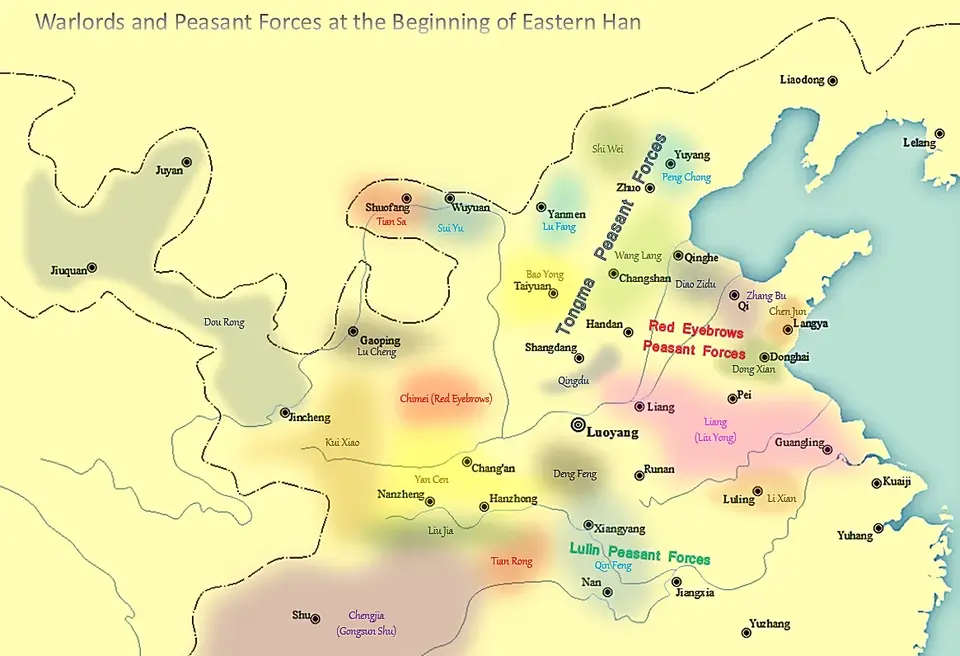
In 25, Liu Xiu ascended the throne amidst the ruins of the Xin dynasty, unifying China through protracted military campaigns against the Red Eyebrows, Bronze Horses, and regional warlords. Faced with extensive post-war devastation and fractured regional administrations, Emperor Guangwu determined to eliminate the structural weaknesses that had plagued the late Western Han.
As the dynastic restorer, Liu Xiu recognized that his veteran generals commanded dangerous military prestige. To avert warlordism, he established the policy of honoring generals with peerages and rich revenue domains while strictly barring them from civilian government posts. Concurrently, implementing post-war land cadastres, census surveys, and fiscal rehabilitation required a streamlined, highly disciplined civil bureaucracy entirely subordinate to the sovereign. Under these imperatives, Emperor Guangwu elevated the literate civil clerks of the Secretariat to rebuild imperial authority.
Under Qin and Western Han regulations, the Imperial Secretaries were minor functionaries attached to the Privy Purse, an office managing imperial palace expenditures. Ranked at several hundred bushels, their duties were limited to transmitting memorials and cataloging palace archives. Although Emperor Wu had utilized secretaries to circumvent the Chancellor, the office retained its status as a domestic palace service.
Upon restoring the dynasty at Luoyang, Emperor Guangwu executed a structural overhaul of the secretarial apparatus, severing its subservience to the Privy Purse and establishing it as an independent executive organ known as Shangshu Tai or Taige. Guangwu appointed a Secretariat Director at one thousand bushels to superintend state documentation, assisted by a Vice Director who supervised internal discipline and administrative routines. Beneath them, Guangwu established six specialized chambers, each directed by an Imperial Secretary ranked at six hundred bushels, assisted by six secretarial attendants and three senior clerks, creating an articulate administrative hierarchy.
The six chambers established by Emperor Guangwu mirrored the full administrative spectrum of imperial government. The Chamber of the Three Excellencies conducted annual audits and personnel reviews of regional commandery administrators and imperial circuit inspectors. The Chamber of Personnel directed the appointments, transfers, dismissals, and promotions of civil officials across the empire. The Chamber of the People oversaw agricultural colonization, water conservancy works, population registrations, and tax collections. The Chamber of Foreign Guests managed relations with frontier tribes and tribute missions. The Chamber of Two-Thousand-Bushel Officials directed the high judicial appeals court, capital investigations, and serious criminal prosecutions. The Chamber of the Capital Constabulary supervised internal metropolitan security across Luoyang and adjacent commanderies.
Every dispatch, memorial, and fiscal report from commanderies, frontier commands, and central ministries was delivered to the Shangshu Tai. Secretarial clerks opened, cataloged, researched precedents, and drafted marginal recommendations before presenting the documents directly to the emperor. Every imperial rescript, appointment patent, amnesty, and legal statute was drafted and stamped by the Secretariat before national distribution. In practice, the Shangshu Tai took over the comprehensive operational authority once exercised by the Western Han Chancellor's Office.
While expanding the secretarial apparatus, Emperor Guangwu systematically hollowed out the executive powers of the Three Excellencies. The Grand Commandant, Minister over the Masses, and Minister of Works remained ranked at the apex of the civil bureaucracy with nominal salaries of ten thousand bushels, retaining immense prestige. However, in functional governance, the Excellencies merely received finished decisions. Their offices were excluded from daily policy discussions, becoming ceremonial bodies.
The Excellencies lost the right to command military forces or unilaterally issue administrative statutes. When momentous imperial debates arose, the Excellencies participated in joint court conferences, but final adjudication remained with the Secretariat and the emperor. Furthermore, Emperor Guangwu enforced rigorous legal discipline; chancellors were repeatedly impeached and cashiered by secretarial auditors over astrological anomalies or flawed administrative tallies. Ministers over the Masses Han Xin, Ouyang She, and Dai She were successively imprisoned or forced to commit suicide following secretarial investigations. Minister of Works Zhu Fu submitted an urgent memorial protesting that although the Three Excellencies were appointed, all affairs devolved upon the Secretariat, and high dignitaries regarded the Secretariat Director as their foremost adversary. Zhu Fu's memorial documented the institutional reality of Eastern Han statecraft.
Following Emperor Guangwu's death in 57, Emperor Ming of Han, Liu Zhuang, preserved and reinforced the Secretariat system. Governed by a legalistic approach to imperial administration, Emperor Ming was meticulous and suspicious, relying heavily upon secretarial officials to oversee provincial governance. Every morning, Emperor Ming summoned secretarial attendants into the inner palace to examine judicial rolls and review commandery statistics.
Under Emperor Ming, the operational framework of the Shangshu Tai was codified. Secretarial officers were assigned permanent duty quarters within the imperial palace, with directors and clerks rotating on nocturnal watches equipped with palace bedding, incense, and secretarial stipends. The authority of the Secretariat towered over the external Nine Ministers, firmly securing personnel appointments, legal judgments, and tax oversight under the personal purview of the emperor, consolidating the bureaucratic zenith of the early Eastern Han.
The expansion of the Imperial Secretariat permanently terminated the Western Han system of an autonomous chancellor's office. By concentrating executive administration within the Shangshu Tai, the Eastern Han successfully concentrated decision-making, executive oversight, and imperial patronage within the inner court. The traditional chancellors became nominal dignitaries, allowing the emperor to govern directly through a compact, professional secretarial body.
The elevation of the Shangshu Tai established a cyclical pattern in Chinese institutional history wherein inner-court secretariats progressively displaced external ministries to become formal chancellors. During the late Eastern Han, the Secretariat evolved into the formal chief executive organ of the realm. Under the Cao Wei dynasty, the Secretariat severed all domestic ties, prompting Cao Pi to create the Palace Secretariat to balance its power. Throughout the Six Dynasties, the organ developed into the Department of State Affairs, operating alongside the Secretariat and Chancellery to form the Three Departments. Emperor Guangwu's six specialized chambers directly provided the historical blueprint for the Six Ministries—Personnel, Revenue, Rites, War, Justice, and Works—that governed China through the Qing dynasty.