Fall of Beijing and Death of Chongzhen
Li Zicheng's Dashun army captures Beijing; Emperor Chongzhen commits suicide, ending Ming rule.
Ming-Qing Transition, Shun Dynasty (明末清初、大顺) · HISTORICAL EVENT
山海关之战与清军入关
The Battle of Shanhai Pass and the Qing Entry into the Central Plains was the pivotal dynastic turning point of 1644 that transformed the geopolitical landscape of East Asia. In the third lunar month of 1644, Li Zicheng's Dashun peasant forces seized Beijing, leading to the suicide of the Chongzhen Emperor and the downfall of the Ming dynasty after 276 years of rule. General Wu Sangui retreated to Shanhai Pass, where he rebelled against Dashun after his…
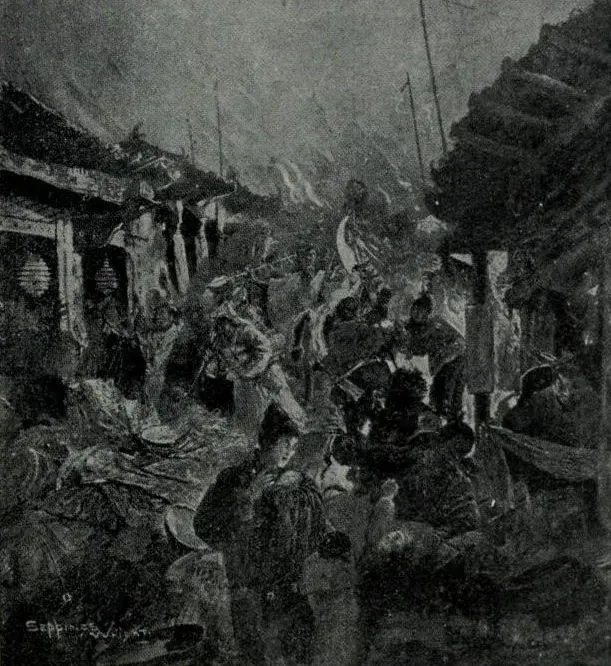
The Battle of Shanhai Pass and the Qing Entry into the Central Plains was the pivotal dynastic turning point of 1644 that transformed the geopolitical landscape of East Asia. In the third lunar month of 1644, Li Zicheng's Dashun peasant forces seized Beijing, leading to the suicide of the Chongzhen Emperor and the downfall of the Ming dynasty after 276 years of rule. General Wu Sangui retreated to Shanhai Pass, where he rebelled against Dashun after his father Wu Xiang was tortured and his household seized in Beijing. Confronting a sixty-thousand-strong Dashun punitive expedition led by Li Zicheng, Wu appealed to Qing Prince Regent Dorgon, opening the gates in submission. Marching day and night, Dorgon led over one hundred thousand banner troops into the pass. On the twenty-second day of the fourth month, as Guan-Ning and Dashun troops engaged in brutal combat along the Shi River, a sudden dust storm blinded the Dashun lines. Dorgon unleashed tens of thousands of heavy banner cavalrymen, routing Li Zicheng's host. Dorgon occupied Beijing on the second day of the fifth month, performed imperial funeral rites for Chongzhen, and welcomed the young Shunzhi Emperor to establish Beijing as the permanent capital of the Qing empire.
Li Zicheng's Dashun army captures Beijing; Emperor Chongzhen commits suicide, ending Ming rule.
Dorgon leads over 100,000 banner troops from Shengjing; learning of Beijing's fall, he targets the capital.
Enraged by Wu Sangui's defiance, Li Zicheng leads 60,000 veteran troops eastward to subdue the pass.
Facing destruction, Wu Sangui dispatches messengers offering to surrender and requesting immediate Qing intervention.
Dashun forces reach the Shi River, deploy at Yipianshi, and assault the west and north fortifications of the pass.
Wu Sangui rides to Weiyuan Fort, submits to Dorgon, shaves his head, and opens the gates for 80,000 hidden Qing troops.
As Wu's troops falter, a sudden dust storm erupts; Qing cavalry charges Dashun's flanks, completely routing Li Zicheng's army.
Li Zicheng executes Wu Xiang's family, crowns himself in Beijing, burns the palace, and flees toward Xi'an.
Dorgon leads the Eight Banners into Beijing, enforcing order and mourning Chongzhen to win northern literati loyalty.
Emperor Shunzhi enters Beijing, ascends the imperial throne in the Forbidden City, and proclaims national dynastic rule.
In the spring of 1644, Li Zicheng, sovereign of the Dashun dynasty, led veteran peasant armies across the Yellow River, sweeping through Shanxi and Xuanfu before investing Beijing. On the nineteenth day of the third lunar month, Dashun forces breached the capital ramparts. Emperor Chongzhen, Zhu Youjian, committed suicide on Meishan, bringing an end to Ming imperial authority in northern China. Although Li Zicheng established administrative ministries in Beijing, General Liu Zongmin subjected former Ming nobles and senior ministers to brutal physical torture to extract silver, generating acute terror and alienating the northern literati class.
Concurrently, Count of Pingxi Wu Sangui commanded several thousand elite Guan-Ning cavalrymen at Ningyuan. Having received urgent imperial orders to relieve Beijing, Wu escorted thousands of Liaodong refugees inside the Great Wall. Reaching Fenrun, Wu learned that Beijing had fallen and the emperor was dead, prompting him to fall back on Shanhai Pass. Li Zicheng dispatched general Tang Tong with eight thousand troops to solicit Wu's submission. Wu initially consented, but upon reaching Shahe Post, retainers informed him that his father Wu Xiang had been tortured and his concubine Chen Yuanyuan had been seized. Infuriated, Wu executed Dashun messengers, counter-attacked Tang Tong, and fortified Shanhai Pass.
At Shengjing (modern Shenyang), Emperor Taizong Hong Taiji had died in 1643, elevating six-year-old Fulin to the throne under the regency of Prince Dorgon and Jirgalang. Recognizing that civil strife had fatally exhausted Ming defenses, Dorgon mobilized over one hundred thousand banner troops on the ninth day of the fourth month to invade northern China.
Reaching the Liao River on the eleventh day, Dorgon received intelligence that Beijing had fallen and Chongzhen was dead. Defected Ming viceroy Hong Chengchou presented a decisive strategic proposal: previously, the Qing had raided northern China merely for loot, but now, with the Ming destroyed by bandits who had alienated the populace, the Qing should present itself as an army of justice. Hong advised Dorgon to enforce strict discipline, avenge the fallen Chongzhen Emperor, win the allegiance of the Han scholarly elite, and march directly upon Beijing to establish unified imperial rule. Dorgon adopted this plan, accelerating his march toward Shanhai Pass.
Learning of Wu Sangui's defiance on the thirteenth day of the fourth month, Li Zicheng marched east from Beijing with sixty thousand veteran troops, taking along Wu Xiang and the captured Ming crown prince. Recognizing that his isolated garrison could not withstand Dashun's assault, Wu dispatched messengers on the fifteenth day pleading for Dorgon's intervention. At Lianshan, Dorgon recognized that the gateway to China was open; he ordered his horsemen to double their pace, riding over two hundred li in a single day and night.
On the twenty-first day, Dashun forces deployed along the western bank of the Shi River. Li Zicheng sent Bai Guang'en around Mount Jiao to Yipianshi to cut off Wu's rear, while directing Liu Zongmin to launch frontal assaults against West Luo City and North Wing City. Guan-Ning defenders employed western cannon to inflict severe casualties, but by nightfall their outer works had been breached. At dawn on the twenty-second, Wu rode out to Weiyuan Fort to surrender to Dorgon in person. Dorgon demanded that Wu's troops shave their foreheads in Manchu style, wear Qing uniforms, bind white cloth around their arms, and serve as the shock vanguard. Wu accepted all terms, opening the fortress gates.
At eight in the morning on the twenty-second day, Princes Ajige and Dodo led eighty thousand elite banner cavalrymen through the gates of Shanhai Pass, concealing their banners behind Huanxi Ridge. Li Zicheng deployed his sixty thousand troops into an extensive linear array stretching several dozen li from Mount Jiao to the Bohai coast. Ascending the Weiyuan observation terrace, Dorgon noted that the Dashun line was thinly stretched along the coast. He ordered Wu Sangui to engage the enemy center while holding his heavy cavalry in reserve.
Wu's troops charged into the Dashun line, initiating ferocious hand-to-hand combat that lasted from dawn until noon. As Guan-Ning resistance began to collapse, a violent gale swept down from the northwest, churning up thick dust clouds that blinded the Dashun troops. Seizing the opening, Dorgon lowered his command pennant. Princes Ajige and Dodo led twenty thousand ironclad Manchu cavalrymen in a devastating charge into Dashun's exposed flanks. Shattered by the surprise cavalry assault, Dashun ranks disintegrated into an uncontrollable rout.
Li Zicheng sounded a hasty retreat toward Yongping. Dorgon invested Wu Sangui as Prince Who Pacifies the West, ordering him to spearhead the pursuit. Qing and Guan-Ning forces pursued the remnants for forty li, slaying tens of thousands. Reaching Fanjia Post, Li executed Wu Xiang and displayed his severed head. Arriving in Beijing, Li staged a hasty coronation ceremony in the Wuying Palace, slaughtered Wu's remaining relatives, set fire to the Forbidden City, and fled west toward Xi'an on the thirtieth day.
On the second day of the fifth lunar month, Dorgon led the Eight Banners through Chaoyang Gate into Beijing amidst kneeling officials and residents. Dorgon enforced strict military discipline, prohibiting looting and violence. He ordered three days of official mourning for the Chongzhen Emperor, oversaw the construction of the Siling tomb, and retained all former Ming officials in their offices, rapidly winning over the northern Han elite.
On the fifteenth day of the fifth month, Dorgon received formal felicitations from civil and military officials in the imperial palace, establishing Beijing as the administrative center of the Qing dynasty. Dorgon dispatched couriers to Shengjing to escort the young Shunzhi Emperor and Empress Dowager Xiaozhuang to Beijing. In the ninth month, the imperial entourage arrived. On the first day of the tenth lunar month in 1644, six-year-old Emperor Shunzhi ascended the throne in the Forbidden City, proclaiming an empire-wide amnesty and officially announcing Beijing as the capital of a unified Qing empire. Dorgon immediately dispatched armies under Dodo and Ajige to pursue Dashun remnants and conquer southern China, inaugurating more than two and a half centuries of unified Qing dynastic rule.
The Battle of Shanhai Pass and the Qing entry into Beijing abruptly terminated the brief period of regional warlordism that followed the fall of the Ming. The loss of tens of thousands of seasoned veterans along the Shi River shattered the military core of the Dashun dynasty, compelling Li Zicheng to abandon northern China and retreat toward Shaanxi and Hubei, where his regime collapsed within two years. Concurrently, the elite Guan-Ning army was incorporated into the Qing military apparatus, creating an irresistible combined force that dominated all regional adversaries.
The capture of Beijing inaugurated 268 years of Qing imperial rule over China. By adopting the posture of restoring dynastic order and performing rites for the deceased Ming monarch, Dorgon successfully co-opted the Han gentry elite, preserving Ming legal codes, tax schedules, and the examination system. Over the subsequent decades, the Qing crushed Southern Ming resistance, extinguished the Three Feudatories, and brought Taiwan, Mongolia, Tibet, and Xinjiang into an expansive multi-ethnic empire, defining the territorial frontiers of modern China.