Dorgon Proposes Coordinated Action
Dorgon invites Li Zicheng to jointly conquer Ming territory; Li ignores the letter as Qing prepares for invasion.
Ming-Qing Transition, Shun Dynasty (明末清初、大顺) · HISTORICAL EVENT
山海关之战
The Battle of Shanhai Pass, known also as the Battle of Yipianshi, was a monumental strategic clash fought in the fourth lunar month of 1644 at Shanhai Pass on the border of modern Liaoning and Hebei. In the third month of 1644, Li Zicheng's Dashun peasant forces seized Beijing, prompting the suicide of the Chongzhen Emperor and the collapse of the Ming dynasty. Retreating to Shanhai Pass with his elite Guan-Ning cavalry, General Wu Sangui refused to…
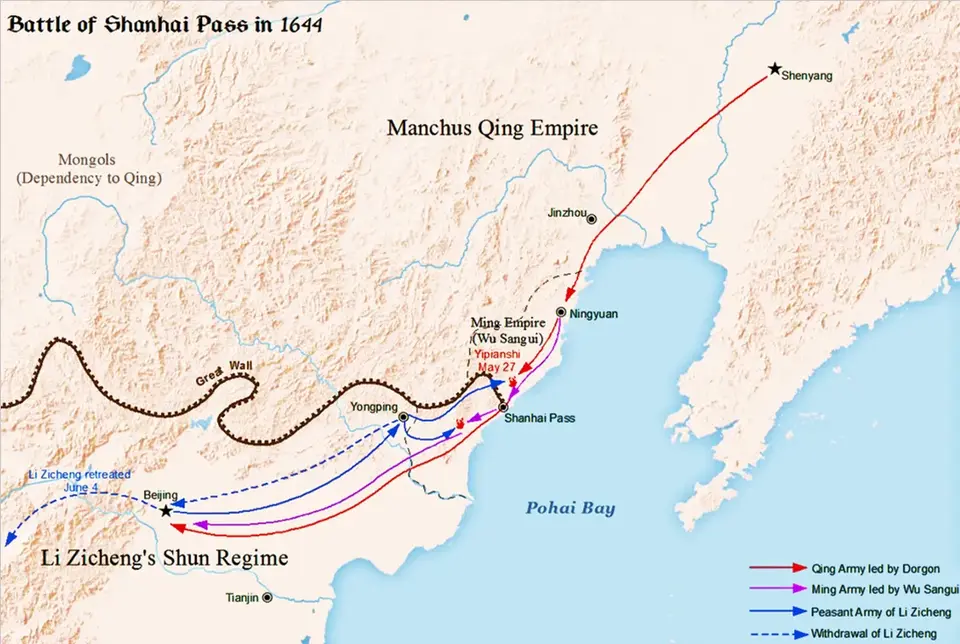
The Battle of Shanhai Pass, known also as the Battle of Yipianshi, was a monumental strategic clash fought in the fourth lunar month of 1644 at Shanhai Pass on the border of modern Liaoning and Hebei. In the third month of 1644, Li Zicheng's Dashun peasant forces seized Beijing, prompting the suicide of the Chongzhen Emperor and the collapse of the Ming dynasty. Retreating to Shanhai Pass with his elite Guan-Ning cavalry, General Wu Sangui refused to submit to the Dashun regime after his father Wu Xiang was tortured and his estate seized. When Li Zicheng personally led sixty thousand veteran troops east to reduce the fortress, Wu Sangui found himself hopelessly trapped and appealed to Qing Prince Regent Dorgon, shaving his head in submission. On the twenty-second day of the fourth month, as Dashun soldiers and Guan-Ning defenders engaged in bloody hand-to-hand combat along the Shi River, a violent sandstorm suddenly erupted. Seizing the opening, Dorgon unleashed tens of thousands of elite banner cavalrymen into Dashun's overstretched flanks. Shattered by the surprise cavalry assault, Li Zicheng's host collapsed in total rout. The Qing-Wu victory delivered Beijing to the Qing court, inaugurating over two and a half centuries of Qing dynastic rule over China.
Dorgon invites Li Zicheng to jointly conquer Ming territory; Li ignores the letter as Qing prepares for invasion.
Li Zicheng captures Beijing; Emperor Chongzhen commits suicide, ending the Ming dynasty's northern rule.
Dorgon leads over 100,000 banner troops from Shengjing; learning of Beijing's fall at the Liao River, he targets the capital.
Enraged by Wu Sangui's defiance, Li Zicheng leads 60,000 veteran troops eastward to subdue the pass.
Facing destruction, Wu Sangui dispatches messengers offering to surrender and requesting immediate Qing intervention.
Dashun forces reach the Shi River, deploy at Yipianshi, and assault the west and north fortifications of the pass.
Wu Sangui rides to Weiyuan Fort, submits to Dorgon, shaves his head, and opens the gates for 80,000 hidden Qing troops.
As Wu's troops falter, a sudden dust storm erupts; Qing cavalry charges Dashun's flanks, completely routing Li Zicheng's army.
Li Zicheng executes Wu Xiang's family, crowns himself in Beijing, burns the palace, and flees toward Xi'an.
Dorgon leads the Eight Banners into Beijing, later moving the capital from Shengjing and inaugurating Qing rule over China.
In the autumn of 1643, Hong Taiji, Emperor Taizong of Qing, passed away, and his young son Fulin succeeded to the throne under the co-regency of Prince Regent Dorgon and Jirgalang. Observing the terminal exhaustion of the Ming state caused by protracted peasant rebellions, Dorgon discerned an unprecedented opportunity to conquer China. In early 1644, Dorgon addressed an imperial letter to rebel leader Li Zicheng proposing a joint campaign against the Ming, though Li ignored the overture.
On the ninth day of the fourth lunar month in 1644, Dorgon led more than one hundred thousand Manchu, Mongol, and Han banner troops westward from Shengjing. Reaching the Liao River on the eleventh day, Dorgon received shocking intelligence: Li Zicheng's Dashun army had breached Beijing on the nineteenth day of the third month, and the Chongzhen Emperor had hanged himself on Meishan. Accepting the strategic counsel of defected Ming general Hong Chengchou, Dorgon abandoned his plan to conduct secondary border raids and redirected his entire army straight toward Beijing, transforming the campaign into a contest for supreme imperial hegemony.
Prior to the fall of Beijing, General Wu Sangui had garrisoned the outer bastion of Ningyuan with five thousand veteran Guan-Ning horsemen. Ordered to relieve the capital, Wu withdrew past Shanhai Pass, incorporating scattered garrisons and local militias until his force numbered several tens of thousands. Following Beijing's fall, Li Zicheng dispatched general Tang Tong with eight thousand troops to solicit Wu's submission. Weighing his options, Wu initially agreed to surrender and marched his command toward the capital.
However, upon reaching Shahe Post west of Yongping, Wu encountered family retainers fleeing Beijing. They reported that Dashun generals had subjected Ming grandees to brutal extortions; Wu's father Wu Xiang had been placed in irons and tortured, while his beloved concubine Chen Yuanyuan had been seized by a rebel commander. Enraged by this humiliation, Wu renounced his submission, executed Dashun emissaries, and counter-marched to Shanhai Pass, scattering Tang Tong's detachment. Recognizing the strategic threat, Li Zicheng mobilized sixty thousand veterans on the thirteenth of the fourth month, escorting Wu Xiang and the captured Ming crown prince on a forced march eastward to crush Wu Sangui.
On the fifteenth day of the fourth month, recognizing that his isolated garrison could not withstand the veteran Dashun host, Wu Sangui dispatched deputy commanders Guo Yunlong and Yang Kun with desperate pleas for military aid to Dorgon, offering to shave his head and yield territorial sovereignty. Receiving the dispatch at Lianshan, Dorgon recognized that the gateway to the Central Plains had swung wide open. He ordered the Eight Banners to double their march, covering over two hundred li in a single day and night.
On the twenty-first day, Li Zicheng's grand army arrived along the western bank of the Shi River outside Shanhai Pass. Anchored against Mount Jiao to the north and the Bohai Gulf to the south, Shanhai Pass was shielded by West Luo City, East Luo City, and North Wing City. After Wu rejected a surrender ultimatum, Li Zicheng launched a double envelopment: general Bai Guang'en led twenty thousand troops around the northern pass at Yipianshi to sever Wu's eastward escape routes, while Li's main body launched furious assaults against West Luo City and North Wing City.
Wu Sangui deployed his veterans west of the Shi River to contest the crossings. Combat was fierce; Dashun shock infantry surged forward in dense waves. To break the assault, Guan-Ning defenders feigned retreat, luring thousands of Dashun vanguard fighters close to the walls before opening up with heavy western culverins and cannon batteries, inflicting massive casualties. Nevertheless, Dashun troops pressed forward relentlessly, breaching secondary fortifications by dusk and exhausting the garrison.
On the night of the twenty-first, Dorgon's Eight Banners halted and encamped covertly fifteen li outside Shanhai Pass. Inside the pass, night fighting raged along the northern parapets, where a demoralized Guan-Ning unit surrendered to Dashun stormers. At dawn on the twenty-second, with the fortress on the brink of capitulation, Wu Sangui broke out through the East Water Gate with a handful of trusted horsemen and galloped two li east to Weiyuan Fort to surrender to Dorgon in person.
Dorgon treated Wu with hospitality, bestowing tea and honors while setting unyielding conditions: Wu's troops were required to immediately adopt Manchu tonsure, shave their foreheads, put on Qing uniforms, and bind white cloth around their shoulders as a battlefield insignia, operating as the vanguard shock force. Wu capitulated to all terms. In return, Dorgon promised to betroth Princess Jianning, daughter of Hong Taiji, to Wu's eldest son Wu Yingxiong.
At eight in the morning, the eastern and water gates of Shanhai Pass opened. Dorgon dispatched Princes Ajige and Dodo with eighty thousand elite banner cavalrymen, entering the fortress through the South Water Gate, North Water Gate, and Main Gate. Dorgon strictly ordered his troopers to remain concealed behind the inner ramparts and the Huanxi Ridge, refraining from raising banners or showing movement until the main armies were fully locked in decisive combat.
Having failed to storm the citadel in twenty-four hours, Li Zicheng adjusted his tactical layout, deploying sixty thousand troops into an extensive linear array stretching several dozen li from the foothills of Mount Jiao down to the Bohai shore. Li Zicheng took up a command post atop an elevated knoll west of the river. MULTITUDES of colorful banners fluttered as Dashun infantry advanced in deep, bristling ranks.
Climbing to the Weiyuan observation terrace on Huanxi Ridge, Dorgon observed that while the Dashun array was imposing, its excessive length left its southern coastal wing dangerously thin. Dorgon directed Wu Sangui's Guan-Ning cavalry to advance against the enemy center and right, while holding his heavy banner cavalry concealed in reserve along the coast. Shouting battle cries, Wu's white-ribboned horsemen charged across the dry riverbed into the Dashun line. Hand-to-hand combat raged savagely from morning until midday; Dashun troops encircled Wu's formations, hacking down defenders and fracturing Guan-Ning cohesion.
At high noon, as Guan-Ning resistance hovered on the precipice of collapse, a sudden atmospheric tempest struck the coastal plain. Blinding gales roared in from the northwest, churning up thick clouds of dust that blocked out the sun. The storm blew directly into the faces of the Dashun ranks, blinding their eyes and disorienting their battle lines.
Watching from his high terrace, Dorgon seized the decisive moment and dropped his command pennant. White flags unfurled as Princes Ajige and Dodo surged through the gates at the head of twenty thousand heavily armored Manchu cavalrymen. Moving like an avalanche through the driving dust, the ironclad horsemen slammed into the disoriented Dashun flank with an overwhelming hail of heavy armor-piercing arrows.
As the wind abruptly subsided, the exhausted Dashun soldiers looked up in terror to discover that the force attacking them was not the battered Guan-Ning garrison, but fresh, ironclad Manchu banner cavalry. The sudden shock proved psychologically fatal. Under the shattering impact of the heavy horsemen, Dashun formations fractured into uncoordinated fragments. Panic swept across the battlefield, triggering a chaotic, stampeding rout.
From his knoll, Li Zicheng witnessed his army dissolving in terror. A Buddhist monk knelt before his stirrup, warning that the cavalry flying white banners were not Ming troops but the dreaded Manchus. Recognizing total defeat, Li sounded a hasty retreat toward Yongping. Dorgon immediately invested Wu Sangui with the title of Prince Who Pacifies the West, ordering him to lead the pursuit. Qing and Guan-Ning horsemen pursued the fleeing remnants for forty li, slaying tens of thousands. Fleeing through Fanjia Post, Li executed Wu Xiang and displayed his severed head on a pole. Arriving in Beijing, Li staged a hasty coronation ceremony in the Wuying Palace, executed Wu's remaining family members, set fire to the Forbidden City, and fled west toward Xi'an. The Battle of Shanhai Pass concluded in an overwhelming victory for the Qing-Wu alliance.
The Battle of Shanhai Pass proved fatal to the Dashun dynasty. The loss of tens of thousands of seasoned veterans along the Shi River and Yipianshi gutted the core military cadres that Li Zicheng had forged over fifteen years of rebellion. Stripped of tactical initiative, Dashun armies were pursued through Baoding, Zhengding, and Taiyuan, eventually abandoning the northern plains to make a doomed stand in Shaanxi and Hubei.
The engagement decisively altered the course of East Asian history. For over two centuries, the fortifications of Shanhai Pass had barred northern invaders from Beijing. Wu Sangui's capitulation surrendered this vital gateway to the Qing Eight Banners without an architectural siege. Dorgon occupied Beijing, announced an amnesty, performed mourning rites for the Chongzhen Emperor, and won the collaboration of the northern Han gentry. In the ninth lunar month of 1644, the Shunzhi Emperor entered Beijing and ascended the throne in the Forbidden City, inaugurating more than 260 years of Qing imperial rule.