First Inconclusive War
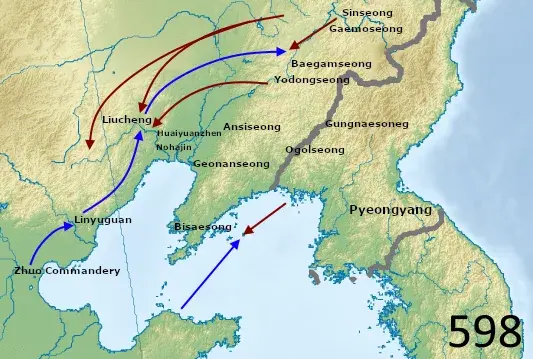
Emperor Wen dispatches Prince Yang Liang with 300,000 troops; the campaign aborts amid disease and typhoons.
Sui Dynasty (隋朝) · HISTORICAL EVENT
三征高句丽
The Three Campaigns Against Goguryeo (Sanzheng Gaojuli, 三征高句丽) were three successive, large-scale strategic invasions launched by Emperor Yang of the Sui dynasty between 612 and 614 (the eighth through tenth years of the Daye reign). Following the reunification of northern and southern China, Goguryeo had expanded across Liaodong and northern Korea, developing into a formidable regional power that harassed western Liaodong borders and conducted covert…
The Three Campaigns Against Goguryeo (Sanzheng Gaojuli, 三征高句丽) were three successive, large-scale strategic invasions launched by Emperor Yang of the Sui dynasty between 612 and 614 (the eighth through tenth years of the Daye reign). Following the reunification of northern and southern China, Goguryeo had expanded across Liaodong and northern Korea, developing into a formidable regional power that harassed western Liaodong borders and conducted covert diplomacy with the nomadic Turks. Driven to reassert Chinese imperial control over ancient Han and Jin commanderies, Emperor Yang resolved to crush Goguryeo with total national mobilization. In 612, Emperor Yang mobilized over 1.13 million combat troops for the initial invasion, but became bogged down before the fortified bastion of Liaodong Fortress. A detached army of 305,000 troops sent toward Pyongyang was ambushed and annihilated by Goguryeo commander Eulji Mundeok at the Salsu River (Chongchon River), with fewer than 3,000 soldiers surviving. A second campaign in 613 was aborted when Minister of Rites Yang Xuangan rebelled at Liyang. In 614, amid sweeping domestic peasant uprisings, Emperor Yang mounted a third expedition; exhausted by years of total war, King Yeongyang sent envoys offering nominal submission and extradited the renegade officer Husi Zheng, permitting an imperial withdrawal. The catastrophic loss of life and resources shattered the Sui state, triggering general rebellions that destroyed the dynasty four years later.
Emperor Wen dispatches Prince Yang Liang with 300,000 troops; the campaign aborts amid disease and typhoons.
Emperor Yang encounters Goguryeo envoys in the Turkic qaghan's camp, demanding royal attendance at court.
Emperor Yang issues the decree for invasion, amassing over a million soldiers at Zhuojun; Wang Bo rebels in Shandong.
After failing to take Liaodong Fortress, 305,000 troops advance on Pyongyang and are wiped out at Salsu by Eulji Mundeok.
Second invasion forces invest Liaodong Fortress; Yang Xuangan rebels at Liyang, forcing a hasty imperial retreat.
Amid widespread civil rebellion, Lai Hu'er captures Bisa; King Yeongyang offers nominal submission and extradites Husi Zheng.
Exhausted by the northeastern wars, the empire fractures into general rebellion; Emperor Yang is assassinated at Jiangdu.
The regions of Liaodong and the Taedong River basin had been incorporated under direct Chinese imperial administration since Emperor Wu of Han established the Four Commanderies of Han (Lelang, Xuantu, Lintun, and Zhenfan). During the prolonged divisions of the Six Dynasties period, Goguryeo expanded southward and westward, seizing Liaodong and relocating its capital to Pyongyang. Following imperial reunification, palace attendant Pei Ju presented a memorial asserting: "Goguryeo territory was originally the ancient realm of Guzhu, enfeoffed to Jizi by the Zhou and divided into commanderies under the Han. Jin likewise ruled Liaodong. Now they refuse vassalage; the late emperor long desired their chastisement." This historical worldview underpinned the court's geopolitical commitment to reconquering Liaodong.
In 598, King Yeongyang had raided western Liaodong, provoking Emperor Wen of Sui to dispatch a 300,000-man amphibious army that aborted due to pestilence and maritime storms. Emperor Yang's suspicion intensified in 607 when he personally discovered Goguryeo emissaries inside the royal yurts of the Eastern Turkic ruler, Qimin Qaghan. Alarmed by the prospect of a coordinated geopolitical encirclement by Turks and Goguryeo, Emperor Yang demanded that King Yeongyang present himself in person. Relying on their mountainous topography and impregnable stone fortifications, Goguryeo refused, infuriating the emperor.
To sustain continental military operations in the northeast, Emperor Yang mobilized millions of conscripted laborers to construct the Grand Canal network, linking Luoyang with Zhuojun (Beijing) via the Yongji Canal and Hangzhou via the Tongji Canal. In early 611, the emperor decreed total mobilization, designating Zhuojun as the army assembly headquarters and commissioning 3,000 naval warships at Donglai. Millions of agrarian laborers were stripped from their fields to haul supplies, devastating agrarian production across Shandong and Hebei and inciting popular insurrections led by figures such as Wang Bo.
In 589, the Sui dynasty conquered the Chen dynasty, ending three centuries of division. Alarmed by this reunification, King Pyeongwon of Goguryeo immediately prepared defenses. In 598, his successor King Yeongyang raided Liaoxi with 10,000 Mohe cavalry. Emperor Wen retaliated by dispatching Prince Yang Liang with 300,000 troops. However, torrential rains brought pestilence to the land army, while a typhoon wrecked the naval fleet under Zhou Luohou in the Bohai Sea. Facing heavy logistical losses before engaging the enemy, Emperor Wen accepted King Yeongyang's nominal submission and withdrew, though tensions over Liaodong remained unresolved.
In 607, Emperor Yang inspected the northern frontier, visiting Eastern Turkic ruler Qimin Qaghan at Yulin. Inside the qaghan's yurt, the emperor discovered secret Goguryeo envoys negotiating an alliance with the Turks. Alarmed by this encirclement, Emperor Yang warned the envoys that their king must attend the imperial court. Palace attendant Pei Ju seized this opportunity to submit a memorial arguing that Liaodong was ancient Chinese territory dating back to the Han commanderies, urging the emperor to reassert control. King Yeongyang's subsequent refusal to attend court hardened Emperor Yang's resolve for war.
In the second month of 611, Emperor Yang decreed the conquest of Goguryeo, making Zhuojun (Beijing) the main staging ground and ordering 3,000 warships built at Donglai. Millions of troops and civilian laborers were mobilized nationwide to transport grain and forge armor. Transportation lines were littered with casualties, devastating northern agriculture.
In the first month of 612, the expeditionary army deployed from Zhuojun. According to the Book of Sui, the regular combat force numbered 1,133,800 men, divided into twenty-four armies across the Left and Right Wings. Columns departed forty li apart over forty consecutive days, with standards stretching 960 li. With civilian laborers, total mobilization reached over three million people, marking one of the largest troop movements in pre-modern history.
Draconian conscription pushed the populace to revolt. Artisans building warships at Donglai spent days waist-deep in freezing water, suffering high mortality. Peasant draft laborers faced execution for falling behind schedule. In autumn 611, Wang Bo led an uprising at Mount Changbai in Shandong, styling himself the 'Wise Man' and composing the Song of Not Dying Meaninglessly in Liaodong, calling upon commoners to resist the war. His insurrection ignited widespread peasant rebellions across northern China, including the forces of Dou Jiande and Gao Jipo.
In the third month of 612, Sui forces reached the western bank of the Liao River, where Goguryeo held fortified positions on the eastern bank. Minister of Works Yuwen Kai constructed three pontoon bridges, but miscalculations left them one zhang short of the opposite shore. General Mai Tiezhang leaped into the icy waters with an assault party, engaging in fierce hand-to-hand combat until he was overwhelmed and killed.
Two days later, General Yuwen Shu completed the bridge, allowing cavalry and infantry formations to cross and storm the ramparts, killing over 10,000 defenders. Goguryeo forces abandoned their river line and retreated into Liaodong Fortress (Liaoyang) for a prolonged siege.
Liaodong Fortress was an imposing mountain citadel surrounded by deep moats and stocked with years of supplies. Sui forces deployed towering siege towers, battering rams, and scaling ladders, while digging tunnels beneath the walls.
However, siege operations were paralyzed by Emperor Yang's command that field officers must obtain imperial approval before making tactical decisions. Whenever a breach was imminent, defenders offered fake surrenders, using the days required for couriers to consult imperial headquarters to repair their walls and resume resistance. After three months of futile assaults and heavy casualties, the siege remained deadlocked.
To break the deadlock, Emperor Yang detached nine armies comprising 305,000 troops under Yuwen Shu and Yu Zhongwen to bypass Liaodong Fortress and strike directly at Pyongyang. However, troops were forced to carry three shi (nearly one hundred pounds) of rations, armor, and gear. Suffering under the load, soldiers secretly buried or dumped their grain. By the time they crossed the Yalu River, rations were largely exhausted, turning the advance into a desperate gamble.
Concurrently, General Lai Hu'er sailed thousands of warships from Donglai up the Taedong River, anchoring sixty li outside Pyongyang. Goguryeo prince Go Geon-mu set an ambush near a temple outside the city, using a small detachment to feign retreat. Overconfident, Lai led 40,000 marines into the outer city without waiting for the land armies. Once Sui soldiers dispersed to loot, hidden defenders sprang the trap, inflicting catastrophic casualties. Lai retreated to his ships with only a fraction of his men, neutralizing the naval wing of the campaign.
On the northern front, Goguryeo supreme commander Eulji Mundeok adopted Fabian tactics, feigning retreats to draw the starving Sui columns deeper into mountainous terrain. He personally visited the Sui camp under the guise of negotiating surrender to assess enemy supplies. General Yu Zhongwen considered capturing him, but hesitated, allowing Eulji Mundeok to return safely.
During the subsequent pursuit, Goguryeo forces fought seven skirmishes and retreated each time. Overconfident Sui commanders pursued them across the Salsu River, advancing to Mount Mayi, thirty li north of Pyongyang.
Reaching Pyongyang's outskirts, Yuwen Shu discovered formidable ramparts and realized his army was out of food, with Lai Hu'er's navy unable to assist. Eulji Mundeok delivered a taunting poem praising Yuwen Shu's cosmic strategy while sarcastically advising him to withdraw before his luck ran out.
Using Eulji Mundeok's token offer of peace as a pretext, Yuwen Shu ordered an immediate retreat toward the Salsu River. Starving and exhausted, the retreating columns struggled to maintain cohesion under relentless Goguryeo cavalry harassment.
On the twenty-fourth day of the seventh month of 612, Sui forces began crossing the Salsu River (Chongchon River). When the column was stretched across the riverbed, Eulji Mundeok broke upstream earthen dams, unleashing torrents of water that swept away countless troops. Goguryeo shock cavalry then attacked the disorganized ranks from both flanks.
Rearguard general Xin Shixiong was killed, and the entire army disintegrated. Soldiers trampled each other in panicked flight, with commanders fleeing 450 li back to the Yalu River in a single day and night. Of the 305,000 troops who marched out, only 2,700 returned to Liaodong Fortress. Emperor Yang was forced to execute failed officers and withdraw his armies.
Humiliated by the Salsu disaster, Emperor Yang launched a second invasion in the spring of 613, gathering fresh armies at Zhuojun. In the fourth month, the emperor personally supervised the siege of Liaodong Fortress. Sui engineers built higher siege mounds and assault towers, pounding the ramparts around the clock for over twenty days. The city's defenses were on the verge of collapse when crisis struck the empire's interior.
In the sixth month of 613, Minister of Rites Yang Xuangan, responsible for grain logistics at Liyang, revolted against the dynasty. Denouncing Emperor Yang's megalomania, he distributed grain to the hungry and gathered over 100,000 insurgents, advancing on Luoyang. Prominent nobles such as Li Mi joined the rebellion, threatening the dynasty's political core.
Realizing that the loss of Luoyang or the Grand Canal would trap his armies in Liaodong, Emperor Yang ordered a secret night evacuation on the twenty-eighth day of the sixth month. Immense stockpiles of grain, siege engines, and tents were abandoned. Once defenders realized the camp was empty, Goguryeo cavalry pursued the retreat, killing thousands of rearguard troops before the emperor crossed the border.
Although Yang Xuangan's revolt was crushed, rebellions proliferated across China under figures like Dou Jiande and the Wagang Army. Obsessed with conquest, Emperor Yang ordered a third expedition in early 614.
Sui society broke down entirely. Conscripts mutilated their hands and feet—calling them 'auspicious limbs'—to escape mobilization. Hundreds of soldiers deserted daily at Zhuojun, with entire units vanishing into the hills. Disregarding the breakdown of order, Emperor Yang forced his demoralized army forward to Huaiyuan.
In the seventh month of 614, General Lai Hu'er sailed across the Bohai Sea and assaulted Bisa Fortress on the Liaodong Peninsula. Officer Bai Shizheng led assault teams up vertical cliffs, capturing the citadel and taking thousands of prisoners.
However, Goguryeo was also economically exhausted after three years of total mobilization, suffering widespread famine. Recognizing that continued resistance against an empire risked national extinction, King Yeongyang chose to negotiate.
In the eighth month of 614, King Yeongyang sent envoys offering formal submission and extradited Husi Zheng, the renegade Sui vice minister of the Ministry of War. Facing widespread unrest at home and mutinous troops, Emperor Yang seized upon this diplomatic overture to end the war.
Accepting the submission, Emperor Yang had Husi Zheng executed and ordered a general withdrawal. Although Lai Hu'er urged continued operations, the third expedition concluded with a superficial settlement.
Upon returning to Luoyang, Emperor Yang summoned King Yeongyang to attend court. Once Sui forces departed, Goguryeo ignored all imperial summons and refused to repatriate hundreds of thousands of captured Sui subjects. The emperor contemplated a fourth campaign, but central authority had collapsed.
In 616, Emperor Yang fled south to Jiangdu. In the third month of 618, imperial guards led by Yuwen Huaji strangled the emperor, ending the thirty-eight-year reign of the Sui dynasty. The catastrophic failure of the Goguryeo campaigns served as a critical lesson in statecraft for Emperor Taizong of Tang.
Over three years of relentless warfare, the Sui dynasty mobilized more than three million soldiers and civilian laborers, expending vast imperial reserves without conquering Liaodong Fortress or capturing Pyongyang. Over 300,000 elite soldiers perished in the first campaign alone, and hundreds of thousands more died of disease, starvation, and exposure in subsequent expeditions, representing one of the deadliest military failures in pre-modern history.
The unsustainable exactions required by the campaigns shattered northern agrarian society, sparking sweeping peasant insurgencies across the empire. Disillusioned with imperial governance, prominent aristocratic lineages broke with the throne, leading directly to the disintegration of central authority. In 618, Emperor Yang was murdered by his own guards in Jiangdu, terminating the Sui dynasty after only thirty-eight years of rule and leaving an enduring cautionary tale for the emerging Tang dynasty.