Fall of the Fortresses
British forces occupy Sifang Fortress; Qing general Yishan signs the Agreement of Guangzhou.
Qing Dynasty (清朝) · HISTORICAL EVENT
三元里抗英
The Sanyuanli Anti-British Incident (三元里抗英) was a historic popular armed uprising taking place in May 1841 during the First Opium War in the northern suburbs of Guangzhou, Guangdong Province. Following the collapse of imperial coastal defenses, Qing Commander-in-Chief Yishan signed the humiliating Agreement of Guangzhou, agreeing to pay six million silver dollars in ransom fees in exchange for British withdrawal. However, British landing parties stationed…
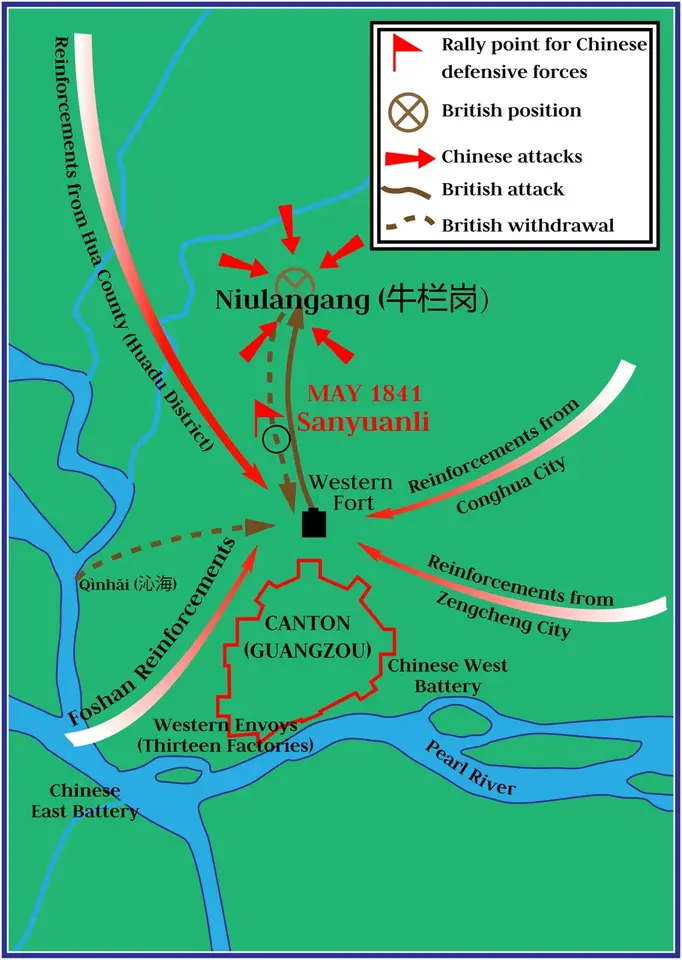
The Sanyuanli Anti-British Incident (三元里抗英) was a historic popular armed uprising taking place in May 1841 during the First Opium War in the northern suburbs of Guangzhou, Guangdong Province. Following the collapse of imperial coastal defenses, Qing Commander-in-Chief Yishan signed the humiliating Agreement of Guangzhou, agreeing to pay six million silver dollars in ransom fees in exchange for British withdrawal. However, British landing parties stationed at Sifang Fortress violated the truce, raiding northern suburban hamlets, plundering grain, desecrating graves, and assaulting local women. Outraged by these indignities, local vegetable farmer Wei Shaoguang rallied village elders at the Sanyuan Ancient Temple, mobilizing tens of thousands of rural producers from one hundred and three neighboring villages. On May 30, villagers lured the British expeditionary force into a tactical trap at Niuling Ridge. When torrential rain disabled British flintlock muskets, thousands of peasant fighters armed with spears and hoes encircled the invaders. Threatened with total encirclement at Sifang Fortress, British commander Major General Sir Hugh Gough was forced to withdraw under the mediation of Guangzhou prefect Yu Baochun.
British forces occupy Sifang Fortress; Qing general Yishan signs the Agreement of Guangzhou.
British raiding parties attack Sanyuanli; villagers swear blood oaths beneath the dragon banner.
Villagers trap the British expedition at Niuling; monsoon rains disable enemy flintlocks, forcing a British retreat.
Thousands encircle Sifang Fortress until Qing officials intervene, allowing British troops to withdraw aboard fleet ships.
In June 1840, the British Empire launched the First Opium War to protect its lucrative narcotics trade, dispatching an expeditionary naval fleet to blockade the Pearl River estuary. Following coastal engagements, the British concentrated military operations against the trade hub of Guangzhou in the spring of 1841.
In May, Major General Sir Hugh Gough and Commodore Sir Gordon Bremer navigated the Pearl River channel, assaulting coastal fortifications and seizing Sifang Fortress on Yongkang Hill overlooking Guangzhou. Located barely half a mile north of the city battlements, British heavy naval artillery commanded the entire metropolis, placing municipal yamens directly under enemy fire.
Appointed by Emperor Daoguang to direct the war effort, Imperial Commissioner Yishan and senior commanders succumbed to cowardice. Panicked by naval artillery, they rejected all appeals for protracted urban defense and sought immediate capitulation.
On May 27, Yishan dispatched Guangzhou Prefect Yu Baochun to the British camp to finalize the Agreement of Guangzhou. The Qing government agreed to pay a staggering six million silver dollars in city ransom and withdrew imperial auxiliary troops sixty miles from the provincial capital in exchange for British promises to evacuate city heights. However, British forces delayed their evacuation, maintaining garrisons atop Sifang Fortress.
Troop discipline among British and Indian sepoy detachments rapidly disintegrated. Beginning on May 28, raiding bands fanned out into surrounding rural villages, including Sanyuanli, Xiaogang, and Xicun, ransacking homes, plundering livestock, and looting ancestral graves.
When raiding parties assaulted and violated local village women, centuries of communal fury boiled over. Village clans organized clandestine emergency meetings, swearing solemn covenants to defend their ancestral soil to the death.
On the morning of May 29, 1841, a British detachment raided Sanyuanli, attempting to assault the wife of villager Wei Shaoguang. Rushing to her defense with an agricultural hoe, Wei struck down two soldiers as neighboring villagers gathered with clubs and spades, driving the intruders out of the village.
Recognizing that British commanders would dispatch heavy retaliatory forces, Wei convened village patriarchs He Yucheng and Deng Kelin at the local Sanyuan Ancient Temple. Kneeling before the sacred altars, the villagers swore blood oaths, appointing Wei and He as operational leaders and unfurling the ancient black Three-Star Flying Dragon Banner from the temple to serve as their unified combat standard.
Village messengers rode throughout the day to Nanhai, Panyu, and neighboring counties, sounding communal bronze gongs in clan ancestral halls. A massive rural network mobilized within twenty-four hours, assembling over twenty thousand peasants, quarry stonecutters, boatmen, and blacksmiths armed with fowling pieces, matchlocks, forged spears, long billhooks, and agricultural pitchforks.
On the morning of May 30, Major General Hugh Gough led a punitive expedition of several hundred British soldiers armed with state-of-the-art flintlock muskets and field artillery toward Sanyuanli. Wei Shaoguang deployed small detachments to engage and feign tactical retreat, luring the overconfident British column deep into the rugged ravines of Niuling Ridge.
As the British entered the sunken ravine at Niuling, war gongs erupted across the ridges and dragon banners were hoisted into the wind. Thousands of hidden villagers emerged from surrounding brush and ditches, charging down the embankments with spears and pitchforks to encircle the British force in muddy paddy fields.
At that crucial moment, a sudden subtropical squall drenched the valley. Pouring monsoon rain soaked the powder pans of the British flintlocks, rendering their firearms completely useless, while artillery carts bogged down in knee-deep mud. Denied their ranged firepower superiority, the British were reduced to bayonets.
Leaping into the mud, the villagers utilized eight-foot spears and bamboo billhooks to strike from beyond bayonet reach. Major Thomas Beech of the 37th Regiment was slain, and British soldiers suffered heavy casualties as their formations fractured. Sir Hugh Gough narrowly evaded capture, retreating in panic toward a small hilltop shrine under desperate rearguard protection.
Rallying survivors, Gough fled back to Sifang Fortress and barred the iron gates. By dawn on May 31, over twenty thousand armed villagers had encircled the fortress, waving banners and beating war drums in preparation for an all-out assault.
Desperate and facing annihilation, Gough transmitted an ultimatum to Yishan within Guangzhou, threatening to resume naval bombardments against the metropolis unless imperial officials dispersed the siege.
Terrified of renewed conflict, Yishan denounced the patriotic peasants as rebellious rioters and ordered Prefect Yu Baochun to the front lines. Yu climbed onto an elevated platform, threatening the clan elders with execution for treason while pleading for the preservation of imperial peace. Bitterly denouncing official cowardice, the villagers reluctantly dispersed. Under the cover of municipal protection, Gough evacuated Sifang Fortress and withdrew his battered forces aboard transport vessels.
The Sanyuanli Anti-British Incident was the first significant instance in modern Chinese history where ordinary peasants and laborers spontaneously organized, strategized, and achieved decisive battlefield victory against Western imperialist invaders. Operating without state assistance and betrayed by imperial magistrates, the people demonstrated that foreign military superiority could be broken by unified popular resistance.
The triumph of Sanyuanli ignited regional resistance movements throughout southern China, leading to the establishment of widespread self-defense militias and inspiring decades of anti-colonial struggle. It cemented the indomitable spirit of popular sovereignty, serving as an enduring symbol of Chinese patriotic awakening.
The Guangdong Gazette preserved the Ballad of Sanyuanli: "At the strike of the gong, smoke rises from the peaks; the foreign invaders flee in panic as the dragon banners unfurl. Within seven paces, our spears strike home; ten thousand brothers stand united to defend our native soil!"
Historian Mao Haijian observed in The Collapse of the Heavenly Dynasty: "The Sanyuanli Anti-British Incident was the opening climax of spontaneous popular resistance against Western colonial aggression, demonstrating to the world that the Chinese people would never submit to foreign domination."