Cao Wei Founded
Cao Pi accepts the abdication of Emperor Xian of Han, ascending the throne as founding emperor of Cao Wei and ending the Eastern Han.
Three Kingdoms Period · HISTORICAL EVENT
三国时期
The Three Kingdoms Period (Sanguo Shiqi, 三国时期, 220–280) is an era of division and integration in Chinese history between the Eastern Han and Western Jin dynasties, defined by the tripartite confrontation among Cao Wei, Shu Han, and Eastern Wu. In the twilight of the Eastern Han, the Yellow Turban Rebellion ignited sweeping warlord conflict. Through the pivotal Battles of Guandu and Red Cliffs, the three rival coalitions led by Cao Cao, Liu Bei, and Sun…
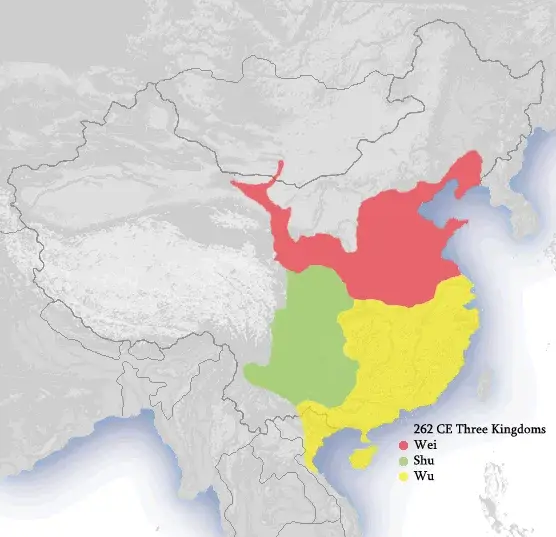
The Three Kingdoms Period (Sanguo Shiqi, 三国时期, 220–280) is an era of division and integration in Chinese history between the Eastern Han and Western Jin dynasties, defined by the tripartite confrontation among Cao Wei, Shu Han, and Eastern Wu. In the twilight of the Eastern Han, the Yellow Turban Rebellion ignited sweeping warlord conflict. Through the pivotal Battles of Guandu and Red Cliffs, the three rival coalitions led by Cao Cao, Liu Bei, and Sun Quan established the tripartite division of the realm. In 220, Cao Pi usurped the Han throne to establish Cao Wei; the following year, Liu Bei assumed the imperial title in Chengdu to perpetuate the Han lineage; and in 229, Sun Quan proclaimed himself emperor of Wu, formalizing the tripartite equilibrium. Spanning six decades, the Three Kingdoms era witnessed relentless military campaigns, institutional evolution, and regional economic transformation. In Shu Han, Zhuge Liang pacified the southern frontier and led the Northern Expeditions; Eastern Wu navigated the southern seas, dispatched naval expeditions to Yizhou (Taiwan), and developed the Yangtze Delta; while Cao Wei institutionalized military agricultural colonies (tuntian) and the Nine-Rank System. In 263, Cao Wei conquered Shu Han; in 265, Sima Yan replaced Wei to establish the Western Jin; and in 280, Western Jin annexed Eastern Wu, reunifying the Chinese empire.
Cao Pi accepts the abdication of Emperor Xian of Han, ascending the throne as founding emperor of Cao Wei and ending the Eastern Han.
Liu Bei assumes the imperial title in Chengdu to perpetuate the Han lineage, confirming the formal division of China.
Eastern Wu commander Lu Xun uses fire tactics to shatter Liu Bei's main army, forcing Liu Bei to withdraw to Baidi City.
Liu Bei dies at Yong'an Palace; Zhuge Liang assumes regency over Liu Shan and dispatches Deng Zhi to restore the Wu-Shu alliance.
Zhuge Liang leads the southern expedition, capturing and releasing Meng Huo seven times to secure the southwestern border.
Zhuge Liang advances to Mount Qi; Ma Su loses Jieting, forcing a tactical retreat and the execution of Ma Su.
Sun Quan declares himself emperor of Wu at Wuchang, later moving the capital to Jianye.
Sun Quan dispatches Wei Wen and Zhuge Zhi with 10,000 naval troops to Yizhou (Taiwan), opening maritime links.
Zhuge Liang confronts Sima Yi across the Wei River and dies of illness in camp; Shu forces retreat in good order.
Sima Yi launches a coup in Luoyang, executing Cao Shuang and seizing paramount control over the Cao Wei court.
Deng Ai navigates the Yinping pass to capture Jiangyou; Liu Shan surrenders in Chengdu, ending Shu Han.
Sima Yan compels Cao Huan to abdicate, ascending the throne in Luoyang as founding emperor of the Western Jin.
Emperor Wu of Jin mobilizes 200,000 troops across six routes to launch the final invasion of Eastern Wu.
Wang Jun's naval fleet reaches Jianye; Sun Hao surrenders, concluding the Three Kingdoms era and reunifying China.
During the mid-to-late Eastern Han, young emperors ascended the throne in rapid succession, resulting in cyclical power struggles between imperial consort clans and court eunuchs. Under Emperors Huan and Ling, eunuchs monopolized palace authority and initiated the Disasters of Partisan Prohibitions, ruthlessly purging Imperial Academy scholars and scholar-officials. Severe land concentration left countless peasants dispossessed, exacerbating agrarian tensions to the brink of systemic rebellion.
In 184, Zhang Jue founded the Way of Supreme Peace (Taiping Dao) and mobilized millions of impoverished peasants across eight provinces in the Yellow Turban Rebellion. Although imperial commanders Lu Zhi, Huangfu Song, and Zhu Jun crushed the main rebel forces within months, the prestige and administrative machinery of the Han court were shattered. To suppress persistent local uprisings, the court instituted regional governors (zhoumu), decentralizing military and fiscal powers to local magnates and warlords.
The violent usurpation of power by Dong Zhuo provoked the Guandong coalition of warlords, sparking a protracted civil war across the Central Plains. Cao Cao secured Emperor Xian in Xu City, established agricultural colonies, and defeated Yuan Shao at the Battle of Guandu to unify northern China. Meanwhile, the Sun family consolidated their base in Jiangdong, and Liu Bei allied with Zhuge Liang under the Longzhong Plan. In 208, the allied forces of Sun Quan and Liu Bei shattered Cao Cao's grand fleet at the Battle of Red Cliffs, checking northern advance and setting the geopolitical stage for the Three Kingdoms.
In the first month of 184, Zhang Jue launched the Yellow Turban Rebellion, declaring that the Azure Heaven was dead and the Yellow Heaven would rise. Rebel armies swept across northern and central China, laying waste to local commanderies. Although the central government managed to crush the core insurgent formations, remnants of the rebels continued guerrilla operations for decades, permanently fracturing the court's administrative hold over rural commanderies.
In 188, Court Clan Director Liu Yan proposed replacing inspection commissioners with regional governors (zhoumu), granting senior ministers comprehensive authority over civil, military, and revenue administration. Appointed governors, such as Liu Yan in Yi Province and Liu Biao in Jing Province, swiftly amassed private armaments and withheld provincial tax revenues, transforming the unified imperial domain into fractured warlord territories.
Following Emperor Ling's death in 189, palace struggles between General-in-Chief He Jin and the eunuchs erupted into violent street combat. He Jin summoned the frontier general Dong Zhuo to Luoyang, but He was assassinated before Dong arrived. In the ensuing mayhem, Yuan Shao and Cao Cao massacred the eunuchs, allowing Dong Zhuo's frontier cavalry to seize control of the imperial capital.
Dong Zhuo deposed Emperor Shao and installed the child Emperor Xian, exercising autocratic tyranny over the court. In response, regional warlords formed the Guandong Coalition under Yuan Shao in 190. Fearing the allied advance, Dong Zhuo burned Luoyang to ashes, looted imperial tombs, and forcibly relocated millions of inhabitants to Chang'an. Soon, internal factionalism dissolved the anti-Dong coalition, initiating widespread warlord warfare across China.
Emerging as an agile commander in Yan Province, Cao Cao defeated the Qingzhou Yellow Turbans in 192, enlisting 300,000 surrendered fighters into his elite "Qingzhou Troops." In 196, following Emperor Xian's flight back to ruined Luoyang, Cao Cao welcomed the emperor and moved the capital to Xu City, securing unmatched political legitimacy under the maxim of "upholding the Son of Heaven to command insubordinate vassals."
Leveraging imperial authority and recruiting capable advisors, Cao Cao implemented state-sponsored agricultural colonies (tuntian), harvesting millions of bushels of grain to sustain extended military campaigns. Over the following decade, Cao Cao campaigned relentlessly, eliminating Lü Bu in Xu Province, securing the submission of Zhang Xiu, driving Yuan Shu to ruin, and consolidating his mastery over the Central Plains.
In 199, Yuan Shao eliminated Gongsun Zan, consolidating control over four northern provinces with an army exceeding 100,000 men. In 200, Yuan launched a massive invasion southward to capture Xu City. Cao Cao deployed a defensive force of approximately 20,000 troops at Guandu, setting the stage for one of the most famous underdog victories in Chinese military history.
After eliminating Yuan's vanguard commanders Yan Liang and Wen Chou, Cao Cao fell back into fortified earthworks. As supplies ran perilously low, Yuan's strategist Xu You defected and disclosed the location of Yuan's main grain depot at Wuchao. Cao Cao personally led a night assault that set Wuchao ablaze, inducing panic and total collapse across Yuan's army. Following this triumph, Cao Cao spent seven years eliminating Yuan's heirs, culminating in the Battle of White Wolf Mountain in 207 against the Wuhuan, thereby unifying northern China.
Following northern pacification, Cao Cao marched southward with over 200,000 troops in 208 to seize Jing Province. Liu Biao's successor Liu Cong surrendered without resistance, forcing Liu Bei to withdraw southward. After narrow escapes at Changban, Liu Bei joined Liu Biao's eldest son Liu Qi at Xiakou and dispatched Zhuge Liang to negotiate a military alliance with Sun Quan in Jiangdong.
Persuaded by Zhou Yu and Lu Su, Sun Quan committed 30,000 elite marines to join Liu Bei's forces against Cao Cao at Red Cliffs on the Yangtze. Plagued by illness and unaccustomed to naval warfare, Cao chained his vessels together. Zhou Yu's subordinate Huang Gai staged a feigned surrender with fire-ships, setting Cao Cao's fleet ablaze and sparking widespread chaos. Cao retreated through the Huarong path, leaving Sun Quan dominant along the lower Yangtze and enabling Liu Bei to seize southern Jing Province.
To fulfill the Longzhong Plan, Liu Bei required an expansive territorial base. In 211, Yi Province Governor Liu Zhang, alarmed by threats from Zhang Lu in Hanzhong and Cao Cao's northern maneuvers, invited Liu Bei into Sichuan to assist in frontier defense. Liu Bei arrived with tens of thousands of seasoned veterans, establishing headquarters at Jiameng Pass.
By late 212, relations fractured into open war. Liu Bei marched south, capturing Baishui and Fucheng, though strategist Pang Tong fell during the prolonged siege of Luocheng. Liu Bei summoned Zhuge Liang, Zhang Fei, and Zhao Yun with reinforcements from Jing Province, securing Baidi, Jiangzhou, and Qianwei before converging on Chengdu. In 214, after Ma Chao joined Liu Bei's coalition, Liu Zhang surrendered Chengdu to spare the civilian population, granting Liu Bei complete control over the fertile Sichuan Basin.
Controlling the northern gateway to Sichuan, the Hanzhong Basin was vital for Shu's security. In 215, Cao Cao conquered Hanzhong from Zhang Lu, stationing Xiahou Yuan and Zhang He to guard the frontier. Recognizing the existential threat, Liu Bei launched the two-year Battle of Hanzhong in 217.
In early 219, Liu Bei staged a night diversion at Dingjun Mountain, enabling veteran general Huang Zhong to launch a surprise downhill charge that killed Xiahou Yuan. When Cao Cao arrived with reinforcements, Liu Bei held mountainous fortifications and dispatched Zhao Yun to disrupt Cao's grain supply. Frustrated by mounting logistical attrition, Cao Cao withdrew his armies. In the seventh month of 219, Liu Bei proclaimed himself King of Hanzhong, marking the apex of Shu Han's geopolitical reach.
In autumn 219, Guan Yu advanced from Jiangling to besiege Cao Ren at Fancheng. Cao Cao sent Yu Jin and Pang De with seven armies to relieve the siege. Heavy autumnal downpours caused the Han River to overflow, allowing Guan Yu's naval flotilla to surround and capture Yu Jin along with 30,000 troops, while Pang De was executed after refusing surrender.
Guan Yu's triumph alarmed both Cao Cao and Sun Quan. Fearing Guan Yu's ascendancy, Sun Quan covertly allied with Cao Cao. In late 219, Sun's general Lü Meng executed the "White Clothing Crossing," disguising warships as merchant vessels to seize Jiangling and Gong'an. Besieged by Xu Huang at Fancheng and deprived of his supply base, Guan Yu's army disintegrated. Trapped at Maicheng, Guan Yu was ambushed and executed near Linju, dealing an irreparable strategic blow to Shu Han.
In the first month of 220, Cao Cao died in Luoyang, and his son Cao Pi inherited the titles of King of Wei and Imperial Chancellor. To secure aristocratic backing during the dynastic transition, Cao Pi enacted the Nine-Rank System devised by Chen Qun, vesting leading Central Plains clans with the authority to evaluate and nominate civil officials.
In the tenth month of 220, Cao Pi accepted the abdication of Emperor Xian at Fanyang, ascending the throne as the founding emperor of Cao Wei and designating Luoyang as the imperial capital. This act formally concluded four centuries of Han rule. Governing the fertile Central Plains and retaining the bulk of China's population, Cao Wei instituted strict edicts barring palace eunuchs and imperial in-laws from political affairs, while expanding agricultural colonies and hydraulic infrastructure.
News of Cao Pi's usurpation prompted outrage in Sichuan. To uphold dynastic legitimacy and counter Wei's claims, civil and military leaders urged Liu Bei to assume the imperial mantle. In the fourth month of 221, Liu Bei ascended the throne in Chengdu, naming his state "Han" (historically known as Shu Han) and appointing Zhuge Liang as Chancellor.
Establishing ancestral shrines to the Han emperors, Liu Bei pledged to annihilate the usurping Cao clan and restore the Han dynasty. Though territorially confined to Sichuan and Hanzhong, Shu Han leveraged formidable mountain passes and fertile agricultural basins to establish an enduring southwestern regional state, cementing the ideological and military confrontation between north and south.
Driven to reclaim Jing Province and avenge Guan Yu, Liu Bei launched a massive invasion of Eastern Wu in 221, brushing aside diplomatic warnings from Zhao Yun and Zhuge Liang. Shu forces secured early victories at Wushan and Zigui, setting up a continuous string of encampments extending hundreds of li through heavily forested terrain along the Yangtze.
Sun Quan appointed Lu Xun as Supreme Commander to oversee defense with 50,000 troops. Lu Xun retreated into fortified positions at Yiling, exhausting Shu forces through months of summer heat. In the sixth month of 222, Lu Xun launched a coordinated fire attack against Shu's wooden fortifications, routing Liu Bei's army and forcing the emperor to retreat to Baidi City. Following Liu Bei's death in 223, Zhuge Liang dispatched Deng Zhi to negotiate peace with Sun Quan, restoring the anti-Wei alliance.
In autumn 222, irritated by Sun Quan's refusal to send his heir Sun Deng as a hostage to Luoyang, Cao Pi launched a three-pronged invasion against Eastern Wu. Cao Zhen, Xiahou Shang, and Zhang He besieged Jiangling, while Cao Xiu attacked Dongkou and Cao Ren assaulted Ruxu. Wu general Zhu Ran held Jiangling with 5,000 troops for six months, repelling repeated assaults despite severe disease and dwindling supplies.
At Dongkou and Ruxu, Wu commanders Lü Fan and Zhu Huan utilized naval superiority to sink hundreds of Wei vessels. Faced with mounting logistical strain, Wei forces withdrew. In 224 and 225, Cao Pi personally led 100,000 troops to Guangling on the northern bank of the Yangtze. Gazing upon the turbulent waters and Wu's expansive naval lines, Cao Pi lamented that heaven had divided north and south, ordering a complete withdrawal and affirming the impregnability of the southern front.
Ascending the throne amid internal fragility, Emperor Liu Shan faced rebellions across Nanzhong led by local chieftains Yong Kai, Gao Ding, and Meng Huo. Zhuge Liang spent two years consolidating internal revenue and armaments before personally heading south in 225. Adopting Ma Su's advice to win hearts rather than merely capture territory, Zhuge Liang conducted his famed campaign of capturing and releasing Meng Huo seven times.
Following Meng Huo's sincere submission, Zhuge Liang refrained from stationing permanent northern garrisons, instead appointing indigenous leaders to administrative posts. He recruited elite southern warriors into the "Infallible Flying Army" (Wudang Feijun) and mobilized local iron, copper, and salt resources, transforming the pacified southwest into a vital strategic supply base for his upcoming Northern Expeditions.
In 227, Zhuge Liang stationed the Shu army at Hanzhong and submitted the Memorial on Deploying the Army (Chushi Biao). In spring 228, he dispatched Zhao Yun and Deng Zhi as decoys through Ji Gorge, while leading the main army through Mount Qi. Three Wei commanderies—Tianshui, Nan'an, and Anding—defected to Shu, and talented Wei officer Jiang Wei surrendered to Zhuge Liang.
However, at the strategic bottleneck of Jieting, Shu vanguard commander Ma Su disregarded tactical instructions, forsaking water sources to camp on isolated hilltops. Wei general Zhang He severed Ma's water access and shattered the Shu vanguard. Deprived of logistical security, Zhuge Liang withdrew his army to Hanzhong, demoted himself by three ranks, and tearfully executed Ma Su to uphold military discipline. Later that winter, Zhuge besieged Chencang for twenty days, but was halted by Hao Zhao's stubborn defense.
In 229, Shu general Chen Shi conquered Wudu and Yinping, restoring Zhuge Liang to the chancellorship. In 231, Zhuge launched his fourth northern campaign, besieging Mount Qi and debuting his logistical invention, the "wooden ox." Wei Emperor Cao Rui deployed Sima Yi to command the defense. Knowing Shu's supply constraints, Sima Yi avoided decisive engagements.
Zhuge Liang harvested wheat at Luchang and lured Wei forces into combat, scoring a tactical victory where Wei lost 3,000 armored troops. However, torrential rains and deceptive supply reports from Li Yan forced an orderly withdrawal. During the retreat through Mumen Trail, veteran Wei general Zhang He pursued aggressively, fell into an ambush, and died from arrow wounds. Back in Hanzhong, Zhuge Liang dismissed Li Yan and developed the improved "flowing horse" transport for intensive agricultural drills.
In the fourth month of 229, Sun Quan formally declared himself emperor of Eastern Wu at Wuchang, adopting the reign title Huanglong. Months later, he relocated the imperial capital to Jianye (modern Nanjing), establishing palace secretariats and reinforcing the southern dynastic framework.
Sun Quan relied on the Yangtze barrier and hereditary gentry retinues for defense, appointing Gu Yong as Chancellor and Lu Xun as Upper General. To counteract Wei's geopolitical encirclement, Sun Quan conducted maritime diplomacy with Gongsun Yuan in Liaodong and maintained fortified positions along the Chaohu and Ruxu waterways to intercept northern advances.
Barred from northern expansion by Wei's Huainan defense lines, Eastern Wu concentrated on domestic colonization and maritime trade. Sun Quan campaigned against indigenous Shanyue tribes in the southern hills, resettling hundreds of thousands of people as agrarian taxpayers and infantry recruits.
In 230, Sun Quan dispatched Generals Wei Wen and Zhuge Zhi with a 10,000-man naval fleet to Yizhou (Taiwan), inaugurating official maritime navigation across the Taiwan Strait. Additionally, Wu envoys Kang Tai and Zhu Ying visited Funan (Cambodia) and other Southeast Asian kingdoms, establishing maritime trade connections that transformed Jianye into a bustling commercial metropolis. In the far south, Wu pacified Jiaozhi and expanded territorial administration across Hainan and the South China Sea.
In spring 234, Zhuge Liang launched his final campaign with 100,000 troops, establishing camp at Wuzhang Plains south of the Wei River. Shu forces instituted agricultural colonies alongside local farmers to prepare for prolonged operations, while coordinating an offensive with Eastern Wu against Hefei. However, Wu's offensive faltered, leaving Wei free to concentrate all forces in Shaanxi.
Sima Yi fortified his positions and refused open combat, ignoring provocative letters and women's garments sent by Zhuge Liang to incite him. Sima correctly deduced that Zhuge was physically exhausted from micromanaging administrative affairs. In the eighth month of 234, Zhuge Liang died of illness in camp at age fifty-four. Under secret instructions, Shu forces executed a disciplined retreat back to Hanzhong, immortalizing Zhuge's selfless dedication to the state.
Confronting persistent two-front pressure, Cao Wei strengthened internal agrarian defenses. During Cao Rui's reign, general Deng Ai authored the Treatise on River Development, orchestrating massive hydraulic projects in Huainan. Deng constructed the Huaiyang and Baichi canals, transforming hundreds of thousands of wasteland acres into productive grain fields that could sustain 100,000 southern garrison troops without external transport.
On the northeastern frontier, Sima Yi led 40,000 troops in 238 to besiege Xiangping, annihilating Gongsun Yuan and recovering the four Liaodong commanderies. In 244–245, You Province Inspector Guanqiu Jian invaded Goguryeo, sacking Wandu Castle and securing northern frontier borders for decades.
Following Sun Quan's death in 252, Wei Regent Sima Shi invaded Eastern Wu with 70,000 troops, attempting to destroy the strategic Dongxing Dam. Wu Regent Zhuge Ke led 40,000 troops to relieve the garrison, while veteran commander Ding Feng launched a daring amphibious charge through heavy snowfall that shattered the Wei vanguard, killing tens of thousands of enemy soldiers in the "Dongxing Victory."
Emboldened by victory, Zhuge Ke mobilized 200,000 troops in 253 to besiege Hefei New City. Wei general Zhang Te defended stubbornly for months under blistering summer heat, while disease devastated the Wu ranks. Zhuge Ke was forced to retreat with immense casualties. Upon returning to Jianye, his autocratic behavior alienated the imperial family, resulting in his assassination by Sun Jun and triggering factional violence within Wu.
In the first month of 249, political tensions within Cao Wei reached a violent climax. While young Emperor Cao Fang and Regent Cao Shuang were visiting the Gaoping Tombs, Grand Tutor Sima Yi staged a coup in Luoyang with 3,000 secretly gathered retainers, seizing control of the imperial capital under the dowager empress's decree.
Sima Yi pledged by the Luo River to spare Cao Shuang's life if he yielded his command. Trusting the vow, Cao Shuang surrendered, but Sima promptly reneged, executing Cao Shuang and his inner circle on treason charges. This purge eliminated the Cao family's military power, transferring imperial control entirely to the Sima lineage.
Following Sima Yi's coup, loyalist commanders stationed in Huainan launched three major uprisings against Sima hegemony. In 251, Grand Commandant Wang Ling conspired to replace Cao Fang with Cao Biao, but Sima Yi suppressed the rebellion, driving Wang to suicide.
In 255, Guanqiu Jian and Wen Qin rebelled against Sima Shi; Sima Shi crushed the uprising despite suffering from a fatal eye disease, passing authority to his brother Sima Zhao. In 257, Zhuge Dan revolted at Shouchun with Eastern Wu support. Sima Zhao invested Shouchun with 260,000 troops for a year, capturing the fortress in 258 and executing Zhuge Dan. The pacification of Shouchun eradicated all internal military resistance to the Sima regime.
During his later years, Sun Quan triggered an internal succession crisis known as the "Two Palaces Rivalry." Following the death of Crown Prince Sun Deng in 241, Sun Quan elevated Sun He as heir while granting equal honors to Prince Sun Ba, splitting the court into hostile camps.
Chancellor Lu Xun and veteran officials defended traditional primogeniture, whereas imperial in-law factions backed Sun Ba. Over a decade of political purges, Sun Quan exiled or executed numerous prominent scholar-officials, driving Lu Xun to death from grief. In 250, Sun Quan deposed Sun He, ordered Sun Ba to commit suicide, and designated his youngest son Sun Liang as heir, permanently undermining the alliance between the crown and southern gentry families.
Following the deaths of Zhuge Liang's successors Jiang Wan and Fei Yi, General-in-Chief Jiang Wei assumed military command in Shu. Driven to fulfill Zhuge Liang's legacy, Jiang conducted nine northern expeditions against Wei between 253 and 262, winning a tactical triumph over Wang Jing at the Battle of Taoxi.
However, continuous mobilization exhausted Shu's limited population of less than one million, bankrupting the treasury. Concurrently, Emperor Liu Shan indulged the corrupt eunuch Huang Hao, who monopolized palace patronage and marginalized competent ministers. To escape political intrigue, Jiang Wei withdrew to Tazhong to oversee military farming, leaving the Hanzhong border vulnerable to external invasion.
In the fifth month of 260, Wei Emperor Cao Mao attempted a desperate coup against Sima Zhao, declaring that "Sima Zhao's intentions are known to every passerby." Sima Zhao's confidant Jia Chong directed Cheng Ji to assassinate the emperor in the streets. Sima Zhao deflected blame by executing Cheng Ji, placing Cao Huan on the throne as a puppet monarch.
To restore political prestige and establish credentials for dynastic usurpation, Sima Zhao decided to conquer the declining state of Shu Han. Disregarding court skepticism, Sima organized an 180,000-man army divided into three columns under Deng Ai, Zhong Hui, and Zhuge Xu to invade Sichuan.
In autumn 263, Wei forces launched their grand invasion. Zhong Hui captured Hanzhong passes, forcing Jiang Wei to retreat to the precipitous terrain of Jianmen Pass, where the Shu army held firm against repeated assaults.
With the northern front stalemated, Deng Ai executed an audacious strategic maneuver. Leading 10,000 elite troops along the Yinping mountain track, his men scaled 700 li of uninhabited cliffs and gorges, with Deng rolling down precipices wrapped in woolen felt. Emerging unexpectedly before Jiangyou, Deng secured the garrison's surrender, defeated Zhuge Zhan at Mianzhu, and marched directly on Chengdu. Panicked by the rapid advance, Liu Shan surrendered, bringing an end to the forty-three-year history of Shu Han.
Following Shu's surrender, Jiang Wei surrendered to Zhong Hui, intending to exploit Zhong's ambition to orchestrate a restoration. Jiang persuaded Zhong to fabricate treason charges against Deng Ai, leading to Deng's arrest.
In early 264, Zhong Hui and Jiang Wei seized Chengdu to launch an independent rebellion against Sima Zhao. However, Wei garrison troops mutinied under officers loyal to the Sima family. Mutinous soldiers stormed the palace, killing both Zhong Hui and Jiang Wei amid widespread urban looting, while Deng Ai was killed during his transport to Luoyang. Sima forces subsequently consolidated total control over the Sichuan Basin.
In Eastern Wu, Sun Hao ascended the throne in 264, quickly demonstrating severe cruelty, lavish extravagance, and paranoid brutality. Sun Hao executed loyal ministers and imposed brutal corporal punishments, alienating the southern aristocracy.
In 272, Bu Chan, commander of the strategic Xiling fortress, defected to Western Jin out of fear of imperial execution. Jin general Yang Hu marched to reinforce Xiling. Wu Supreme Commander Lu Kang fortified dual defense lines, checking Yang Hu at Jiangling while assaulting Xiling, capturing the city and executing Bu Chan. Although this victory prolonged Wu's survival, Lu Kang's death in 274 removed the last capable commander safeguarding the Yangtze frontier.
Following the conquest of Shu, Sima Zhao was enfeoffed as Prince of Jin. Upon his death in 265, his son Sima Yan inherited his position and compelled Cao Huan to abdicate in the twelfth month, founding the Western Jin dynasty with Luoyang as its capital.
Sima Yan prioritized the conquest of Eastern Wu. Jin commander Yang Hu maintained a benevolent border policy at Xiangyang while secretly formulating a comprehensive invasion plan. Meanwhile, Yi Province Inspector Wang Jun spent seven years constructing an enormous armada of two-thousand-man multi-decked warships in Sichuan to lead an assault down the Yangtze.
In the eleventh month of 279, Sima Yan launched the invasion of Wu, deploying over 200,000 troops across six coordinated fronts under Sima Zhou, Wang Hun, Wang Rong, Hu Fen, Du Yu, and Wang Jun.
Du Yu overran Wu fortifications in Jingzhou, capturing Jiangling. Concurrently, Wang Jun's armada navigated through the Three Gorges, using massive flaming rafts soaked in oil to melt the heavy iron chains that Wu had strung across the river. Jin forces swept downriver, capturing Danyang and Niuzhu in rapid succession.
In the third month of 280, Wang Jun's naval flotilla arrived at the gates of Jianye. After Prime Minister Zhang Ti died in a last-ditch stand, Sun Hao surrendered, offering his submission to Wang Jun. The capitulation of Eastern Wu terminated six decades of tripartite division, restoring imperial unity under the Western Jin.
The Three Kingdoms era transformed imperial governance through institutional innovations. To reconcile imperial centralization with aristocratic privilege, Cao Wei instituted the Nine-Rank System (Jiupin Zhongzheng Zhi). Regional arbiters evaluated scholar-candidates across nine grades based on ancestry and virtue. Over time, powerful aristocratic families monopolized these ratings, cementing the medieval political structure where high offices were reserved exclusively for prestigious clans.
At court, the Imperial Secretariat (Shangshutai) expanded, while the Palace Secretariat (Zhongshusheng) emerged to manage imperial edicts, forming the structural prototype of the Three Departments system finalized under the Sui and Tang. In military organization, the hereditary soldier system (shixing bingzhi) segregated military families from civilian society, ensuring permanent recruit reserves during war while accelerating social stratification.
Prolonged division spurred extensive regional economic development across southern and southwestern China. In the north, Cao Wei restored devastated agrarian communities through state-administered civil and military agricultural colonies (tuntian), sustaining northern demographic recovery.
In the Yangtze basin, Eastern Wu constructed extensive irrigation networks throughout the Taihu and eastern Zhejiang plains, digging cross-basin canals such as the Pogang Canal to transform coastal marshes into fertile paddy fields. Wu shipbuilders constructed five-decked warships capable of carrying thousands of passengers, stimulating river trade and maritime commerce. In Sichuan, Zhuge Liang restored the ancient Dujiangyan irrigation system under state-appointed water magistrates, fostering the silk weaving industry (shujin) and state salt monopolies to sustain the southwest economy.
The Three Kingdoms witnessed vibrant literary and intellectual transformations. Cao Cao, Cao Pi, Cao Zhi, and the "Seven Masters of Jian'an" created "Jian'an Literature," characterized by vigorous emotional resonance and philosophical melancholy, breaking away from conventional Han scholasticism.
In philosophy, the collapse of Han Confucian apocrypha gave rise to Neo-Daoist Metaphysics (Xuanxue) during the Zhengshi era, led by He Yan and Wang Bi. Scholars explored the concept of "Nothingness" (wu) and reconciled moral teachings with natural spontaneity, cultivating the individualistic ethos exemplified by the "Seven Sages of the Bamboo Grove." Scientifically, mathematician Liu Hui formulated the circle-cutting method to compute pi; cartographer Pei Xiu established the "six principles of cartography"; mechanical engineer Ma Jun invented the South-Pointing Chariot and square-pallet chain pump; and physician Hua Tuo pioneered general anesthesia with Mafeisan, marking a golden age of medieval Chinese scientific innovation.
Six decades of division concluded with Cao Wei annexing Shu Han, followed by the Western Jin replacing Wei and conquering Eastern Wu. The tripartite political structures dissolved, restoring unified imperial administration under the Western Jin in 280. Prolonged civil conflicts ceased, initiating a period of domestic peace during the Taikang era.
Institutionally, the Nine-Rank System developed during this era remained the defining mechanism for civil recruitment throughout the Southern and Northern Dynasties, shaping the aristocratic social structure of early medieval China. Concurrently, the reorganization of executive power into the Imperial and Palace Secretariats established the institutional prototype for the Sui-Tang Three Departments system. Economically, the hydraulic reclamation of the Taihu Basin in Wu, the expansion of Dujiangyan waterworks in Shu, and the exploitation of southwestern minerals shifted the demographic and agrarian weight of China southward, laying the long-term foundations for the emergence of Jiangnan as the nation's primary economic center.