Treaty of Shimonoseki
China and Japan sign the peace treaty, ceding the Liaodong Peninsula to Japan.
Qing Dynasty (清朝) · HISTORICAL EVENT
三国干涉还辽
The Triple Intervention (三国干涉还辽) was a watershed modern diplomatic showdown occurring between April and November 1895 following the conclusion of the First Sino-Japanese War and the signing of the Treaty of Shimonoseki. Under Article II of the treaty, the defeated Qing Empire was compelled to cede the strategic Liaodong Peninsula, encompassing Port Arthur and Dalian, to the Empire of Japan. This territorial concession directly threatened the Russian…
The Triple Intervention (三国干涉还辽) was a watershed modern diplomatic showdown occurring between April and November 1895 following the conclusion of the First Sino-Japanese War and the signing of the Treaty of Shimonoseki. Under Article II of the treaty, the defeated Qing Empire was compelled to cede the strategic Liaodong Peninsula, encompassing Port Arthur and Dalian, to the Empire of Japan. This territorial concession directly threatened the Russian Empire's grand strategy to extend the Trans-Siberian Railway south across Manchuria to secure an ice-free Pacific warm-water port. Orchestrated by Russian Foreign Minister Prince Lobanov-Rostovsky and Finance Minister Sergei Witte with the direct blessing of Tsar Nicholas II, Russia formed a diplomatic coalition with the German Empire and the French Third Republic. On April 23, 1895, envoys from the three powers delivered joint diplomatic notes to the Japanese Foreign Ministry, "advising" Tokyo to renounce Liaodong. Lacking naval capacity to confront three European empires simultaneously, Japanese Prime Minister Ito Hirobumi capitulated, agreeing to retrocede the peninsula in exchange for thirty million silver taels in indemnity payments.
China and Japan sign the peace treaty, ceding the Liaodong Peninsula to Japan.
Envoys from Russia, Germany, and France deliver notes advising Japan to abandon Liaodong.
Facing naval isolation, the Japanese imperial council accepts the advice and agrees to retrocede Liaodong.
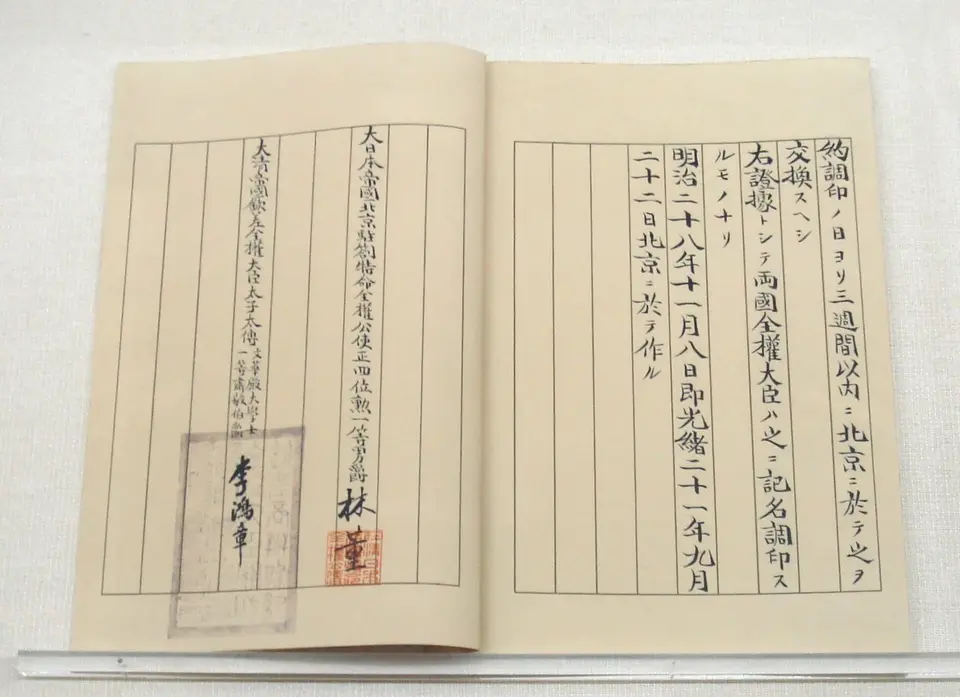
Li Hongzhang and Hayashi Tadasu sign the treaty in Beijing, retroceding Liaodong for thirty million taels.
In the spring of 1895, the First Sino-Japanese War concluded with the total destruction of the Qing Beiyang Fleet and catastrophic defeats across Manchuria. On April 17, 1895, Qing Plenipotentiary Li Hongzhang and Japanese Prime Minister Ito Hirobumi signed the Treaty of Shimonoseki at the Shunpanro hall.
In addition to imposing an astronomical war indemnity of two hundred million Kuping taels and opening new treaty ports, Article II ceded the entire Liaodong Peninsula, Taiwan, and the Penghu Islands to Japan in perpetuity. Securing Liaodong gave Japan a permanent continental foothold flanking Beijing and threatening the ancestral heartland of the Qing Dynasty in Manchuria.
Ever since annexing Outer Manchuria through unequal treaties in the mid-nineteenth century, the Russian Empire had sought mastery over the Pacific and an ice-free maritime outlet. In 1891, Russia commenced construction on the monumental Trans-Siberian Railway, designed to integrate Siberia and project hegemonic influence across Manchuria and northern China.
Liaodong Peninsula, particularly the natural deep-water havens of Port Arthur (Lushun) and Talienwan (Dalian), commanded the maritime approaches to the Bohai Gulf. Russian statesmen recognized that permanent Japanese fortification of Liaodong would permanently sever Russia from the Yellow Sea and extinguish its Far Eastern imperial expansion.
Confronting Japanese hegemony, Russia found eager allies in Berlin and Paris. Kaiser Wilhelm II and German chancellors sought to divert Russian military attention away from the Franco-Russian border and the Balkan theater into the remote Pacific, relieving German two-front defense anxieties in Europe.
For France, having recently forged the Franco-Russian Alliance of 1894, unwavering diplomatic alignment with Saint Petersburg was necessary to secure Russian continental assistance against Imperial Germany. Consequently, Saint Petersburg, Berlin, and Paris coordinated their diplomatic apparatus into the formidable Triple Coalition.
On April 11, 1895, prior to the formal signing at Shimonoseki, Tsar Nicholas II convened an extraordinary imperial council at the Winter Palace. Finance Minister Sergei Witte forcefully argued that Japanese possession of southern Manchuria constituted an intolerable strategic threat that Russia must resist through diplomatic coercion or outright war.
Tsar Nicholas II approved Witte's aggressive stance, ordering Baltic naval squadrons to sail for the Pacific and placing Amur military garrisons on full mobilization alert, while instructing Lobanov-Rostovsky to solicit diplomatic support from Paris and Berlin.
Berlin responded with unprecedented speed, authorizing its Tokyo legation to act in complete concert with Russian diplomats. French Foreign Minister Gabriel Hanotaux promptly affirmed French solidarity, ordering the French Far Eastern naval squadron to join Russian naval maneuvers.
Great Britain maintained its traditional stance of "splendid isolation." Prime Minister Lord Rosebery determined that while Britain opposed Russian dominance in Manchuria, London had no desire to fight on Japan's behalf, officially declaring strict British neutrality.
On the afternoon of April 23, 1895, Russian Minister Mikhail Hitrovo, German Minister Felix von Gutschmid, and French Charge d'Affaires Lucien Courmont arrived at the Japanese Foreign Ministry in Tokyo, presenting coordinated diplomatic notes to Vice Foreign Minister Hayashi Tadasu.
The notes stated that Japanese permanent possession of the Liaodong Peninsula represented a direct threat to the Chinese capital, rendered the independence of Korea illusory, and constituted a permanent menace to East Asian peace, "cordially advising" Tokyo to renounce its annexation. German Minister Gutschmid accompanied the delivery with an arrogant verbal warning that refusal to comply would invite military consequences.
The joint intervention struck the Japanese public and political elite like a thunderbolt. On April 24, Prime Minister Ito Hirobumi convened an emergency imperial conference before Emperor Meiji at the Hiroshima Imperial Headquarters.
Militarists like Yamagata Aritomo demanded armed resistance against the three powers. However, Navy Minister Saigo Tsugumichi and Army Minister Oyama Iwao presented sobering operational appraisals: Japanese naval magazines were exhausted, armored warships had suffered severe attrition, and field divisions were stranded in Manchuria. Confronting thirty modern European ironclads in Asian waters, Japan had no hope of naval victory.
Foreign Minister Mutsu Munemitsu desperately sought counter-intervention from Great Britain and the United States, offering commercial concessions across Liaodong in exchange for diplomatic mediation.
However, British Foreign Secretary Lord Kimberley rebuffed Tokyo, advising Japanese statesmen to yield. Realizing Japan stood completely isolated against European naval might, Emperor Meiji presided over a final imperial council on May 4, issuing an imperial decree accepting the advice to retrocede Liaodong. On May 5, Japan formally notified the three legations of its surrender of the territory.
Seeking monetary compensation for its lost conquest, Japan demanded an exorbitant indemnity of one hundred million taels from the Qing government. Russian Finance Minister Witte intervened diplomatically to cap the amount within bounds that would allow Russian financial institutions to dominate Qing state loans.
Following protracted diplomatic exchanges, Qing Plenipotentiary Li Hongzhang and Japanese Minister Hayashi Tadasu signed the Convention of Retrocession (Convention of Liaodong) in Beijing on November 8, 1895. Japan agreed to evacuate all garrisons within three months, while China agreed to remit an extra thirty million Kuping taels in silver as a retrocession ransom.
The Triple Intervention averted the permanent detachment of Liaodong, recovering vital coastal fortresses at Port Arthur and Dalian and shielding Manchuria from direct Japanese occupation.
However, the fiscal cost proved catastrophic. Added to the Shimonoseki indemnity, the thirty million taels ransom brought total war payments to over two hundred and thirty million taels, pushing Qing public finances into insolvency. To service these debts, China contracted massive foreign loans from Anglo-German and Russo-French banking syndicates, hypothecating customs duties and salt taxes to foreign creditors.
The intervention initiated the rapid imperialist partition of China. Claiming gratitude for their services, the three powers seized strategic footholds: Germany occupied Jiaozhou Bay in 1897, Russia leased Port Arthur and Dalian in 1898 while seizing railroad concessions across Manchuria, France leased Guangzhouwan, and Britain took Weihaiwei and the New Territories.
For Japan, the intervention was experienced as a traumatic national humiliation. Chanting the slogan "Gashin Shotan" (Persevering Through Hardship), the Japanese government allocated over eighty-five percent of Chinese indemnities to naval and army expansion, designating Tsarist Russia as the empire's mortal enemy and directly paving the bloody road toward the Russo-Japanese War in 1904.
Liang Qichao remarked in Biography of Li Hongzhang: "When the Shimonoseki treaty was concluded, the Triple Intervention occurred not through Li Hongzhang's brilliance, but because the great powers pursued their own imperial ambitions. Yet Li utilized their rivalries so that thousands of miles of fertile soil were preserved from Japanese hands, which must be recognized as a notable achievement."
Vladimir Lenin wrote in The War in China: "The European capitalists carved up China like wolves pouncing upon prey. When the Russian Tsar intervened to expel Japan, he did so not out of generosity, but solely to ensure that he alone might annex Manchuria without interference."