Accession of Emperor Renzong
Emperor Yongle died on campaign, and Crown Prince Zhu Gaochi ascended the throne to initiate the Hongxi reforms, halting maritime voyages and military expeditions.
Ming Dynasty (明朝) · HISTORICAL EVENT
仁宣之治
The Reign of Ren and Xuan (仁宣之治) refers to the golden era of enlightened civil governance, administrative stability, and economic flourishing under the successive reigns of Emperor Renzong (Hongxi era) and Emperor Xuanzong (Xuande era) between 1424 and 1435. Following more than two decades of expansionist warfare under Emperor Yongle—marked by five northern expeditions into the Mongolian steppes, seven maritime voyages to the Indian Ocean, the Grand Canal…
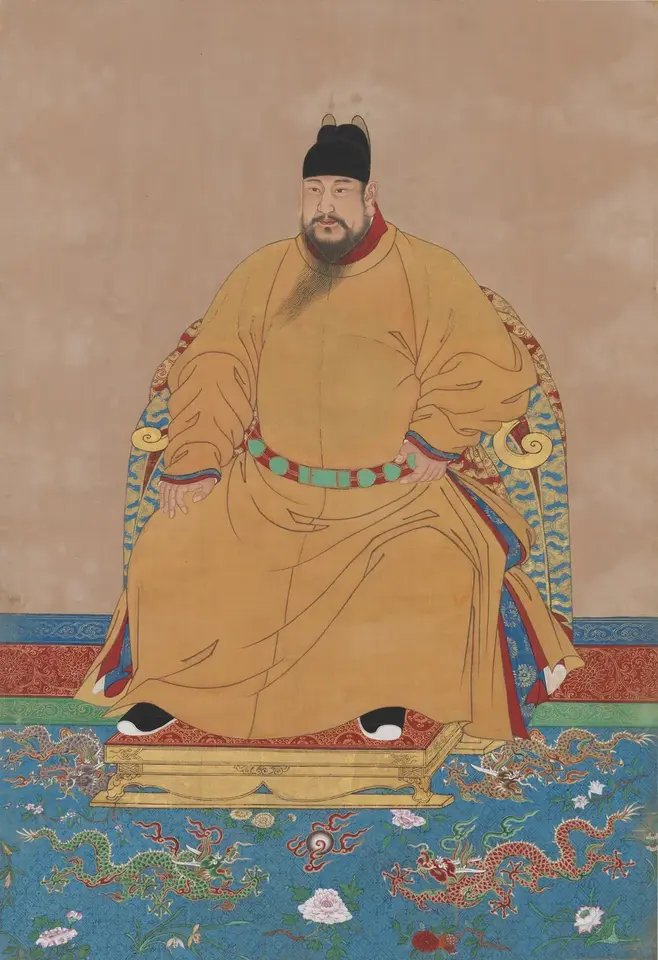
The Reign of Ren and Xuan (仁宣之治) refers to the golden era of enlightened civil governance, administrative stability, and economic flourishing under the successive reigns of Emperor Renzong (Hongxi era) and Emperor Xuanzong (Xuande era) between 1424 and 1435. Following more than two decades of expansionist warfare under Emperor Yongle—marked by five northern expeditions into the Mongolian steppes, seven maritime voyages to the Indian Ocean, the Grand Canal reconstruction, and the massive construction of the Forbidden City—the empire faced severe financial depletion, heavy corvée burdens, and mounting agrarian unrest. Upon ascending the throne, Emperor Renzong immediately initiated a strategic retrenchment, canceling maritime expeditions and northern campaigns, rehabilitating loyalist officials purged during the Jingnan civil war, and reducing agrarian taxes across the Yangtze delta. His successor, Emperor Xuanzong, continued this benevolent governance, personally leading forces to suppress Prince Zhu Gaoxu's revolt, formalizing the Grand Coordinator (xunfu) provincial oversight system, instituting regional quotas in civil service examinations, and withdrawing military garrisons from Jiaozhi (northern Vietnam). Over eleven years, the empire achieved widespread prosperity and overflowing granaries, earning acclaim in the History of Ming (Ming Shi) as an era of exemplary peace comparable to the ancient reigns of Wen and Jing in Han and Zhenguan in Tang.
Emperor Yongle died on campaign, and Crown Prince Zhu Gaochi ascended the throne to initiate the Hongxi reforms, halting maritime voyages and military expeditions.
Emperor Renzong promulgated general pardons for Jianwen officials, reduced land taxes across Jiangnan, and elevated the Three Yangs.
Renzong died after ten months, and Crown Prince Zhu Zhanji returned safely from Nanjing to assume the throne as Emperor Xuanzong.
Prince Zhu Gaoxu rebelled at Le'an; Emperor Xuanzong led imperial forces to encircle the city, securing the prince's surrender.
Xuanzong established the Neishutang to instruct young eunuchs in literacy, establishing the administrative precedent for Directorate of Ceremonial authority.
Xuanzong withdrew Ming forces from northern Vietnam, recognizing Le Loi as King of Annam to relieve imperial fiscal burdens.
Xuanzong personally led elite cavalry through Xifengkou, defeating Uriankhai Mongol raiders at Kuanhe to stabilize the northern frontier.
Xuanzong appointed Yu Qian to Henan and Shanxi and Zhou Chen to Jiangnan, institutionalizing provincial coordination.
Xuanzong instituted regional examination quotas, reserving quotas for northern, southern, and central scholars to preserve regional equity.
Emperor Xuanzong died in Beijing at age thirty-eight, concluding eleven years of prosperity and leaving state granaries overflowing.
During his twenty-two-year reign (1402-1424), Emperor Yongle pursued an aggressive, expansionist grand strategy. Yongle personally led hundreds of thousands of troops across the Gobi Desert on five northern expeditions against the Eastern Mongols and Oirats, dispatched Admiral Zheng He on colossal maritime voyages to the Western Oceans, mobilized hundreds of thousands of laborers to rebuild the Grand Canal, and erected imperial palaces at Beijing. These colossal state projects exhausted the fiscal reserves accumulated since the founding of the dynasty. Commanderies across Shandong, Henan, and Jiangnan suffered under oppressive grain requisitions and labor levies, forcing peasants into flight and sparking the Tang Sai'er White Lotus uprising.
Following the founding of the Ming dynasty, Emperor Hongwu enforced strict penal statutes, purging tens of thousands of military and civil elites in the Hu Weiyong and Lan Yu treason cases. Following the Jingnan civil war (1399-1402), Emperor Yongle executed prominent loyalists of the Jianwen Emperor, including Qi Tai, Huang Zicheng, and Fang Xiaoru, subjecting their families to extermination or lifetime penal servitude. This brutal purge created profound political trauma and alienated the literati of Jiangnan, who regarded the Yongle court with latent hostility. The imperial state urgently required a transition from terror and militarism to Confucian benevolence and reconciliation.
Emperor Renzong (Zhu Gaochi), the eldest son of Emperor Yongle, possessed a gentle, benevolent, and scholarly disposition. Created crown prince in 1404, he served as regent in the southern capital of Nanjing for nearly two decades while his father campaigned on the northern frontier. Supported by dedicated scholar-statesmen like Yang Shiqi, Yang Rong, Yang Pu, and Xia Yuanji, Zhu Gaochi managed national finances, procured military grain, and alleviated popular hardships across southern China. Through decades of administrative experience, Zhu Gaochi internalized a governance philosophy centered on Confucian ethics, administrative restraint, and popular welfare.
In July 1424 (twenty-second year of Yongle), sixty-five-year-old Emperor Yongle died at Yumuchuan during his return from his fifth northern expedition. Guided by Grand Secretaries Yang Rong and Jin Youzi, Crown Prince Zhu Gaochi stabilized the capital and formally ascended the throne in the Forbidden City, adopting the reign title Hongxi as Emperor Renzong. The new emperor faced an empire exhausted by endless military mobilization and depleted public treasuries.
Renzong acted with immediate decisiveness. Within four days of his accession, he issued sweeping imperial decrees halting Zheng He's maritime expeditions, disbanding shipbuilders and sailors, terminating procurement missions for exotic luxuries in Yunnan and Jiaozhi, and suspending non-essential imperial construction projects. These measures reversed the aggressive expansionism of the Yongle reign, refocusing state policy on domestic recovery and public welfare.
To heal the political wounds of the Jingnan civil war, Emperor Renzong demonstrated extraordinary magnanimity. In early 1425 (first year of Hongxi), he promulgated a general amnesty officially exonerating prominent ministers of the Jianwen court, including Qi Tai, Huang Zicheng, Fang Xiaoru, and Tie Xuan. He commuted penal sentences, emancipated their surviving descendants from military slavery, and provided travel allowances for their return home alongside restored properties.
Renzong also eliminated political prejudices against the literati of Jiangnan, dispatching imperial commissioners to investigate local grievances and rectify judicial errors. These sweeping reconciliatory measures won the enthusiastic support of the scholar-gentry across southern China, eliminating two decades of regional estrangement and building broad political solidarity for the dynasty.
The golden age of civil governance during the Ren-Xuan era rested on the emperor's profound trust in institutional advisors. Upon his accession, Renzong promoted Eastern Palace advisors Yang Shiqi, Yang Rong, and Yang Pu into the Grand Secretariat, known collectively as the "Three Yangs." Yang Shiqi was celebrated for his moral integrity and statecraft, Yang Rong for his decisive military and political counsel, and Yang Pu for his incorruptibility and mastery of administrative precedent.
Under Renzong and Xuanzong, the Grand Secretariat transformed from a minor advisory bureau into the supreme executive decision-making body of the empire. Renzong granted grand secretaries sealed memorial privileges to report directly on public affairs, while Xuanzong institutionalized the power of "drafting rescripts" (piaoni), allowing secretaries to formulate policy recommendations directly on state memorials. Collaborating with Ministers Xia Yuanji and Jian Yi, the Three Yangs established an enduring model of civil bureaucratic partnership.
The dramatic career of Minister of Revenue Xia Yuanji exemplified the benevolent patronage of Renzong and Xuanzong. In the late Yongle era, Xia was imprisoned in the Embroidered Uniform Guard dungeons for opposing costly northern expeditions. On the night of his accession in August 1424, Emperor Renzong ordered Xia's immediate release, taking his arm and confessing that the empire's fiscal distress required his expertise.
Restored as Minister of Revenue, Xia audited imperial accounts, curtailed palace expenditures, and lowered transport surcharges. Through his disciplined financial management, the Ming treasury reversed its chronic deficits within several years, achieving substantial fiscal surpluses and granary reserves that underwrote subsequent prosperity.
Emperor Renzong enacted structural tax relief across the lower Yangtze prefectures, including Suzhou and Songjiang, which had shouldered disproportionate land taxes since the reign of Emperor Hongwu. Meeting with Minister Xia Yuanji, Renzong ordered government land rents reduced by one-third throughout Jiangnan, while canceling back taxes in flood-ravaged regions of Shandong and Henan.
To address the crisis of rural displacement, Renzong instituted an accommodating resettlement policy. Forbidding magistrates from using force against displaced peasants, he decreed that migrants could register locally where they settled, receive allocations of fallow land, and enjoy three years of tax exemptions. This benevolent measure encouraged millions of displaced households to resume agriculture, restoring productivity across northern plains.
In May 1425, after ruling for only ten months, Emperor Renzong died suddenly in the Forbidden City at age forty-seven. His unexpected death destabilized the court, as Crown Prince Zhu Zhanji was in Nanjing observing ancestral rites. Seeing an opportunity, the emperor's ambitious uncle, Prince Zhu Gaoxu of Han, prepared ambushes along northern transit routes to assassinate the heir.
Alerted by confidential couriers dispatched by Yang Shiqi and Xia Yuanji, the twenty-seven-year-old crown prince demonstrated remarkable daring. Disguised with a small cavalry escort, Zhu Zhanji bypassed main post roads and traveled through secondary paths in Shandong. While ambushers waited along the Grand Canal, Zhu Zhanji arrived safely in Beijing, ascending the throne in June 1425 as Emperor Xuanzong.
Following Xuanzong's accession, Prince Zhu Gaoxu grew openly defiant, mobilizing armed retainers at Le'an, Shandong, and plotting to emulate his father's Jingnan revolt. In August 1426 (first year of Xuande), Zhu Gaoxu rose in open rebellion, denouncing the Grand Secretariat and seeking to march on Beijing.
While some courtiers urged sending generals to suppress the revolt, Grand Secretary Yang Rong and Minister Xia Yuanji urged the emperor to lead the campaign personally, arguing that imperial presence would shatter rebel morale. Xuanzong mobilized elite divisions, surrounding Le'an with modern artillery from the Shenji Division. Shaken by the emperor's resolve, the rebel garrison collapsed, and Zhu Gaoxu surrendered without a protracted siege.
Following Zhu Gaoxu's surrender, Xuanzong initially spared his uncle's life, stripping his titles and placing him under house arrest in Beijing (though Gaoxu was later executed after tripping the emperor). Concurrently, Prince Zhu Gaosui of Zhao faced accusations of complicity in the conspiracy.
Adopting Yang Shiqi's counsel, Xuanzong forwarded all impeachment memorials directly to Zhu Gaosui, allowing his uncle to understand the gravity of his exposure. Terrified, the Prince of Zhao surrendered his personal bodyguard units to the throne. Xuanzong systematically disarmed other princely households across the empire, terminating the threat of regional princely rebellions that had troubled the dynasty since its founding.
Emperor Xuanzong maintained rigorous oversight over imperial bureaucracy, believing that sound administration began with selecting ethical officials. Working alongside Minister of Personnel Jian Yi and Censor-in-Chief Gu Zuo, Xuanzong conducted rigorous inspections across the administration, purging corrupt and negligent magistrates.
Gu Zuo restructured the Censorate, impeaching over thirty corrupt censors to restore professional discipline. Xuanzong also instituted strict triennial performance evaluations for prefects and magistrates, promoting officials who governed with integrity while summarily dismissing corrupt administrators, establishing a culture of clean governance throughout the empire.
To dismantle the legacy of harsh corporal punishments from the early Ming, Emperor Xuanzong instituted humanitarian judicial reforms. Xuanzong personally reviewed capital punishment dossiers at the Ministry of Justice, cautioning magistrates against extracting confessions through torture or prioritizing convictions over justice.
Xuanzong instituted the celebrated Morning Court Assize (Chaoxhen) and prisoner review systems (Luqiu). Annually, the Minister of Justice, Censor-in-Chief, and Grand Secretaries convened at Chengtian Gate to re-examine all pending capital sentences, establishing the precedent for supreme judicial reviews under the Ming and Qing dynasties. Over ten years, thousands of capital sentences were commuted, moving the legal system toward equity and restraint.
In 1430 (fifth year of Xuande), thirty-two-year-old rising official Yu Qian was appointed Vice Minister of War and Grand Coordinator of Henan and Shanxi. The border provinces suffered from Yellow River floods, recurring droughts, and noble exploitation, leaving communities impoverished. Yu Qian traveled in simple attire through devastated villages, investigating local grievances directly.
Yu Qian released one hundred thousand bushels of relief grain, constructed river embankments along the Yellow and Qin rivers, and curtailed illegal land seizures by local princely estates. He established community granaries (Shecang) to store emergency grain reserves. Yu Qian served as Grand Coordinator for over a decade with exceptional integrity, earning widespread veneration and establishing an enduring model for provincial administration.
In the vital economic center of Suzhou, Emperor Xuanzong appointed Kuang Zhong as prefect in 1430 on the recommendation of Minister Jian Yi. Suzhou was the empire's heaviest taxed prefecture, where corrupt clerks falsified tax registers and shifted fiscal burdens onto poor tenant farmers. Feigning incompetence upon arrival, Kuang quietly documented the illicit practices of administrative staff.
Within three months, Kuang convened the municipal administration, announced evidence of corruption, and punished or dismissed over thirty corrupt clerks. Working alongside Grand Coordinator Zhou Chen, Kuang overhauled land registers, reduced excessive rents on state lands, and abolished informal service levies. Revered for his incorruptibility and protection of commoners, Kuang was honored as "Kuang Qingtian" (Kuang of the Clear Sky), celebrated alongside Song dynasty icon Bao Zheng.
In cultural and administrative recruitment, the Ren-Xuan era enacted an influential reform: the Regional Quota System (Nanbei Fenjuan). Since the Song and Yuan dynasties, southeastern China had dominated classical scholarship, leaving northern scholars unable to compete in unified examinations and sparking incidents like the 1397 Northern and Southern Roster controversy under Emperor Hongwu.
Grand Secretary Yang Shiqi urged Xuanzong to adopt a balanced imperial perspective: "Recruitment must value talent, but the state must maintain national unity; if northern provinces have no successful candidates, how can the realm remain whole?" Xuanzong instituted regional quotas for metropolitan examinations, allocating fifty-five percent of degrees to southern candidates, thirty-five percent to northern candidates, and ten percent to central provinces (such as Sichuan and Guizhou). This policy balanced regional interests and preserved long-term imperial cohesion.
The distinctive provincial administrative institution of imperial China—the Grand Coordinator (xunfu)—was formalized during the Xuande reign. In the early Ming, provincial authority was divided among three separate commissioners for administration, justice, and military affairs, causing bureaucratic paralysis during major natural disasters or border crises.
In 1430, Xuanzong adopted Secretariat advice, dispatching high-ranking central officials to reside permanently in key provinces as imperial coordinators, appointing Yu Qian to Henan and Shanxi, and Zhou Chen to Jiangnan. The Grand Coordinators unified provincial authority, improving disaster relief and administrative efficiency while preventing warlord autonomy, marking an institutional milestone in centralized governance.
In Jiangnan, Vice Minister of Revenue Zhou Chen executed transformative fiscal reforms. Suzhou, Songjiang, and Changzhou contributed nearly a quarter of national revenues, but grain shipments to the northern capital suffered heavy transit losses, prompting corrupt clerks to levy extortionate surcharges that bankrupted smallholders.
In 1430, Zhou Chen introduced the Equalized Grain Law (Pingmifa), consolidating irregular surcharges into base land taxes and establishing public relief granaries (Jinongcang) to buy grain in abundant years and sell during famines. Working with Suzhou Prefect Kuang Zhong, Zhou Chen curbed clerk extortion, reducing popular burdens while ensuring that imperial grain tribute arrived in full at the capital.
In foreign and military strategy, Renzong and Xuanzong demonstrated pragmatic geopolitical realism. Since Emperor Yongle's conquest of northern Vietnam and the establishment of the Jiaozhi Provincial Administration, Ming forces faced protracted guerrilla resistance led by Le Loi's Lam Son uprising, suffering heavy casualties in tropical terrain. Expeditions under generals Wang Tong and Liu Sheng suffered recurring reverses, with Liu falling in battle at Daomaqi.
In 1427 (second year of Xuande), despite vocal opposition from court hawks, Xuanzong and the Three Yangs executed a calculated withdrawal. Xuanzong recognized that retaining Jiaozhi drained national wealth without contributing strategic value. The emperor ordered all imperial forces withdrawn and invested Le Loi as King of Annam, shedding a debilitating strategic entanglement and redirecting imperial resources to internal stability.
The withdrawal from Jiaozhi did not signal defensive negligence along the northern frontier. Instead, Xuanzong concentrated military resources along the Great Wall. In autumn 1428 (third year of Xuande), Uriankhai Mongol raiders invaded Da'ning and raided the Jizhou frontier. Xuanzong personally led three thousand elite cavalry from the Shenji Division through Xifengkou to intercept the invaders.
Encountering superior Mongol forces at Kuanhe (modern Hebei), Xuanzong personally led the cavalry charge, shooting down three enemy vanguard commanders. Imperial gunners unleashed barrages of rockets and matchlock fire, routing the raiders. The Uriankhai leadership submitted, dispatching annual tribute. Xuanzong subsequently inspected border garrisons, promoting military farming and strengthening the northern frontier.
The Ren-Xuan era fostered remarkable artistic and material sophistication. Emperor Xuanzong was an accomplished painter and patron of classical arts, producing celebrated works such as Opera of Apes and Three Rams Bringing Auspiciousness, recognized among the most gifted imperial artists in Chinese history alongside Emperor Huizong of Song.
Under his direction, the imperial kilns at Jingdezhen produced iconic Xuande blue-and-white porcelain, utilizing imported cobalt pigment (sumaliqing) to achieve deep blue tones that remain pinnacles of ceramic art. Concurrently, Xuanzong oversaw the production of Xuande bronze incense burners, refining imported copper through multiple smeltings to achieve lustrous patinas that established historic benchmarks in metallurgy.
Beneath the brilliance of the Xuande reign, an institutional reform created significant consequences for the later Ming dynasty. Early Ming founder Zhu Yuanzhi had banned eunuchs from learning to read or meddling in state affairs. However, in 1426, Xuanzong established the Palace Academy for Eunuchs (Neishutang) to assist in processing voluminous state correspondence.
Xuanzong appointed Hanlin scholars to instruct young palace eunuchs in Confucian classics, legal history, and calligraphy. Subsequently, the emperor granted the Directorate of Ceremonial (Silijian) the authority to append red-ink imperial rescripts (pihong) on state memorials. While checked by the Three Yangs during the Xuande reign, this bureaucratic authority later enabled powerful eunuchs, from Wang Zhen to Wei Zhongxian, to usurp imperial authority.
The political machinery of the Ren-Xuan era formalized the executive balance of power that operated throughout the Ming dynasty. Following Hongwu's abolition of the chancellorship, the emperor personally directed the six ministries, creating an overwhelming workload. Renzong and Xuanzong formalized the Grand Secretariat's authority to draft policy recommendations (piaoni) on slips affixed to memorials for imperial review.
Simultaneously, the Directorate of Ceremonial copied the emperor's decisions in vermilion ink. During the Xuande reign, harmonious cooperation between the emperor, the Three Yangs, and disciplined palace attendants achieved efficient, balanced governance. This system preserved administrative continuity even during subsequent eras of imperial absenteeism, though it contained structural vulnerabilities when monarchs neglected state affairs.
On January 31, 1435, Emperor Xuanzong died in the Forbidden City at age thirty-eight, receiving the temple name Xuanzong. He bequeathed to his successors an empire characterized by administrative clarity, social harmony, and remarkable prosperity. Over eleven years of benevolent governance, state granaries held sufficient grain reserves for decades, public treasuries overflowed, prices remained low, and public crime decreased significantly.
The official History of Ming (Ming Shi) concluded with high praise: 'The governance of Ren and Xuan achieved administrative competence, equity in policy, clarified laws, overflowing granaries, and public contentment. Sixty years after the founding of the dynasty, the spirit of the people relaxed into true peace. Later historians universally compare this era to the golden reigns of Wen and Jing in Han and Zhenguan in Tang.' The era remains celebrated as the pinnacle of Ming civil governance.
The Reign of Ren and Xuan fundamentally transformed the Ming governance model, shifting from early Ming terror and militarism to Confucian benevolence and civil bureaucratic primacy. The maturation of the Grand Secretariat, the institutionalization of provincial Grand Coordinators, and the enforcement of triennial performance audits established an administrative system that maintained stability for two centuries, even during later periods of imperial neglect.
Through eleven years of tax remissions, fallow land allocations, and cancellation of arrears, millions of displaced peasants returned to farming across northern China and the Huai River basin. In Jiangnan, fiscal innovations like the Equalized Grain Law stimulated textile manufacturing, commerce, and urbanization, laying the material foundations for late Ming commercial flourishing. State granaries accumulated reserves sufficient for decades, securing widespread social prosperity.
The institution of regional quotas (Nanbei Fenjuan) in civil service examinations was a landmark reform in imperial Chinese statecraft. By legally reserving degree quotas for northern and central candidates, the system prevented southeastern scholars from monopolizing bureaucratic offices. This policy integrated northern and frontier literati into imperial governance, eliminating regional alienation and preserving multi-ethnic national cohesion.
In the official History of Ming (Ming Shi), court historians summarized the era: "Emperor Xuanzong's reign was cut short, yet during the governance of Ren and Xuan, magistrates fulfilled their offices, policies achieved equity, laws were clarified, granaries overflowed, and commoners lived in peace. Sixty years after the founding of the dynasty, the spirit of the people relaxed into true prosperity. Later commentators universally compare this era to the golden reigns of Wen and Jing in Han and Zhenguan in Tang."
In Private Records of the Ming Dynasty (Guoque), late Ming historian Tan Qian observed: "The glory of Yongle was demonstrated through martial conquest; the governance of Ren and Xuan was celebrated for civil virtue. Emperor Yongle expanded frontiers while exhausting the people with labor; Emperor Renzong pacified armies with benevolence, while Emperor Xuanzong managed state affairs with diligence. Entrusting the Three Yangs at court and ethical magistrates in the provinces, reducing taxes and moderating penalties, the empire flourished as never before."
Philosopher Wang Fuzhi analyzed in Notes on the Comprehensive Mirror (Du Tongjian Lun): "The era of Ren and Xuan was the pinnacle of the Ming dynasty. Emperor Yongle exhausted the empire's wealth on distant campaigns, pushing society to the brink of ruin. Emperor Renzong died swiftly, yet by halting voyages, remitting heavy taxes, and honoring Jianwen loyalists, he restored national morale; Emperor Xuanzong succeeded him, curbing regional magnates, moderating justice, and abandoning the campaign in Annam, refusing to exhaust China for remote territories. This was the profound wisdom of rulers who understood what to prioritize and what to abandon."