Inception of Emigre Administration
Emperor Yuan of Jin establishes emigre provinces and counties to resettle northern refugees and uphold political legitimacy.
Wei, Jin, Southern and Northern Dynasties · HISTORICAL EVENT
侨州郡县
Following the upheaval of the Disaster of Yongjia and the fall of the Western Jin capitals, northern aristocratic clans and millions of commoners migrated en masse across the Yangtze River, a historical event known as the Southward Flight of the Clothing and Caps. The newly established Eastern Jin court in Jiankang, seeking to accommodate these displaced refugees, maintain the pedigree and political allegiance of northern emigre clans, and assert its…
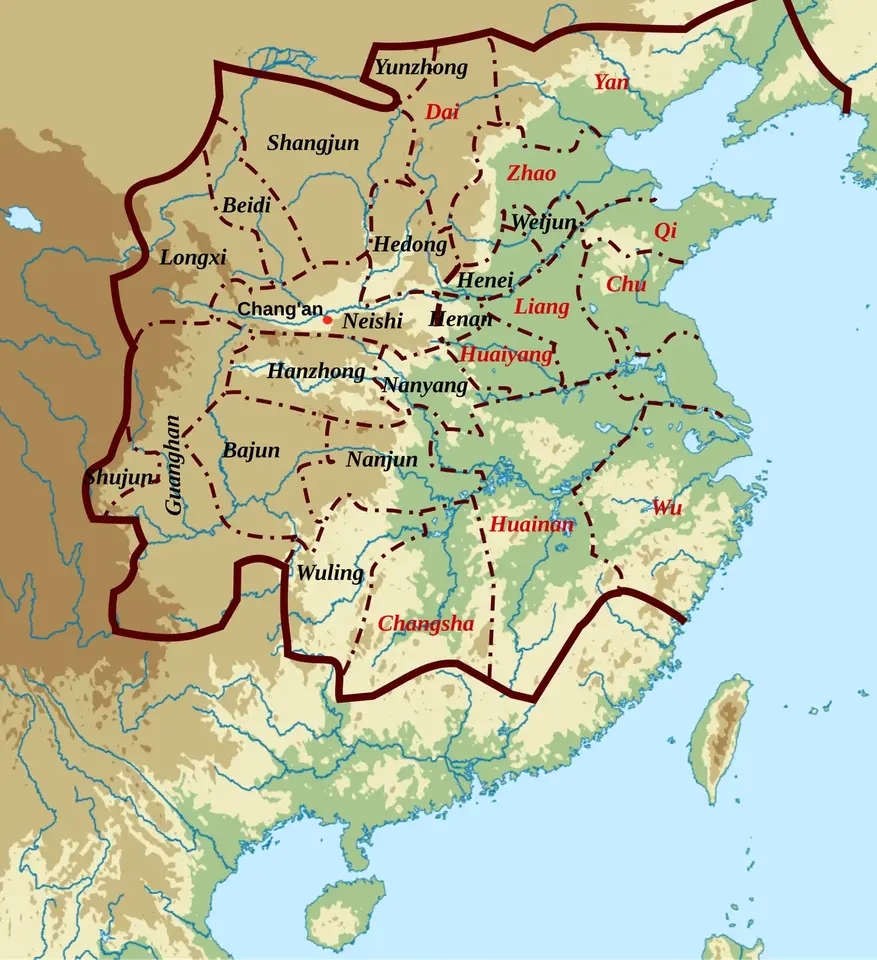
Following the upheaval of the Disaster of Yongjia and the fall of the Western Jin capitals, northern aristocratic clans and millions of commoners migrated en masse across the Yangtze River, a historical event known as the Southward Flight of the Clothing and Caps. The newly established Eastern Jin court in Jiankang, seeking to accommodate these displaced refugees, maintain the pedigree and political allegiance of northern emigre clans, and assert its dynastic legitimacy to recover the northern heartland, created nominal administrative units in the south bearing the names of lost northern homelands, an institutional innovation known as Emigre Provinces, Commanderies, and Counties. Originating under Emperor Yuan of Jin in 317, the system persisted across Eastern Jin and the four Southern Dynasties of Song, Qi, Liang, and Chen. Initially granted tax exemptions under provisional white registers, emigrants were gradually incorporated into regular southern tax rolls through several Tuduan residency-determination campaigns. The entire emigre administrative system was definitively dismantled in 589 when Emperor Wen of Sui unified China.
Emperor Yuan of Jin establishes emigre provinces and counties to resettle northern refugees and uphold political legitimacy.
Emperor Cheng of Jin issues edicts to survey household registers and restrict fiscal privileges of white register holders.
Grand Marshal Huan Wen enforces rigorous registration reforms, prosecuting aristocratic families harboring concealed laborers.
Liu Yu completes comprehensive registration reforms, converting emigre Xu Province into territorial Southern Xu Province.
Liu Yu ascends the throne as Emperor Wu of Song, consolidating emigre counties into Southern Yan and Southern Yu provinces.
Sui forces conquer Chen, and Emperor Wen of Sui definitively abolishes all emigre administrative divisions across China.
The catastrophic collapse of Western Jin authority during the Disaster of Yongjia led to the sacking of Luoyang and Chang'an, plunging northern China into two centuries of fragmentation and warfare. Aristocratic lineages such as the Wang of Langya, Xie of Chenliu, and Xun of Yingchuan, accompanied by vast entourages of kinsmen, tenant farmers, and retainers, migrated south to escape famine and armed slaughter. Millions of northern commoners also fled to the Huai River and lower Yangtze regions, placing severe structural pressure on the preexisting political and economic order of southern society.
When Sima Rui and his chief advisor Wang Dao founded the Eastern Jin dynasty in Jiankang, the fledgling court faced delicate political challenges. The indigenous Jiangdong gentry possessed deep roots, sprawling agricultural estates, and extensive localized clans, whereas the exiled northern aristocrats monopolized the military command and central civil bureaucracy. To avert civil strife, provide legal standing for displaced northern populations, and project ideological legitimacy over the lost Central Plains, the court devised the emigre administrative system to organize refugees without alienating indigenous landowners.
In the initial years of the Eastern Jin dynasty, hundreds of thousands of northern refugees crowded into the strategic riparian zones of the Huai and Yangtze rivers. The central government lacked the bureaucratic capacity to survey land and immediately register these vast migrant populations into the local southern fiscal registers. To placate displaced northern aristocrats and keep intact the familial, communal, and military organizations of northern lineages, Chancellor Wang Dao proposed establishing titular local administrative units named after the fallen northern prefectures and counties on uncultivated southern crown lands or within existing southern jurisdictions.
Around the first year of the Jianwu era in 317, the Eastern Jin government founded several emigre provinces, commanderies, and counties in the environs of Jiankang and along strategic river corridors. For example, refugees from northern Xu Province concentrated in Jingkou, leading to the creation of emigre Xu Province; migrants from Yan Province gathered in Guangling, forming emigre Yan Province. Titular administrations for Qing, Ji, You, and Bing provinces were similarly established along both banks of the Yangtze River. This institutional device provided displaced northern aristocrats with recognized bureaucratic posts while maintaining the symbolic claim of the Jin court to rule all of China.
During its initial phase, the emigre administrative system was distinguished by its virtual and provisional character. Most emigre provinces and counties were parasitic, residing physically within the walled urban centers or territories of existing southern commanderies. These titular divisions possessed no fixed geographic borders and no allocated arable territory; their administrative reach was defined exclusively by the human groupings of northern refugees who shared a common ancestral provenance. This created an unprecedented administrative phenomenon of people without land and multiple governing entities overlapping on the same geographical soil.
As the division between North and South hardened into a multi-generational confrontation, emigrant populations took deep root in southern soil, and the number of emigre administrative units proliferated rapidly. Over decades, the local administrative geography evolved into three distinct patterns: purely emigre jurisdictions, purely indigenous jurisdictions, and hybrid mixed jurisdictions. To enhance regional administrative efficiency, the imperial court gradually transferred jurisdiction over certain indigenous southern counties to emigre commanderies, granting them real landed boundaries. Along the lower Yangtze in Jingkou and Wujin, dozens of emigre commanderies and hundreds of emigre counties existed alongside native administrative structures.
To entice northern populations to journey south and pledge fealty to the Jin court, the government instituted a dual household registration regime. Northern migrants were enrolled on unstained, yellowish-white paper records known as white registers, while native southern inhabitants were registered on formal yellow registers treated with protective cork-tree dye. Emigrants holding white registers enjoyed legal immunity from state corvee labor and military conscription, and paid minimal or no direct grain levies. In the early decades, this favorable fiscal policy provided essential relief that allowed refugees to survive and clear extensive untamed southern wilderness.
Over generations, however, the fiscal exemption associated with white registers became an unsustainable burden on imperial governance and a major source of social friction. Powerful northern aristocratic lineages abused their privileged status by sheltering large numbers of unregistered tenant laborers, indentured retainers, and landless vagrants within their expanding private estates. Conversely, indigenous southern peasant households, buckling under crushing state corvee and heavy tax quotas, fled their ancestral lands to place themselves under the protective patronage of emigre magnates or falsified their ancestry to secure illicit white register status. Consequently, the registered imperial taxpayer base dwindled, treasury revenues dried up, and administrative cohesion deteriorated.
To dismantle the entrenchment of emigrant tax evasion, replenish the depleted state treasury, and curb the aggrandizement of aristocratic households, the Eastern Jin court launched successive land-settlement campaigns known as Tuduan. The foundational tenet of Tuduan was residency-based determination, mandating that all residents, whether indigenous locals or displaced emigrants, be registered strictly according to the actual land on which they currently resided. Emigre status was revoked, white registers were abolished in surveyed districts, and all inhabitants were integrated into the standard state yellow register to shoulder regular fiscal and labor obligations. In 341, Emperor Cheng of Jin promulgated the Xiankang Tuduan, initiating the first systemic effort to eliminate abusive white register privileges.
In 364, Grand Marshal Huan Wen initiated the more sweeping and rigorous Gengxu Tuduan. Huan Wen enforced strict statutory penalties against any magnate concealing unregistered laborers, prosecuting even imperial princes such as Sima Hong, Prince of Pengcheng, for shielding unauthorized dependents. The Gengxu reform proved remarkably effective: vast numbers of displaced commoners and private retainers were severed from aristocratic control and enrolled directly onto imperial tax registers, restoring imperial revenues and providing vital manpower reserves for the military.
Between 412 and 413, during the late Eastern Jin, Grand Commander Liu Yu orchestrated the Yixi Tuduan, the most comprehensive and unyielding registration campaign in the dynasty's history. Liu Yu utilized imperial authority to crush the resistance of entrenched oligarchs who concealed tenant labor, systematically eliminating white registers across the Huai River and Jiangnan valleys and enrolling all emigrant populations into standard yellow registers.
Concurrent with the Yixi reform, Liu Yu carried out an extensive territorial reorganization of nominal emigre divisions. The long-standing emigre Xu Province based in Jingkou was formally renamed Southern Xu Province and assigned demarcated physical territory, transforming it from a nominal emigre office into a fully staffed provincial government with genuine territorial authority. The robust, battle-hardened emigrant population of Southern Xu Province, having been organized and integrated into regular civil and military structures, formed the foundational core of the formidable Beifu Army, which provided Liu Yu with the military strength to depose the Jin dynasty and establish the Liu Song dynasty in 420.
Although subsequent Southern Dynasties—Song, Qi, Liang, and Chen—periodically enacted further Tuduan measures to merge and streamline defunct emigre offices, persistent geopolitical competition with northern rivals led emperors to repeatedly resurrect or create new emigre designations to reward loyal generals or integrate fresh defectors. The administrative confusion of overlapping borders, identical toponyms in different provinces, and cumbersome bureaucratic duplication remained an unresolved systemic challenge throughout the Southern Dynasties.
In 589, Emperor Wen of Sui launched a massive amphibious campaign that conquered the Chen capital of Jiankang, ending more than two and a half centuries of North-South division. With the restoration of universal imperial authority, the ideological and logistical justification for maintaining emigre administrative divisions ceased to exist. Emperor Wen decreed a comprehensive overhaul of southern administration, abolishing all remaining emigre provinces, commanderies, and counties, consolidating redundant offices, and absorbing all local populations into a standardized nationwide prefecture-county system, bringing the historic emigre administrative era to a permanent close.
Through iterative Tuduan reforms across the Eastern Jin and Liu Song eras, millions of displaced northern emigrants and concealed agricultural laborers were transferred from provisional white registers into formal state yellow registers as taxpaying, service-bound imperial subjects. Virtual emigre administrations were systematically consolidated, demarcated, or transformed into regular territorial jurisdictions. This fiscal recovery rescued the southern imperial treasuries from insolvency and provided steady conscription pools. Upon the Sui conquest in 589, all surviving emigre administrative nomenclature was expunged, completing the transition to a unified local administrative hierarchy.
The emigre administrative system exerted profound and enduring influences on medieval Chinese civilization. Politically, it preserved dynastic legitimacy for the southern regimes and maintained the internal solidarity of northern aristocratic houses. Militarily, refugee concentrations in regions like Jingkou generated the elite Beifu Army, which turned the tide of battle at the Fei River and repeatedly checked northern expansionism. Economically, northern migrants introduced sophisticated metallurgical, irrigation, and farming techniques to the Yangtze valley, transforming the southern marshlands into fertile agrarian centers and accelerating the southward shift of China's economic center of gravity. Administratively, the hard-won experience of residency-based household management directly informed the territorial administrative restructuring of the Sui and Tang dynasties.