Huan Wen's invasion of Fangtou
Eastern Jin forces threaten Ye; Former Yan promises territorial concessions west of Hulao to Former Qin in exchange for military intervention.
Former Yan Dynasty (前燕) · HISTORICAL EVENT
前秦灭前燕
Former Qin's Conquest of Former Yan (前秦灭前燕) was a decisive campaign fought between 369 and 370 that determined political hegemony across northern China during the Eastern Jin and Sixteen Kingdoms era. Confronted by the third northern expedition of Eastern Jin grand marshal Huan Wen, Former Yan had desperately requested military intervention from Former Qin, promising to cede all territory west of Hulao in return. However, after joint operations repelled…
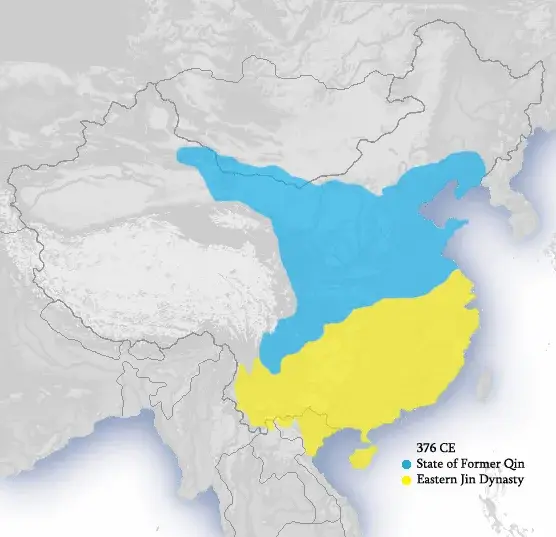
Former Qin's Conquest of Former Yan (前秦灭前燕) was a decisive campaign fought between 369 and 370 that determined political hegemony across northern China during the Eastern Jin and Sixteen Kingdoms era. Confronted by the third northern expedition of Eastern Jin grand marshal Huan Wen, Former Yan had desperately requested military intervention from Former Qin, promising to cede all territory west of Hulao in return. However, after joint operations repelled Jin armies at the Battle of Fangtou, the corrupt regent of Yan, Murong Ping, repudiated the agreement. Simultaneously, internal political infighting engulfed the Yan court: Empress Dowager Kezuhun and Murong Ping conspired against Prince of Wu Murong Chui, whose tactical genius had saved the dynasty. Persecuted and fearing execution, Murong Chui fled with his sons to Chang'an, seeking asylum under Heavenly King Fu Jian. Possessing complete intelligence on Yan's domestic paralysis, Fu Jian authorized Chancellor Wang Meng to launch a decisive eastern campaign. Marching out in late 369, Wang Meng secured Luoyang before executing a coordinated offensive across Shanxi in 370, capturing Huguan and breaching Jinyang through mining tactics. At the Battle of Luchuan, Wang Meng and vanguard general Deng Qiang shattered Murong Ping's army of three hundred thousand. Qin forces surrounded the capital city of Ye, where cavalry attendant Yu Wei opened the northern gate, resulting in the capture of Murong Wei and the permanent annexation of Former Yan.
Eastern Jin forces threaten Ye; Former Yan promises territorial concessions west of Hulao to Former Qin in exchange for military intervention.
Joint operations repel Huan Wen; Former Yan regent Murong Ping repudiates the territorial agreement.
Murong Ping and Kezuhun plot Murong Chui's murder, prompting the celebrated general to seek asylum in Chang'an.
Wang Meng leads thirty thousand troops eastward, defeats relief columns, and secures Luoyang.
Fu Jian commissions Wang Meng with sixty thousand troops to conduct the total conquest of Yan.
Qin armies batter Huguan with siege artillery, capturing Murong Yue and pacifying southern Shanxi.
Deng Qiang tunnels beneath the fortifications of Jinyang, capturing governor Murong Zhuang.
Murong Ping's army of three hundred thousand is crushed; Qin forces capture one hundred thousand prisoners.
Yu Wei opens the northern gate of Ye; Guo Qing captures the fleeing emperor Murong Wei, ending the dynasty.
In the fourth month of 369, Grand Marshal Huan Wen of the Eastern Jin launched his third northern expedition, driving fifty thousand infantry and cavalry deep into the Central Plains to reach Fangtou, only a short march from the Former Yan capital of Ye. Emperor Murong Wei and Grand Tutor Murong Ping were thrown into utter panic, contemplating the abandonment of the capital to retreat into their ancestral homelands in Liaodong.
Facing annihilation, the Yan court dispatched urgent envoys to Chang'an, officially pledging to cede all territory west of Hulao Pass to Former Qin in exchange for military relief. Evaluating the geopolitical stakes, Heavenly King Fu Jian and Chancellor Wang Meng recognized that if Huan Wen conquered Yan, Eastern Jin armies would control the entire Yellow River valley and imperil Guanzhong.
Qin dispatched generals Gou Chi and Deng Qiang with twenty thousand cavalry and infantry to assist Yan. Simultaneously, Murong Chui executed brilliant counter-offensives at Fangtou, severing Jin supply lines and dealing Huan Wen a catastrophic defeat that cost over thirty thousand Jin lives.
With Huan Wen's retreat, the existential peril dissipated, and the reactionary faction at the Yan court immediately reneged on its territorial promises. Grand Tutor Murong Ping, driven by greed and strategic myopia, arrogantly informed the Qin emissaries that neighboring states routinely assisted one another and that the envoy had lacked authorization to pledge territory.
Heavenly King Fu Jian was incensed by the bad faith of the Yan leadership. Wang Meng observed that by breaking solemn covenants, Former Yan had forfeited divine favor and political legitimacy. Yan's betrayal provided Former Qin with an indisputable casus belli to mount an armed intervention.
The victory at Fangtou elevated Murong Chui to supreme military renown, but his popularity ignited toxic paranoia within the Yan regency. Empress Dowager Kezuhun, who harbored a long-standing personal hatred against Murong Chui's family, joined Murong Ping in forging plans to execute the prince.
Advised by his nephew Murong Kai and trusted generals to mount a preemptive coup to purge the corrupt regency, Murong Chui refused to shed clan blood. In November 369, he fled Ye alongside his sons Murong Ling and Murong Bao, defecting to Former Qin.
Fu Jian welcomed Murong Chui outside Chang'an with royal honors, appointing him Champion General and enfeoffing him as Marquis of Bintu. The defection deprived Yan of its finest tactical commander and provided Qin with exhaustive geographic and political intelligence regarding Yan's defenses.
In December 369, citing Yan's treaty violation, Fu Jian formally commissioned Chancellor Wang Meng as Grand Commander, leading generals Liang Cheng and Deng Qiang with thirty thousand troops eastward through Tong Pass.
Qin armies advanced south of the Yellow River toward Luoyang. In response, Yan sent Prince of Wudong Murong Zang with one hundred thousand men to relieve the city, fortifying Shimen. Wang Meng dispatched Deng Qiang with light cavalry to intercept the relieving column; Deng Qiang smashed the Yan vanguard, beheading commanders and capturing over ten thousand troops.
Panicked by the defeat, Murong Zang retreated into Xingyang. Isolated and hopeless, the Yan garrison inside Luoyang surrendered. Wang Meng secured the southern bank of the Yellow River, stationed garrisons, and returned to Chang'an to orchestrate the total annexation campaign.
In June 370, Fu Jian declared a general mobilization for the conquest of Yan. Wang Meng was appointed commander-in-chief, directing General Who Suppresses the South Yang An, General of Soaring Eagle Deng Qiang, and Guerrilla General Guo Qing with sixty thousand elite troops along the southern slopes of the Taihang Mountains.
Wang Meng directed the main force against Huguan, the southern sentinel of Bing province, while ordering Yang An to strike north toward Jinyang. In July, Wang Meng surrounded Huguan, which was defended by Yan administrator Murong Yue. Deploying siege towers and stone-throwing artillery, Qin troops battered the fortifications day and night, storming the ramparts within days and capturing Murong Yue. Wang Meng maintained strict military discipline, prohibiting looting and winning over local populations across Shangdang commandery.
While Wang Meng secured Huguan, Yang An encountered resolute resistance at Jinyang. Commanded by Yan governor Murong Zhuang, Jinyang possessed massive walls and vast grain stores, successfully thwarting direct assaults.
In August, Wang Meng left garrisons at Huguan and marched north to reinforce the siege. Recognizing that prolonged sieges would deplete provisions, Wang Meng devised an underground assault. He constructed earthen ramparts to divert the garrison's attention while ordering Deng Qiang to tunnel under the fortress walls with several hundred commandos under cover of darkness.
Deng Qiang's warriors emerged behind defensive lines within the city center, setting fires and sounding battle drums. Seized by panic, the garrison broke into confusion, allowing Yang An and Wang Meng to breach the perimeter from outside. Murong Zhuang was captured, and the entire garrison was liquidated. The loss of Jinyang severed Yan's communication with the northern steppe and exposed the capital city of Ye to direct invasion.
Terrified by the collapse of Shanxi, Emperor Murong Wei dispatched Grand Tutor Murong Ping with thirty thousand royal troops, stripped from all eastern provinces, to halt the invasion. Murong Ping encamped at Luchuan along the Zhuozhang River.
Confronted by Qin's seasoned soldiers, Murong Ping adopted a passive defensive posture, attempting to exhaust the invaders. However, his avarice undermined military discipline: Murong Ping privatized adjacent forests and freshwater springs, forcing his own soldiers and merchants to pay cash for firewood and drinking water. Within weeks, the commander accumulated colossal wealth while his three hundred thousand troops were demoralized and mutinous.
Informed of this grotesque corruption, Wang Meng exclaimed that Murong Ping was a petty slave whose destruction was assured. Wang Meng advanced to the riverbank and dispatched Guo Qing with five thousand commandos across the shallows at night to set fire to Yan supply depots. Billowing smoke blackened the sky and was visible from the walls of Ye, inducing severe anxiety within the Yan imperial court.
On November 21, 370, Wang Meng assembled the Qin army along the river, ordering cooking pots smashed to demonstrate that retreat was impossible. Wang Meng delivered a stirring address, reminding the ranks that victory meant survival and glory while hesitation meant slaughter.
Prior to the general assault, vanguard commander Deng Qiang demanded an appointment: he requested the post of Colonel Director of Retainers upon victory. Wang Meng replied that while he could guarantee a grand commandery and marquisate, the directorship was reserved for imperial appointment. Deng Qiang took offense and feigned illness, refusing to leave his tent.
Recognizing that Deng Qiang's ferocity was indispensable against massive odds, Wang Meng rode alone to his tent and promised to endorse his petition before the emperor. Mollified and energized, Deng Qiang consumed several jars of wine, mounted his steed, and charged directly into the heart of Murong Ping's lines alongside valiant general Zhang Hao.
Deng Qiang and Zhang Hao pierced the Yan battle formations multiple times, cutting down banners and slaughtering commanders. Wang Meng unleashed the main army in a crushing frontal assault. The three hundred thousand Yan troops disintegrated in chaotic rout. Qin forces beheaded over fifty thousand enemy combatants and captured one hundred thousand prisoners, while Murong Ping fled alone back to Ye.
Capitalizing on the rout at Luchuan, Wang Meng marched directly upon Ye, establishing a tight encirclement around the imperial capital. Wang Meng enforced impeccable civil discipline: soldiers were executed for disturbing private households, and trade continued without disruption. Astonished townsfolk praised Qin rule as equivalent to the golden age of classical antiquity.
In Guanzhong, upon receiving news of the victory, Fu Jian assigned Crown Prince Fu Hong to oversee Chang'an and personally led one hundred thousand cavalry on a forced march, covering hundreds of miles in seven days to reinforce the siege lines at Ye. Fu Jian distributed lavish rewards to the troops, elevating morale to an unprecedented peak.
By December 370, the besieged capital was depleted of provisions, and internal betrayal accelerated the dynastic end. Palace attendant Yu Wei, a noble of Buyeo descent, conspired with tribal auxiliary soldiers inside the city. Under cover of night, Yu Wei unbolted the northern gate and welcomed Qin assault columns into the fortress.
Qin troops occupied the palace precincts as Murong Ping fled north toward Goguryeo, where he was subsequently arrested and extradited. Emperor Murong Wei fled with a dozen personal bodyguards, attempting to reach Longcheng in Liaodong. General Guo Qing pursued relentlessly with light cavalry, intercepting Murong Wei at Fulu.
Abandoned by his retainers, Murong Wei was taken prisoner and escorted back to Ye. Fu Jian pardoned the captive sovereign, enfeoffing him as Marquis of Xinxing. The entire realm of Former Yan—comprising six provinces, one hundred and fifty-seven commanderies, 2.46 million households, and nearly ten million individuals—was incorporated into Former Qin. Former Yan ceased to exist.
The conquest of Former Yan in less than a single year transferred vast demographic, economic, and agricultural resources to Former Qin. Absorbing nearly ten million people and one hundred and fifty-seven commanderies, Former Qin eradicated its primary geopolitical peer in East Asia, leaving Eastern Jin in the south and regional regimes in the northwest as the only remaining powers.
This campaign validated Wang Meng's administrative and operational systems, consolidating the central Yellow River plains under Guanzhong governance. With the elimination of Former Yan, Former Qin secured uncontested military supremacy, enabling Fu Jian to conquer Former Liang and Dai in subsequent years, culminating in the brief complete unification of northern China.