Outbreak of Rebellion
Liu Bi unites seven principalities, mobilizing over two hundred thousand troops westward under the banner of executing Chao Cuo.
Western Han (西汉) · HISTORICAL EVENT
七国之乱
The Rebellion of the Seven States (七国之乱) was a climactic armed conflict erupting in 154 BCE between the Western Han centralized imperial court and powerful regional collateral kingdoms in eastern China. Following the collapse of the Qin Dynasty, Emperor Gaozu established a hybrid system of imperial commanderies and hereditary fiefdoms, ennobling clan relatives to shield the dynastic throne. Over subsequent decades of economic rejuvenation, major…
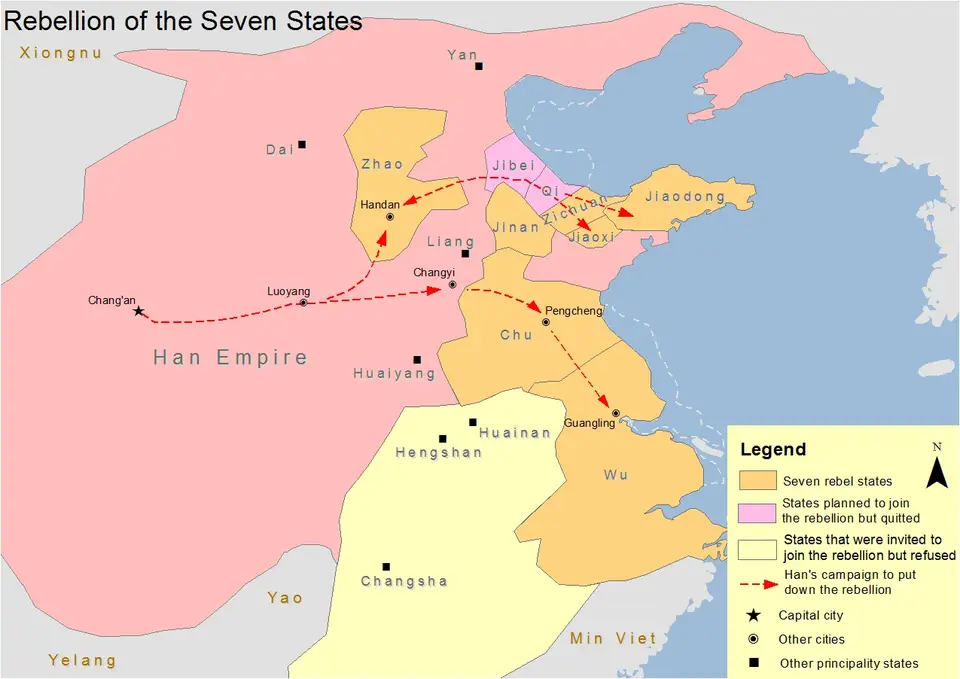
The Rebellion of the Seven States (七国之乱) was a climactic armed conflict erupting in 154 BCE between the Western Han centralized imperial court and powerful regional collateral kingdoms in eastern China. Following the collapse of the Qin Dynasty, Emperor Gaozu established a hybrid system of imperial commanderies and hereditary fiefdoms, ennobling clan relatives to shield the dynastic throne. Over subsequent decades of economic rejuvenation, major principalities like Wu and Chu expanded their demographic bases, struck independent copper coinage, harvested marine salt, and commanded personal armies that flouted imperial authority. When Emperor Jing adopted Imperial Censor Chao Cuo's bold policy of curtailing princely territories, Liu Bi, King of Wu, forged a military alliance with the kings of Chu, Zhao, Jiaoxi, Jiaodong, Zichuan, and Jinan, assembling over two hundred thousand troops under the pretext of executing Chao Cuo to cleanse the court. Emperor Jing dispatched Grand Commandant Zhou Yafu to head the counteroffensive. Adopting a defensive strategy that let the Kingdom of Liang pin down rebel forces while his cavalry severed supply lines, Zhou crushed the rebel confederacy within three months, permanently dismantling regional autonomy and securing absolute central authority.
Liu Bi unites seven principalities, mobilizing over two hundred thousand troops westward under the banner of executing Chao Cuo.
Zhou Yafu fortifies Changyi camp while Liang garrisons defend Suiyang; imperial light cavalry severs rebel supply routes.
Imperial forces crush the nighttime assault at Changyi; Liu Bi is assassinated in exile, completely ending the seven-state revolt.
During the Chu-Han Contention, Liu Bang ennobled prominent military commanders as non-imperial kings to dismantle Xiang Yu's hegemony. Upon ascending the imperial throne in 202 BCE, Emperor Gaozu instituted a dual system combining imperial commanderies with hereditary princely fiefdoms, granting kingdoms superior administrative prestige and extensive geographic domains.
These princely fiefs governed vast agricultural heartlands, exercising independent rights to appoint magistrates, levy local revenues, command armed garrisons, and mint private coinage. Recognizing non-imperial kings as direct threats to centralized rule, Gaozu methodically purged them, replacing their seats with nine collateral Liu lineage princes bound by the White Horse Covenant: "Should anyone not of the Liu lineage claim kingship, all under Heaven shall unite to destroy him."
However, over decades of peace, kinship bonds between regional kings and the central throne deteriorated. Kingdoms expanded into de facto autonomous states. In his Security Memorial, Jia Yi urgently warned Emperor Wen of looming disaster, advocating the partition of regional kingdoms. In particular, Liu Bi ruled fifty-three cities across Wu, exploiting copper mines and coastal salt reserves to amass fabulous fortunes while sheltering fugitive outlaws and flouting imperial court ceremonies.
Following Emperor Jing's accession, Imperial Censor Chao Cuo gained tremendous influence and passionately advocated immediate territorial reductions. In his memorial, Chao insisted: "If we reduce their fiefs today, they will rebel; if we do not reduce them, they will still rebel. Reducing them brings early rebellion with minor harm; failing to reduce them brings delayed rebellion with catastrophic harm."
Emperor Jing approved the strategy, systematically confiscating Donghai Commandery from Chu, Changshan from Zhao, and six districts from Jiaoxi. When imperial envoys arrived in Guangling demanding the surrender of Kuaiji and Yuzhang commanderies, Liu Bi realized that total subjugation was imminent and initiated full-scale armed revolt in the spring of 154 BCE.
In the first month of 154 BCE, Liu Bi dispatched confidential envoys to forge an anti-imperial alliance. The warlike King of Jiaoxi eagerly pledged military support, rallying neighboring Shandong princes. Enraged by the loss of Donghai, King Liu Wu of Chu mobilized his armies, while King Liu Sui of Zhao petitioned Xiongnu nomads for northern cavalry diversions.
At Guangling, Liu Bi consecrated military altars and mobilized all able-bodied male subjects aged fourteen to sixty, assembling over two hundred thousand elite troops. The Wu army crossed the Huai River to join Chu forces, forming a formidable strike force marching directly toward the Central Plains.
To undermine imperial morale, Liu Bi proclaimed the politically deceptive slogan: "Execute Chao Cuo to cleanse the sovereign's court," claiming the campaign was aimed solely at eliminating the treacherous censor rather than overthrowing Emperor Jing.
Rebel forces swept westward through imperial border garrisons and encircled the Kingdom of Liang, ruled by Emperor Jing's younger brother, King Xiao. Suiyang fortress guarded the vital eastern gateway to Chang'an, where King Xiao directed heroic garrison resistance.
Confronting panicky aristocrats in Chang'an, Emperor Jing executed Chao Cuo in a vain bid to appease the rebels. However, having reached the height of his power, Liu Bi proclaimed himself Eastern Emperor and arrogantly demanded supreme imperial authority, exposing his true objective to seize the throne.
Emperor Jing abandoned all illusions of negotiation, appointing Grand Commandant Zhou Yafu to lead thirty-six generals and thirty thousand imperial soldiers eastward, while Dou Ying fortified Xingyang.
Zhou Yafu presented a brilliant operational plan: "Southern troops are agile and thrive on swift tactical clashes, but lack long-range logistical endurance. Let Liang forces absorb their direct assaults at Suiyang, while imperial armies fortify Changyi and dispatch cavalry to sever their Huai River supply lines." Emperor Jing fully endorsed the doctrine.
Rebel armies assaulted Suiyang day and night with siege towers and subterranean tunnels. King Xiao, supported by celebrated commanders Han Anguo and Zhang Yu, repelled every storm with lethal crossbow volleys and boiling oil, inflicting tens of thousands of rebel casualties.
Although Liang desperately appealed for direct tactical relief and Emperor Jing issued urgent imperial orders, Zhou Yafu held his ground at Changyi, refusing direct combat. Behind impregnable earthworks, Zhou dispatched three thousand elite light horsemen under Han Tuici to raid the rear, burning the rebel grain fleet on the Huai River and cutting off all supplies.
Starving in their siege lines and unable to take Suiyang, rebel forces abandoned the fortress and launched reckless assaults against Zhou Yafu's fortified camp at Changyi.
Anticipating a tactical deception when rebels feigned a nighttime strike on his southeastern defenses, Zhou concentrated elite crossbow formations at the northwestern palisade. When the main rebel force surged forward, imperial archers unleashed devastating volleys. Panic swept rebel ranks, and the coalition fractured into general rout. Liu Bi fled across the Yangtze to Dongyue with a few thousand horsemen, where local tribesmen were bribed to assassinate him and surrender his head. King Liu Wu of Chu committed suicide with his sword.
In the northern theater, imperial legions crushed Zhao and the four Shandong principalities. Liu Sui ingested poison, while the remaining princes were executed. The Xiongnu retreated into the steppe, bringing the historic three-month rebellion to a permanent conclusion.
Following the victory, Emperor Jing thoroughly restructured princely governance. The imperial court rescinded the rights of kings to appoint administrative officials or command regional armed forces. Kings were reduced to passive recipients of state-stipulated land taxes, while imperial chancellors dispatched directly from Chang'an assumed total administrative authority over kingdoms.
Furthermore, large fiefdoms like Wu, Chu, and Zhao were fractured into smaller commanderies, permanently returning all copper minting and iron manufacturing monopolies to the central court.
The decisive suppression of the seven states eradicated half a century of centrifugal feudal fragmentation, establishing absolute imperial supremacy over all demographic and fiscal resources within the realm.
This structural unification allowed Emperor Wu to effortlessly implement the subsequent "Decree of Extending Favor" (Tui'en Ling), mobilizing the untrammeled wealth and manpower of a unified China to launch epic campaigns against the Xiongnu and open the historic Silk Road.
Sima Qian recorded in the Records of the Grand Historian: "Liu Bi, King of Wu, stood as the foremost offender among imperial princes, seducing seven states and shaking the empire with hundreds of thousands of troops. Zhou Yafu utilized brilliant generalship, refusing direct frontal clashes while severing supply lines, causing the rebel coalition to collapse like dust. The grand architecture of the state was permanently solidified here."
Ban Gu concluded in the Book of Han: "When Han arose, it abolished Qin harshness to rest with the populace. Emperors Wen and Jing were frugal and benevolent, enriching the realm. With the suppression of the seven states, supreme authority returned to the imperial capital, governance issued from a single throne, and the grandeur of Han was achieved."