Tang Songmo Commandery Creation
Dahe Kuge submits to the Tang Dynasty and is appointed military commander of Songmo.
Tang Dynasty (唐朝) · HISTORICAL EVENT
契丹統治者列表
The Dynastic Succession and Lineage of Khitan Rulers encompasses nearly six centuries of political transformation and monarchical continuity among the Khitan people from the mid-seventh century to the early thirteenth century. Beginning as an autonomous tribal confederacy in the Liao River basin, the leadership evolved through four distinct historical phases: the Dahe clan tributary alliance under the Tang Dynasty, the elective Yaonian clan khaganate…
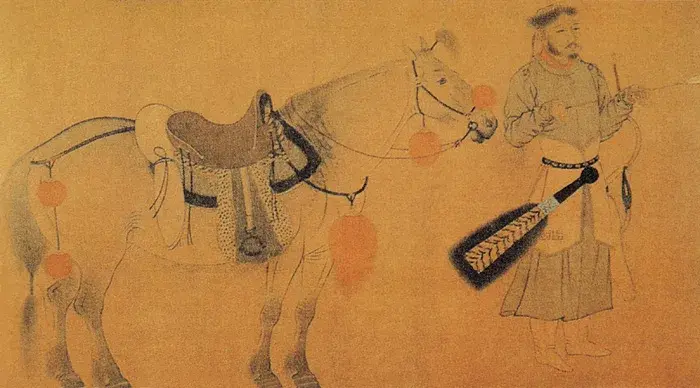
The Dynastic Succession and Lineage of Khitan Rulers encompasses nearly six centuries of political transformation and monarchical continuity among the Khitan people from the mid-seventh century to the early thirteenth century. Beginning as an autonomous tribal confederacy in the Liao River basin, the leadership evolved through four distinct historical phases: the Dahe clan tributary alliance under the Tang Dynasty, the elective Yaonian clan khaganate governed by three-year council elections, the hereditary imperial monarchy of the Yelü clan governing the Great Liao Empire across nine successive emperors, and the Western Liao dynasty established in Central Asia by Yelü Dashi. This dynastic lineage reflects the institutional adaptation of steppe nomadic elites who synthesized Chinese imperial statecraft, introduced dual northern and southern administrative systems, and constructed an enduring multi-ethnic Inner Asian empire.
Dahe Kuge submits to the Tang Dynasty and is appointed military commander of Songmo.
Dahe Jinzhong proclaims himself Supreme Khagan, rebelling against Wu Zhou tyranny.
The Yaonian clan establishes a triennial elective khaganate spanning nine tribal rulers.
Yelü Abaoji abolishes elective rotation, crowning himself emperor and inaugurating hereditary monarchy.
The Liao Empire reaches its zenith of military and administrative power, signing the Chanyuan Treaty.
Yelü Dashi founds the Western Liao Empire in Central Asia, enduring five reigns until overthrown by Kuchlug.
The Khitan people originated in the valleys of the Shira Muren and Xar Moron rivers in northeastern China, first appearing in Chinese historical records during the Northern Wei dynasty. Throughout the pre-Tang centuries, the Khitans comprised decentralized hunting and pastoral clans under continuous tributary subjugation by the Göktürk Khaganate and Goguryeo.
In the mid-seventh century, following Emperor Taizong of Tang's subjugation of the Eastern Turks, the eight Khitan tribes organized under the paramount leadership of the Dahe clan to seek imperial protection. Emperor Taizong incorporated the confederation into the Tang tributary system, establishing the Songmo Area Command in 648 and bestowing the Tang imperial surname on its chieftains. However, pastoral economic vulnerabilities and extortion by predatory Tang frontier governors triggered repeated insurrections, culminating in Dahe Jinzhong's rebellion against the Wu Zhou dynasty in 696.
Following the decline of the Dahe clan, the confederation reorganized under the Yaonian clan in 730, inaugurating a triennial elective khaganate governed by military councils. Although this elective system maintained tribal equilibrium for over a century, the escalating civil warfare of the late Tang period expanded the power of the Yila lineage, which monopolized supreme military offices. By the early tenth century, tribal military democracy became incompatible with imperial administrative demands, paving the way for absolute hereditary monarchy.
In 648 (the 22nd year of Zhenguan), chieftain Dahe Kuge submitted to the Tang court with his followers. Emperor Taizong invested him as military commander of Songmo and bestowed the imperial surname Li, marking the initial recorded institutionalization of Khitan rulership. This lineage persisted through commanders Rugezhu and Kumuoli. In 696, enraged by the abuses of Tang border magistrates, chieftain Dahe Jinzhong proclaimed himself the Supreme Khagan, launching an open rebellion that captured regional frontier bases and shattered imperial armies.
Following Jinzhong's death and retaliatory attacks from the Second Turkic Khaganate, the Dahe leadership collapsed. In 730, the eight tribes elected Yaonian Zuwu as paramount ruler, inaugurating the Yaonian dynasty. The Yaonian lineage produced nine successive elective khagans, including Zuwu, Hula, Su, Bala, and Hende. While religious authority remained with the elective khagan, actual executive and military command concentrated within the Yila lineage, whose leaders served as supreme military commissioners.
In 907, following the death of Hende Khagan, Yila chieftain Yelü Abaoji was elected khagan. Demonstrating extraordinary statecraft, Abaoji abolished the triennial elective rotation, ruthlessly suppressed tribal revolts, and proclaimed himself emperor in 916, founding the Liao Dynasty under the reign era of Shence. This reform established absolute hereditary succession within the Yelü imperial house, transforming the Khitan tribal confederation into a centralized Eurasian empire.
The Liao Empire flourished across two centuries through nine imperial generations: Emperor Taizong (Yelü Deguang) annexed the Sixteen Prefectures of Yanyun, destroyed the Later Jin Dynasty, and officially designated the empire Great Liao in Kaifeng; Emperor Shizong formalized the dual administrative structure; Emperor Muzong consolidated domestic stability; Emperor Jingzong enacted civil reforms; Emperor Shengzong and Empress Dowager Chengtian (Xiao Chuo) directed the golden age of Liao power, concluding the historic Chanyuan Treaty with Northern Song; and emperors Xingzong and Daozong presided over intense cultural, Buddhist, and literary flourishing. The imperial line concluded with Emperor Tianzuo (Yelü Yanxi), who was captured by Jurchen forces in 1125, terminating the imperial dynasty in China proper.
Confronting dynastic collapse, imperial scion Yelü Dashi escaped westward with two hundred elite horsemen in 1124, uniting nomadic tribes across the Tarim Basin to establish the Western Liao Empire (Qara Khitai). Ruling from Balasagun in modern Kyrgyzstan, Yelü Dashi routed the Seljuk Empire at the Battle of Qatwan in 1141, establishing hegemony across Central Asia. Western Liao persisted across five generations under Yelü Dashi, Empress Xiao Tabuyan, Emperor Renzong, Empress Yelü Pusuwan, and Emperor Zhilugu, until usurped by Naiman prince Kuchlug in 1211, concluding nearly six centuries of continuous Khitan monarchical rule.
The succession of Khitan rulers left an indelible imprint on the institutional history of Inner Asia and East Asia. Administratively, it demonstrated the successful institutional evolution of a nomadic society from pastoral tribalism into a sophisticated bureaucratic empire. The invention of the dual northern and southern administrative system—governing Khitans according to pastoral customs while administering sedentary Han populations through Chinese bureaucratic law—provided an enduring institutional prototype utilized by the Jurchen Jin, Mongol Yuan, and Manchu Qing empires.
Geopolitically and culturally, the far-reaching expansion of Khitan monarchs carried their name across Eurasia. Because the Liao and Western Liao empires dominated trans-Eurasian trade corridors, the ethnonym Khitan became the standard designation for China throughout Central Asia, Russia, and medieval Europe, immortalized as Cathay in English and Kitay in Russian.
Furthermore, the pluralistic governance of Khitan monarchs fostered unprecedented cultural and religious syncretism. Rulers patronized Confucian academies, subsidized massive Buddhist translations and temple complexes, honored ancestral shamanic rites, and protected Nestorian Christian and Islamic communities across Central Asia, standing as an enduring testament to the cosmopolitan flexibility of Inner Asian statecraft.
Traditional Chinese annals and modern Inner Asian historians evaluate the succession of Khitan rulers as an extraordinary demonstration of political adaptability. The History of Liao praised early monarchs for their military prowess and later emperors for their literary refinement, noting that the dynasty achieved exceptional administrative stability across more than two centuries.
Modern scholars emphasize that the historical progression of Khitan rulership illustrates the dynamic integration of nomadic and agrarian political traditions. Far from being passive recipients of Chinese culture, Khitan monarchs actively refashioned imperial governance to accommodate pastoral heritage, creating a distinctive model of conquest dynasty that fundamentally reshaped medieval Eurasian history.