Founding through Yanyun Cession
Shi Jingtang cedes the Sixteen Prefectures and accepts vassalage to establish Later Jin.
Later Jin Dynasty (后晋) · HISTORICAL EVENT
契丹灭后晋
The Khitan Conquest of Later Jin was a momentous military campaign fought between 946 and 947 in northern and central China, in which Emperor Taizong of Liao (Yelü Deguang) led steppe cavalry forces to conquer the Central Plains empire of Later Jin. Initially founded in 936 by Emperor Gaozu of Later Jin (Shi Jingtang) through the cession of the Sixteen Prefectures of Yanyun and submission as a vassal, relations disintegrated following the accession of…
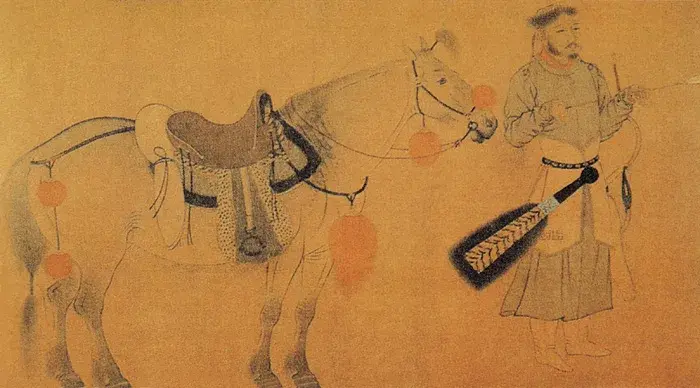
The Khitan Conquest of Later Jin was a momentous military campaign fought between 946 and 947 in northern and central China, in which Emperor Taizong of Liao (Yelü Deguang) led steppe cavalry forces to conquer the Central Plains empire of Later Jin. Initially founded in 936 by Emperor Gaozu of Later Jin (Shi Jingtang) through the cession of the Sixteen Prefectures of Yanyun and submission as a vassal, relations disintegrated following the accession of Emperor Chu of Later Jin (Shi Chonggui) in 942. Asserting sovereignty, Shi Chonggui addressed the Khitan monarch as a grandson rather than a subject, provoking repeated invasions. In late 946, during the decisive Battle of the Hutuo River, Later Jin commander-in-chief Du Chongwei betrayed his dynasty, surrendering two hundred thousand imperial soldiers. In January 947, Khitan forces captured the imperial capital of Bianjing, dethroning Shi Chonggui and extinguishing Later Jin. Although Yelü Deguang proclaimed himself Emperor of the Great Liao in Bianjing, widespread popular uprisings against brutal forage raids compelled a Khitan withdrawal months later.
Shi Jingtang cedes the Sixteen Prefectures and accepts vassalage to establish Later Jin.
Shi Chonggui ascends the throne and asserts imperial autonomy, addressing Liao as grandson but not subject.
Khitan forces invade northern China but suffer tactical setbacks against Jin defenses at Yangcheng.
Emperor Taizong launches an all-out invasion; Jin mobilizes two hundred thousand troops under Du Chongwei.
Du Chongwei surrenders his entire army to the Khitan along the Hutuo River.
Khitan cavalry captures Bianjing; Shi Chonggui surrenders; Yelü Deguang proclaims the Great Liao dynasty.
The foundation of the Later Jin Dynasty was deeply compromised by external subjugation. In 936, military commissioner Shi Jingtang rebelled against the Later Tang Dynasty in Jinyang. Confronting imminent defeat, Shi Jingtang sought armed intervention from Emperor Taizong of Liao. In exchange for military support, Shi Jingtang concluded a humiliating pact: ceding the vital Sixteen Prefectures of Yanyun, pledging thirty thousand bolts of annual silk tribute, and styling himself a son-emperor to the younger Khitan monarch. With Khitan cavalry assistance, Shi Jingtang destroyed the Later Tang and founded Later Jin as Emperor Gaozu of Later Jin, establishing his capital at Bianjing.
During his reign, Emperor Gaozu adhered strictly to humble vassalage. However, the loss of the Yanyun mountain passes dismantled northern China's natural defense perimeter, allowing Khitan cavalry unrestricted access across the Hebei plain directly to the Yellow River. This left the Central Plains defenseless against future steppe incursions.
In 942, Shi Jingtang died of illness and was succeeded by his nephew Shi Chonggui, posthumously known as Emperor Chu of Later Jin. Supported by influential military commissioner Jing Yanguang, the young emperor pursued an assertive foreign policy. In his diplomatic dispatches to the Liao court, Shi Chonggui styled himself as grandson but pointedly refused the terminology of a subject. Furthermore, Jing Yanguang expelled Khitan merchants, confiscated tributary goods, and taunted Khitan ambassadors with threats of armed confrontation.
Infuriated by this diplomatic defiance, Emperor Taizong launched large-scale punitive expeditions across the Yellow River between 944 and 945. Later Jin forces defended their territory with determination, inflicting tactical defeats on Khitan cavalry at Chanzhou and Yangcheng. However, continuous mobilization bankrupted the imperial treasury, while mutual suspicion crippled the high command, creating conditions for military catastrophe.
In October 946, Emperor Taizong mobilized several hundred thousand Khitan cavalry and allied steppe contingents for a decisive third campaign. Confronted by an existential threat, Emperor Chu of Later Jin committed the empire's entire strategic reserve, assembling an army of two hundred thousand seasoned troops under the command of his uncle, military commissioner Du Chongwei, assisted by Li Shouzhen.
In November, the two massive armies converged along the Hutuo River near modern Zhengding, Hebei. Du Chongwei entrenched his forces at the Zhongdu Bridge, entering an extended standoff across the river. Recognizing that frontal assaults against heavily armored infantry were costly, Emperor Taizong dispatched light cavalry detachments to ford shallow upstream crossings, severing the Later Jin supply lines from the south.
Encircled on the riverbanks without provisions, the Jin troops faced starvation. Commander Du Chongwei, driven by selfish political ambition, sought to emulate Shi Jingtang by leveraging Khitan military power to seize the throne for himself. Perceiving Du's treacherous inclinations, Emperor Taizong dispatched secret emissaries bearing a forged imperial oath promising to invest Du Chongwei as the new Emperor of the Central Plains if he surrendered.
Dazzled by the prospect of imperial elevation, Du Chongwei engineered a treasonous capitulation. On January 10, 947, Du Chongwei compelled his subordinate generals to surrender, ordering all two hundred thousand soldiers to disarm. The entire field army surrendered without resistance, completely dismantling the imperial defenses of the Later Jin state.
Exploiting the total collapse of Jin resistance, Emperor Taizong dispatched turncoat general Zhang Yanze with vanguard cavalry to march day and night toward Bianjing. On January 26, 947, Zhang Yanze's troops stormed into the capital through undefended gates, capturing the city and executing anti-Khitan chancellor Jing Yanguang.
Abandoned and surrounded in his palace, Emperor Chu of Later Jin attempted self-immolation but was restrained by attendants. On January 30, Shi Chonggui composed an unconditional letter of surrender, submitting the dynastic jade seals and prostrating himself before the conquerors. On February 5, Emperor Taizong entered Bianjing in ceremonial procession, confining the deposed emperor in a temple and formally terminating the Later Jin Dynasty.
On February 24, 947, Emperor Taizong held a grand coronation ceremony in the Chongyuan Hall of Bianjing, officially changing his dynastic title from Khitan to Great Liao and adopting the reign title Datong. Shi Chonggui and the imperial clan were stripped of royal status and exiled into the far northeastern wilderness of Huanglong Prefecture. Within three months, the Later Jin dynasty was entirely eradicated.
The Khitan Conquest of Later Jin represented an unprecedented rupture in the political landscape of the Five Dynasties period. For the first time since the fall of the Tang Dynasty, an Inner Asian nomadic empire successfully captured the imperial heartland, occupied the central capital, and proclaimed an imperial dynasty over the Central Plains.
However, the occupation collapsed rapidly. Lacking bureaucratic institutions to govern an agrarian populace, the Khitan army resorted to seasonal grazing raids known as beating grassroots, conducting ruthless plunder across Henan and Hebei. This rampant pillaging provoked universal outrage. Peasants and townspeople formed local militias, assassinating occupation officials and repelling foraging detachments.
Confronted with widespread popular guerrilla warfare, Emperor Taizong acknowledged his failure to pacify the Central Plains and ordered an emergency withdrawal northward in April 947. During the retreat, the emperor died of sudden illness at Luancheng in Hebei, his body preserved as mummified imperial meat for transport back to the steppe.
The sudden power vacuum allowed Hedong military commissioner Liu Zhiyuan to march southward into Bianjing, where he established the Later Han Dynasty. Nonetheless, the campaign firmly consolidated Khitan control over the Sixteen Prefectures of Yanyun, depriving subsequent Chinese dynasties, including the Northern Song, of northern defensive barriers for over two centuries.
Traditional Chinese historiography viewed the fall of Later Jin as a tragic consequence of dynastic illegitimacy and unprincipled treachery. The Old History of the Five Dynasties lamented that Du Chongwei's surrender of two hundred thousand loyal troops stood as one of the most disgraceful betrayals in imperial annals.
In the Comprehensive Mirror for Aid in Governance, Sima Guang analyzed the catastrophe as an inevitable retribution for Shi Jingtang's original cession of Yanyun, noting that when a state surrenders its vital frontiers to foreign powers, subsequent rulers cannot easily restore geopolitical autonomy without total ruin.
Modern historians emphasize that the 946-947 conquest illustrated the limits of nomadic military supremacy over dense sedentary agrarian populations. While mobile cavalry could shatter conventional armies and occupy urban capitals, long-term administration required institutional accommodation and administrative integration, a lesson that fundamentally transformed Liao statecraft in subsequent decades.