Galdan Invades Khalkha Mongolia
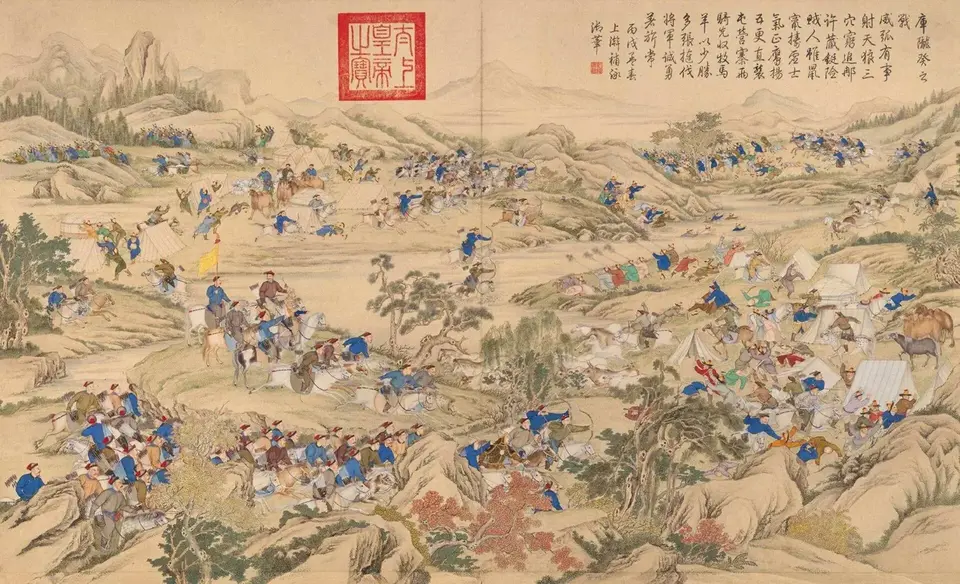
Galdan crosses the Altai Mountains, attacks the Khalkhas, and drives hundreds of thousands of refugees south to seek Qing protection.
Qing Dynasty (清代, Reigns of Kangxi, Yongzheng, and Qianlong) · HISTORICAL EVENT
平定准噶尔
The Pacification of the Dzungars (平定准噶尔) was a monumental series of military and strategic campaigns prosecuted across nearly seven decades under the Kangxi, Yongzheng, and Qianlong emperors of the Qing Dynasty, culminating in the total eradication of the Dzungar Khanate and the territorial consolidation of the empire. In the late seventeenth century, the Choros Oirat Mongols founded a sprawling nomadic empire in the Ili River Basin under Baatur…
The Pacification of the Dzungars (平定准噶尔) was a monumental series of military and strategic campaigns prosecuted across nearly seven decades under the Kangxi, Yongzheng, and Qianlong emperors of the Qing Dynasty, culminating in the total eradication of the Dzungar Khanate and the territorial consolidation of the empire. In the late seventeenth century, the Choros Oirat Mongols founded a sprawling nomadic empire in the Ili River Basin under Baatur Khung-Taiji and Galdan Boshugtu Khan, conquering the Tarim Basin and Tibet. In 1688, Galdan launched an invasion of Khalkha Mongolia, driving the northern tribes south of the Great Wall and advancing to Ulan Butung, just seven hundred li from Beijing. The Kangxi Emperor personally led three northern expeditions into the steppe, shattering Galdan's camel fortresses at Ulan Butung in 1690 and annihilating his elite forces at Jao Modo in 1696, driving Galdan to his death. Subsequent Dzungar rulers Tsewang Rabtan and Galdan Tsering persisted in challenging Qing suzerainty, invading Tibet in 1716 and raiding Khalkha territory. The Kangxi court expelled the Dzungars from Lhasa in 1720, and Prince Celing scored a decisive victory at Erdene Zuu in 1732 to stabilize the frontier. Exploiting the succession struggles that paralyzed the khanate after Galdan Tsering's death, the Qianlong Emperor dispatched two expeditionary armies into the Ili Valley in 1755, where cavalry officer Ayusi mounted a daring night assault at Gedaingshan to rout Khan Dawachi. Following the suppression of Amursana's subsequent revolt in 1757 by General Zhaohui, the Dzungar Khanate ceased to exist. The Qing established the Office of the General of Ili, permanently consolidating imperial sovereignty over the vast expanse of Xinjiang.
Galdan crosses the Altai Mountains, attacks the Khalkhas, and drives hundreds of thousands of refugees south to seek Qing protection.
The Kangxi Emperor leads armies north; Prince Fuquan destroys Galdan's camel defenses at Ulan Butung, though Tong Guogang falls.
Fiyanggū intercepts Galdan's main host at Jao Modo, killing Queen Anu and destroying the Dzungar army in an all-day clash.
Cornered in the wilderness of Kobdo, Galdan commits suicide by poison, securing imperial authority over Outer Mongolia.
Tsewang Rabtan sends Tsering Dondup on a secret march across the Kunlun Mountains, sacking Lhasa and killing Lhazang Khan.
Imperial armies under Yansin and Garbi expel the Dzungars from Tibet and enthrone the Seventh Dalai Lama in Lhasa.
General Furdan falls into an ambush laid by Galdan Tsering at Hoton Nur, suffering catastrophic losses in western Mongolia.
Prince Celing crushes Galdan Tsering's invasion force at the Battle of Erdene Zuu, forcing the Dzungars to sue for border peace.
Two imperial columns enter Ili; Ayusi leads twenty-two riders to rout Dawachi at Gedaingshan, capturing the Dzungar khan.
General Zhaohui crushes the rebellion; Amursana dies in Russian exile, bringing total closure to the Dzungar Khanate.
Following the collapse of the Northern Yuan, the Western Mongols (Oirats) gradually coalesced into four major confederations: the Dzungars, Khoshuts, Dorbets, and Torghuts. In 1634, Baatur Khung-Taiji established the Dzungar Khanate centered in the fertile Ili River Valley, constructing fortified settlements, introducing sedentary agriculture, and promoting legal codification through the Great Code of the Nomads. In 1648, the scholar Zaya Pandita devised the Clear Script (Todo Bichig), consolidating the political and cultural identity of the Oirats.
In 1676, Baatur's son Galdan returned from Buddhist theological studies in Lhasa to seize leadership, adopting the title of Boshugtu Khan. A gifted military tactician, Galdan rapidly subjugated the neighboring Khoshut and Dorbet tribes, uniting the Western Mongols under his banner. In 1678, Galdan's armies crossed the Tian Shan mountains southward, seizing Yarkand, Kashgar, and Khotan. By bringing the agrarian oasis cities of the Tarim Basin under tribute, Galdan constructed a sprawling pastoral-military empire spanning Eastern Central Asia.
Having established his hegemony across the western territories, Galdan directed his ambitions eastward toward the Khalkha Mongols of the Outer Steppe. The three Khalkha khanates—Tushiyetu, Jasaghtu, and Sechen—were paralyzed by endemic internecine rivalries. Galdan actively intervened in Khalkha disputes to expand his influence. Concurrently, the Tsarist Russian Empire was aggressively expanding eastward across Siberia toward the Amur River. Anxious to halt Qing expansion, Russian agents supplied Galdan with firearms, cannons, and gunpowder, encouraging him to challenge the Qing court.
In 1688, while the Qing army was engaged against Russian forces at Albazin on the Amur, Galdan mobilized thirty thousand veteran cavalrymen, crossed the Altai Mountains, and launched an invasion of Khalkha territory. Overwhelmed in combat, the Tushiyetu Khan and the Jebtsundamba Khutuktu fled southward with hundreds of thousands of refugees to seek protection along the Great Wall. The arrival of the destitute Khalkha host compelled the Kangxi Emperor to make a fateful geopolitical choice between defending his northern borders and embracing the Khalkhas under imperial suzerainty.
In 1690, Galdan brushed aside imperial screening forces under Minister Alani and drove deep into Inner Mongolia, encamping at Ulan Butung (in modern Hexigten Banner), a mere three hundred and fifty kilometers north of Beijing. Recognizing the mortal danger to the capital, the Kangxi Emperor ordered an immediate counter-offensive, mobilizing the Eight Banners under Prince Fuquan. On August 1, 1690, Qing artillery commenced a sustained barrage against Galdan's defensive line. The Dzungars had tied the legs of ten thousand camels together, resting them on the ground behind ramparts of baggage to create a formidable "camel wall" (tuocheng), from which musket-men fired in volleys.
The Qing Artillery Corps deployed heavy siege guns and Shenji cannons, shattering the camel barricades under continuous shellfire, after which Manchu cavalry and infantry charged the breaches with cold steel. Imperial Minister Tong Guogang died in combat while leading the assault. Devastated by the bombardment, Galdan feigned peace negotiations to delay pursuit, retreating into the northern wilderness under cover of darkness. Refusing to yield, Galdan regrouped in Kobdo, maintaining secret communications with Tsarist authorities.
In 1696, the Kangxi Emperor resolved to crush Galdan in a decisive confrontation, mobilizing one hundred thousand soldiers across three converging columns through the Gobi Desert. Kangxi commanded the central column in person, while Grand General Fiyanggū led the forty-six thousand-man western column from Guihua along the Ongi River to sever Galdan's retreat. On May 13, Fiyanggū intercepted the Dzungar host at Jao Modo (near modern Zuunmod, south of Ulan Bator). Galdan launched desperate uphill charges against the Qing heights. Fiyanggū dispatched his cavalry through hidden mountain defiles to assault the enemy baggage train from the rear, collapsing the Dzungar lines. Over three thousand Dzungar warriors were slain, Galdan's wife Queen Anu was killed in action, and Galdan fled with only a handful of riders. In 1697, cornered at Acha Amutai, Galdan ended his life by poison, resulting in the pacification of Outer Mongolia.
Following Galdan's demise, his nephew Tsewang Rabtan secured the Dzungar throne. Although maintaining formal tributary relations with Beijing, Tsewang Rabtan expanded his forces and constructed fortified outposts along the frontier. In 1716, he dispatched his top general, Tsering Dondup, with six thousand elite horsemen across the formidable Kunlun Mountains. Covering treacherous high-altitude terrain without detection, the Dzungars raided Lhasa, executed Lhazang Khan of the Khoshut, imprisoned the Seventh Dalai Lama Kelzang Gyatso, and looted the great monastic establishments of Tibet. Dzungar control of the Tibetan plateau posed an intolerable threat to the security of Qinghai and Sichuan.
Recognizing that Tibet was the essential southern shield of the northwest, the Kangxi Emperor appointed Prince Yinti as Grand General in 1718 to direct operations from Xining. In 1720, the Qing launched a coordinated two-pronged counter-offensive: General Garbi advanced from Sichuan via Dartsendo, while General Yansin marched from Qinghai escorting the Seventh Dalai Lama. Overcoming blinding blizzards and oxygen deprivation across mountain passes, Qing forces routed Dzungar detachments outside Lhasa. Tsering Dondup's depleted remnants retreated toward the northwest, and the Qing liberated Lhasa, enthroning the Seventh Dalai Lama in the Potala Palace. The court subsequently installed imperial resident commissioners (Ambans) and permanent garrisons in Lhasa, bringing Tibet firmly within imperial governance.
In 1727, Tsewang Rabtan died and was succeeded by his son Galdan Tsering. Ambitious and bellicose, Galdan Tsering established casting foundries to produce modern artillery, detained Qing border envoys, and launched assaults against Qing frontier posts along the Altai range in 1729. The Yongzheng Emperor dispatched two expeditionary armies: General Furdan commanding the northern route from Kobdo, and General Yue Zhongqi leading the western route from Barkol.
In June 1731, Furdan committed a grave tactical blunder by advancing deep into rugged terrain without reconnaissance. His ten thousand troops were trapped by thirty thousand Dzungar cavalry at Hoton Nur (in modern western Mongolia). Besieged in torrential storms without food or water, Qing forces fought for five days; despite desperate resistance, several senior generals fell in combat, and Furdan escaped back to Kobdo with only a remnant, shaking imperial confidence along the northern frontier.
Emboldened by his victory, Galdan Tsering led thirty thousand cavalrymen into the Khalkha heartland in July 1732, intending to sack the holy Buddhist shrine of Erdene Zuu. Imperial son-in-law and Vice General Celing deployed full field artillery along the riverbanks to check the initial charge, subsequently launching an armored cavalry flanking movement against both enemy wings. In the climactic confrontation on September 1, the Qing crushed the Dzungar army, slaughtering over ten thousand invaders and drowning thousands in the Orkhon River. Crippled by the disaster, Galdan Tsering retreated westward and sued for peace in 1734, restoring regional stability.
In 1745, Galdan Tsering died, plunging the Dzungar Khanate into bloody factional strife. His heir Tsewang Dorji Namjal was murdered by his elder brother Lama Darja; in turn, noble Dawachi allied with Amursana of the Khoit tribe to assassinate Lama Darja and seize power. Dawachi subsequently turned upon Amursana, defeating him in battle. In 1754, the desperate Amursana led tens of thousands of his tribesmen across the Altai Mountains to submit to the Qianlong Emperor at the Chengde Mountain Resort, begging for imperial intervention against Dawachi.
The Qianlong Emperor recognized that the disintegration of the Dzungar ruling house provided an unprecedented historical opening to settle the western frontier once and for all. Overruling hesitant ministers who urged fiscal caution, Qianlong ordered a dual-column invasion in February 1755. General Bandi led the northern column from Uliastai, while General Yongchang commanded the western column from Barkol, with Amursana serving as vanguard guide. The combined force of fifty thousand troops advanced across the Ili Basin. Local Oirat clans surrendered without firing a shot, and by May the Qing entered the Ili River Valley. Dawachi retreated with ten thousand loyalists to make a final stand along the craggy heights of Gedaingshan near the Tekes River.
Dawachi entrenched his positions with heavy timber stockades and stone revetments across the cliffs of Gedaingshan. On the stormy night of May 14, 1755, Ayusi, a defected Dzungar cavalry commander serving in the Qing vanguard, led twenty-two hand-picked Mongol riders scaling the rear cliffs of the mountain under cover of darkness. Armed with lances, Ayusi and his men burst through the camp stockades, yelling and stabbing through the command tents. Believing an immense imperial host had enveloped them, Dawachi's troops panicked, trampling each other in chaotic flight.
Dawachi's army disintegrated. The khan fled south across the Tian Shan mountains with a small retinue to Ush Turpan, where he was captured by the local Muslim governor Khojis and delivered to Qing headquarters, completing the pacification of the Ili Basin. However, following the victory, Amursana grew aggrieved when the Qianlong Emperor refused to invest him as supreme khan over all four Oirat tribes. In autumn 1755, Amursana rebelled, killing General Bandi and butchering the small imperial garrison at Ili.
The Qianlong Emperor mobilized a punitive expedition under General Zhaohui in 1756. Although Amursana attempted to mobilize nomadic resistance, his followers were decimated by relentless Qing pursuit and a devastating smallpox epidemic. In 1757, Zhaohui shattered the rebel forces in successive battles along the Ili and Urumqi corridors. Abandoned by his allies, Amursana fled into Siberia, where he died of smallpox in Tobolsk. Qing diplomats demanded and received his body from Russian authorities, bringing an end to the sixty-seven-year conflict and obliterating the Dzungar Khanate.
The pacification of the Dzungars stands as one of the crowning strategic achievements of the Qing Dynasty. Spanning seven decades and the reigns of three great emperors, the enterprise eradicated the last major nomadic empire of Inner Asia, which had contested imperial authority for generations. The vast territories north and south of the Tian Shan mountains—spanning the Ili River Valley, the Junggar Basin, and the Tarim Basin—were integrated into the unified imperial state. In 1762, the court established the Office of the General of Ili headquartered at Huiyuan, exercising combined civil and military governance over the newly conquered frontier territories, which were officially designated as "Xinjiang" (the New Frontier).
The elimination of the Dzungar threat fundamentally restructured the geopolitical architecture of Inner Asia. By incorporating the Khalkha and Oirat Mongols into the Eight Banners banner-league system and accommodating the return of the Torghuts from the Volga in 1771, the Qing permanently resolved the centuries-old cycle of nomadic raiding across the northern steppe. State-sponsored agricultural colonization (tuntian) brought soldiers and civilian settlers into Xinjiang, reviving the ancient caravan routes of the Silk Road. Crucially, the military delineation of the northwestern perimeter checked Tsarist Russian penetration toward the Pamirs, securing the territorial foundation that defines China's modern northwestern frontiers.