Decree of Abolition
Emperor Kangxi orders the complete dissolution of the Three Feudatories to restore imperial centralization.
Qing Dynasty (清朝) · HISTORICAL EVENT
三藩之乱
The Revolt of the Three Feudatories (Sanfan Zhi Luan, 三藩之乱) was an eight-year civil conflict fought between 1673 and 1681 (the twelfth through twentieth years of the Kangxi reign) between the central Qing government and three autonomous regional princes: Wu Sangui (Prince of Pingxi), Geng Jingzhong (Prince of Jingnan), and Shang Zhixin (son of Shang Kexi, Prince of Pingnan). Following the 1644 conquest, the Qing court granted hereditary feudal domains…
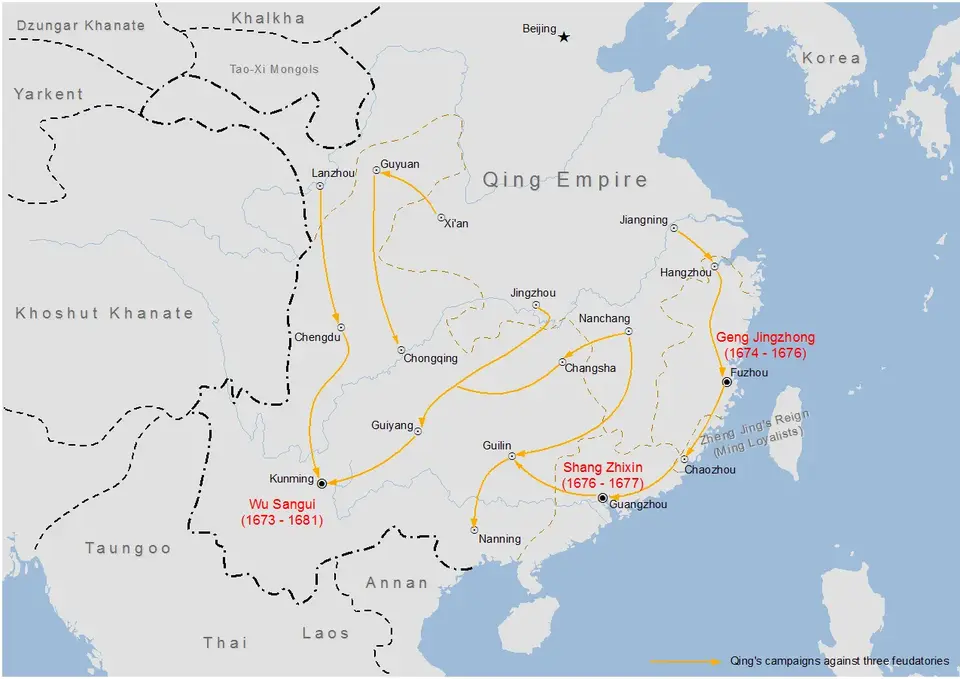
The Revolt of the Three Feudatories (Sanfan Zhi Luan, 三藩之乱) was an eight-year civil conflict fought between 1673 and 1681 (the twelfth through twentieth years of the Kangxi reign) between the central Qing government and three autonomous regional princes: Wu Sangui (Prince of Pingxi), Geng Jingzhong (Prince of Jingnan), and Shang Zhixin (son of Shang Kexi, Prince of Pingnan). Following the 1644 conquest, the Qing court granted hereditary feudal domains in southern China to Han turncoat generals who helped subdue the Southern Ming, leaving Yunnan, Guizhou, Guangdong, and Fujian under their military control. Operating as autonomous domains, the Three Feudatories commanded private armies, monopolized salt and mining revenues, and appointed civil magistrates, consuming half of the empire's annual tax receipts. In 1673, the young Emperor Kangxi resolved to abolish the feudatories to restore imperial authority. Wu Sangui revolted in Yunnan in the eleventh month of 1673, claiming to restore the Ming and rallying Geng Jingzhong, Shang Zhixin, Wang Fuchen in Shaanxi, and Zheng Jing in Taiwan into open war. Demonstrating extraordinary fortitude, Emperor Kangxi contained the rebellion along the Yangtze River, pacified the northwest through conciliation and siege warfare, and systematically dismantled rebel alliances. In 1681, Qing armies captured Kunming, completely extinguishing the rebellion and consolidating unified Qing rule across China.
Emperor Kangxi orders the complete dissolution of the Three Feudatories to restore imperial centralization.
Wu Sangui executes Governor Zhu Guozhi and proclaims the restoration of the Ming, rapidly overrunning the southwest.
Geng Jingzhong revolts in Fujian; Wang Fuchen rebels in Pingliang; Zheng Jing invades coastal Fujian.
Tuhai pacifies Wang Fuchen at Pingliang; Jieshu defeats Geng Jingzhong; Shang Zhixin yields in Guangdong.
Wu Sangui declares himself Emperor of Zhou at Hengzhou, dying of illness months later; his grandson retreats to Yunnan.
Tripartite Qing armies converge on Kunming; Wu Shifan commits suicide, concluding the eight-year civil war.
Following the Qing conquest of Beijing in 1644, Eight Banners forces were insufficient to suppress the Southern Ming and peasant rebel forces across the south. The Qing court relied on former Ming commanders—Wu Sangui, Kong Youde, Geng Zhongming, and Shang Kexi—elevating them to princely rank and granting them autonomous provincial domains. Following Kong Youde's suicide at Guilin, the southern territory was consolidated into three primary feudatories: Wu Sangui governed Yunnan and Guizhou; Geng Jingzhong ruled Fujian; and Shang Kexi garrisoned Guangdong.
The feudatories possessed immense military power, commanding tens of thousands of regular Eight Banners and Green Standard troops. In Yunnan, Wu Sangui created an opulent palace at Wuhuashan, appropriated former Ming estates, and seized state copper and salt monopolies to mint private currency. He conducted independent horse-tea commerce with Tibet and established the "Western Selection" system, appointing civil and military officials across multiple provinces. The imperial treasury was forced to subsidize the feudatories with over twenty million taels of silver annually, consuming half the empire's revenues and threatening central sovereignty.
Upon assuming direct imperial governance after purging the regent Oboi in 1669, Emperor Kangxi identified the feudatories, the Grand Canal, and the Yellow River as his three paramount administrative priorities. In spring 1673, Shang Kexi requested permission to retire to Liaodong while passing his command to his son Shang Zhixin. Recognizing an opportunity, Kangxi permitted the retirement but abolished the hereditary domain. When Wu Sangui and Geng Jingzhong submitted test resignations, senior officials like Mingzhu argued that rebellion was inevitable whether the feudatories were abolished or preserved. Backed by his ministers, Kangxi ordered the immediate dissolution of all three feudatories, prompting Wu to revolt.
In the eleventh month of 1673, imperial commissioners overseeing the demobilization reached Kunming. Knowing his regional hegemony was doomed, Wu Sangui executed a violent rebellion on the twenty-first night of the month. He trapped and killed Yunnan Governor Zhu Guozhi, imprisoned loyalist magistrates, and murdered the imperial envoys. Abandoning Qing regalia and ordering hair cut according to Ming customs, Wu claimed to be fighting to restore the Ming dynasty, adopting the title of Generalissimo and King of Zhou to declare war against the Qing.
Wu's seasoned armies marched along three axes. Wang Pingfan invaded Sichuan, driving Governor Zhou Youde into flight; Ma Bao led cavalry into Guizhou, securing the capitulation of Cao Shenji; and Wu personally advanced into Hunan along the Yuan and Zi Rivers, capturing Changde, Yuezhou, Hengzhou, and Changsha in rapid succession. Wu's armies reached the southern bank of the Yangtze at Yuezhou. Unprepared for the rapid onslaught, Qing frontier commands collapsed, leaving Yunnan, Guizhou, Sichuan, and Hunan in rebel hands within months.
Wu's initial successes triggered widespread rebellions across southern China. In the third month of 1674, Geng Jingzhong revolted in Fuzhou, styling himself Commander-in-Chief, imprisoning Governor-General Fan Chengmo, and dispatching armies north into Zhejiang and west into Jiangxi. In Guangxi, Sun Yanling rebelled at Guilin, styling himself General Anyuan.
Even more catastrophic was the uprising in the northwest. In the twelfth month of 1674, Shaanxi Provincial Commander Wang Fuchen revolted at Pingliang, killing Imperial Commissioner Moluo and accepting commissions from Wu Sangui. Key passes throughout Shaanxi and Gansu fell, placing rebel armies within striking distance of Chang'an and Beijing. Meanwhile, Zheng Jing of Taiwan landed amphibious forces in Fujian, while Shang Zhixin confined his father Shang Kexi in Guangzhou in early 1676, defecting to Wu. Most of southern China was in open rebellion, plunging the Qing state into its most severe existential crisis since 1644.
Confronting this catastrophe, the twenty-year-old Emperor Kangxi displayed extraordinary fortitude and strategic acumen. Politically, the emperor demonstrated iron resolve by executing Wu Sangui's eldest son Wu Yingxiong in Beijing. He published manifestos exposing Wu's treasonous past—reminding the realm of Wu's betrayal of the Ming in 1644 and his murder of the Yongli Emperor—while offering general amnesties to wavering rebel subordinates.
Militarily, Kangxi enacted a strategy of containment: holding the Yangtze barrier, prioritizing the pacification of the northwest, and isolating Wu Sangui in Hunan. The emperor deployed Grand General Yolo and Prince Lekerjin with Eight Banners armies to Jingzhou, Xiangyang, and Wuchang, sealing off northern crossings. Wu Sangui made the critical strategic error of halting at the Yangtze in Hunan, seeking regional partition rather than driving north, granting Kangxi precious months to consolidate his defenses.
With the Yangtze line secured, Kangxi focused on neutralizing the threat in the northwest. In spring 1676, the emperor appointed Grand Secretary Tuhai as Pacifying General to subdue Pingliang. Tuhai adopted an integrated approach of psychological warfare and heavy artillery bombardments, encircling Pingliang with deep circumvallation trenches and deploying Hongyipao cannons against the citadel.
Concurrently, Tuhai sent Zhou Peigong into the besieged city to negotiate terms with Wang Fuchen, guaranteeing imperial pardons and honors. With provisions exhausted and walls collapsing, Wang Fuchen surrendered in the sixth month of 1676. The resolution of the Pingliang crisis eliminated the threat to Beijing, reopened supply lines through Guanzhong, and enabled Qing armies to drive south into Hanzhong, severing Wu Sangui's northwestern flank.
Following northern pacification, rebel alliances in the southeast rapidly disintegrated. In 1676, Prince Jieshu advanced into Fujian, defeating Geng Jingzhong's armies at Xianxia Pass. Trapped between Qing armies and hostile Taiwanese forces under Zheng Jing, Geng surrendered in the tenth month of 1676, restoring imperial control over Fujian.
In Guangdong, Shang Zhixin grew resentful of Wu Sangui's exorbitant financial and military demands. Recognizing the shift in momentum, Shang defected back to the Qing in the fifth month of 1677, retaining his title as Prince Pingnan. In Guangxi, Sun Yanling was assassinated by Wu's nephew Wu Shicong, throwing local forces into confusion. With Geng and Shang subdued, the rebel coalition collapsed, leaving Wu Sangui encircled and isolated in Hunan.
During the height of the rebellion, Zheng Jing (King of Yanping), ruling the Kingdom of Tungning in Taiwan, sought to capitalize on continental disorder to reclaim territory. In 1674, lacking naval power, Geng Jingzhong invited Zheng Jing to coordinate an amphibious offensive, promising to cede the coastal prefectures of Zhangzhou and Quanzhou as logistical supply bases. Zheng mobilized hundreds of warships across the Taiwan Strait, occupying Xiamen and Jinmen and landing marine forces along coastal Fujian.
However, conflicting ambitions and territorial rivalries swiftly transformed the nominal allies into bitter enemies. Fearing Zheng's expansion, Geng withheld promised provisions, garrisoning Quan-zhou to block Zheng's supply access. Enraged, Zheng turned his forces against Geng, capturing Tong'an, Zhangzhou, and Chaozhou in succession. Years of fratricidal warfare between the two rebel factions fatally crippled the southern coalition. Following Geng's surrender in 1676, Qing commanders Jieshu and Yao Qisheng launched a coordinated amphibious counter-offensive, recapturing coastal fortresses and driving Zheng's battered fleet back to Taiwan in 1680.
Facing inevitable defeat, the aging Wu Sangui sought to rally morale by declaring himself emperor. In the third month of 1678, Wu constructed an altar in Hengzhou, proclaiming the founding of the Great Zhou dynasty and adopting the reign title Zhaowu. However, this act alienated Ming loyalist gentry who recognized the hypocrisy of his restoration rhetoric, draining all remaining political legitimacy from his cause.
Within months, Qing forces under Prince Yolo retook Pingjiang and Changsha, rolling back rebel lines. In the eighth month of 1678, suffering from dysentery and carbuncles brought on by despair, Wu Sangui died in his camp at Hengzhou at age sixty-seven. His generals covertly carried his body to Guiyang and crowned his grandson Wu Shifan as emperor under the reign title Honghua, retreating their battered forces into the mountains of Yunnan and Guizhou.
Between 1679 and 1680, Emperor Kangxi mobilized armies for a decisive converging offensive. Prince Yolo advanced from Hunan into Guizhou; General Laita drove through Guangxi into Yunnan; and Generals Zhao Liangdong and Wang Jinbao struck south from Sichuan toward Dali.
Qing columns advanced rapidly, converging outside Kunming in the fifth month of 1681. Encircled by deep siege trenches and subjected to continuous artillery bombardment for months, Kunming ran out of food. Key rebel generals surrendered, and on the twenty-ninth day of the tenth month of 1681, Wu Shifan committed suicide as imperial troops breached the gates. Qing soldiers exhumed Wu Sangui's remains, scattering his ashes across the empire, while Geng Jingzhong and Shang Zhixin were executed for treason. The eight-year Revolt of the Three Feudatories was completely extinguished, establishing total centralized authority over southern China.
The eight-year war dismantled the autonomous military domains established at the beginning of the dynasty. Qing armies eliminated the rebel leadership, executing Wu Sangui's lineage and treasonous commanders, and fully pacified Yunnan, Guizhou, Sichuan, Guangdong, and Fujian under imperial authority.
The pacification of the Three Feudatories marked the definitive transition of the Qing Empire from loose frontier feudalism to a highly centralized bureaucratic autocracy. The hereditary princely domains were replaced by standard provincial administrations headed by imperial governors-general (zongdu) and governors (xunfu), backed by permanent Eight Banners garrisons. The abolition of the "Western Selection" restored imperial control over bureaucratic appointments and redirected southern tax revenues to the Ministry of Revenue in Beijing. This victory consolidated the political stability required for subsequent milestones, including the annexation of Taiwan in 1683, the signing of the Treaty of Nerchinsk in 1689, and the northern campaigns against Galdan.