Release of the Khojas from Ili
Following the pacification of Dawachi, the Qing court frees Burhan al-Din and Jahan Khoja to conciliate the Tarim Basin.
Qing Dynasty (清代, Reign of Qianlong) · HISTORICAL EVENT
平定回部大小和卓
The Pacification of the Revolt of the Altishahr Khojas (平定回部大小和卓) was a decisive military campaign conducted by the Qing Dynasty between 1757 and 1759 under the Qianlong Emperor to suppress the armed rebellion of the White Mountain Sufi leaders Burhan al-Din (the Elder Khoja) and Jahan Khoja (the Younger Khoja), thereby consolidating imperial sovereignty over southern Xinjiang. Following the conquest of the Dzungar Khanate in 1755, the Qing court released…
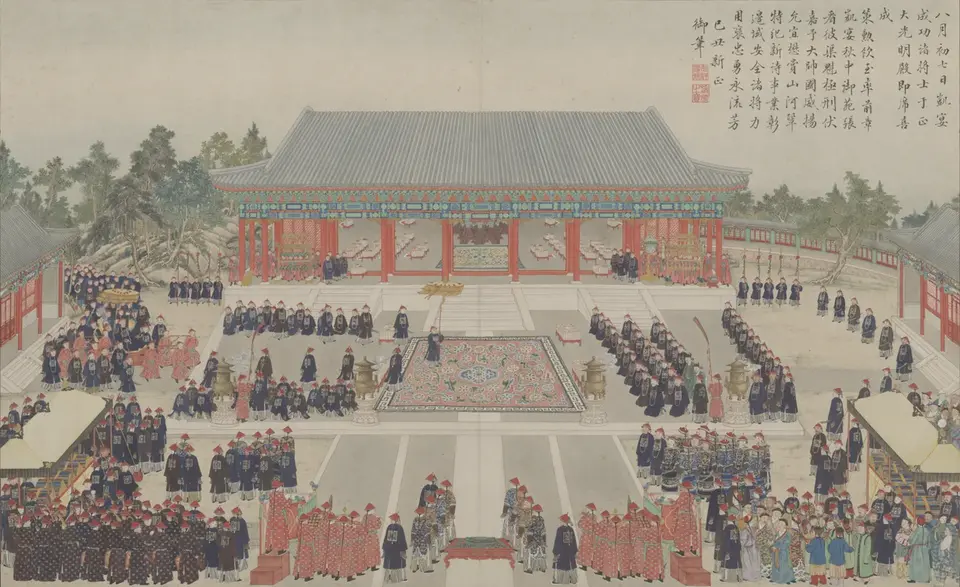
The Pacification of the Revolt of the Altishahr Khojas (平定回部大小和卓) was a decisive military campaign conducted by the Qing Dynasty between 1757 and 1759 under the Qianlong Emperor to suppress the armed rebellion of the White Mountain Sufi leaders Burhan al-Din (the Elder Khoja) and Jahan Khoja (the Younger Khoja), thereby consolidating imperial sovereignty over southern Xinjiang. Following the conquest of the Dzungar Khanate in 1755, the Qing court released the brothers from imprisonment in the Ili Valley, tasking the Elder Khoja with pacifying the southern oasis cities while retaining the Younger Khoja in Ili to manage religious affairs. However, amid the turmoil of Amursana's subsequent revolt, Jahan Khoja fled south, declared himself Batur Khan, executed imperial envoy Amindao and his hundred-man retinue, and rallied the southern towns into open rebellion. The Qianlong Emperor dispatched a punitive expedition, replacing the hesitant commander Yarhashan with General Zhaohui. In the winter of 1758, Zhaohui led an advance force of fewer than two thousand soldiers to Yarkand, where they were encircled by more than ten thousand rebel cavalry along the Black Water River. Entrenched behind timber stockades and digging wells for water, Zhaohui's garrison endured three harrowing months of continuous siege warfare in the celebrated Siege of Black Water Camp. In early 1759, relief armies led by Vice General Fude and Vice Minister Arigun shattered the enemy lines in the Battle of Hurman, linking up with Zhaohui in a coordinated breakout. Re-equipped, Qing forces swept across the Tarim Basin to retake Kashgar and Yarkand, pursuing the fleeing brothers across the Pamir Mountains and crushing their forces at Lake Yashilkul. The brothers sought asylum in Badakhshan, where Sultan Shah executed them and delivered their heads to the Qing, completing the territorial unification of Xinjiang.
Following the pacification of Dawachi, the Qing court frees Burhan al-Din and Jahan Khoja to conciliate the Tarim Basin.
Jahan Khoja styles himself Batur Khan, murders imperial envoy Amindao, and establishes armed control over the southern oasis cities.
General Yarhashan besieges Kucha for three months but allows the rebel garrison to escape, leading to his arrest and execution.
General Zhaohui takes command of imperial forces, securing Aksu and Ush Turpan as advanced operational bases.
Crossing the Black Water River with fewer than two thousand troops, Zhaohui is surrounded by ten thousand rebels and mounts a heroic defense.
Fude and Arigun crush the blocking forces at Hurman, coordinating with Zhaohui's sally to lift the three-month siege.
Two imperial columns advance rapidly, prompting the Khoja brothers to abandon Kashgar and Yarkand to flee toward the Pamirs.
Fude and Mingrui pursue the rebels across the Pamir Mountains, routing them at Lake Yashilkul and capturing twelve thousand troops.
Sultan Shah of Badakhshan executes the fugitive Khoja brothers and delivers their heads to Qing commanders, completing the pacification.
In the oasis cities of the Tarim Basin south of the Tian Shan mountains, Uyghur society had long been fractured by intense theological and political rivalries between two branches of the Naqshbandi Sufi order: the Ishaqiyya (Black Mountain faction) and the Afaqiyya (White Mountain faction). The prominent White Mountain leader Afaq Khoja had originally allied with Galdan Boshugtu Khan of the Dzungars to overthrow the Chagatai Yarkand Khanate. To maintain firm control over the lucrative agricultural revenues and trade routes of the southern oases, subsequent Dzungar rulers, notably Tsewang Rabtan and Galdan Tsering, implemented strict surveillance over the White Mountain lineage, detaining Mahmut and his two sons, Burhan al-Din and Jahan Khoja, as hostages in the Ili Valley.
In May 1755, Qing armies swept into Ili and deposed Dzungar ruler Dawachi. Discovering the two brothers in captivity, the Qianlong Emperor determined that their immense hereditary prestige could serve as a valuable instrument for frontier pacification. The emperor granted them imperial pardons, commissioning the Elder Khoja, Burhan al-Din, to accompany the defecting Ush Turpan governor Khojis south of the Tian Shan to conciliate Yarkand and Kashgar, while keeping the Younger Khoja, Jahan Khoja, in Ili to oversee local Islamic religious affairs.
With imperial backing, Burhan al-Din was warmly welcomed by local oasis populations, expelling remaining Dzungar officials and Black Mountain rivals from Kashgar and Yarkand. However, the political landscape dissolved into chaos in late 1755 when Oirat chieftain Amursana rebelled against the Qing. Seizing the opportunity, Jahan Khoja gathered followers, escaped from Ili, and crossed the mountain passes to join his brother in Yarkand.
Unlike his cautious elder brother, Jahan Khoja harbored radical political ambitions. Usurping supreme authority in the south, he assumed the sovereign title of Batur Khan, purged pro-Qing local nobles, constructed fortresses, and levied heavy taxes to build an independent army. In 1757, the Qianlong Emperor sent Vice Commander Amindao with a hundred-man cavalry detachment to Yarkand to offer peaceful reconciliation. Showing absolute defiance, Jahan Khoja lured the imperial delegation into a banquet, murdered Amindao along with his entire escort, and proclaimed a holy war against the Qing Empire, plunging southern Xinjiang into open rebellion.
In February 1758, infuriated by the murder of Amindao, the Qianlong Emperor appointed Minister of Revenue Yarhashan as General for Pacifying Treason, mobilizing more than ten thousand Banner and Green Standard troops from Turpan to march upon Kucha, the fortified eastern gateway to the Tarim Basin.
In May, Qing forces laid siege to Kucha, which was defended by Jahan Khoja's trusted commander Abdurahman. Kucha's massive earthen walls resisted artillery bombardment and tunneling attempts. After three months of siege, imperial discipline degraded. In July, Jahan Khoja arrived from Yarkand with several thousand cavalrymen to relieve the citadel. Although Qing ambushes drove off the relief force, Yarhashan failed to maintain a tight cordon, allowing Abdurahman and his elite fighters to break through the lines under cover of a thunderstorm. Outraged by Yarhashan's dereliction of duty, the Qianlong Emperor ordered him arrested and transported to Beijing for execution, appointing General Zhaohui, a battle-hardened veteran of the Dzungar campaigns, to assume supreme command.
Assuming command in August 1758, Zhaohui restored strict discipline, capturing Aksu and Ush Turpan as the northern oasis cities welcomed the imperial forces. Eager to prevent the brothers from consolidating their defenses, Zhaohui resolved to strike deep into the southern heartland. In October, he led an advance corps of only four hundred Manchu and Solon cavalry alongside one thousand Green Standard infantry, traversing the Taklamakan wilderness toward Yarkand.
On October 13, Zhaohui reached the outskirts of Yarkand. Learning that massive herds of cattle and sheep were pastured south of the city, Zhaohui led four hundred cavalrymen across the Black Water River (a tributary of the Karakash River) to seize the enemy supplies. During the crossing, the pontoon bridge collapsed under high water, severing Zhaohui's vanguard from his infantry reserves. Seizing the opportunity, the Khoja brothers ambushed the crossing with more than ten thousand cavalrymen, completely surrounding Zhaohui's detachment. Zhaohui conducted a fighting withdrawal into a riverside grove, constructing earthen revetments and abatis. The rebels erected siege batteries, shelling the camp day and night and attempting to flood the enclave by diverting the river. Zhaohui's men diverted the waters, dug shallow wells for fresh water, and boiled horse saddles and tree bark for food. Despite suffering multiple bullet wounds, Zhaohui commanded the perimeter with stoic resolve, repelling dozens of assaults across three months of bitter winter siege in the celebrated Siege of Black Water Camp.
When dispatches describing Zhaohui's desperate encirclement reached Beijing, the Qianlong Emperor mobilized imperial relief divisions, appointing Vice General Fude and Vice Minister Arigun to command three thousand elite cavalrymen accompanied by ten thousand remounts and grain convoys.
On January 6, 1759, Fude and Arigun reached Hurman, northeast of Yarkand, where they encountered five thousand elite rebel cavalry deployed to block their relief corridor. Arigun led a hundred vanguard riders charging through enemy lines, dismounting his archers and riflemen to deliver devastating volleys that slew dozens of rebel officers and killed over a thousand enemies. Hearing artillery fire in the distance, Zhaohui realized relief had arrived and led his emaciated garrison in a surprise sally through the enemy siege works. Caught between internal and external assaults, the rebel army broke in panic. Jahan Khoja fled back into the fortifications of Yarkand, and the three-month siege of Black Water Camp was successfully lifted.
Following the relief, the unified imperial armies withdrew to Aksu to re-equip, receive fresh reinforcements, and coordinate a comprehensive offensive. Meanwhile, in the southern oasis of Khotan, local Uyghur beg Ashmat led a popular uprising against the exactions of the Khojas, executing the rebel governor and submitting the oasis to Qing authorities.
In June 1759, the Qianlong Emperor initiated the final offensive: General Zhaohui commanded the northern route advancing upon Kashgar, while Vice General Fude led the southern route advancing upon Yarkand. As imperial forces closed in, local inhabitants refused to fight for the discredited theocrats. Recognizing their cause was lost, Burhan al-Din and Jahan Khoja abandoned their palaces in Yarkand and Kashgar, fleeing westward with several thousand soldiers and family members toward the treacherous Pamir Mountains to seek sanctuary in Badakhshan. Qing armies liberated Yarkand and Kashgar without bloodshed, restoring imperial authority over all eight major oasis cities.
Determined to prevent the rebellion from reigniting, Qing commanders organized an immediate pursuit. Vice General Fude and Imperial Guardsman Mingrui led several thousand elite cavalrymen across the freezing heights of the Pamir plateau, tracking the fleeing host across blinding snowfields.
On July 7, 1759, the Qing vanguard engaged the rebel rearguard at Alchur (in modern eastern Tajikistan), where Mingrui charged into the enemy lines, slaying hundreds of adversaries. On July 9, the Qing closed with the main rebel force at Lake Yashilkul (near the Sarykol Range). The Khojas entrenched their forces along mountain ridges, firing muskets and rolling boulders down the slopes. Fude deployed camel-mounted swivel guns to shatter the stone ramparts, while cavalry detachments crossed the frozen shallows to envelope the heights. The rebel army disintegrated, with more than twelve thousand warriors surrendering. The Khoja brothers escaped with fewer than four hundred retainers across the passes into Badakhshan (in modern northeastern Afghanistan).
Sultan Shah, the ruler of Badakhshan, observed the overwhelming martial display of the Qing army in the Pamirs. Receiving an ultimatum from General Fude warning that sheltering the fugitives would invite an immediate invasion, Sultan Shah resolved to appease the Qing Empire. He ambushed the Khoja brothers; Jahan Khoja resisted fiercely with his dagger before being hacked to death, while Burhan al-Din was captured and executed. In October 1759, Sultan Shah dispatched envoys bearing the severed heads of both brothers to the Qing headquarters. The two-year rebellion was extinguished, and southern Xinjiang was permanently integrated into the Qing Empire.
The suppression of the Altishahr Khojas completely shattered the century-old theocratic and feudal tyranny that the White Mountain Sufi aristocracy had exercised over the Tarim Basin. The hereditary political privileges of the Khoja lineage were dismantled. To replace the chaotic feudal order, the Qing court established the office of the Imperial Councilor Minister Residing in Altishahr (stationed at Kashgar), supported by local imperial agents in Yarkand, Khotan, and Aksu. While respecting local religious customs, the state integrated the traditional Beg system into the imperial bureaucratic hierarchy, strictly separating religious authority from judicial and administrative governance.
The triumph over the Khoja brothers, arriving directly upon the heels of the pacification of the Dzungars, completed the total unification of the territories north and south of the Tian Shan mountains under direct imperial rule for the first time since the Tang Dynasty. The Qianlong Emperor formally designated the recovered western territories as "Xinjiang" (meaning "the ancient lands newly returned"). This unification eradicated external threat vectors along the western frontiers, fostered commercial interregional trade along the rejuvenated Silk Road, and permanently established the territorial integrity and administrative boundaries that define China's modern northwestern frontiers.