Helu Submits to Tang Court
Ashina Helu surrenders to Emperor Taizong and is appointed Area Commander of Yaochi at Tingzhou.
Tang Dynasty (唐代, Reign of Emperor Gaozong) · HISTORICAL EVENT
平定阿史那贺鲁
The Pacification of Ashina Helu (平定阿史那贺鲁) was a historic military campaign fought in 657 CE (the second year of the Xianqing era of Emperor Gaozong of Tang), wherein celebrated general Su Dingfang led Tang and Uyghur auxiliary forces deep into Central Asia to crush Ashina Helu (Shaboluo Khagan) and eliminate the Western Turkic Khaganate. In 649 CE, Ashina Helu submitted to the Tang and was enfeoffed as Area Commander of Yaochi. Following the death of…
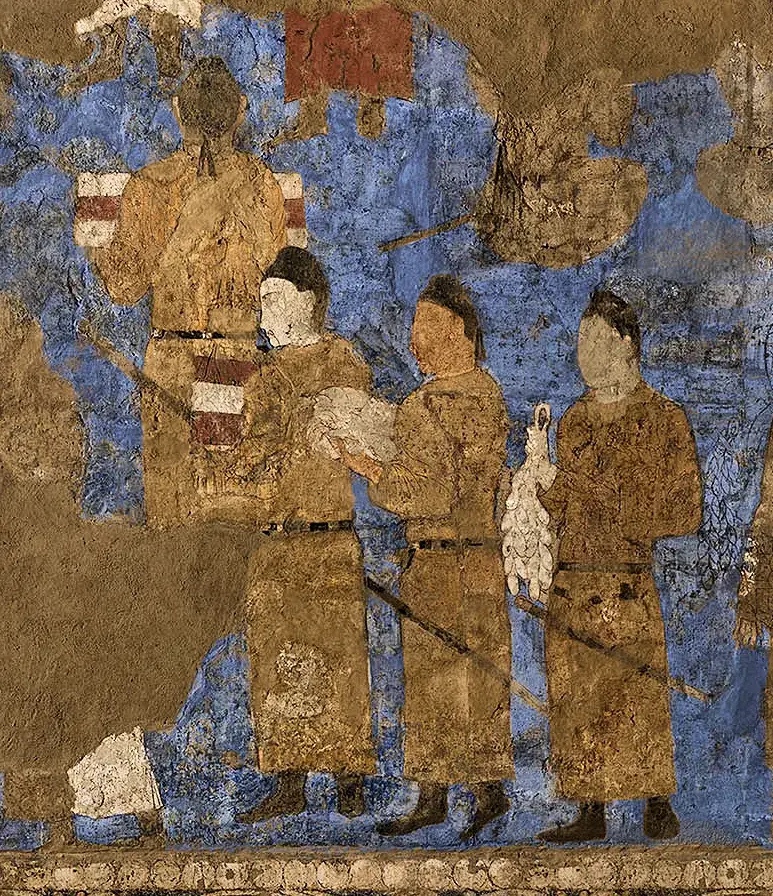
The Pacification of Ashina Helu (平定阿史那贺鲁) was a historic military campaign fought in 657 CE (the second year of the Xianqing era of Emperor Gaozong of Tang), wherein celebrated general Su Dingfang led Tang and Uyghur auxiliary forces deep into Central Asia to crush Ashina Helu (Shaboluo Khagan) and eliminate the Western Turkic Khaganate. In 649 CE, Ashina Helu submitted to the Tang and was enfeoffed as Area Commander of Yaochi. Following the death of Emperor Taizong, Helu reneged on his allegiance, proclaimed himself Shaboluo Khagan, unified the Ten Tribes of the Western Turks, and launched destructive incursions into Tingzhou, capturing Jinman Fortress and terrorizing the frontier. Early Tang expeditions under Liang Jianfang and Cheng Zhijie checked the invaders but failed to inflict a decisive defeat. In 657 CE, Emperor Gaozong appointed General Su Dingfang as Commander-in-Chief of the Yili Marching Administration, launching a dual-front offensive. The northern column led by Su Dingfang advanced across the Altay range with ten thousand elite troops and Uyghur horsemen under Porun, while defected Turkic princes Ashina Mishe and Ashina Buzhen advanced along the southern route to conciliate tribal leaders. At the Battle of the Irtysh River, Su Dingfang deployed his infantry behind a wall of pikes on the southern heights to absorb three cavalry charges, then led his cavalry from the northern ridge to smash the enemy flanks, routing Helu's hundred thousand horsemen. Advancing through blizzards and two feet of snow, Su Dingfang launched a surprise attack upon Helu's royal encampment at Jinya Mountain, capturing the camp and forcing Helu to flee to Chach (Tashkent), where he was captured and sent to the Tang capital. The victory dissolved the Western Turkic Khaganate and established Tang hegemony over the Silk Road oases.
Ashina Helu surrenders to Emperor Taizong and is appointed Area Commander of Yaochi at Tingzhou.
Exploiting Taizong's death, Helu proclaims himself khagan, unifies the Ten Tribes, and sacks Jinman Fortress.
Liang Jianfang and Qibi Heli rout the Chuyue tribe, killing five thousand, while Helu's main army retreats into the steppe.
Cheng Zhijie invades the west; Su Dingfang's five hundred cavalry rout the Shunishi, but the expedition withdraws without decisive results.
Emperor Gaozong launches a dual-column campaign, naming Su Dingfang Commander-in-Chief of the Yili Marching Administration.
Su Dingfang deploys pike-men on the southern heights and flanks with cavalry, crushing Helu's hundred-thousand-strong host.
Defying blizzards and two-foot snowdrifts, Su Dingfang mounts a surprise raid on Jinya Mountain, capturing the khagan's camp.
Helu is apprehended in Chach and surrendered to Xiao Siye; the Tang creates the Kunling and Mengchi protectorates.
Su Dingfang presents captives at the ancestral temple; the Anxi Protectorate returns to Kucha to govern the Western Regions.
During the Zhenguan era under Emperor Taizong, the Tang Dynasty engaged in energetic expansion across Central Asia to reopen continental caravan corridors along the Silk Road. In 640 CE, the Tang annexed Gaochang, creating the prefecture of Xizhou and installing the Anxi Protectorate. When Western Turkic Khagan Yipi Duolu raided imperial border outposts at Yizhou (Hami) in 642 CE, Anxi Protector Guo Xiaoke routed the invaders, prompting internal division that led to the elevation of Yipi Shekui Khagan with imperial backing.
Amid the endemic fragmentation of the Western Turks, the chieftain of the Chuyue and Chumi clans, Ashina Helu, suffered defeat against rival factions. In 649 CE, Helu led over five thousand households to submit to the Tang court. Recognizing his strategic value, Emperor Taizong bestowed upon him the rank of Grand General of the Left Militant Guard and Area Commander of Yaochi, basing his tribesmen in Tingzhou (modern Jimsar, Xinjiang) under the supervision of the Anxi Protectorate to protect the frontier.
In the summer of 649 CE, Emperor Taizong passed away and was succeeded by Emperor Gaozong. Perceiving the imperial succession as a moment of weakness, Ashina Helu defected. He launched surprise raids westward across the steppe, conquering the territories of Yipi Shekui Khagan and bringing the five Dulu and five Nushibi clans—collectively known as the "Ten Arrows" or "Ten Tribes" (Shixing Tujue)—under his absolute command. Helu established his imperial headquarters at Qianquan (near modern Tokmok, Kyrgyzstan) and assumed the title of Shaboluo Khagan.
In July 651 CE, Ashina Helu invaded Tingzhou with tens of thousands of horsemen, overrunning Jinman Fortress and Pulei County, butchering thousands of inhabitants, and severing communications across the Western Regions. In response, Emperor Gaozong dispatched punitive expeditions under Generals Liang Jianfang and Qibi Heli in 652 CE, followed by Cheng Zhijie in 655 CE. Although Tang forces won tactical engagements at Mount Laocheng and Yingsochuan—where vice commander Su Dingfang led five hundred horsemen to break the Shuni shi clan—Cheng Zhijie's timidity and lack of discipline allowed Helu's main army to escape intact into the wilderness.
In early 657 CE (the second year of the Xianqing era), Emperor Gaozong resolved to eliminate Ashina Helu once and for all. He appointed Right Guard General Su Dingfang as Commander-in-Chief of the Yili Marching Administration, with Yanran Protector Ren Yaxiang and Vice Protector Xiao Siye as deputies, mobilizing over ten thousand elite imperial troops alongside the veteran cavalry of Uyghur Chieftain Porun. Simultaneously, the court commissioned loyal Western Turkic princes Ashina Mishe and Ashina Buzhen to lead the southern route through the Tarim Basin to rally former subjects, creating a strategic pincer movement.
Before marching, Emperor Gaozong adopted a proposal from officer Xue Rengui: because Helu had abducted the families of the Nishu tribe to coerce their loyalty, the Tang should liberate and restore these hostages, transforming the Nishu into active allies. Su Dingfang enforced this policy rigorously. When the northern column reached the northern foothills of the Altay Mountains, Chumu Kun chieftain Nendulu surrendered his ten thousand tents after an initial clash; Su treated them with magnanimity, recruiting one thousand local horsemen as vanguard scouts. The repatriation of Nishu families induced large numbers of Western Turkic tribesmen to abandon Helu and join the Tang ranks.
In November 657 CE, Su Dingfang's vanguard advanced to the western banks of the Irtysh River (near the southern foothills of the Altay). Learning that the Tang advance force was numerically inferior, Ashina Helu mobilized his entire host of one hundred thousand mounted warriors to envelop the imperial army. Facing ten-to-one odds, some imperial soldiers showed apprehension. Su Dingfang remained undaunted, executing a coordinated tactical plan: he ordered Ren Yaxiang to position the infantry and Uyghur foot archers upon the southern plateau, locking their shields and planting a circular thicket of long pikes pointing outward like an impenetrable iron hedgehog. Su Dingfang stationed his cavalry reserves behind the northern heights.
Believing the small Tang detachment was doomed, Helu hurled his waves of cavalry against the southern position. The Tang infantry held their ground like an unyielding wall; as the horsemen closed within thirty paces, crossbowmen discharged salvos, followed by disciplined pike thrusts that shattered three successive cavalry charges. As the Dzungar cavalry stalled in disarray, Su Dingfang seized the critical moment, personally leading his cavalry down from the northern ridge into the enemy's exposed rear flank. Tang horsemen drove deep into the formation with lances and broadswords. Trapped in a vicious pincer, Helu's massive army dissolved into panic. Tang units pursued the fleeing host for thirty li, slaying over two hundred tribal grandees and killing or capturing tens of thousands of enemy combatants, turning the waters of the Irtysh red.
The catastrophe at the Irtysh River destroyed the military spine of the Western Turkic Khaganate. Leaders of the five Nushibi clans surrendered their banners to Su Dingfang, while the five Dulu clans submitted to the southern army under Ashina Buzhen. Ashina Helu escaped southwest into the desert with only several hundred royal bodyguards.
Su Dingfang detached Xiao Siye and Uyghur leader Porun with light cavalry to maintain close pursuit, while he and Ren Yaxiang followed with the main body. In December, severe winter blizzards struck the steppe, burying the plains beneath more than two feet of snow. Imperial officers petitioned Su Dingfang: "The cold is extreme, the snow reaches the bellies of our horses, and our men are exhausted; let us halt and await the thaw before advancing." Su Dingfang rejected their plea: "The barbarian relies on the deep snow, assuming we cannot pursue him, and is now resting in false security. If we delay until spring, he will rally his dispersed tribes and fortify mountain citadels, and we will never take him! Speed is supreme in war; striking through the snow when he least expects us will yield complete victory!"
Su Dingfang commanded an immediate advance. Wrapped in sheepskins, the troops pressed forward across hundreds of li without halting. The Tang army linked up with Ashina Mishe's southern division at Shuanghe (modern Bole, Xinjiang). Covering another two hundred li in a nocturnal march, the cavalry fell upon Helu's imperial headquarters at Jinya Mountain (near the Chu River Valley) while the khagan was preparing for a hunt. Tang troopers charged through the tents, scattering resistance, capturing tens of thousands of prisoners, and seizing the khagan's royal consorts and treasury.
Following the destruction of his royal camp, Ashina Helu fled southward across the Jaxartes River (Syr Darya) with his son Dieyuan and son-in-law Yanchuo, arriving at the fortress of Suduo in Chach (modern Tashkent, Uzbekistan). The city governor welcomed Helu with feigned hospitality, but privately recognized that Tang power was irresistible. The governor locked the gates, detained the fugitives, and sent fast couriers to alert the pursuing imperial forces.
General Xiao Siye arrived at Suduo, taking Ashina Helu, his son, and their entourage into chains. In 658 CE (the third year of Xianqing), Su Dingfang returned in triumph to the eastern capital of Luoyang, presenting the captive khagan before the Tang Ancestral Temple. Moved by historical ties, Emperor Gaozong spared Helu's life, appointing him to an honorary post in the Court of the National Granaries. Following his death, he was buried beside the mausoleum of Illig Khagan outside Chang'an. With Helu's capture, the Western Turkic Khaganate, which had dominated Inner Asia for generations, was eradicated.
The pacification of Ashina Helu marked the zenith of Tang military expansion into Inner Asia. With the capitulation of the Ten Tribes, the Tang government dismantled the Western Turkic confederation and established indirect administrative structures across the steppe. The court created two overarching protectorates: the Kunling Protectorate (governing the five Dulu clans under Ashina Mishe) and the Mengchi Protectorate (governing the five Nushibi clans under Ashina Buzhen), encompassing dozens of subordinate prefectures and counties. The Anxi Protectorate was relocated from Xizhou back to Kucha, anchoring the strategic "Four Garrisons of Anxi" (Kucha, Khotan, Kashgar, and Karasahr). Imperial sovereignty extended across Central Asia to the Chu and Talas river valleys, Lake Balkhash, the Pamirs, and the borders of Tokharistan and the Sasanian Persian realm.
The elimination of the Western Turkic Khaganate restored enduring security to the trans-Eurasian trade routes of the Silk Road. Caravan traffic between Chang'an, the Western Regions, Sogdiana, Persia, and the Byzantine Empire flourished without interruption. Merchants, scholars, monks, and envoys traveled freely across the oasis routes, bringing Central Asian music, dance, grapes, and glassware into the Tang heartland, while Chinese paper-making, silk production, and administrative institutions spread westward. The campaign permanently cemented the image of the Tang Emperor as the legitimate Tian Kehan (Heavenly Khagan) across the Eurasian steppe, inaugurating the golden age of High Tang cosmopolitan civilization.