Gao Di Orders Total Evacuation
Military Commissioner Gao Di orders the abandonment of Liaoxi; Yuan Chonghuan vows to defend Ningyuan to the death
Ming Dynasty (明朝) · HISTORICAL EVENT
宁远之战
The Battle of Ningyuan was a watershed urban siege engagement fought in the first month of 1626 during the sixth year of the Tianqi era at the frontline fortress of Ningyuan Guard (present-day Xingcheng, Liaoning). On the eve of the campaign, newly appointed Military Commissioner Gao Di, crippled by panic toward the Manchurian cavalry, issued an imperial order to surrender over four hundred li of frontier territory outside Shanhai Pass and evacuate all…
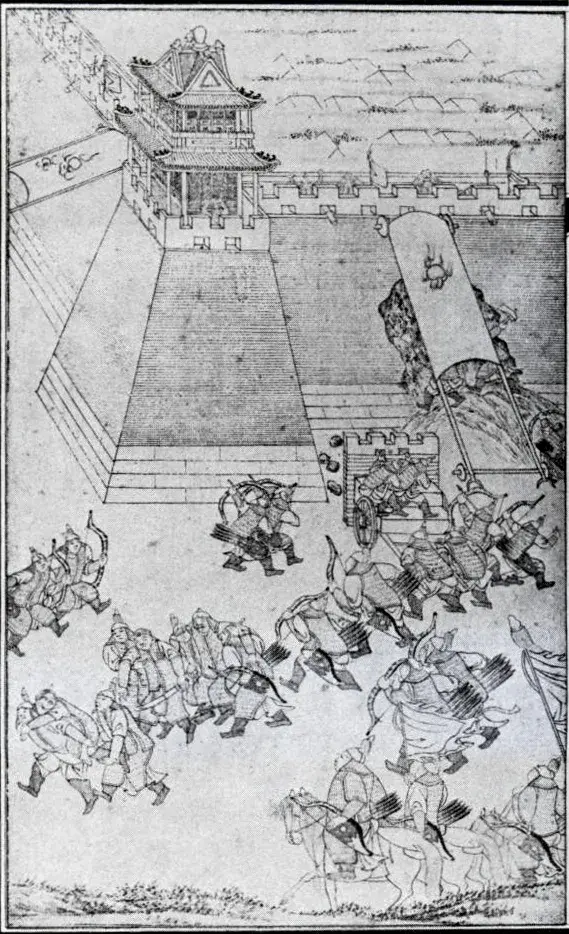
The Battle of Ningyuan was a watershed urban siege engagement fought in the first month of 1626 during the sixth year of the Tianqi era at the frontline fortress of Ningyuan Guard (present-day Xingcheng, Liaoning). On the eve of the campaign, newly appointed Military Commissioner Gao Di, crippled by panic toward the Manchurian cavalry, issued an imperial order to surrender over four hundred li of frontier territory outside Shanhai Pass and evacuate all border troops into the pass. Intendant Yuan Chonghuan vehemently defied the evacuation order, rallying a garrison of fewer than twenty thousand men to defend the isolated outpost of Ningyuan. Seizing upon the Ming retreat, Later Jin Khan Nurhaci mobilized an immense host of over one hundred and thirty thousand Eight Banners cavalry and infantry, advancing directly against Ningyuan. Demonstrating extraordinary fortitude, Yuan Chonghuan wrote an impassioned vow in his own blood to inspire his soldiers, working alongside veteran commanders Man Gui, Zu Dashou, and Zuo Fu to implement rigorous scorched-earth defenses and deploy eleven Portuguese-manufactured heavy cannons atop the bastion ramparts. Across several days of ferocious combat, Ming artillery obliterated Later Jin siege mantlets and broke wave after wave of assault troops. Suffering devastating casualties, Nurhaci's forty-four-year record of unbroken battlefield triumphs was shattered, forcing the Khan to burn his dead and retreat to Shenyang in defeat. The victory at Ningyuan represented the Ming Dynasty's first decisive strategic triumph against the Later Jin since the catastrophe at Sarhu, proving that heavy artillery and fortified urban strongholds could successfully neutralize steppe cavalry and establishing the strategic blueprint for the Guan-Ning-Jin defensive network.
Military Commissioner Gao Di orders the abandonment of Liaoxi; Yuan Chonghuan vows to defend Ningyuan to the death
Nurhaci leads 130,000 Eight Banners troops from Shenyang, advancing against Shanhai Pass and Ningyuan
Yuan Chonghuan razes the suburbs and mounts eleven heavy European cannons atop the Ningyuan battlements
Yuan Chonghuan writes an oath in his own blood; Later Jin vanguards surround Ningyuan at Shoushan
Yuan Chonghuan rejects Nurhaci's surrender ultimatum; Luo Li fires a cannon to disperse an advance enemy camp
Eight Banners assault with armored mantlets; Ming artillery shatters the carts while incendiary quilts burn sappers
Ming commandos burn remaining siege gear; continuous artillery barrages break Later Jin assault morale
Later Jin cavalry crosses frozen sea to destroy the Juehua Island depot, slaying defenders in a tactical distraction
Nurhaci admits defeat and orders a full retreat to Shenyang, concluding the historic Battle of Ningyuan
In the autumn of 1625, Grand Commander Sun Chengzong, who had stabilized the Liaodong frontier through fortified colonies, was forced from office due to political sabotage orchestrated by the eunuch faction of Wei Zhongxian. The imperial court appointed Vice Minister of War Gao Di as the new Military Commissioner of Liaodong. Cowardly and lacking strategic foresight, Gao Di concluded that the flat plains of the Liaoxi Corridor were inherently indefensible against nomadic cavalry. He unilaterally decreed a sweeping withdrawal, ordering supreme general Ma Shilong to abandon over four hundred li of fortified territory—including Jinzhou, Songshan, Xingshan, Youdun, Ningyuan, and Qiantun—and withdraw all personnel within Shanhai Pass.
Gao Di's hasty evacuation caused catastrophic disruption across the frontier. Hundreds of thousands of bushels of grain painstakingly stockpiled over years had to be abandoned or sold for scraps, while thousands of displaced civilian settlers were forced into refugee columns in the freezing winter weather. Serving as Defense Intendant of Ningyuan, Yuan Chonghuan and his military aide Mao Yuanyi furiously opposed this defeatist policy. Confronting Gao Di, Yuan Chonghuan passionately declared: "Ningyuan is the throat of Liaoxi and the protective shield of Shanhai Pass. If we surrender it without a fight, the enemy will march unopposed to Beijing! Let others retreat if they must, but I am the intendant of Ningyuan. I shall remain in this lone city to live or die with it; I swear I will never enter Shanhai Pass!"
After subjugating the nomadic tribes of Inner Mongolia in late 1625, Nurhaci learned that the Ming court had replaced the formidable Sun Chengzong with the timid Gao Di, and that Ming forces were razing their own fortresses in chaotic retreat. Recognizing an unprecedented historical opportunity to overrun the Liaoxi Corridor and breach Shanhai Pass, Nurhaci assembled the core strike divisions of the Eight Banners, mobilizing over one hundred and thirty thousand elite troops, which he proclaimed as an armada of two hundred thousand. On the fourteenth day of the first month of 1626, the Later Jin host departed Shenyang in a massive show of military strength, marching directly toward Ningyuan.
Ningyuan found itself in absolute strategic isolation. Adhering stubbornly to his withdrawal plan, Gao Di refused to dispatch any relieving field divisions from Shanhai Pass, openly declaring that even if Ningyuan were besieged, no imperial reinforcements would venture beyond the pass. The defenders within Ningyuan consisted solely of veteran contingents under commanders Man Gui, Zuo Fu, Zhu Mei, and Zu Dashou, totaling fewer than twenty thousand men including armed civilians and regrouped refugees. Confronting a formidable army outnumbering them nearly tenfold, the defenders prepared to fight for their lives.
On the eighteenth day of the first month of 1626, upon confirming that Later Jin vanguards had crossed the Liao River, Yuan Chonghuan placed the fortress on total war footing. To prevent Later Jin sappers from using suburban structures as cover or firewood, Yuan enacted ruthless scorched-earth protocols, ordering all suburban merchants and civilians to move inside the walls with their provisions, after which imperial soldiers razed all buildings, ancestral temples, and trees within several miles of the ramparts, transforming the perimeter into a vast, unobstructed kill-zone for artillery fire.
Simultaneously, Yuan completed the installation of eleven European-designed heavy cannons purchased earlier from Macao through scholar-officials Xu Guangqi and Li Zhizao. Supervised by artillery commander Peng Zangu and General Zhu Mei, hundreds of soldiers hauled the multi-ton iron guns up the four-story stone ramparts using block-and-tackle winches, mounting them on protruding corner bastions to establish an interlocking field of fire. Trained gunners under Luo Li calibrated gunpowder charges and firing elevations to ensure devastating accuracy.
To weld the garrison into an unbreakable unit, Yuan Chonghuan assembled generals Man Gui, Zuo Fu, Zu Dashou, and He Kegang, performing a blood covenant before the gathered troops. Slitting his finger to compose an oath in his own blood, Yuan declared: "Ningyuan is Liaodong; we swear to live or die with this fortress!" He then prostrated himself before his men. Moved to tears, the soldiers shouted in unison their resolve to fight to the last man. Yuan assigned defense sectors: Man Gui and Zuo Fu guarded the East Gate, Zhu Mei took the North Gate, Zu Dashou defended the South Gate, while Yuan personally commanded the mobile reserves from the center.
On the twenty-second day of the first month, Later Jin cavalry vanguards reached Shoushan, ten miles northeast of Ningyuan. By the twenty-third, Nurhaci established his central command post at Longguan Temple, five miles southwest of the walls, arraying the Eight Banners in seven sprawling fortified camps. Finding the temple granaries already incinerated by the Ming scorched-earth operations, Later Jin soldiers fanned out across the frozen landscape to fell trees and construct wooden siege mantlets.
Seeking to avoid a costly siege, Nurhaci dispatched a captured Han official to deliver a surrender demand to the city gates, stating: "I come with an army of two hundred thousand; your fortress cannot withstand my might! If you surrender, you shall receive high office in the Eight Banners." Standing atop the battlements, Yuan Chonghuan replied: "You claim two hundred thousand, yet I know your host numbers barely one hundred and thirty thousand. The soldiers and civilians of Ningyuan have sworn to perish with this city; we shall die in battle before we ever yield!"
Later that afternoon, a detachment of Plain Blue Banner cavalry began constructing advance entrenchments five miles northwest of the city. Observing the enemy activity, artilleryman Luo Li trained a heavy cannon upon the encampment under Yuan's direction. With a thunderous detonation that shook the landscape, the solid iron projectile struck the camp, obliterating tents and scattering horses and men in a shower of debris. Shocked by the extreme range and concussive power of the weapon, the Later Jin forces hastily dismantled the camp and withdrew, providing an immense psychological boost to the garrison.
At dawn on the twenty-fourth day of the first month, severe winter gales battered Ningyuan. Nurhaci personally inspected the vanguard as the Eight Banners launched a general assault, pushing hundreds of heavy siege mantlets plated with raw oxen hides and iron sheets toward the southwest and southern gates. Infantry cohorts marched closely behind the armored carts, bearing axes, picks, and scaling ladders, attempting to use the mantlets to absorb arrow fire while reaching the wall base to undermine the masonry.
Ming defenders held their fire until the carts entered point-blank range, unleashing a simultaneous barrage of heavy cannons, three-eyed muskets, and explosive mortars. The immense kinetic energy of the cannonballs splintered the armored mantlets like brittle kindling, crushing the soldiers sheltering behind them. Displaying legendary tenacity, Later Jin sappers surged through the crossfire to reach the foot of the wall, swinging heavy picks to excavate breaches in the brickwork.
Recognizing the crisis, Yuan Chonghuan rushed elite reserves to reinforce Man Gui and Zu Dashou at the southern wall. Ming archers fired relentlessly into the enemy clusters, while Eight Banners archers returned fire from the field, blanketing the battlements with so many arrows that defensive shields resembled pincushions. To eradicate the sappers burrowing into blind spots at the wall base, Yuan ordered the deployment of incendiary cotton quilts saturated with combustible oils and gunpowder, dropped via heavy iron chains. Exploding at the wall base, the incendiaries incinerated the assault squads in horrific firestorms. By midnight, having sustained immense casualties, Nurhaci sounded the retreat.
Before dawn on the twenty-fifth day, Yuan Chonghuan organized a daring counter-raid. Fifty hand-picked commandos in blackened armor were lowered down the ramparts on ropes, carrying torches and incendiary flasks to set fire to the abandoned Later Jin mantlets and ladders littering the ditch. At sunrise, an enraged Nurhaci launched an even more desperate offensive, with executioners stationed behind the lines to cut down any warrior who retreated.
However, Ningyuan's foundations were anchored on massive dressed granite blocks extending five feet underground, rendering the ramparts impervious to sappers. Ming gunners maintained continuous cannon fire throughout the day, raking the enemy ranks and the Khan's yellow pavilion in the distance, slaying numerous high-ranking banner officers. After two days and nights of futile assaults with thousands of casualties, the Eight Banners' morale collapsed, and soldiers refused to approach the walls. Realizing the fortress was impregnable, Nurhaci conceded defeat and ordered his army to dismantle their camps and retreat, stacking timber from suburban houses to cremate their fallen warriors outside the western gate.
Frustrated by his defeat at Ningyuan, Nurhaci targeted Juehua Island, a major naval depot located ten miles offshore where the Ming navy stored vast grain reserves. The exceptionally harsh winter had frozen the Bohai Gulf solid, allowing Eight Banners cavalry to gallop across the ice sheet. On the twenty-sixth day, Prince Ajige led thousands of elite horsemen across the frozen sea in a surprise raid on the naval base.
Commander Jin Guan and Intendant Yao Yuxian organized a desperate defense behind trenches hacked into the sea ice. Overwhelmed by superior cavalry numbers, the island garrison of one thousand soldiers fought to the death, and thousands of civilian laborers were massacred, with eighty thousand bushels of grain and over two thousand naval transports torched by the invaders.
While the loss of Juehua Island was a painful material blow to the Ming, it could not alter the decisive outcome of the siege. On the twenty-seventh day of the first month, facing freezing weather, exhausted troops, and continuous artillery fire from Ningyuan, Nurhaci commenced a general retreat toward Shenyang. Ming troops sallied out to reclaim the surrounding terrain, recovering over three hundred thousand expended enemy arrows from around the walls, sealing the historic triumph of the Ningyuan Victory.
The Battle of Ningyuan concluded with an overwhelming tactical and strategic victory for the Ming garrison. A force of under twenty thousand Ming soldiers successfully repulsed over one hundred and thirty thousand Eight Banners troops, inflicting thousands of casualties upon the elite Manchu banners and forcing the Khan to abandon the siege. The victory astounded the imperial court in Beijing; Emperor Xizong disbursed one hundred thousand taels of silver to reward the frontier soldiers and promoted Yuan Chonghuan to Governor of Liaodong with supreme command over regional military affairs.
The Battle of Ningyuan exerted a decisive influence on the course of the Ming-Qing conflict:
First, it shattered the psychological myth of Manchu invincibility. Following serial catastrophes at Sarhu, Kaiyuan, Tieling, Liaoyang, and Guangning, the Ming military had been gripped by widespread panic regarding the Eight Banners cavalry. Ningyuan demonstrated for the first time that fortified cities equipped with Western artillery could decisively repel massed Manchu assaults, revitalizing morale throughout the empire.
Second, it validated the Guan-Ning-Jin defensive doctrine. The engagement proved the strategic wisdom of Sun Chengzong and Yuan Chonghuan's concept of combining deep urban fortifications with Western heavy cannons to neutralize steppe mobility. This victory established the Guan-Ning-Jin Line, which successfully barred the Later Jin from invading directly through Shanhai Pass for nearly two decades.
Third, it reshaped Later Jin leadership and military doctrine. Severely traumatized by his unprecedented failure at Ningyuan, the sixty-eight-year-old Nurhaci fell ill and died seven months later in the eighth month of 1626, precipitating the succession of Hong Taiji. Recognizing the lethal power of gunpowder weapons, Hong Taiji initiated extensive artillery casting programs, transitioning the Later Jin into a modern combined-arms military power.