Liu Yu Founds the Liu Song Dynasty
Liu Yu received the abdication of Emperor Gong of Jin, establishing the Liu Song dynasty and initiating the Southern Dynasties.
Wei, Jin, Southern and Northern Dynasties (420–589 CE) · HISTORICAL EVENT
南北朝时期
The Northern and Southern Dynasties Period (420–589 CE) was an epoch of continental division and profound civilizational synthesis spanning from the fall of the Eastern Jin dynasty to the Sui dynasty's nationwide reunification. In 420 CE, plebeian commander Liu Yu deposed the Eastern Jin emperor to establish the Liu Song dynasty, inaugurating the sequence of Southern Dynasties (Song, Qi, Liang, and Chen) based at Jiankang. In 439 CE, Emperor Taiwu of…
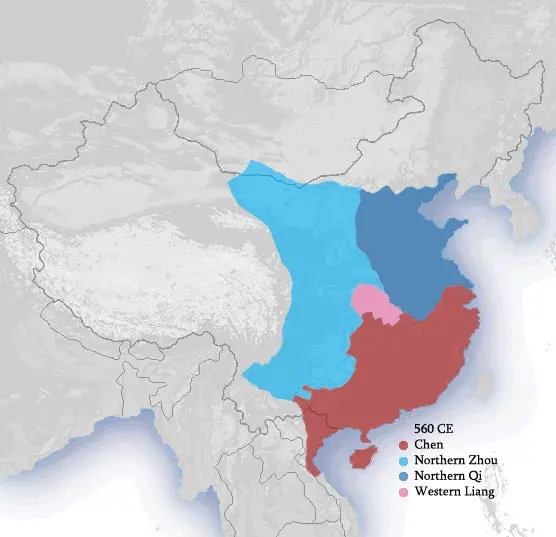
The Northern and Southern Dynasties Period (420–589 CE) was an epoch of continental division and profound civilizational synthesis spanning from the fall of the Eastern Jin dynasty to the Sui dynasty's nationwide reunification. In 420 CE, plebeian commander Liu Yu deposed the Eastern Jin emperor to establish the Liu Song dynasty, inaugurating the sequence of Southern Dynasties (Song, Qi, Liang, and Chen) based at Jiankang. In 439 CE, Emperor Taiwu of Northern Wei conquered Northern Liang, ending the chaotic Sixteen Kingdoms era and consolidating the sequence of Northern Dynasties (Northern Wei, Eastern Wei, Western Wei, Northern Qi, and Northern Zhou). The south witnessed early economic prosperity during the Reign of Yuanjia and the cultural zenith of Southern Liang, but suffered catastrophic ruin during the Hou Jing Disturbance, which decimated the southern aristocratic gentry. In the north, Northern Wei relocated its capital to Luoyang and enforced thorough Sinicization under Emperor Xiaowen, but subsequently disintegrated following the Rebellion of the Six Garrisons. In western China, Western Wei and Northern Zhou forged the Guanlong military aristocracy and instituted the equal-field and fubing militia systems, enabling Emperor Wu of Northern Zhou to conquer Northern Qi in 577 CE. In 581 CE, Yang Jian founded the Sui dynasty and in 589 CE mounted a decisive amphibious campaign across the Yangtze River that annexed Southern Chen, reuniting all of China after nearly three centuries of division.
Liu Yu received the abdication of Emperor Gong of Jin, establishing the Liu Song dynasty and initiating the Southern Dynasties.
Emperor Taiwu captured Guzang and annexed Northern Liang, ending the Sixteen Kingdoms era and establishing the North-South division.
Emperor Wen's northern campaign failed; Emperor Taiwu reached Guabu on the Yangtze, depleting Liu Song's resources.
Xiao Daocheng deposed Emperor Shun of Liu Song, establishing the Southern Qi dynasty and conducting land audits.
Emperor Xiaowen moved the capital to Luoyang, outlawing Xianbei speech and dress, and promoting intermarriage and Han institutions.
Xiao Yan captured Jiankang, deposed Xiao Baojuan, and founded Southern Liang, fostering an era of Buddhist and cultural prosperity.
Poluohan Baling rebelled at Woye Garrison, triggering widespread uprisings that destroyed the defensive framework of Northern Wei.
Erzhu Rong drowned Empress Dowager Hu in the Yellow River and slaughtered over two thousand officials at Heyin, shattering imperial authority.
Emperor Xiaowu fled to Yuwen Tai in Chang'an, while Gao Huan crowned Emperor Xiaojing at Ye, partitioning the north into Eastern and Western Wei.
Hou Jing revolted at Shouyang, crossed the Yangtze, and besieged Taicheng, starving Emperor Wu to death and devastating southern gentry society.
Gao Yang forced Emperor Xiaojing of Eastern Wei to abdicate, founding Northern Qi at Ye as an aggressive northern military power.
Yuwen Jue founded Northern Zhou in the north, while Chen Baxian established Southern Chen in the south to preserve the southern dynasty.
Emperor Wu of Northern Zhou stormed Ye, captured Gao Wei, and annexed Northern Qi, reunifying northern China under Northern Zhou.
Yang Jian accepted the abdication of Emperor Jing of Northern Zhou, founding the Sui dynasty and preparing for nationwide reunification.
Sui forces under Han Qinhu and He Ruobi stormed Jiankang, captured Chen Shubao, and unified China after nearly three centuries.
Following the southward flight of the Jin court to Jiankang in 317 CE, imperial governance rested upon an oligarchy of northern emigrant aristocratic families (such as the Wang of Langya, Yu of Yingchuan, Huan of Qiaoguo, and Xie of Chenjun), creating a political order characterized by aristocratic co-rule with the imperial house. Over successive generations, these elite clans succumbed to decadent luxury and philosophical escapism, losing military vigor and administrative dynamism.
By the late Eastern Han and Jin periods, intense socio-economic grievances sparked major domestic rebellions, including the Sun En and Lu Xun revolts in coastal commanderies and the armed usurpation of Huan Xuan. The traditional court lacked reliable troops to withstand these threats, becoming dependent upon veteran garrisons of the Beifu Army stationed at Jingkou.
Amid this crisis, Liu Yu, an impoverished officer from the lower ranks of the Beifu Army, emerged through supreme martial daring and tactical talent. Liu Yu crushed Huan Xuan's rebel regime, suppressed the coastal insurgents, and subsequently launched two successful northern expeditions that annexed Southern Yan in Shandong and Later Qin in Guanzhong, capturing Luoyang and Chang'an. By monopolizing absolute military power, Liu Yu shattered the century-old aristocratic monopoly over state governance.
Concurrently across northern China, the catastrophic warfare of the Sixteen Kingdoms had devastated agricultural production, exhausting urban populations and breeding widespread longing for stable rule. Rising from their northern grassland base at Pingcheng, the Tuoba Xianbei established the Northern Wei dynasty.
Following Emperor Daowu's decisive victory over Later Yan at the Battle of Canhebei, Northern Wei heavy cavalry swept across the Taihang Mountains to seize Hebei and Shanxi. Under successive monarchs, Northern Wei dismantled archaic nomadic clan structures, registered households onto agrarian tax rolls, and recruited prominent Northern Han gentry scholars such as Cui Hao to design court rituals and legal codes, transforming a tribal confederacy into a formidable centralized empire.
Prolonged regional warfare carved out a durable geographical frontier along the Huai River, the Qinling Mountains, and the Yangtze River. The southern dynasties capitalized on vast networks of rivers and canals, sophisticated naval fleets, and the formidable natural barrier of the Yangtze to repel northern cavalry assaults.
Conversely, northern regimes commanded immense arable plains, vast populations, heavy armored cavalry, and powerful military draft mechanisms that prevented southern forces from establishing permanent footholds north of the Yellow River.
The corridor spanning the Huai and Han river valleys became a contested buffer zone. Decades of military friction and intermittent trade across this frontier fostered distinct cultural landscapes while generating deep historical momentum toward eventual imperial reunification.
In June 420 CE, Liu Yu, King of Song and supreme military commander of Eastern Jin, coerced Emperor Gong into abdication. Erecting a sacred altar outside Jiankang, Liu Yu ascended the imperial throne, proclaimed the Great Song dynasty (historically Liu Song), and adopted the era title Yongchu. Born into humble circumstances, Liu Yu understood rural poverty and elite abuses. He vigorously reorganized provincial administrations, enforced the tuduan policy to register displaced migrants and curb tax evasion by aristocratic estates, appointed talented commoners to strategic bureaus, and pardoned tax debts for war-ravaged districts, opening the era of the Southern Dynasties.
Following Liu Yu's demise, his eldest son Liu Yifu was deposed for negligence, and his third son, Liu Yilong, Prince of Yidu, ascended the throne in 424 CE as Emperor Wen of Song. Emperor Wen governed for thirty years with exceptional diligence, personal frugality, and enlightened patronization of talent. He reduced peasant corvée, encouraged sericulture and wetland reclamation, and appointed capable ministers including Wang Hua, Wang Tanshou, and Yin Jingren to stabilize imperial governance. Establishing four state academies for Confucianism, Metaphysics, History, and Literature, Emperor Wen fostered widespread prosperity, creating the golden era known as the Reign of Yuanjia.
However, Emperor Wen harbored an unyielding ambition to reconquer the Central Plains that outstripped his military strategic capacity. He launched major northern expeditions in 430, 450, and 452 CE, each failing due to flawed strategic coordination and inept battlefield command. In autumn 450 CE, Liu Song vanguard commander Wang Xuanmo failed to breach the fortress of Huatai. Emperor Taiwu of Northern Wei seized the initiative, personally commanding hundreds of thousands of armored cavalry in a massive counteroffensive. The Northern Wei army rolled through southern defensive lines, reached the northern bank of the Yangtze River at Guabu, and menaced Jiankang itself. Although southern forces held the riverline and forced a northern retreat, the lands between the Huai and Yangtze were utterly devastated, depleting Liu Song's military strength and inspiring the famous lament of reckless northern ambition ending in despair.
North of the Yellow River, Emperor Taiwu (Tuoba Tao), the third ruler of Northern Wei, demonstrated exceptional military brilliance upon ascending the throne in 423 CE. Determined to extinguish remaining independent regimes and re-establish imperial unity across the north, Taiwu first secured his northern frontier. Leading successive cavalry campaigns deep into the Mongolian steppe, he crushed the main armies of the Rouran Khaganate, compelling hundreds of thousands of nomads to submit and forcing the Rouran to retreat into the far north, thereby securing Northern Wei's rear flanks.
Having neutralized the steppe threat, Taiwu initiated comprehensive campaigns across northern China. In 431 CE, his armies advanced westward against the Xia kingdom, storming its impregnable white fortress of Tongwan, capturing King Helian Chang, and subsequently destroying the remaining forces of Helian Ding. In 436 CE, Northern Wei cavalry marched into western Liaoning, storming Helong and extinguishing the Northern Yan dynasty.
In August 439 CE, Emperor Taiwu personally directed tens of thousands of elite cavalry across Mount Helan, executing a rapid desert march to encircle the Northern Liang capital of Guzang. King Juqu Mujian, realizing his supplies were exhausted and no relief was possible, opened the city gates and surrendered unconditionally. The fall of Northern Liang formally terminated the one hundred and thirty-five-year period of the Sixteen Kingdoms.
Northern Wei consolidated uninterrupted control over the North China Plain, the Central Plains, the Guanzhong Basin, and the Hexi Corridor, establishing the enduring dual confrontation between Northern Wei and Liu Song. Emperor Taiwu governed with the assistance of distinguished Han chancellor Cui Hao, codifying laws and establishing classic ritual governance during a triumphant era of northern unity.
Following northern unification, sharp cultural and linguistic divergences between the ruling Xianbei aristocracy and the vast Han agrarian populace posed an existential threat to internal stability. Beginning in 477 CE, Empress Dowager Feng, acting as regent, launched systemic structural reforms.
Empress Dowager Feng instituted official salaries to combat bureaucratic extortion and embezzlement, established the Three Chiefs system (appointing neighborhood, village, and commune chiefs) to register concealed populations, and promulgated the landmark Equal-Field System. The equal-field decree distributed unclaimed arable land to peasant cultivators according to household size, granting forty mu of open land to adult males and twenty mu to adult females, which stimulated agricultural reclamation and filled state granaries.
Upon Empress Dowager Feng's death in 490 CE, Emperor Xiaowen (Tuoba Hong) assumed personal rule. Steeped in classical Confucian erudition, Xiaowen resolved to transform Northern Wei into a legitimate Chinese dynasty. In 493 CE, seeking to bypass the entrenched opposition of conservative Xianbei elders at Pingcheng, Xiaowen mobilized thirty thousand troops under the pretext of launching a southern expedition. Arriving at the ruined ancient capital of Luoyang amid torrential autumn rains, Xiaowen declared to his exhausted ministers that since the army had marched so far, it could not return without achievement; if they did not advance south, the imperial capital must permanently relocate to Luoyang. Faced with this choice, the court consented, and Luoyang became the new imperial capital.
At Luoyang, Emperor Xiaowen implemented sweeping Sinicization decrees: wearing nomadic Xianbei garments was outlawed in favor of Han-style court robes; speaking the Xianbei language was prohibited at court, requiring all officials under thirty to speak standard Chinese; Xianbei polysyllabic surnames were converted to single-character Han surnames, with the imperial Tuoba house adopting the name Yuan; elite Xianbei families were compelled to intermarry with the preeminent Northern Han aristocratic lineages of Cui, Lu, Zheng, and Wang; and the bureaucracy was reorganized along classical Nine-Rank lines. These measures dissolved rigid tribal barriers, accelerating profound ethnic integration and laying the cultural foundation for the Sui and Tang dynasties.
In the south, the later decades of the Liu Song dynasty descended into horrific fratricidal bloodshed within the imperial household. Emperor Xiaowu ruled with deep paranoia, and his successor Emperor Ming murdered nearly all his brothers upon seizing the throne. Following Ming's death, the ten-year-old Emperor Houfei (Liu Yu) proved mentally unhinged, roaming the streets of Jiankang with weapons to murder commoners and retainers at whim.
Right Guard General Xiao Daocheng, commander of the imperial palace guards, conspired with close attendants to assassinate Liu Yu on the night of the Double Seventh Festival in 477 CE, enthroning Emperor Shun as a powerless puppet. In April 479 CE, Xiao Daocheng accepted Shun's abdication, ascending the throne at Jiankang to establish the Southern Qi dynasty (historically Southern Qi) and adopting the era title Jianyuan.
Emperor Gao (Xiao Daocheng) and his successor Emperor Wu (Xiao Ze) practiced personal thrift and attempted administrative cleanup through the jianji policy, which audited fraudulent household registrations among elite estates. Although this sparked the brief Tang Yuzhi peasant rebellion, its suppression allowed Emperor Wu to grant tax amnesties and maintain diplomatic peace with Northern Wei, sustaining three decades of southern stability.
However, following Emperor Wu's death, Southern Qi plunged into an even bloodier cycle of palace murders. Grand Preceptor Xiao Luan orchestrated successive coups, murdering the young emperors Xiao Zhaoye and Xiao Zhaowen to seize the throne as Emperor Ming. Obsessed with securing power for his own sons, Ming systematically slaughtered dozens of princes descended from Emperors Gao and Wu. Ming's son, the Marquis of Donghun (Xiao Baojuan), proved exceptionally decadent and cruel, executing distinguished military commanders and spending fortunes on golden palace tiles, which provoked regional governors to rise in open armed rebellion and doomed Southern Qi within twenty-three years of its founding.
Confronted by the tyranny of Xiao Baojuan, Xiao Yan, Governor of Yong Province, mobilized veteran riverine forces at Xiangyang in 501 CE. Advancing east down the Yangtze River, Xiao Yan breached the defenses of Jiankang. Imperial guards inside the capital assassinated Xiao Baojuan and surrendered the gates. In April 502 CE, Xiao Yan received the abdication of Emperor He, establishing the Liang dynasty (historically Southern Liang) as Emperor Wu of Liang and adopting the era title Tianjian.
Emperor Wu was an erudite scholar, skilled administrator, and capable military strategist who presided over an era of profound southern prosperity. In the Tianjian era, Emperor Wu founded the Five National Academies to educate talented commoners, codified the humane Liang Statutes, reformed the Nine-Rank bureaucratic appointments to eliminate corrupt lineage monopolies, and sponsored extensive irrigation projects that enriched lower Yangtze agriculture.
During the first half of Emperor Wu's reign, the metropolitan population of Jiankang surpassed one million residents. The capital boasted more than five hundred magnificent Buddhist temples, bustling merchant docks along the Qinhuai River, and unprecedented flourishing in literature, philosophy, and fine arts, representing the cultural zenith of the Southern Dynasties.
However, Emperor Wu's later reign suffered from extreme religious obsession and administrative indulgence. He declared Buddhism the official imperial faith and four times renounced his throne to serve as a menial monastic slave at Tongtai Temple, compelling his ministers to assemble hundreds of millions of coins from state treasuries to ransom his return. Simultaneously, he refused to discipline corrupt imperial relatives, pardoning treason and embezzlement among aristocratic kinsmen. Beneath the veneer of Buddhist devotion and cultural elegance, the foundations of the Southern Liang state were fatally compromised.
In the north, following the relocation of the capital to Luoyang, the imperial court and southern Xianbei nobility embraced elite Chinese manners and accumulated immense private fortunes. However, the hereditary garrisons defending the six frontier outposts along the northern frontier (Woye, Huaishuo, Wuchuan, Fuming, Rouxuan, and Huaihuang) suffered catastrophic social degradation. Stripped of imperial prestige and bureaucratic promotion, these veteran frontier soldiers were relegated to the humiliating status of hereditary military serfs (fuhu) and subjected to extortion by corrupt commanders.
In March 523 CE, Poluohan Baling launched an open rebellion at Woye Garrison, killing his garrison commander. Within months, hundreds of thousands of frontier soldiers and displaced nomads across all six garrisons rose in armed revolt, shattering the northern defensive barrier. Northern Wei dispatched imperial armies, but all were defeated, forcing the court to enlist two hundred thousand Rouran cavalry to brutally crush the rebellion. Over two hundred thousand displaced garrison residents were forcibly relocated to Hebei, where starvation sparked a second massive uprising under Ge Rong, dissolving northern imperial authority.
Amid this chaos, Erzhu Rong, chieftain of the Northern Xiurong Jie tribe in Shanxi, expanded his private cavalry army. In 528 CE, when Empress Dowager Hu poisoned her own son, Emperor Xiaoming, to retain power through an infant proxy, Erzhu Rong marched on Luoyang under the banner of military righteousness. He seized the capital, drowned Empress Dowager Hu and the infant emperor in the Yellow River, and at Heyin massacred over two thousand Northern Wei princes, chancellors, and court officials, an atrocity known as the Heyin Incident that annihilated the prestige of the imperial clan.
Following Erzhu Rong's assassination, his foremost lieutenants partitioned the empire: Gao Huan entrenched his power across Hebei and Shanxi, while Yuwen Tai secured command over Guanzhong. In 534 CE, unable to endure Gao Huan's autocratic pressure, Emperor Xiaowu (Yuan Xiu) fled west to Chang'an to seek sanctuary under Yuwen Tai. In response, Gao Huan enthroned Emperor Xiaojing at Ye, moving the administrative capital eastward. Northern Wei fractured permanently into Eastern Wei and Western Wei, initiating a protracted duel for northern hegemony.
Following the death of Eastern Wei warlord Gao Huan in 547 CE, his son Gao Cheng assumed power and clashed with veteran general Hou Jing, who governed thirteen strategic commanderies across Henan. Fearing execution, Hou Jing revolted, initially offering his territories to Western Wei, but finding Yuwen Tai vigilant, he dispatched envoys offering his submission to Southern Liang. Blinded by the illusory ambition of reconquering central China, Emperor Wu of Liang ignored unanimous court objections, accepted Hou Jing's submission, and created him King of Henan and Grand General.
Shortly thereafter, Liang's northern expeditionary force was annihilated by Eastern Wei commander Murong Shaozong at the Battle of Hanshan, prompting Eastern Wei to propose peace negotiations. Learning that Emperor Wu contemplated extraditing him in exchange for the captured Liang prince Xiao Yuanming, Hou Jing rebelled at Shouyang in August 548 CE.
Commanding several thousand veteran cavalry, Hou Jing crossed the Yangtze River with the treasonous assistance of disgruntled imperial princes, advancing rapidly to encircle Jiankang and laying siege to the imperial palace complex at Taicheng.
The siege of Taicheng lasted over one hundred and thirty days under horrific conditions of starvation and epidemic, with defenders resorting to cannibalism. In March 549 CE, Taicheng fell. The eighty-six-year-old Emperor Wu was confined to Jingju Hall and starved to death. Hou Jing's troops unleashed indiscriminate slaughter across the affluent estates of southern aristocratic families, exterminating entire lineages and devastating the commanderies of Wu, Wuxing, and Kuaiji. Contemporary annals recorded that for thousands of li, no cooking smoke arose and bleached bones covered the plains.
Regional Liang princes commanding large armies refused to relieve the capital, turning their arms against one another in pursuit of the throne. Prince Xiao Yi (Emperor Yuan) slaughtered his nephews at Jiangling and summoned Western Wei armies for assistance. Western Wei general Yu Jin stormed Jiangling, where Xiao Yi incinerated one hundred and forty thousand volumes of ancient imperial literature before being executed. Western Wei enslaved tens of thousands of Jiangling scholars and citizens, transporting them to Chang'an and reducing the cultural and political vitality of the Southern Dynasties to ruins.
While Eastern Wei occupied the fertile agricultural heartland of the lower Yellow River and commanded vast field armies, Western Wei was confined to the rugged, impoverished terrain of Guanzhong, facing chronic resource deficits and immediate existential peril. Western Wei's paramount leader, Yuwen Tai, responded with radical institutional innovations.
Yuwen Tai appointed the eminent Confucian scholar Su Chuo to codify the celebrated Six Edicts (purifying the mind, cultivating moral education, maximizing agricultural yield, advancing the virtuous, adjudicating legal grievances fairly, and equalizing tax obligations), instituting rigorous fiscal auditing and administrative reviews that eliminated official corruption.
Crucially, Yuwen Tai joined the interests of prominent Northern Han aristocratic families of Shaanxi (such as the Wei of Jingzhao, the Pei of Hedong, and the Liu family) with veteran Xianbei commanders to create the revolutionary Fubing (militia) System. Yuwen Tai organized the army under Eight Pillar Generals and Twelve Senior Generals, drafting affluent local peasants into elite militia divisions, granting Xianbei surnames to Han soldiers to foster common military identity, and unifying agricultural cultivation with permanent martial training.
This cohesive administrative and military elite formed the renowned Guanlong Military-Aristocratic Bloc. Harnessing superior organizational discipline, Western Wei routed Gao Huan's vastly larger army at the Battle of Shayuan, permanently securing Guanzhong. Capitalizing on the Hou Jing Disturbance, Western Wei marched south to annex the entire Sichuan Basin and the strategic middle Yangtze around Jiangling, fundamentally overturning the balance of power across China.
In May 550 CE, Gao Huan's second son, Gao Yang, forced Emperor Xiaojing to abdicate, ascending the throne at Ye to establish the Northern Qi dynasty as Emperor Wenxuan. In his early reign, Gao Yang campaigned aggressively against the Rouran, Khitan, and Shanhu tribes, earning acclaim as a formidable martial monarch. However, subsequent Northern Qi rulers succumbed to severe cruelty, madness, and unceasing palace assassinations, crippling administrative governance.
In western China, Yuwen Tai passed away in 556 CE, leaving his nephew Yuwen Hu as regent. In January 557 CE, Yuwen Tai's third son, Yuwen Jue, received the abdication of Western Wei, founding the Northern Zhou dynasty. After Yuwen Hu assassinated the first two young emperors, Emperor Wu (Yuwen Yong) ascended the throne, bided his time for twelve years, and in 572 CE executed Yuwen Hu in a palace ambush, regaining supreme imperial authority.
Emperor Wu lived with extreme personal austerity, enforced strict military discipline, and enacted comprehensive reforms. He launched a nationwide suppression of Buddhist and Daoist monasticism, closing over forty thousand temples and returning three million monks and nuns to the tax registers and military rolls while seizing monastic landholdings to finance state defense. He emancipated domestic slaves, integrated them into agriculture, and expanded the fubing militia.
In October 576 CE, Emperor Wu personally led one hundred and fifty thousand troops to invade Northern Qi. Northern Zhou forces captured the stronghold of Jinzhou, shattered Northern Qi's main army outside Ye, and stormed the capital, capturing the debauched ruler Gao Wei and his infant heir. In January 577 CE, Northern Qi was officially extinguished. Northern Zhou annexed Hebei, Henan, and Shandong, reunifying northern China under a single centralized authority forty years after the division of Northern Wei.
During the dark nadir of the Hou Jing Disturbance, Chen Baxian, military commandant of Jiaozhou and native of Wuxing, emerged from southern Guangdong. Leading veteran southern troops northward, Chen Baxian allied with Wang Sengbian, fought through brutal engagements, and in April 552 CE recaptured the ruins of Jiankang, eradicating Hou Jing's forces.
Shortly thereafter, Wang Sengbian yielded to Northern Qi military intimidation and attempted to install Xiao Yuanming, a northern puppet prince, on the Liang throne. Determined to preserve southern autonomy, Chen Baxian executed a surprise attack from Jingkou, stormed Jiankang, and executed Wang Sengbian, installing Emperor Jing.
In October 557 CE, Chen Baxian accepted the abdication of Emperor Jing, ascending the throne at Jiankang to establish the Southern Chen dynasty as Emperor Wu of Chen, adopting the era title Yongding. Upon his accession, the northern regimes had already annexed Sichuan and the middle Yangtze, leaving Southern Chen with barely a fraction of its former territory while Northern Qi armies crossed the Yangtze to threaten the capital. Chen Baxian personally directed defenders at the battles of Xuanwu Lake and the northern outskirts, routing one hundred thousand northern invaders and preserving the legitimate continuity of the southern dynasty.
Emperor Wu and his successors, Emperor Wen (Chen Qian) and Emperor Xuan (Chen Xu), governed prudently, reducing taxes, settling displaced refugees, and restoring basic agriculture. However, Southern Chen remained geographically constricted to the lower Yangtze and Lingnan, possessing an economy far too frail to withstand the unified northern empire. In 582 CE, Chen Shubao (the Last Lord of Chen) ascended the throne. Utterly negligent of statecraft, Chen Shubao constructed lavish pavilions, composed romantic poetry with favored consorts such as Zhang Lihua, and neglected border garrisons, leaving the southern dynasty defenseless before impending northern invasion.
In May 580 CE, Emperor Xuan of Northern Zhou died, leaving an infant heir. Yang Jian, Duke of Sui and father-in-law to the late emperor, seized control of the central chancery with the backing of key palace officials. Yang Jian acted with decisive firmness, swiftly suppressing armed insurrections launched by veteran generals Yuchi Jiong in Xiangzhou and Sima Xiaonan. In February 581 CE, Yang Jian accepted the abdication of Emperor Jing of Northern Zhou, ascending the imperial throne at Chang'an to establish the Sui dynasty as Emperor Wen of Sui and adopting the era title Kaihuang.
Emperor Wen implemented sweeping institutional overhauls: abolishing the archaic Nine-Rank system, consolidating the Three Departments and Six Ministries, codifying the lenient Kaihuang Code, instituting nationwide household audits (Dasuo Maoyue) that registered millions of hidden taxpayers, and constructing the Guangtong Canal to facilitate grain transport, propelling Sui state power to extraordinary heights. Emperor Wen then finalized grand strategy for southern conquest, naming his son Yang Guang as commander-in-chief, with Yang Su and Gao Jiong directing operational strategy, massing five hundred and eighteen thousand soldiers and naval forces along the northern bank of the Yangtze.
In late 588 CE, Emperor Wen issued the imperial proclamation for the conquest of Chen. In January 589 CE, Sui armies launched a synchronized amphibious offensive across the Yangtze River. General Han Qinhu led five hundred elite horsemen in a daring nighttime crossing at Caishiji, while General He Ruobi breached the forward defenses at Jingkou. Sui vanguards stormed the gates of Jiankang, entering the imperial palace and capturing Chen Shubao and Lady Zhang concealed inside an abandoned dry well. Southern Chen was officially extinguished.
With the fall of Jiankang, nearly three centuries of regional partition and dynastic fragmentation since the Western Jin dynasty drew to a final close. Across the expanse of the Chinese subcontinent, a magnificent new era of unified imperial civilization commenced under the standard of the Sui dynasty.
The one hundred and seventy-year period of the Northern and Southern Dynasties concluded the protracted political chaos that began with the Western Jin dynasty, permanently dismantling the archaic Han-Wei aristocratic order.
The revolutionary administrative frameworks perfected during this era—including Yuwen Tai's Fubing militia system that integrated agrarian labor with military service, the Equal-Field system that allocated lands to free cultivators, and the emerging Three Departments and Six Ministries—were inherited in their entirety by the Sui and Tang empires, providing the operational architecture for China's medieval imperial golden age.
Northern history throughout this era functioned as a profound cultural and biological crucible. Emperor Xiaowen's Sinicization policies obliterated rigid tribal divisions, inducing deep intermarriage between the Xianbei imperial house and Northern Han aristocratic lineages.
In western China, the resulting Guanlong Military-Aristocratic Bloc combined steppe martial vigor with Chinese bureaucratic administrative expertise. This elite socio-political coalition produced the ruling houses of Northern Zhou, Sui, and Tang, forging an expansive, confident multi-ethnic empire that dominated East and Central Asia.
In the south, prolonged stability during the Liu Song and Southern Liang periods catalyzed extensive agricultural reclamation across the middle and lower Yangtze River basin, the Poyang Lake plain, and the Han River valley. The introduction of advanced northern iron plows and hydraulic irrigation converted vast marshes into rich paddy fields.
The flourishing of ceramic kilns, textile manufacturing, and maritime trade permanently elevated the economic productivity of southern China. This historical transformation initiated the long-term southward relocation of China's economic and demographic center of gravity, laying the structural foundation for the economic prosperity of the mid-Tang and Song dynasties.