Commissioning the Campaign
Zhu Yuanzhang presides over sacrifices in Yingtian, appointing Xu Da as Senior Generalissimo and Chang Yuchun as Vice Generalissimo over 250,000 troops marching from Huai'an.
Ming Dynasty (明朝) · HISTORICAL EVENT
徐达北伐
Xu Da's Northern Expedition (徐达北伐) refers to the decisive strategic offensive launched between 1367 and 1369 during the Yuan-Ming transition, wherein Ming founder Zhu Yuanzhang dispatched Senior Generalissimo Xu Da and Vice Generalissimo Chang Yuchun at the head of a quarter-million troops to overthrow the Mongol-led Yuan Dynasty and unify the Central Plains. In November 1367, following the pacification of southern rivals Chen Youliang and Zhang Shicheng,…
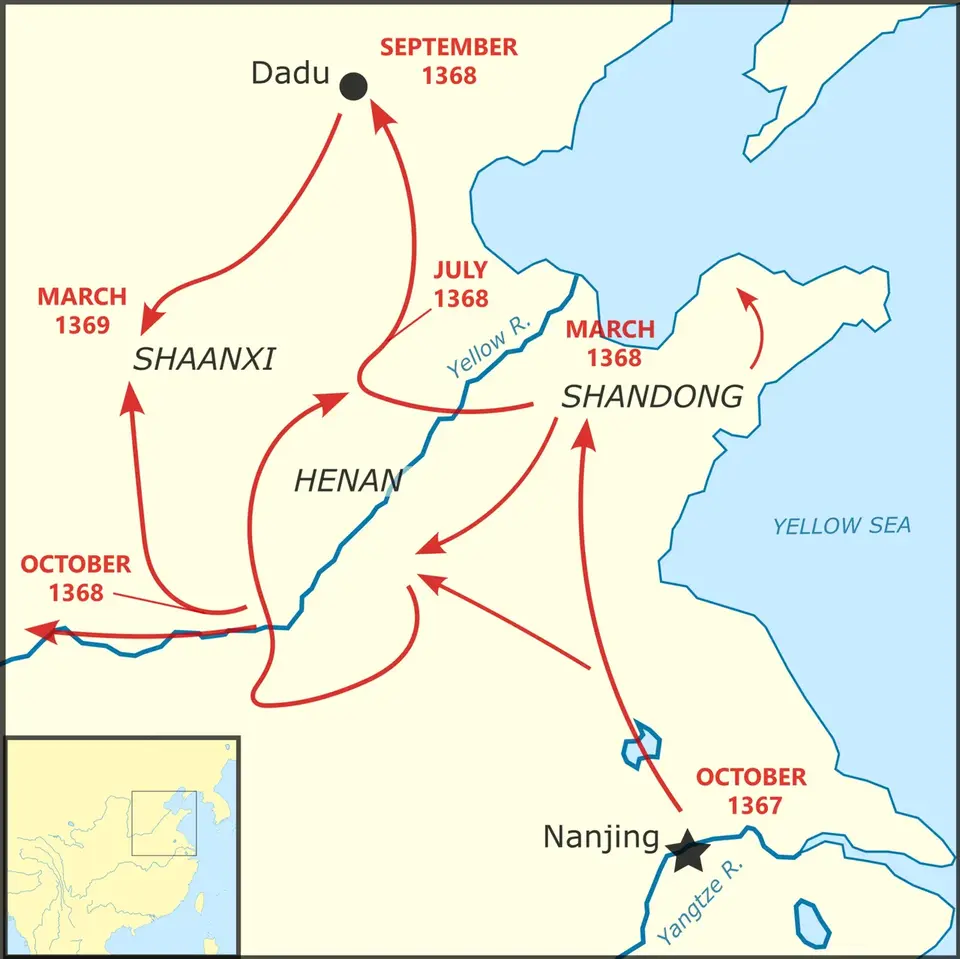
Xu Da's Northern Expedition (徐达北伐) refers to the decisive strategic offensive launched between 1367 and 1369 during the Yuan-Ming transition, wherein Ming founder Zhu Yuanzhang dispatched Senior Generalissimo Xu Da and Vice Generalissimo Chang Yuchun at the head of a quarter-million troops to overthrow the Mongol-led Yuan Dynasty and unify the Central Plains. In November 1367, following the pacification of southern rivals Chen Youliang and Zhang Shicheng, Zhu Yuanzhang adopted Xu Da's methodically calculated operational blueprint: first secure Shandong to eliminate coastal outposts, wheel westward into Henan to sever lateral reinforcement corridors, seize Tongguan Pass to block northwestern counter-offensives, and finally advance along converging axes to seize the Yuan capital of Dadu. Promulgating the historic proclamation to "expel the barbarian nomads and restore China," the expeditionary host advanced from Huai'an, sweeping across Shandong before subduing Kaifeng and Luoyang. In September 1368, Xu Da converged upon Tongzhou by river and land, prompting the final Yuan sovereign, Toghon Temür (Emperor Huizong), to flee northward to Shangdu under cover of night. Ming forces occupied Dadu without urban pillage, re-establishing the historic northern metropolis as Beiping Prefecture. Reorienting westward, the Ming command executed a nocturnal cavalry assault at Taiyuan, shattering the formidable host of Köke Temür (Wang Baobao), and subsequently pacified the Wei River basin and Gansu corridor. Concluded by late 1369, the campaign terminated Yuan dominion over agrarian China, initiating the unified reign of the Ming Dynasty.
Zhu Yuanzhang presides over sacrifices in Yingtian, appointing Xu Da as Senior Generalissimo and Chang Yuchun as Vice Generalissimo over 250,000 troops marching from Huai'an.
Ming vanguard columns capture Yizhou, subsequently storming Yidu and defeating Yuan loyalist defender Puyan Bukha, prompting the general submission of Shandong.
Advancing westward into the Central Plains, Ming armies enter Kaifeng and rout Toyin Temür at Ta'erwan, successfully taking Luoyang.
Ming divisions capture the strategic defile of Tongguan, severing lateral communication links between northwestern Mongol warlords and the imperial capital.
Xu Da defeats the final external defense army at Tongzhou, destroying the riverine defense line protecting Dadu.
Emperor Huizong departs Dadu through the Jiande Gate with imperial consorts and the crown prince, retreating to Shangdu.
Ming troops breach the Qihua Gate, occupying the Yuan imperial capital without civil pillage and creating Beiping Prefecture.
Xu Da executes an indirect march against Taiyuan, where Chang Yuchun's night assault shatters Köke Temür's army, forcing the Mongol commander to flee with eighteen horsemen.
Ming armies march through Tongguan to capture Xi'an; Li Siqi capitulates at Fengxiang, and Feng Sheng secures Lintao.
Ming columns eradicate Zhang Liangbi at Qingyang and seize Shangdu in Inner Mongolia, successfully concluding the First Northern Expedition.
In the mid-fourteenth century, the Mongol Yuan imperial administration entered an acute crisis. Imperial nobility and privileged Semu aristocrats seized vast agricultural holdings, driving displaced peasants into insolvency while fiscal authorities levied unprecedented surtaxes. Unrestricted emissions of unbacked paper currency—Zhongtong and Zhizheng banknotes—precipitated catastrophic monetary inflation. Catastrophic breaches along the Yellow River flooded Shandong and Henan, leaving millions destitute. In 1351, the Red Turban Rebellion erupted under Han Shantong and Liu Futong, igniting widespread popular insurrections across the realm.
Paralyzed by internal factionalism, the Yuan imperial court proved incapable of mounting coordinated counter-offensives. Emperor Huizong neglected governance, while bitter political struggles between Crown Prince Ayushiridara and imperial ministers degenerated into armed conflict among regional Mongol commanders. Generals Chaghan Temür and Bolod Temür turned their swords against one another. Following Chaghan's assassination, his nephew Köke Temür (Wang Baobao) engaged in prolonged internecine warfare against northwestern rivals Li Siqi and Zhang Liangbi across Shanxi and Shaanxi. The northern imperial defense network collapsed into fragmented warlord fiefdoms unable to resist external invasion.
Amidst regional strife, Zhu Yuanzhang pursued a disciplined state-building strategy anchored in the recommendation of scholar Zhu Sheng to "build high walls, store abundant grain, and delay claiming kingship." Based in Yingtian (modern Nanjing), Zhu enforced rigorous military discipline, promoted agricultural reclamation, and accumulated extensive logistical reserves. In 1363, he destroyed the armada of Chen Youliang at Lake Poyang; by late 1367, his armies breached the ramparts of Pingjiang, eliminating the rival kingdom of Zhang Shicheng.
With the submission of maritime magnate Fang Guozhen in Zhejiang and the pacification of Chen Youding in Fujian, Zhu Yuanzhang completed the unification of the affluent Yangtze basin and southern coastal provinces. Backed by abundant agricultural revenues and an armed host of several hundred thousand battle-tested soldiers, the Ming administration acquired the strategic depth and economic capacity necessary to mount a full-scale northern offensive.
In military councils formulating the northern campaign, operational philosophies diverged. Vice Generalissimo Chang Yuchun, relying on the recognized striking power of his cavalry, advocated a direct, high-speed dash from Shandong straight to Dadu, arguing that the capital could be seized in a single stroke. Conversely, Zhu Yuanzhang and Senior Generalissimo Xu Da perceived the grave hazards of overextension. Zhu pointed out that Dadu was a fortified metropolis, and northern Mongol warlords commanded hundreds of thousands of horsemen across Shaanxi and Shanxi. A protracted siege at Dadu would allow regional cavalry armies to sever the expedition's southern supply lines, stranding the advance force.
Consequently, Zhu and Xu established a four-stage plan: first secure Shandong to remove northern outposts; wheel into Henan to sever regional communications; seize Tongguan to shield the army's western flank; and finally converge along land and riverine avenues against Dadu. Complementing this military deployment, court scholar Song Lian drafted the celebrated Proclamation to the Central Plains, invoking the restoration of ancestral Chinese sovereignty and the rule of law. Prohibiting summary executions of surrendered soldiers and civilians, the proclamation successfully won the political endorsement of northern gentry lineages and the broader rural population.
On November 12, 1367 (the twenty-first day of the tenth lunar month), Zhu Yuanzhang presided over ancestral sacrifices in Yingtian, commissioning Xu Da as Senior Generalissimo for Pacifying the North and Chang Yuchun as Vice Generalissimo, commanding an integrated force of two hundred thousand infantry and fifty thousand cavalry. On November 19, the vanguard embarked from Huai'an, utilizing high water levels on the Grand Canal to transport provisions northward into Shandong.
Shandong represented the strategic southern buffer of Dadu, yet its defensive garrisons were scattered and demoralized. Approaching Yizhou (modern Linyi), Xu Da confronted Yuan regional commanders Wang Xuan and his son Wang Xin, who capitulated upon witnessing the numerical scale of the Ming host. Incorporating their contingents, Xu advanced north, subverting Yizhou and Juzhou in rapid succession. In December, Ming amphibious columns surrounded the regional administrative center of Yidu (modern Qingzhou). Chang Yuchun cut off the garrison's retreat, and heavy bombardment breached the city walls, resulting in the capture of Yuan loyalist defender Puyan Bukha.
Following the reduction of Yidu, surrounding prefectures submitted without battle. Xu Da pushed westward to Jinan, compelling the Yuan privy councilor Boyan Temür to retreat to Dongping. The Ming command enforced strict non-looting directives and opened imperial granaries to relieve local famine victims. Within three months, the entire province of Shandong was secured, removing Dadu's southern screen and yielding critical logistical depots.
Adhering to the overarching operational plan, Xu Da deferred an immediate northward thrust toward Dadu, redirecting his main columns westward into Henan to eliminate the threat of flank counter-attacks. In April 1368, leaving detachments to guard the Yellow River crossings, Xu and Chang moved along the waterway toward the strategic regional metropolis of Bianliang (Kaifeng).
Yuan garrisons across Henan collapsed before the advance. Ming forces entered Chenzhou and Xuzhou unopposed, occupying Kaifeng in mid-spring. Delighted by the news, Zhu Yuanzhang personally visited the front to reward the troops and designated Bianliang as the auxiliary northern capital. Xu Da then pushed toward the historic stronghold of Luoyang, where Yuan Left Chancellor Toyin Temür concentrated several tens of thousands of mounted warriors north of the Luo River.
In May 1368, the opposing hosts clashed at Ta'erwan on the outskirts of Luoyang. Exploiting their equestrian mobility, Yuan cavalry drew up in battle formations. Chang Yuchun personally charged the enemy center, felling the forward commanders with precise archery. Ming infantry and cavalry followed with a general assault, routing the Yuan formations, executing over ten thousand defenders, and capturing Prince of Liang Aruwen. Toyin Temür fled westward toward Shanzhou, leaving Luoyang in Ming hands. Capitalizing on the victory, Ming columns advanced to Tongguan Pass, whose defender Yan Sixiao abandoned the fortress. By securing Tongguan, the Ming severed the communication line between the northwestern warlords in Shanxi and Shaanxi and the imperial capital.
In August 1368, Zhu Yuanzhang conferred with Xu Da and Chang Yuchun in Kaifeng, determining that the final phase of the campaign could proceed. Xu assembled twenty-five thousand troops and a transport fleet of over one thousand vessels at Dongping, advancing northward along the Grand Canal. By late August, the expedition reached Dezhou, clearing Cangzhou and Tianjin.
On September 8, Ming land and naval forces reached Tongzhou, the primary granary and riverine transshipment terminus southeast of Dadu. Yuan Privy Councilor Boyan Temür and Senior Minister Zhang Kangbo deployed defensive detachments behind fortified earthen dykes along the Bai River. Xu Da ordered Chang Yuchun's light cavalry to cross the river upstream and encircle the rear of the Yuan positions, while the main army launched a frontal assault. Under combined pressure, the defensive line collapsed; Zhang Kangbo was killed, and Boyan Temür fled to Dadu with only a hundred horsemen. The defeat shattered the final exterior defense line protecting the capital.
Confronted by the approaching Ming forces, Emperor Huizong recognized that resistance was futile. On the night of September 14, 1368, the emperor assembled his imperial consorts and Crown Prince Ayushiridara, evacuated the palace, and exited Dadu through the Jiande Gate, retreating northward through the Juyong Pass toward Shangdu in Inner Mongolia.
On September 20, 1368 (the fourteenth day of the eighth lunar month), Xu Da's armies reached the Qihua Gate (Chaoyang Gate) of Dadu. Scaling the stone walls with siege ladders, Ming soldiers entered the city as remaining defenders threw down their weapons. Xu Da executed the Yuan regent Altun Buqa and Prince of Huai Temür Bukha, who refused to acknowledge defeat, successfully restoring order throughout the municipal perimeter.
Following the takeover, Xu Da enforced strict military regulations: soldiers were prohibited from entering the private quarters of the imperial palace; imperial registers, historical archives, and treasury vaults were sealed and cataloged; special guards protected imperial concubines and captured Mongol nobles; and retail trade in the urban markets continued uninterrupted.
Upon receiving the dispatch in Yingtian, Zhu Yuanzhang issued an imperial edict renaming Dadu as "Beiping Prefecture" and reorganizing the region under the Beiping Provincial Administrative Commission. The Sixteen Prefectures of Yanyun, separated from Chinese administrative governance since their cession by Shi Jingtang in 936, were reintegrated into the imperial realm after 432 years.
The fall of the capital did not instantly pacify the northern frontier. Mongol commander Köke Temür (Wang Baobao) still maintained over one hundred thousand veteran mounted warriors around Taiyuan, preparing a massive counter-offensive to retake Beiping. In October, Köke marched his cavalry out of Yanmen Pass, moving along the eastern foothills of the Taihang Mountains toward Baoding and Beiping.
Anticipating the maneuver, Xu Da devised a classic stratagem to "besiege Wei to rescue Zhao." Deducing that Köke's eastward march left Taiyuan vulnerable, Xu observed: "Köke has ventured deep into the field, leaving his home base empty. If our main force strikes Taiyuan, he must wheel about to save it. If he turns back, his men will be exhausted, and we shall defeat him at our leisure!" Leaving a blocking detachment to defend Beiping, Xu led his main divisions southwestward through Juyong Pass directly into Shanxi.
Realizing that his logistical base was in mortal peril, Köke halted his advance and raced westward back to Taiyuan. In November, both armies converged before the walls of Taiyuan. Recognizing that the Yuan cavalry had arrived after grueling marches and had not yet entrenched their encampment, Chang Yuchun advised an immediate night assault. Xu Da approved, assigning Chang to spearhead the strike with one thousand elite shock horsemen while he supported with the main infantry formations.
Under cover of darkness, Chang Yuchun's cavalry penetrated the perimeter of Köke's encampment, setting fires and sounding battle drums. Caught completely unawares, the Yuan army dissolved into panic. Köke Temür, who had been reading by candlelight in his command tent, fled barefoot on an unsaddled mount. Ming troops captured senior general Huobima, executed thousands of defenders, and took forty thousand prisoners along with tens of thousands of warhorses. Köke escaped northward to Datong with only eighteen riders, securing the total pacification of Shanxi.
With Shanxi secured, Xu Da and Chang Yuchun concentrated their divisions at Tongguan in early 1369, launching a coordinated offensive into the Guanzhong plains. Shaanxi was controlled by rival warlords Li Siqi and Zhang Liangbi. Acknowledging the overwhelming power of the Ming forces, Li Siqi surrendered his army at Fengxiang without combat, while Zhang Liangbi retreated to make a final stand at Qingyang.
In March 1369, Xu Da occupied the provincial administrative center of Xi'an. He dispatched General Feng Sheng westward to secure Lintao and Gongchang across the Gansu corridor. In June, Ming forces completed the encirclement of Qingyang, annihilating the remaining forces of Zhang Liangbi.
Simultaneously, to eliminate cross-border incursions by northern Mongol remnants, Chang Yuchun and Li Wenzhong were ordered to march through Yanmen Pass toward Datong. The Yuan garrison commander Tuoliebo fled without engaging, allowing the Ming to occupy Datong and accept the surrender of over ten thousand tribal nomads.
Advancing into the Inner Mongolian steppe, Chang Yuchun pushed toward Shangdu (Kaiping, modern Plain Blue Banner, Inner Mongolia). In June 1369, Ming columns invested the perimeter of Shangdu, forcing Emperor Huizong to evacuate further north to Yingchang along Lake Dalinor. Chang Yuchun occupied Shangdu, capturing hundreds of Yuan aristocratic officials and thousands of livestock, and reorganized the outpost as the Kaiping Guard. This victory pushed the northern defense boundary of the Ming state directly into the southern steppe margins, establishing the foundational outposts of the subsequent Nine Garrisons defense system. By December 1369, resistance throughout Shaanxi and Gansu ceased, marking the conclusion of the First Northern Expedition.
Spanning over two years, Xu Da's Northern Expedition deployed 250,000 soldiers across five northern provinces, liberating the ancient capitals of Kaifeng, Luoyang, Dadu, Taiyuan, and Xi'an. The campaign terminated the unified Mongol imperial state in China, driving the remnant Yuan court into the northern steppes to form the Northern Yuan regime. Furthermore, through victories at Taiyuan and Qingyang, the expedition neutralized the primary field armies of Köke Temür and the Shaanxi warlords, fulfilling all strategic objectives formulated by Zhu Yuanzhang.
Xu Da's Northern Expedition occupies an epochal position in Chinese military and geopolitical history. First, it ended 432 years of foreign occupation over the Sixteen Prefectures of Yanyun, reuniting the northern borderlands with the agrarian heartland. Second, it demolished the institutional and social hierarchies established during the Mongol conquest, restoring traditional administrative systems rooted in Chinese classical statecraft. Third, it provided a rare historical example of a successful strategic conquest launched from southern China against the north, serving as a tactical masterpiece of sequential, phased warfare.