Imperial Proclamation in Hebei
Liu Xiu ascends the throne at Hao in June, takes Luoyang in October, and fixes the grand strategy of prioritizing the east before the west.
Eastern Han Dynasty (东汉) · HISTORICAL EVENT
刘秀统一天下之战
Liu Xiu's War of Unification (刘秀统一天下之战) was a strategic campaign conducted between 25 and 36 CE by Emperor Guangwu of Han (Liu Xiu) to eliminate regional warlord regimes and re-establish a unified Han imperial dynasty. Following the downfall of the Xin dynasty, the Chinese realm fractured into competing regional states, while the Red Eyebrows army and warlords carved out autonomous realms. In October 25 CE, Liu Xiu proclaimed himself Emperor and made…
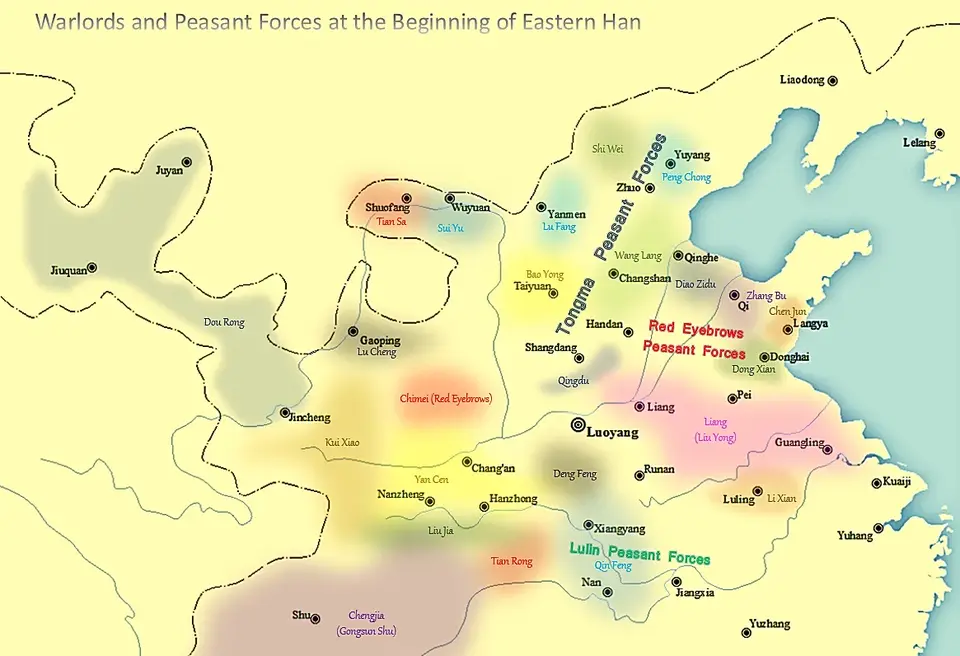
Liu Xiu's War of Unification (刘秀统一天下之战) was a strategic campaign conducted between 25 and 36 CE by Emperor Guangwu of Han (Liu Xiu) to eliminate regional warlord regimes and re-establish a unified Han imperial dynasty. Following the downfall of the Xin dynasty, the Chinese realm fractured into competing regional states, while the Red Eyebrows army and warlords carved out autonomous realms. In October 25 CE, Liu Xiu proclaimed himself Emperor and made Luoyang his capital, formulating the grand strategy of pacifying the east before subjugating the west. Over twelve years of warfare, Liu Xiu relied on capable generals from the Yuntai terrace such as Geng Yan, Feng Yi, Cen Peng, and Wu Han. He first destroyed Liu Yong and the Qi-Lu warlords in the east, accepted the surrender of hundreds of thousands of Red Eyebrows troops at Yiyang to secure Guanzhong, and eliminated Peng Chong in Youzhou. Beginning in 30 CE, Liu Xiu turned westward, breaking Wei Xiao's defense in Longyou and launching amphibious pincers into Sichuan, culminating in the capture of Chengdu and death of Gongsun Shu in 36 CE. This restored all under heaven under unified rule, ushering in the Guangwu Revival.
Liu Xiu ascends the throne at Hao in June, takes Luoyang in October, and fixes the grand strategy of prioritizing the east before the west.
Gai Yan surrounds Suiyang, crushing the coalition forces of Liu Yong and Gengshi remnants across the central plains.
Feng Yi defeats the Red Eyebrows at Xiaodi, and Liu Xiu blocks their eastward escape at Yiyang, receiving the surrender of hundreds of thousands.
Geng Yan and Zhu You lead Han forces into Youzhou, tightening the siege lines around Peng Chong in Yuyang.
Geng Yan crushes Zhang Bu's host at Linzi, while Peng Chong is assassinated by retainers, securing the northeast.
Wu Han eliminates Dong Xian at Quxian, securing the eastern seaboard; Liu Xiu shifts his military focus to Wei Xiao in the west.
Lai She seizes Lüeyang by night, Liu Xiu brings relief across Mount Long, and Ma Yuan designs a relief map of rice, collapsing Wei Xiao's defense.
Wei Xiao dies in distress at Xicheng, and Wu Han captures his successor Wei Chun, annexing Longyou.
Cen Peng leads the naval wing to shatter the Jingmen water palisades and takes Wuyang by surprise, before being assassinated.
In November, Gongsun Shu is mortally wounded by Gao Wu's spear, Chengdu capitulates, and all China is reunified.
In the late Western Han dynasty, imperial relative Wang Mang usurped the throne to found the Xin dynasty, enacting sweeping institutional reforms modeled on idealized antiquity. However, these archaic policies exacerbated economic dislocation and currency chaos, failing to alleviate severe agrarian distress and land concentration. Devastating floods along the Yellow River triggered widespread famine, precipitating nationwide agrarian uprisings spearheaded by the Green Forest and Red Eyebrows armies.
In 23 CE, Green Forest insurgents sacked Chang'an, executed Wang Mang, and elevated Han imperial kinsman Liu Xuan as the Gengshi Emperor. Yet upon taking power, the Gengshi leadership degenerated into factional infighting and administrative incompetence. Regional magnates across the commanderies seized the opportunity to fortify their own bastions, plunging China into fragmentation far more complex than the initial fall of the Xin.
As a ninth-generation descendant of Han founder Liu Bang, Liu Xiu demonstrated military leadership during the Battle of Kunyang, where he routed Wang Mang's primary army with a strike vanguard. Following the murder of his elder brother Liu Yan by the suspicious Gengshi Emperor, Liu Xiu concealed his grief and accepted an imperial commission to cross the Yellow River and pacify Hebei.
In Hebei, Liu Xiu neutralized the pretender Wang Lang and absorbed massive peasant forces known as the Bronze Horses, reorganizing their veterans into a loyal fighting core that earned him the title Bronze Horse Emperor. In June 25 CE, Liu Xiu ascended the throne at Hao, proclaiming the restoration of the Han dynasty under the era title Jianwu. In October, he entered Luoyang and designated it the imperial capital, launching the grand effort to unify the empire.
At the time of his accession, Liu Xiu's authority was confined to portions of Hebei and Henei, encircled by formidable regional warlords. In the east, Western Han prince Liu Yong claimed the imperial title at Suiyang, allied with Zhang Bu in Qingzhou and Dong Xian in Xuzhou. In the north, Peng Chong established an independent principality in Yuyang. In Guanzhong, hundreds of thousands of Red Eyebrows insurgents occupied Chang'an, while Wei Xiao controlled Longyou and Gongsun Shu reigned as Emperor of Chengjia in Sichuan.
To overcome these encirclements, Liu Xiu adopted the strategic counsel of Lai She, implementing a grand design based on pacifying the east before attacking the west, and securing the near frontiers before advancing to the distant provinces. Liu Xiu maintained diplomatic ties with Wei Xiao in Longyou to neutralize Gongsun Shu, allowing Eastern Han to concentrate its armed might on clearing the central plains before turning westward.
In early 25 CE, while Liu Xiu was campaigning in Hebei, the Gengshi regime retained control of both Luoyang and Chang'an. Recognizing that Henei was fertile, rich in resources, and guarded by the Yellow River, Liu Xiu identified the commandery as the essential springboard for taking Luoyang and shielding his rear from western incursions. He appointed Kou Xun as Grand Administrator of Henei to organize grain logistics and directed Feng Yi to hold the crossing at Mengjin.
The Gengshi court dispatched Grand Minister of War Zhu Wei and Chancellor of the Left Li Song with a massive host of three hundred thousand troops to attack Henei. In a coordinated defense, Feng Yi crossed the Yellow River from Mengjin to strike the enemy rear, while Kou Xun engaged them in front near Wenxian. The Han forces routed Zhu Wei's army, slaying commander Jia Qiang and capturing extensive equipment, thereby cementing the Yellow River defensive perimeter.
In the autumn of that year, Liu Xiu led his main forces to encircle Luoyang. General Zhu Wei, fearing retribution for his past role in the death of Liu Xiu's elder brother, refused to surrender. Liu Xiu sent Cen Peng to assure Zhu Wei of royal clemency. Convinced of Liu Xiu's sincerity, Zhu Wei surrendered the capital. Liu Xiu honored his pledge, granting Zhu Wei a marquisate, and entered Luoyang to inaugurate it as the Eastern Han capital.
Simultaneously, western China was engulfed in violent turmoil. Massive Red Eyebrows columns overran the passes, captured Chang'an, and deposed the Gengshi Emperor. However, the Red Eyebrows lacked constructive political vision, plundering the capital and setting fire to imperial palaces and temples, triggering severe famine across the three capital districts.
Prior to his accession, Liu Xiu had dispatched Grand Minister of Education Deng Yu with an elite detachment westward. Deng Yu entered Hedong through Zhiguan Pass, cleared Gengshi garrisons at Puban, and consolidated the commandery. Advancing across the Yellow River into Guanzhong, Deng Yu routed Red Eyebrows outposts at Yaxian, winning over local fortress magnates.
Nevertheless, as provisions ran completely dry in the capital basin, Deng Yu's army was pinned down by overwhelming enemy numbers under Fan Chong and Xu Xuan. Suffered reverses near Chang'an and Gaoling, Deng Yu fell back toward Yunyang. Recognizing the shifting operational reality, Liu Xiu dispatched Feng Yi to take charge of the western front.
In late 26 CE, Liu Xiu appointed Feng Yi as General Subduing the West. Advancing into Huayin, Feng Yi engaged the Red Eyebrows in grueling defensive warfare, strictly prohibiting pillaging and distributing relief grain, thereby winning the loyalty of the Guanzhong population.
In early 27 CE, having exhausted all food in Chang'an, the Red Eyebrows burned the remaining palaces and marched eastward with more than two hundred thousand followers in an attempt to break out back to their home commanderies. Feng Yi prepared an ambush at Xiaodi, dressing his shock troops in red garments matching those of the insurgents. During the melee, the Han infiltrators sowed total confusion, allowing Feng Yi to shatter the Red Eyebrows vanguard and capture over eighty thousand soldiers.
The remaining Red Eyebrows forces fled toward Yiyang. Foreseeing their path, Liu Xiu had personally advanced with the imperial guards to Yiyang, sealing the mountain defiles with massed archers and heavy infantry. Hemmed in by Liu Xiu in front and pursued by Feng Yi from behind, Red Eyebrows chieftains Fan Chong and Xu Xuan, alongside their puppet ruler Liu Penzi, formally surrendered bare-chested. Liu Xiu pardoned the leaders, settled the rank and file on farmland, and brought Guanzhong permanently into the imperial fold.
In the eastern plains, Western Han prince Liu Yong held Suiyang and proclaimed himself Emperor, appointing Dong Xian as General Aiding the Han and Zhang Bu as Prince of Qi. His coalition spanned modern Henan, Shandong, Anhui, and Jiangsu, presenting the principal obstacle to Han reunification.
In 26 CE, Liu Xiu dispatched General of Tiger Prowess Gai Yan to lay siege to Suiyang. After holding out for months, Liu Yong broke out of the encirclement and retreated to Qiaoxian. When Liu Yong's lieutenants Su Mao and Zhou Jian arrived with relief armies, Gai Yan collaborated with fierce commander Jia Fu to crush the reinforcements outside Suiyang, despite Jia Fu sustaining twelve severe wounds.
In the spring of 27 CE, Liu Xiu personally commanded the assault on Suiyang, where mutinous soldiers slew Liu Yong. Liu Yong's remnants rallied around his son Liu Yu at Shanyang. In 29 CE, Grand Minister of War Wu Han and Gai Yan laid siege to Shanyang, wiping out the defenders, while Liu Yu was killed by his own subordinate, neutralizing the primary eastern warlord alliance.
Following Liu Yong's demise, warlord Zhang Bu maintained over a hundred thousand troops across the Qi-Lu region, fortifying strongholds at Linzi and Juxian. In the autumn of 29 CE, Liu Xiu ordered General Establishing Martial Authority Geng Yan to pacify the Shandong peninsula.
Geng Yan executed brilliant tactical feints. Feigning an advance on the heavily fortified city of Xi'an, he launched a surprise night march against Linzi, seizing the provincial capital in a single day. Zhang Bu hurried his primary army from Juxian to contest the prize in a pitched battle beneath the walls of Linzi.
During the engagement, an arrow pierced Geng Yan's thigh. Geng Yan drew his sword, severed the shaft, and continued beating the war drum to rally his troops. The Han forces slaughtered tens of thousands of enemy soldiers, staining the riverbanks. Liu Xiu traveled to Linzi to celebrate the triumph, comparing Geng Yan's feat to Han Xin's historic conquest of Qi. Trapped at Juxian, Zhang Bu surrendered bare-chested bearing an executioner's ax, bringing Qi-Lu under dynastic authority.
With Zhang Bu subdued, the eastern resistance narrowed to Dong Xian and Pang Meng in Donghai commandery. Dong Xian concentrated his followers at Quxian and Tancheng, coordinating with rebel leader Li Xian in Huainan. Pang Meng turned traitor against the Han and joined Dong Xian, temporarily unsettling the eastern commanderies.
In late 29 CE, Liu Xiu personally crushed Pang Meng's forces at Taoxiang, driving him to seek refuge with Dong Xian. Grand Minister of War Wu Han subsequently directed joint amphibious forces to surround Tancheng and Quxian, erecting double palisades and cutting off maritime communication routes.
In early 30 CE, Wu Han carried Quxian by storm. Dong Xian fled into the coastal mountains on horseback, where he was run down and beheaded by Han cavalry scouts, while Pang Meng was captured and executed. Soon after, Li Xian was crushed in Huainan, extinguishing warlord resistance across the eastern plains and the Huai River basin.
While Eastern Han was campaigning in the east, Grand Administrator of Yuyang Peng Chong, resentful that his early contributions in Hebei had not been rewarded with prime ministerial rank, rebelled in 26 CE, styling himself Prince of Yan and enlisting tens of thousands of Xiongnu and Xianbei cavalry to ravage the northern marches.
Peng Chong's northern cavalry posed a persistent threat to Hebei. In 28 CE, Liu Xiu directed Zhu You and Geng Yan to march northward. Employing steady siege encirclements, Han forces reduced peripheral outposts across Zhuojun and Shanggu, slaying rebel general Han Hong and trapping Peng Chong inside Yuyang.
In February 29 CE, domestic mutiny unseated the rebel prince. Peng Chong's household retainers slew him and his wife in their bedchamber and delivered their severed heads to Luoyang. Han troops entered Yuyang and Youbeiping without further resistance, reincorporating the northern frontier into the imperial orbit.
With the east and north secure, only Wei Xiao in Longyou and Gongsun Shu in Sichuan remained outside imperial authority. Initially, Wei Xiao maintained nominal allegiance to Eastern Han, and Liu Xiu treated him with dignity, designating him Senior General of the Western Provinces. In reality, Wei Xiao intended to retain local independence, secretly maintaining communication with Gongsun Shu.
Renowned general Ma Yuan, sent by Wei Xiao to observe Liu Xiu in Luoyang, urged Wei Xiao to submit whole-heartedly to the Han throne, praising Liu Xiu's magnanimity and vision. However, Wei Xiao's regional lieutenants favored continued autonomy. In 30 CE, when Gongsun Shu raided toward Chang'an, Liu Xiu ordered Wei Xiao to strike southward into Sichuan. Wei Xiao demurred, revealing his deceit, whereupon Liu Xiu resolved to launch the Longyou campaign.
In May 30 CE, Han forces under Geng Yan and Gai Yan entered the Longyou passes, but suffered an initial reverse at Jiequan when ambushed by Wei Xiao's general Wang Yuan. Wei Xiao attempted an invasion of Guanzhong to capture Chang'an, but Generals Feng Yi and Ji Zun held the fortified lines at Qianxian and Anding, defeating the rebel cavalry and stabilizing the frontier east of Mount Long.
In the spring of 32 CE, Attendant Gentleman Lai She devised an audacious scheme to strike at the heart of Wei Xiao's realm. Leading two thousand hand-picked commandos across vertical cliffs by night, Lai She took the strategic citadel of Lüeyang by surprise, severing Wei Xiao's internal communication lines.
Stunned by the loss of Lüeyang, Wei Xiao hurled his entire army against the fortress in relentless day-and-night assaults. Lai She's garrison held fast for months, exhausting food stores until soldiers boiled bowstrings and boots to survive. Liu Xiu welcomed the tactical opportunity and personally led the empire's main army across Mount Long to relieve the citadel.
At this critical juncture, Ma Yuan brought three thousand Longyou cavalry into the Han camp, piling white rice on an imperial table to form a topographic relief map illustrating mountain defiles and tactical axes. Guided by Ma Yuan's intelligence, the Han armies routed Wei Xiao's army outside Lüeyang. Warlord formations surrendered in mass, and Wei Xiao fled to Xicheng with a handful of retainers. Relief troops sent by Gongsun Shu were crushed by Cen Peng along the Western Han River. In 33 CE, Wei Xiao died of illness in isolation, and the mop-up of his remnants concluded the pacification of Longyou in 34 CE.
In the spring of 35 CE, Liu Xiu issued the general directive for the conquest of Sichuan, where Gongsun Shu had reigned as Emperor of Chengjia for over a decade behind mountain barriers. Liu Xiu appointed General Subduing the South Cen Peng to command the southern naval wing out of Jingzhou, constructing thousands of multi-decked warships and assault vessels, while Grand Minister of War Wu Han marshaled the northern land armies.
Gongsun Shu fortified the Three Gorges, bridging the Yangtze River at Jingmen and Jiangguan with massive floating palisades and iron chains manned by tens of thousands of archers. Observing the seasonal easterly winds, Cen Peng dispatched fire ships under a following gale directly into the wooden river barrier. Flaming projectiles ignited the floating forts, while Han naval archers unleashed coordinated volleys. The Sichuan fleet was obliterated, its commanders slain, and the waterway forced open.
Capitalizing on the breach, Cen Peng pushed upstream, seizing Jiangguan and Baidicheng before overrunning Fuzhi and securing Jiangzhou. The western river defenses crumbled completely under the amphibious assault.
Advancing from Jiangzhou, Cen Peng executed a brilliant tactical encirclement. Confronting heavy Sichuan defensive fortifications arrayed under Yan Cen at Dianjiang, Cen Peng staged public naval maneuvers to fix the enemy in front. Meanwhile, he covertly led an elite strike force of cavalry and light infantry on a secret thousand-li forced march through the mountain valleys.
Cen Peng bypassed the main defenses and appeared out of nowhere at Wuyang, situated merely dozens of li south of Chengdu. Taking the logistical depot by surprise, Cen Peng captured vast stockpiles and pointed his spears directly at Gongsun Shu's capital.
When the news reached Chengdu, Gongsun Shu struck the ground with his staff in utter disbelief, lamenting that divine soldiers had materialized within his heartland. Panic swept through the Chengjia administration, and Chengdu was rendered completely vulnerable.
Having fortified Wuyang, Cen Peng established defensive perimeters while preparing for the final assault on Chengdu. Desperate to avert doom, Gongsun Shu hired assassin infiltrators who disguised themselves as civilian refugees seeking shelter in the Han encampment.
During the night, the assassins penetrated Cen Peng's command pavilion and stabbed the general to death. News of Cen Peng's demise shook the army, prompting Gongsun Shu to attempt a counteroffensive. Deeply grieved by the loss of his commander, Liu Xiu bestowed posthumous honors on Cen Peng and ordered Grand Minister of War Wu Han to take over the supreme command in Sichuan.
Wu Han imposed iron discipline, restored combat order, and drove his armies from Wuyang to the gates of Chengdu, establishing fortified siege works along both banks of the Jin River. By the autumn of 36 CE, Chengdu was completely cut off from all outside succor.
In November 36 CE, with supplies depleted, Gongsun Shu committed his remaining tens of thousands of palace retainers and death-ground volunteers to a final sortie outside the western gates. Dressed in gold armor, Gongsun Shu personally oversaw the assault, while general Yan Cen struck the Han vanguard.
Wu Han remained composed, deploying strike commanders Gao Wu and Tang Han with thousands of elite cavalry into the exposed flank of the enemy center. In the ferocious melee, Han cavalryman Gao Wu charged forward and drove his spear through Gongsun Shu's breastplate. Gravely wounded, Gongsun Shu fell from his mount and was carried back into the city, where he succumbed to his wounds that night.
The following morning, seeing that their sovereign was dead, Yan Cen threw open the gates to surrender. Eastern Han armies marched into Chengdu, extinguishing the Chengjia regime. Twelve years after Liu Xiu assumed the imperial throne in 25 CE, the War of Unification ended in complete triumph, restoring unified rule across all under heaven.
Liu Xiu's War of Unification extinguished the destructive cycle of regional warlord fragmentation that followed the fall of the Xin dynasty. For the third time in Chinese history, following the Qin and Western Han, an expansive unified bureaucratic empire was reconstituted across the subcontinent. From Youzhou to Jiaozhi, and from the eastern seaboard to the Sichuan basin, territory was reintegrated under centralized civil administration based in Luoyang, establishing the political boundaries of the Eastern Han for nearly two centuries.
Following the conclusion of sustained conflict, Liu Xiu pivoted state policy toward tax reductions, demobilization, and economic rejuvenation. Imperial decrees emancipated private slaves, dissolved redundant administrative organs, and initiated the nationwide cadastral and population survey known as the Land Measurement Incident. Restored domestic peace facilitated rapid recovery in agriculture, commerce, and artisan crafts, inaugurating the prosperous historical epoch celebrated as the Guangwu Revival.
Throughout the campaigns, Liu Xiu distinguished himself by avoiding gratuitous bloodshed, honoring surrendering commanders, and conferring landed marquisates upon meritorious generals while gently relieving them of operational military commands. Settling his capital at Luoyang, the Eastern Han court promoted Classical Confucian learning, rituals, and moral philosophy, leaving an enduring imprint on the scholar-official bureaucracy and traditional Chinese civilization.