Tang Jian Commemorated at Lingyan
Following the Liu Wuzhou campaign, Emperor Gaozu commissions Tang Jian's portrait inside Lingyan Pavilion
Tang Dynasty (唐朝) · HISTORICAL EVENT
凌烟阁二十四功臣
The Twenty-Four Meritorious Officials of Lingyan Pavilion refers to the premier state commemoration project commissioned in March and April 643 (the second and third lunar months of the seventeenth year of the Zhenguan era) by Emperor Taizong (Li Shimin) of the Tang Dynasty. After more than two decades of dynastic foundation and governance, founding veterans were passing away, while the dynastic succession crisis involving Crown Prince Li Chengqian…
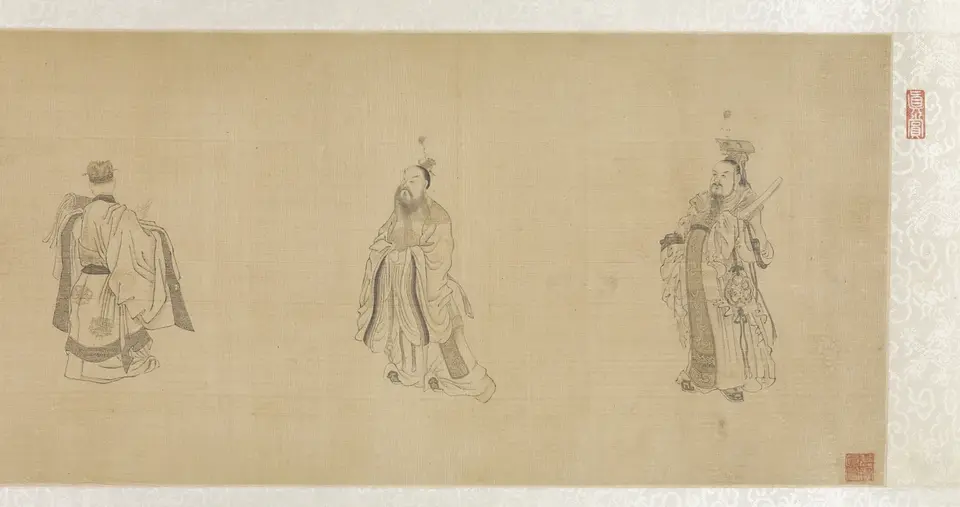
The Twenty-Four Meritorious Officials of Lingyan Pavilion refers to the premier state commemoration project commissioned in March and April 643 (the second and third lunar months of the seventeenth year of the Zhenguan era) by Emperor Taizong (Li Shimin) of the Tang Dynasty. After more than two decades of dynastic foundation and governance, founding veterans were passing away, while the dynastic succession crisis involving Crown Prince Li Chengqian generated acute political anxiety across the bureaucracy. Seeking to honor the sacrifices of founding heroes and consolidate court solidarity, Emperor Taizong issued an imperial edict commissioning life-sized portraits of twenty-four paramount civil and military figures—including Zhangsun Wuji, Li Xiaogong, Du Ruhui, Wei Zheng, and Fang Xuanling—inside the Lingyan Pavilion of Taiji Palace in Chang'an. Master court artist Yan Liben painted the portraits, calligrapher Chu Suiliang inscribed their titles, and Emperor Taizong composed imperial encomiums for each figure. Lingyan Pavilion evolved into the spiritual pantheon of the Tang Empire and an enduring cultural symbol of patriotic service, exercising profound influence on Chinese literati ideals.
Following the Liu Wuzhou campaign, Emperor Gaozu commissions Tang Jian's portrait inside Lingyan Pavilion
Following the capture of Khagan Illig, Gaozu and Taizong host a celebration at Lingyan Pavilion
Chancellor Wei Zheng passes away; Taizong laments the loss of his mirror, recognizing the passing of founding comrades
Emperor Taizong issues the formal edict selecting twenty-four meritorious officials for portraiture at Lingyan Pavilion
Yan Liben completes life-sized portraits, Chu Suiliang inscribes titles, and Taizong writes personal encomiums
Crown Prince Li Chengqian is deposed, Li Zhi is installed as heir, and the commemoration reassures the bureaucracy
Zhang Liang is executed in Chang'an for involvement in treasonous prophetic cults
Following the An Lushan Rebellion, Guo Ziyi and Li Guangbi are added to Lingyan Pavilion
In the institutional development of Chinese imperial governance and ritual, painting portraits of meritorious officials in palace towers possessed venerable precedents. In 55 BCE (the third year of the Ganlu era of the Western Han), following the submission of the Xiongnu Chanyu Huhanye, Emperor Xuan commissioned portraits of eleven pivotal ministers—led by Huo Guang, Zhang Anshi, Han Zeng, Zhao Chongguo, and Su Wu—inside Qilin Pavilion at Weiyang Palace, inaugurating the imperial tradition of monumental meritorious portraiture.
In 60 CE (the third year of the Yongping era of the Eastern Han), Emperor Ming commemorated the Restoration of Emperor Guangwu by commissioning portraits of twenty-eight founding commanders—including Deng Yu, Wu Han, Jia Fu, and Geng Yan—inside the Yuntai tower of the Southern Palace in Luoyang, creating the legendary "Twenty-Eight Generals of Yuntai." Commemorative portraiture functioned not merely as posthumous recognition, but as a symbolic covenant of shared governance between sovereign and elite scholar-commanders.
Throughout the rise of the Tang dynasty—from the Taiyuan uprising and campaigns against regional warlords to the zenith of the Zhenguan reign—Emperor Taizong forged unbreakable fraternal bonds with his staff and commanders. With the passage of decades, these figures reached advanced age. Pioneers such as Yin Kaishan, Liu Zhenghui, and Du Ruhui died early during the Wude and early Zhenguan reigns, followed by Qutu Tong, Chai Shao, Qin Qiong, Yu Shinan, and Zhang Gongjin.
In February 643 (the first month of Zhenguan 17), Chancellor Wei Zheng—whom Taizong regarded as his principal moral mirror—passed away. Taizong wept bitterly, suspending court sessions for five days. Of the twenty-four statesmen selected for the pavilion, eleven had already predeceased the emperor. Confronting his own mortality, Taizong felt an urgent desire to create an enduring architectural sanctuary celebrating their collective achievements.
Beyond nostalgia, the founding of Lingyan Pavilion served an urgent political necessity. In mid-Zhenguan, court politics were convulsed by a dangerous succession struggle. Crown Prince Li Chengqian, afflicted with lameness and erratic temperament, clashed with his talented younger brother, Prince of Wei Li Tai, who enjoyed deep imperial affection. The officialdom divided into hostile factions.
In the spring of 643, Li Chengqian plotted an armed insurrection alongside Prince of Han Li Yuanchang and General Hou Junji. The conspiracy was uncovered, leading to Chengqian's deposition and exile, while Li Tai was demoted for factional maneuvering. This political earthquake rattled the court, causing anxiety among senior commanders. To restore confidence and reaffirm his covenant with founding lineages, Emperor Taizong used the commemoration of founding sacrifices to project imperial benevolence, defuse factional paranoia, and secure an orderly succession for the gentle ninth son, Li Zhi (the future Emperor Gaozong).
Lingyan Pavilion was situated in the northeastern quarter of Taiji Palace in Chang'an, adjacent to Sanqing Hall. Originally erected during the Northern Zhou, it was renovated by Prince Li Shimin during the Wude era. The name "Lingyan" ("Soaring into the Mist") derived from classic Southern Dynasties poetry, connoting lofty grandeur. In 620, Emperor Gaozu had previously ordered Tang Jian's portrait placed there for his loyalty during the Liu Wuzhou rebellion; in 630, following Li Jing's capture of the Eastern Turkic Khagan Illig, Gaozu and Taizong held a banquet in the tower, where Gaozu played the pipa and Taizong danced.
On March 23, 643 (the twenty-eighth day of the second month of Zhenguan 17), Emperor Taizong promulgated the Edict on Painting Portraits of Meritorious Officials at Lingyan Pavilion. The edict proclaimed: "From antiquity, monarchs have honored meritorious virtue, inscribing bronze bells and cauldrons and rendering likenesses in vermilion and cinnabar. May this remembrance of merit match that of former ages, and this demonstration of virtue instruct posterity forever." The edict formalized the list of twenty-four statesmen, initiating the national ceremonial project.
The project united the premier artistic masters of the Zhenguan era. Emperor Taizong appointed master court painter Yan Liben, then serving as Architect-in-Chief, to execute the paintings. Yan Liben investigated the physical likenesses, historical records, and personal bearing of the twenty-four figures, rendering them in full life-size scale. All portraits faced north, symbolizing their eternal reverence toward the imperial throne.
Concurrently, master calligrapher and Imperial Diarist Chu Suiliang was commissioned to inscribe each figure's titles, offices, and peerages in standard script (kaishu) flanking each painting. Emperor Taizong personally composed lyrical encomiums (zan) for each subject, achieving an unprecedented synthesis of imperial decree, master portraiture, calligraphy, and poetic panegyric.
The ranking of the twenty-four officials was determined strictly by administrative rank and court protocol in 643, rather than arbitrary imperial preference, following the rule that higher office preceded lower office.
Crucially, the principle of "priority for the deceased" governed the rankings. Officials who had died prior to 643 had routinely received posthumous promotions to honorary Three Excellencies offices (Grand Commandant, Minister over the Masses, or Minister of Works). Because posthumous ranks exceeded active official ranks, deceased figures generally outranked living peers of comparable status. Deceased leaders Li Xiaogong, Du Ruhui, and Wei Zheng were posthumously titled Ministers of Works, joining living Minister over the Masses Zhangsun Wuji and Minister of Works Fang Xuanling among the top five. The subsequent four figures—Gao Shilian, Yuchi Jingde, Li Jing, and Xiao Yu—held prestigious titles such as Specially Advanced (Tejin) or Opener of the Office Equal to the Three Excellencies.
Zhangsun Wuji (styled Fuji), native of Luoyang, Henan, and elder brother of Empress Wendeshunsheng, held the premier position among the twenty-four officials. Befriending Li Shimin in youth, he joined the Taiyuan uprising and became the prince's foremost confidant. During the rivalry with Crown Prince Li Jiancheng, Zhangsun Wuji advocated preemptive action, organized the conspiracy, and fought beside Li Shimin at the Xuanwu Gate.
Under Taizong, he served as Senior General of the Palace Guard and Minister of Personnel, holding the dukedoms of Qi and Zhao before attaining Minister over the Masses. Mindful of his imperial relative status, he retired from executive duties for nearly two decades to prevent accusations of nepotism. In the 643 succession crisis, he secured the throne for Li Zhi. Entrusted with the regency by the dying Taizong, he later fell victim to Empress Wu's purges, dying in exile in Qianzhou.
Li Xiaogong, first cousin of Emperor Gaozu and grandson of Western Wei Pillar of State Li Wei, ranked second in the pavilion, the foremost commander among imperial princes. Commissioned to pacify the Bashu and Jingxiang regions, he secured thirty-four southern commanderies. In 621, he served as Supreme Commander with Li Jing as second-in-command, leading naval and land forces down the Yangtze to crush the southern regime of Xiao Xian.
In 624, he suppressed the rebellion of Fu Gongshi in Jiangnan, restoring stability across southern China. Maintaining strict military discipline, he forbade indiscriminate execution of captives and reassured local elites. Recognizing the dangers of excessive military prestige, he retired to private indulgence, avoiding political rivalries until his death in 640, when he was posthumously honored as Minister of Works.
Du Ruhui (styled Keming), native of Duling, Jingzhao, was a core strategist of the Qin command, ranking third in the pavilion. Early on, Fang Xuanling recommended him to Li Shimin, advising that Du possessed transcendent statecraft talent indispensable for imperial conquest. Du accompanied Li Shimin in the campaigns against Wang Shichong, Dou Jiande, and Liu Heita.
When Li Jiancheng expelled Qin staff from the capital, Du disguised himself as a Daoist priest to enter the prince's headquarters and finalize the Xuanwu Gate plans. As Vice Director of the Right of the Department of State Affairs alongside Fang Xuanling, he was celebrated for swift, decisive administrative insight, forming the legendary partnership of "Fang's Strategic Vision and Du's Decisiveness" (Fang Mou Du Duan). His premature death in 630 deeply grieved Taizong, who awarded him posthumous rank as Minister of Works.
Wei Zheng (styled Xuancheng), native of Neihuang, Xiangzhou, ranked fourth in the pavilion, celebrated as the paragon of remonstrating officials. Originally an advisor in the Wagang army under Li Mi, he joined the staff of Crown Prince Li Jiancheng, repeatedly urging Jiancheng to eliminate Li Shimin. Following the Xuanwu Gate Incident, Taizong confronted him over his hostility; Wei Zheng boldly answered: "Had the late Crown Prince followed my advice, he would not have perished!" Impressed by his candor, Taizong inducted him into his inner council.
Serving as Imperial Chancellor and Duke of Zheng, Wei Zheng presented over two hundred formal remonstrances, fearlessly rebuking imperial indulgences, notably through his famous memorial Ten Remonstrances to the Emperor. Upon his death in 643, Taizong declared: "With copper as a mirror, one can adjust clothing; with history as a mirror, one can understand dynastic rise and fall; with people as a mirror, one can understand gains and losses. Wei Zheng has passed away, and I have lost my mirror!"
Fang Xuanling (styled Xuanling), native of Linzi, Qizhou, ranked fifth in the pavilion as Taizong's chief chancellor during the Zhenguan reign. Joining Li Shimin's staff in Taiyuan, he served as private secretary throughout the unification wars. Whenever a city fell, while others plundered treasures, Fang combed libraries to preserve archives and recruit scholar-administrators.
Fang orchestrated the administrative apparatus of the Qin household and coordinated the Xuanwu Gate coup. For over twenty years as Vice Director of the Left, he directed domestic administration, codified the Zhenguan Code, refined the Three Departments and Six Ministries system, and introduced the five-fold joint review system for imperial decrees. Dedicated and modest, he drafted a dying memorial from his sickbed in 648 urging Taizong to cease campaigns against Goguryeo, receiving posthumous rank as Minister of Works.
Gao Shilian (styled Shilian), native of Tiao, Bohai, ranked sixth in the pavilion. The maternal uncle of Zhangsun Wuji and Empress Zhangsun, he raised the orphaned siblings and arranged the marriage of his niece to the young Li Shimin. Exiled to Lingnan during late Sui, he later persuaded Jiaozhi Governor Qiu He to submit to the Tang.
On the morning of the Xuanwu Gate Incident, Gao Shilian opened the gates of the capital prisons, armed the convicts, and mobilized imperial guards to reinforce Li Shimin. Under Taizong, he served as Chancellor and oversaw the compilation of the Records of Clans (Shizu Zhi), systematically subordinating traditional aristocratic lineages to imperial state service. He died in 647, receiving posthumous honors as Minister over the Masses.
Yuchi Jingde (styled Jingde), native of Shanyang, Shuozhou, ranked seventh in the pavilion as a premier battlefield warrior. Originally an officer under rebel Liu Wuzhou, he surrendered to Li Shimin in 620 after holding Jiexiu. Li Shimin placed him in charge of elite cavalry during campaigns against Wang Shichong and Dou Jiande. At the Battle of Yubi, when Shan Xiongxin charged Li Shimin, Yuchi galloped forward and unhorsed Shan with a single lance thrust, saving the future emperor.
During the Xuanwu Gate Incident, Yuchi shot Prince Li Yuanji with a bow and entered the imperial lake pavilion fully armored, compelling Emperor Gaozu to transfer military control to Li Shimin. He later served as Senior General of the Palace Guard. In his final years, he withdrew from court affairs to study Daoist internal cultivation, living in seclusion for sixteen years until his death in 658, later honored as a door god.
Li Jing (styled Yaoshi), native of Sanyuan, Yongzhou, ranked eighth in the pavilion, revered as China's premier early Tang military genius. The nephew of Sui general Han Qinhu, he was captured by Li Yuan while attempting to report the Taiyuan rebellion to Emperor Yang. Impressed by his defiance, Li Shimin recruited him into his military staff.
Li Jing directed the amphibious campaign that overthrew Xiao Xian in 621 and pacified Jiangnan. In 629, commanding the northern expedition against the Eastern Turks, he launched a surprise winter cavalry raid on Dingxiang with three thousand elite horsemen, subsequently shattering the Turkish army at Iron Mountain and capturing Khagan Illig. In 635, aged sixty-five, he directed the expedition that destroyed Tuyuhun in Qinghai. His tactical treatises on mobile warfare and logistics made him a foundational military theorist until his death in 649.
Xiao Yu (styled Shiwen), native of Lanling, son of Emperor Ming of Western Liang and younger brother of Sui Empress Xiao, ranked ninth in the pavilion. Possessing imperial demeanor, he surrendered his commandery to Gaozu in 617, serving as Palace Secretariat Director and designing early imperial administrative procedures.
During the Xuanwu Gate crisis, Xiao Yu and Chen Shuda urged Emperor Gaozu to accept Li Shimin as heir. Under Taizong, he served as Vice Director of the Left. Known for scrupulous integrity and unbending principles, he frequently clashed with colleagues, suffering dismissal and reappointment six times. Taizong praised his unwavering loyalty with the famous verse: "Only in fierce winds does one know sturdy grass; only in times of turmoil does one recognize faithful ministers." He died in 648 at Mount Mao.
Duan Zhixuan, native of Linzi, Qizhou, ranked tenth in the pavilion. A skilled equestrian archer, he joined Li Shimin during the Taiyuan rising. At the Battle of Huoyi, he repeatedly charged enemy lines despite sustaining arrow wounds, playing a decisive role in routing Sui general Song Laosheng.
During campaigns against Wang Shichong, his horse fell and he was captured; while being escorted across the Luo River by two enemy horsemen, Duan leaped upwards, dragged both escorts from their saddles, seized their horses, and rode back to Tang lines. He resisted bribes from Prince Li Jiancheng and fought at Xuanwu Gate, later commanding northern border defenses against Tuyuhun until his death in 642.
Liu Hongji (styled Xishou), native of Chiyang, Yongzhou, ranked eleventh in the pavilion. Fleeing military corvée in late Sui, he was imprisoned in Taiyuan, where he formed a close bond with Li Shimin. On the eve of the Taiyuan rising, Liu Hongji and Zhangsun Shunde covertly recruited ten thousand volunteer fighters across local counties, providing the core armed force of the rebellion.
Serving as vanguard commander during the march on Chang'an, he defeated Song Laosheng's forces at Huoyi and secured Fengyi. He fought in campaigns against Xue Ju, Song Jingang, Wang Shichong, and Dou Jiande. Though impeached for financial irregularities, Taizong pardoned him in honor of his foundational service. Aged over sixty, he accompanied Taizong on the Goguryeo expedition, fighting valiantly at Mount Zhubi before passing away in 650.
Qutu Tong, native of Chang'an, Yongzhou, of Xianbei descent, ranked twelfth in the pavilion. A respected veteran who had served the Sui under Emperors Wen and Yang with incorruptible discipline, he commanded forty thousand troops defending Tong Pass against the advancing Tang army. He maintained stubborn resistance until Chang'an fell and Emperor Yang was assassinated in Jiangdu; captured by Tang forces, Emperor Gaozu admired his loyalty, releasing him and appointing him Minister of War.
Entering Qin service, Qutu Tong commanded mobile forces during the siege of Luoyang against Wang Shichong, capturing thousands of enemy troops. He supported Li Shimin during the Xuanwu Gate succession and served as Regional Commissioner in Luoyang, governing with absolute fiscal honesty until his death in 628.
Yin Kaishan (styled Kaishan), native of Hu County, Yongzhou, ranked thirteenth in the pavilion. Renowned for literary eloquence and calligraphy, he joined Li Yuan's staff in Taiyuan, drafting military edicts. He accompanied Li Shimin in crushing Xue Ju at Qianshuiyuan and Wang Shichong at Luoyang.
Yin Kaishan maintained strict logistics and civil order in occupied territories, securing popular submission across the Central Plains. In 622, while marching against Liu Heita in Hebei, he contracted a sudden illness and died in the field. Taizong wept over his passing, awarding him posthumous honors as Minister of Works in 630 and enshrining his memory at Lingyan Pavilion.
Chai Shao (styled Sichang), native of Linfen, Jinzhou, ranked fourteenth in the pavilion. Descended from northern military nobility, he married Princess Pingyang, daughter of Li Yuan. When the Taiyuan rebellion erupted, Chai Shao slipped out of Chang'an to join Li Yuan, while his wife raised the "Army of the Lady" in Guanzhong, the couple uniting forces to capture Chang'an.
Chai Shao served as vanguard cavalry commander in major campaigns against Xue Rengao, Song Jingang, and Dou Jiande. In 628, defending the frontier against Tuyuhun and Turks in Minzhou, he utilized the stratagem of deploying two dancing maidens on a forward ridge; while Turkish archers paused to observe the performance, Chai led heavy cavalry in a surprise flank charge, routing the invaders. In 633, he destroyed Liang Shidu at Shuofang, eliminating the last rival warlord of the Sui-Tang transition, before dying in 638.
Zhangsun Shunde, native of Luoyang, Henan, and clan uncle of Zhangsun Wuji, ranked fifteenth in the pavilion. Avoiding military service in late Sui, he fled to Taiyuan, where he partnered with Liu Hongji to recruit ten thousand volunteers for Li Shimin's initial insurrection.
During the advance on Chang'an, he slew enemy commanders at Huoyi and pacified Jiangjun. When charges of accepting silk bribes were brought against him in early Zhenguan, Emperor Taizong chose not to execute him; instead, Taizong shamed him publicly by bestowing bolts of silk upon him in open court, prompting Zhangsun Shunde to reform his conduct and serve with distinction until his death in 639.
Zhang Liang, native of Xingyang, Zhengzhou, ranked sixteenth in the pavilion. Originally in Li Mi's Wagang army, he joined the Tang and was recommended to Li Shimin by Fang Xuanling. During the succession struggle, Li Shimin dispatched Zhang Liang covertly to Luoyang to recruit regional gentry and prepare a strategic base in case of defeat in the capital.
Arrested and tortured by Prince Li Yuanji's partisans, Zhang Liang endured severe interrogation without compromising Li Shimin's plans. Following Xuanwu Gate, he served as Minister of Justice and Governor of Luoyang. In 644, he commanded naval fleets taking Bisha fortress during the Goguryeo campaign. However, in his final years he became obsessed with esoteric prophecies, adopting five hundred godchildren; executed for treason in 646, he was the most tragic figure among the twenty-four.
Hou Junji, native of Sanshui, Binzhou, ranked seventeenth in the pavilion. Entering Qin service in his youth, he demonstrated decisive tactical boldness during unification campaigns and was a principal advocate of the Xuanwu Gate coup.
Promoted to Minister of War, he served under Li Jing against Tuyuhun in 635, advocating pursuit through desert wastes. In 639, appointed Commander-in-Chief of the Jiaohe Expedition, Hou led armies across the Taklamakan Desert and Tien Shan mountains to conquer the Kingdom of Gaochang, establishing Xizhou. However, his embezzlement of royal treasures in Gaochang led to imprisonment, breeding deep resentment that culminated in his participation in Prince Li Chengqian's coup; executed in 643, Taizong spared his wife and son out of remembrance for his conquests.
Zhang Gongjin (styled Hongshen), native of Fanshui, Weizhou, ranked eighteenth in the pavilion. Abandoning Wang Shichong to submit to the Tang, he entered Qin service on the recommendation of Xu Shiji and Yuchi Jingde. On the eve of the Xuanwu Gate coup, when Li Shimin hesitated over divination, Zhang seized the divination turtle shell, dashed it to pieces on the floor, and insisted that destiny demanded immediate action.
During the coup, when eastern palace forces assaulted Xuanwu Gate, Zhang demonstrated immense strength, single-handedly closing the heavy iron-reinforced palace gate to keep the attackers outside. In 629, he submitted six strategic principles for conquering the Eastern Turks, serving as Li Jing's deputy during the northern victory. He died in 632 while serving as Governor of Xiangzhou at age thirty-nine.
Cheng Zhijie (originally Cheng Yaojin, styled Zhijie), native of Dong'e, Jizhou, ranked nineteenth in the pavilion. A cavalry lance master, he served as one of four elite cavalry commanders under Li Mi in the Wagang army. Defecting from Wang Shichong alongside Qin Qiong at the Battle of Jiuqu, he entered Qin service and fought in campaigns against Song Jingang, Wang Shichong, and Dou Jiande.
Cheng Zhijie fought at Xuanwu Gate and was appointed Senior General of the Right Martial Guard. During Emperor Gaozong's reign, he commanded northern expeditions against the Western Turks in 656. He died in 665 at age seventy-seven, remembered in popular folklore as a charismatic folk warrior.
Yu Shinan (styled Boshi), native of Yuyao, Yuezhou, ranked twentieth in the pavilion, celebrated as one of the four calligraphic masters of the early Tang. Tutored by Monk Zhiyong (seventh-generation descendant of Wang Xizhi), his literary and brushwork mastery was revered throughout the southern dynasties and late Sui. Following the fall of Dou Jiande, Li Shimin invited him to join the Hongwen Academy as an honored mentor.
Serving as Director of the Palace Library, Yu Shinan exhibited profound moral courage, remonstrating against royal extravagances through classical scholarship. Emperor Taizong celebrated him as possessing "five perfections": moral conduct, fearless loyalty, deep erudition, refined prose, and supreme calligraphy. Upon his death in 638 at age eighty-one, Taizong mourned that the imperial academy was left vacant.
Liu Zhenghui, native of Chanshui, Huazhou, ranked twenty-first in the pavilion. Serving as military officer in Taiyuan under late Sui, he was an original conspirator in the Taiyuan rising alongside Li Yuan and Li Shimin. When the main expedition advanced on Chang'an, Liu was entrusted with defending the Taiyuan base and managing northern supply lines.
In 619, when Liu Wuzhou captured Taiyuan, Liu Zhenghui was imprisoned; despite severe interrogation, he covertly dispatched intelligence to Gaozu regarding enemy logistics, demonstrating unshakable loyalty. After the defeat of Liu Wuzhou, he was released and appointed Minister of Justice, passing away in 635.
Tang Jian (styled Maoyue), native of Jinyang, Taiyuan, ranked twenty-second in the pavilion. A lifelong companion of Li Shimin whose family enjoyed generational friendship with Li Yuan, Tang was an initial planner of the Taiyuan rebellion, serving as Chief Secretary during the march on Chang'an.
Captured during the Liu Wuzhou invasion, Tang smuggled warnings to Li Yuan of an impending Turkic raid on Guanzhong, earning Gaozu's admiration as the first official portrayed at Lingyan Pavilion in 620. In 630, serving as Chamberlain for Dependencies, he conducted diplomatic negotiations with Eastern Turkic Khagan Illig, lowering their guard and enabling Li Jing's surprise attack. He retired in 648 and died in 656 at age seventy-eight.
Li Shiji (originally Xu Shiji, styled Maogong), native of Lihu, Caozhou, ranked twenty-third in the pavilion as one of the three supreme military commanders of early Tang. A pillar of the Wagang army under Li Mi, following Li Mi's defeat he placed all territories under Li Mi's name to present to the Tang court rather than claiming personal credit, prompting Gaozu to praise him as a "pure minister" and grant him the imperial surname Li.
Li Shiji pacified northern warlords alongside Li Shimin and governed the northern frontier at Bingzhou for sixteen years with such authority that Taizong likened him to an impenetrable Great Wall. In 630 he defeated the Eastern Turks at Baidao, and in 641 crushed Xueyantuo at Mount Nuozhen. Appointed Chancellor under Gaozong, he directed the final conquest of Goguryeo in 668, passing away in 669 at age seventy-six.
Qin Qiong (styled Shubao), native of Licheng, Qizhou, ranked twenty-fourth in the pavilion, legendary as China's archetypal brave warrior. Beginning his career under Sui commander Lai Huni, he joined Li Mi's Wagang vanguard before defecting from Wang Shichong to join Li Shimin. Appointed cavalry commander, he served as Taizong's personal shock vanguard.
Whenever an enemy champion displayed arrogance before the lines, Li Shimin dispatched Qin Qiong. Charging solo through enemy formations brandishing twin iron maces and spear, Qin unhorsed enemy commanders and seized their standards in over two hundred engagements. In late life he suffered from chronic illnesses due to dozens of battle wounds, remarking: "I spent my youth in warfare, fighting over two hundred battles and losing rivers of blood; how could I not fall ill?" Passing away in 638, he was immortalized alongside Yuchi Jingde as a revered guardian door god.
Lingyan Pavilion was designed with sophisticated spatial conventions using partition screens (ge). Classical records in the Five Dynasties Essentials (Wudai Huiyao) and Southern New Books (Nanbu Xinshu) debate whether the layout featured single intermediate partitions or three concentric tiers. Archaeological and documentary reconstructions suggest that the pavilion possessed an outer gallery, a middle partition, and an inner chamber, allowing imperial visitors to circulate through defined viewing pathways.
Portraits were uniformly oriented northward toward the primary northern entrance, emphasizing vassal loyalty toward the throne. The northern face of the inner partition displayed portraits of civil chancellors; the southern face displayed imperial princes and supreme military commanders; and the outer partition displayed remaining generals and ministers alongside Chu Suiliang's calligraphy. Wall murals depicted Emperor Taizong's battle steeds, harmonizing imperial martial glory with ministerial commemoration.
Lingyan Pavilion remained an active state sanctuary throughout the Tang dynasty. Over centuries, murals suffered weathering, requiring imperial restorations and additions during moments of military crisis or dynastic restoration.
In 763 (Guangde 1), following the suppression of the An Lushan Rebellion, Emperor Daizong added portraits of restoration heroes Guo Ziyi and Li Guangbi. Emperor Dezong added commanders such as Li Sheng and Ma Sui between 780 and 785 following the pacification of regional warlord revolts. In 848 (Dazhong 2), Emperor Xuanzong commissioned thirty-seven additional portraits of early and High Tang ministers, including Ma Zhou, Chu Suiliang, and Zhang Jiuling. In 900 (Guanghua 3), commanders who suppressed court eunuchs received portraits. In 904, when warlord Zhu Quanzhong forced the court to relocate to Luoyang, ministers proposed erecting a new pavilion dedicated to Zhu, tracing the 300-year arc of Tang dynastic fortune.
The Lingyan Pavilion commemorative model was adopted across later Chinese dynasties. In 1064 (Zhiping 1), Emperor Yingzong of Northern Song commissioned portraits of seventy-two ministers of Renzong's reign in the Jingling Palace, a practice continued by Shenzong, Zhezong, and Huizong. In 1226 (Baoqing 2), Emperor Lizong of Southern Song established the Zhaoxun Chongde Pavilion in Lin'an, displaying twenty-four premier Song statesmen including Zhao Pu, Kou Zhun, Fan Zhongyan, and Yue Fei.
Through stone steles and woodblock prints, the portraits entered popular culture. The Linyou County Museum in Shaanxi preserves an authentic 1090 stone engraving of the Lingyan portraits and Taizong's panegyrics carved by Song judicial commissioner You Shixiong. In 1668 (Kangxi 7), Qing artist Liu Yuan and engraver Zhu Gui published The Lingyan Pavilion Commemorative Portraits (Lingyange Gongchen Tu), synthesizing poetry, calligraphy, painting, and seal carving to celebrate the twenty-four heroes.
In modern Tang studies, Lingyan Pavilion constitutes a vital nexus between art history, political ritual, and institutional sociology. Art historian Jin Weinuo initiated modern documentary studies in the 1960s with his comparative analysis of The Sedan Chair (Bunian Tu) and the Lingyan portraits.
Recent scholars, including Du Zhengqian in Lingyan Pavilion and Tang Politics, have clarified the pavilion's exact architectural location adjacent to Sanqing and Liangyi halls, demonstrating how imperial commemoration stabilized court factionalism during the succession crisis of 643. Historian Zhang Naidong examined how the selection of officials balanced the Taiyuan founding clique, Qin command veterans, and former Eastern Palace personnel. Studies by Sun Zhimin have traced how historical generals such as Qin Qiong and Yuchi Jingde transitioned from imperial aristocrats into universal household guardian deities.
Beyond official historiography, the twenty-four officials achieved rich secondary life within popular vernacular literature, storytelling, and performing arts. From Song storytellers' tales to Ming and Qing masterworks such as Sui Tang Yanyi and Shuo Tang, the figures were reimagined as paragons of chivalric brotherhood.
Folk motifs—such as Qin Qiong pawning his weapons, Cheng Yaojin's battleax strikes, and Yuchi Jingde's single-handed lance combat—became universally recognized cultural legends. Most prominently, folk traditions record that Emperor Taizong was haunted by vengeful spirits after the Xuanwu Gate Incident; Qin Qiong and Yuchi Jingde volunteered to stand guard outside the bedchamber in full armor, successfully banishing malevolent visions. To relieve the weary generals, Taizong ordered their likenesses painted on palace gates, initiating the enduring Chinese New Year custom of pasting portraits of Qin and Yuchi as guardian door gods on household portals.
The establishment of the Twenty-Four Meritorious Officials at Lingyan Pavilion successfully defused the political crisis precipitated by Crown Prince Li Chengqian's attempted coup. By publicly honoring founding sacrifices, Emperor Taizong issued an unambiguous promise that the imperial house would preserve the status and prosperity of founding lineages, dispelling paranoia across the aristocracy and securing an orderly transition to Li Zhi (Emperor Gaozong).
Furthermore, Lingyan Pavilion institutionalized a mature paradigm of monarch-minister relations. Unlike early Han purges of founding commanders such as Han Xin and Peng Yue, the Tang dynasty managed military elites through institutional honors and hereditary offices, sustaining a stable coalition between court and aristocracy. Successive Tang monarchs—including Suzong, Daizong, Dezong, and Xuanzong—repeatedly added portraits of contemporary commanders during crises such as the An Lushan Rebellion, maintaining Lingyan Pavilion as the empire's supreme pantheon of dynastic legitimacy.
In Chinese intellectual history, Lingyan Pavilion transcended physical architecture to become the ultimate symbol of imperial service and personal self-realization. "Attaining a place at Lingyan Pavilion" represented the zenith of human achievement within the Confucian framework of moral, military, and intellectual accomplishment (San Bu Xiu).
Tang and Song literature contains ubiquitous invocations of Lingyan Pavilion. Tang poet Li He famously wrote in his Thirteen Poems from the Southern Garden: "Why should a man not wear a Wu hook, and reclaim the fifty provinces of the frontier? Pray, sir, step up to Lingyan Pavilion: which scholar among them was granted a marquisate of ten thousand households?" Bai Juyi, Du Fu, Su Shi, Lu You, and Xin Qiji referenced Lingyan Pavilion to evoke military valor, imperial recognition, or tragic frustration. The Twenty-Four Officials became permanently woven into Chinese cultural identity and patriotic memory.