Inauguration of First Southern Tour
Departing Beijing, the emperor inspects Gaojiayan dikes, visits Ming Xiaoling in Nanjing, and performs full kowtow rites before Confucius at Qufu.
Qing Dynasty (清朝) · HISTORICAL EVENT
康熙帝南巡
The Southern Tours of the Kangxi Emperor (康熙帝南巡) were six major imperial progress and state inspection expeditions conducted by the Kangxi Emperor (Xuan'ye) between 1684 and 1707, following the pacification of the Revolt of the Three Feudatories and the incorporation of Taiwan. Spanning twenty-three years, these tours traversed thousands of miles primarily along the Grand Canal corridor across Zhili, Shandong, Jiangsu, and Zhejiang. Integrating water…
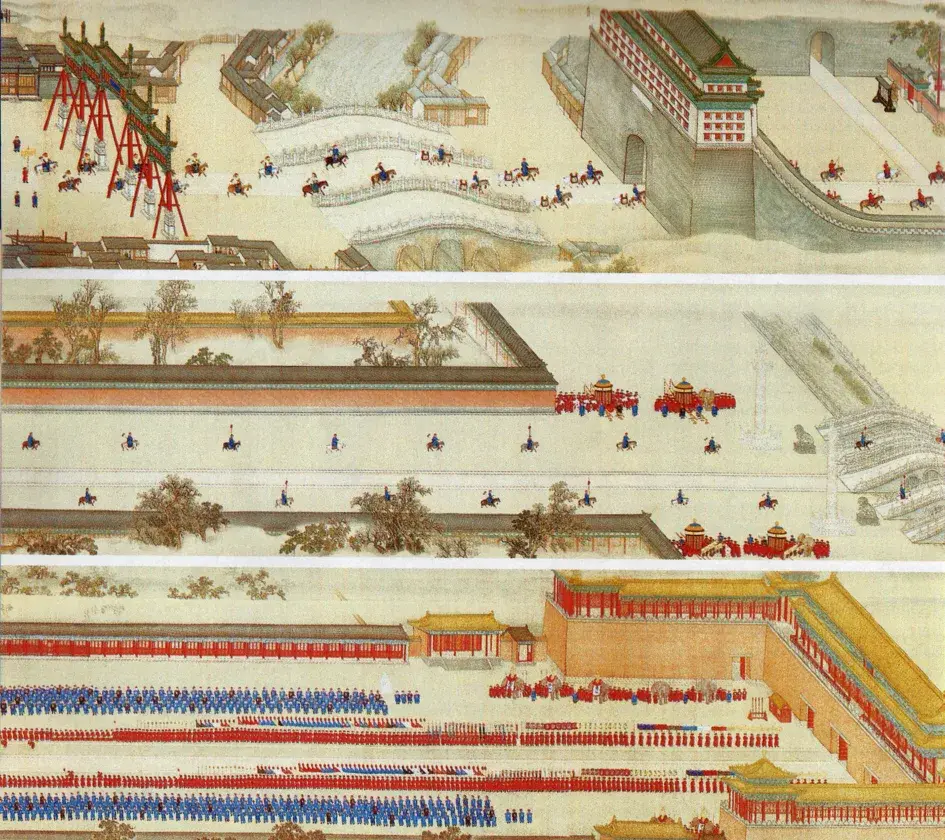
The Southern Tours of the Kangxi Emperor (康熙帝南巡) were six major imperial progress and state inspection expeditions conducted by the Kangxi Emperor (Xuan'ye) between 1684 and 1707, following the pacification of the Revolt of the Three Feudatories and the incorporation of Taiwan. Spanning twenty-three years, these tours traversed thousands of miles primarily along the Grand Canal corridor across Zhili, Shandong, Jiangsu, and Zhejiang. Integrating water conservancy, transport security, and political consolidation, the emperor personally inspected perilous river junctions along the Yellow River and Huai River five times, and surveyed the Qiantang River sea walls four times, providing hands-on direction for hydraulic engineering that restored Grand Canal navigability. Politically and culturally, the emperor climbed Mount Tai, performed full kowtows before Confucius at Qufu, and paid solemn homage six times at the Ming Xiaoling Mausoleum in Nanjing, presenting imperial tablets including "Teacher of Ten Thousand Generations" and "Governance Surpassing Tang and Song." By exempting tens of millions of taels in regional arrears and recruiting Han scholars through special examinations, the tours effectively dismantled ethnic hostility, reconciled Jiangnan literati to Qing sovereignty, and solidified the political and economic foundations of the High Qing era.
Departing Beijing, the emperor inspects Gaojiayan dikes, visits Ming Xiaoling in Nanjing, and performs full kowtow rites before Confucius at Qufu.
The tour is officially codified as river inspection; the emperor surveys Lake Hongze, inscribes "Governance Surpassing Tang and Song" at Xiaoling, and visits Yu the Great Mausoleum.
Accompanied by the Empress Dowager, the emperor inspects dikes in a small boat, approves the completed Middle Canal bypass, and remits widespread provincial tax arrears.
Surveys Qingkou convergence works, provides technical instructions to engineers, and conducts special examinations to recruit southern scholars into court academies.
Inspects Qiantang River defenses, approves the massive construction of granite fish-scale seawalls, and surveys grain price stability across Jiangnan prefectures.
Completes the final southern tour, reviewing the integrated Yellow-Huai waterworks and coastal defenses, cementing Han scholar allegiance to the Qing state.
During the early decades following the 1644 transition, the Qing dynasty was consumed by continuous military mobilizations across mainland China. In 1681, Qing forces captured Kunming, completely eradicating the regional warlordism of the Three Feudatories led by Wu Sangui. Two years later, in 1683, Admiral Shi Lang captured Penghu, prompting the surrender of the Zheng regime in Taiwan and leading to the formal establishment of Taiwan Prefecture. With domestic insurrections comprehensively pacified, the empire achieved territorial stability inside Shanhaiguan.
This transition necessitated a profound strategic shift from wartime conquest to enduring administrative and agrarian rehabilitation. The Jiangnan region, encompassing the fertile Yangtze Delta, served as the economic heartbeat and agrarian tax reservoir of the empire, contributing over a third of national grain revenues and the vast majority of commercial silk and cotton fabrics. Stabilizing Jiangnan society and integrating its affluent gentry into the imperial order emerged as the most critical governance objective for the Qing central court.
The most urgent material threat confronting the young dynasty was systemic flooding along the lower Yellow River and Huai River basins. Since the Yellow River breached its course and captured the lower Huai River in 1128, vast quantities of silt had choked the lower waterways and Lake Hongze, causing continuous catastrophic ruptures where the two river systems converged at Qingkou near modern Huai'an. During the early Qing period, decades of deferred maintenance caused catastrophic seasonal ruptures, submerging millions of fertile acres across Jiangnan and Henan into vast watery wastes.
Crucially, this hydrological chaos severed the Grand Canal, the vital economic conduit supplying Beijing with southern grain tribute. Each year, several million piculs of rice were ferried north along the canal to sustain the imperial court, the civilian populace, and the Eight Banners garrisons. Silting and canal breaches disrupted tribute fleets and depleted capital granaries, threatening the political security of the central government. The Kangxi Emperor regarded river conservancy, canal transport, and the Three Feudatories as the three supreme state priorities, carving their names onto palace pillars and vowing to resolve water management through direct imperial oversight.
Culturally, Jiangnan was the historical bastion of Ming loyalism and anti-Qing resistance. Early Qing edicts enforcing the queue hairstyle had provoked fierce resistance and subsequent military massacres in cities like Yangzhou, Jiading, and Jiangyin, leaving deep psychological scars among the Han scholar-gentry.
Numerous prominent literati who upheld traditional Confucian notions of ethnic orthodoxy refused to serve the Qing court, living as recluse scholars, Buddhist monks, or writing private histories commemorating the fallen dynasty. While the court sponsored special civil service examinations, widespread intellectual resistance persisted. The Kangxi Emperor astutely recognized that harsh penal codes and literary inquisitions alone could never secure genuine loyalty. The monarch needed to descend personally into Jiangnan to demonstrate genuine devotion to Confucian orthodoxy and bridge the emotional divide separating the court from the Han intelligentsia.
In the autumn of 1684, one year after the stabilization of Taiwan and the conclusion of the Three Feudatories conflict, court ministers deliberated over imperial touring precedents. While certain officials urged the monarch to hold ancient sacrificial ceremonies on Mount Tai, the ministry rejected extravagant ceremonies as wasteful vanity. Instead, proposals to conduct a pragmatic imperial inspection tour to survey flood works and pay respects at Mount Tai and Qufu gained imperial approval. The Kangxi Emperor defined the official mandate as evaluating hydraulic infrastructure and investigating civilian livelihoods.
On October 25, the thirty-year-old emperor departed Beijing, inaugurating the first southern tour of the dynasty. Traveling southward by land, he climbed the Jade Emperor Peak of Mount Tai to offer prayers before entering northern Jiangsu. Confronting severe flooding, the emperor braved rain and deep mud to inspect vulnerable dikes across Xuzhou, Suqian, and Taoyuan. At Qingkou and the Gaojiayan embankment near Huai'an, the emperor met Director-General of Waterways Jin Fu and his brilliant hydraulic strategist Chen Huang. The emperor examined the stone containment dikes, reviewed their strategy of concentrating clear currents to scour yellow silt, and composed celebratory poetry to encourage Jin Fu's engineering corps.
Proceeding southward along the Grand Canal by boat, the imperial retinue entered Suzhou in late November. Passing through Changmen Gate, the emperor visited iconic gardens and stayed at the Suzhou Imperial Silk Manufactory, where he received retired Ming officials and local gentry, distributing gifts and soothing longstanding anxieties. Moving on to Nanjing, the emperor visited the Ming Xiaoling Mausoleum on Purple Mountain. Flanked by civilian and military dignitaries, the young Manchu monarch bowed reverently and dispatched sacrificial tributes to the founding Ming emperor Zhu Yuanzhang, moving hundreds of thousands of watching Han onlookers to tears.
Returning northward, the emperor made a historic pilgrimage to the Temple of Confucius in Qufu on December 24. Clad in formal ceremonial robes, he entered the Dacheng Hall and performed three kneelings and nine kowtows before the sacred tablet of Confucius, dismantling the precedent that Manchu rulers never performed full obeisance to Han cultural sages. In the Poetry and Rites Hall, the emperor listened intently as Kong Shangren, a sixty-fourth generation descendant of Confucius, delivered classical lectures on the Great Learning. Deeply impressed, the emperor promoted Kong Shangren to Doctor of the National Academy on the spot and inscribed the famous plaque "Teacher of Ten Thousand Generations," cementing Neo-Confucianism as the supreme state orthodoxy. The sixty-day inaugural tour achieved unprecedented breakthroughs in engineering assessment and elite reconciliation.
On January 23, 1689, the Kangxi Emperor embarked on his second southern tour, officially designated in imperial edicts as inspecting river conservancy, observing regional customs, and investigating bureaucratic conduct.
The central imperative of this expedition was to rigorously verify and accelerate water conservancy projects around Huai'an. In mid-February, the emperor assembled regional leaders, including Governor-General Fu Lada and Waterways Director Wang Xinming, to take field measurements along the dikes. Responding to bureaucratic critics who slandered Jin Fu's innovative channel diversion plans, the emperor demonstrated exceptional technical acumen. Taking a small skiff into the turbulent waters of Lake Hongze along the Gaojiayan stone wall, he personally operated surveying instruments to measure elevation differences between the Yellow and Huai rivers. Confirming the scientific validity of using Lake Hongze waters to flush out silt, the emperor ordered absolute protection for the embankment and authorized the continuous excavation of the Middle Canal.
Following engineering inspections, the emperor traveled south past Yangzhou to Hangzhou, arriving in early March. When local magistrates proposed constructing lavish imperial pavilions along West Lake to extol his virtues, the emperor issued strict reprimands, commanding that all such wasteful expenditures cease immediately. Crossing the Qiantang River to Shaoxing, he visited the Mausoleum of Yu the Great on Mount Kuaiji, performing ceremonial kowtows and erecting a stone monument inscribed with the words "Heaven and Earth Harmonized." At Lingyin Temple, viewing the monastery shrouded in morning mist from the North Peak, he spontaneously composed the calligraphy plaque "Cloud Forest Zen Monastery."
Arriving in Nanjing in mid-March, the emperor visited the Ming Xiaoling Mausoleum a second time. Kneeling before the central hall, he took brush in hand and penned four massive characters: "Governance Surpassing Tang and Song," publicly proclaiming that Zhu Yuanzhang's dynastic governance exceeded that of the Tang and Song emperors. This public gesture underscored that the Qing court did not conquer China as foreign despoilers, but as rightful dynastic successors who restored order from domestic rebels. At the Nanjing Imperial Observatory, the emperor spent late nights studying celestial constellations with Jiangnan scholars, discussing Western astronomy and mathematics. The second tour concluded after seventy-one days of rigorous statecraft.
In early 1699, preparing for his third southern expedition, the Kangxi Emperor issued strict edicts commanding that all travel expenditures be provisioned exclusively from the imperial palace treasury in Beijing, forbidding local magistrates from extracting any levies from civilian households. Demonstrating filial devotion to Confucian ethics, the emperor invited Empress Dowager Renxian to accompany the journey.
Departing in March, the imperial flotilla entered Huai'an. To inspect thousands of miles of levees, the emperor abandoned ornate ceremonial barges and boarded a modest skiff, accompanied by key hydraulic engineers day and night. The primary objective was to inspect the newly completed Middle Canal, directed by Zhang Penghe. Spanning one hundred and eighty li from Zhongjia Sluice in Suqian southward to Qingkou, this canal bypassed the perilous shoals of the Yellow River. Walking several miles on foot to examine sluices and diversion channels, the emperor observed grain tribute fleets navigating smoothly without risking shipwrecks in the raging torrents, rewarding the engineering leadership handsomely.
In April, the emperor performed his third sacrificial rites at the Ming Xiaoling Mausoleum, followed by a grand military review of Eight Banners and Green Standard Army garrisons stationed in Jiangnan. Arriving in Yangzhou, he stayed at the Tianning Temple and was hosted by his close confidant Cao Yin, the Imperial Silk Commissioner of Jiangning. Noting the region's gradual economic resurgence alongside lingering agricultural tax debts, the emperor issued an sweeping decree forgiving millions of taels of back taxes accumulated from natural disasters across Jiangsu, Anhui, and Zhejiang, eliciting widespread popular gratitude.
Between 1703 and 1707, the Kangxi Emperor launched his fourth, fifth, and sixth southern tours in rapid succession, focusing on structural institutionalization and hydraulic permanence.
In early 1703, during the fourth tour, the emperor visited the famous freshwater springs of Jinan, composing calligraphic plaques including "Source of Purity and Clarifying Flow." Reaching Huai'an, he inspected the Qingkou junction alongside Waterways Director Zhang Penghe. Using measuring rods to gauge silt deposition and river velocity, the emperor directed workers to excavate auxiliary discharge channels and reinforce stone lock gates. Outside Changmen Gate in Suzhou, the emperor met retired officials and administered special civil examinations on site, directly commissioning exceptional Han scholars into the Hanlin Academy and the South Study, opening elite bureaucratic pathways for southern talent.
During the fifth tour in 1705 and the sixth tour in 1707, the emperor expanded his hydraulic surveys to the eastern coast. He visited the Qiantang River sea walls four times, where massive tidal bores periodically smashed coastal barriers and salinized millions of acres in Hangzhou and Jiaxing. The emperor examined traditional timber structures, condemned them as perishable and vulnerable, and mandated the construction of permanent granite fish-scale sea walls. He allocated several million taels from the state treasury to construct an expansive stone seawall from Old Salt Granary to Haining, permanently protecting the northern Zhejiang agricultural basin.
Throughout all six expeditions, the emperor visited the Ming founder's mausoleum every time, reiterated his commitment to Confucian statecraft, and held private audiences with southern literati, presenting imperial calligraphy and administrative honors. By May 1707, when the sixth tour concluded, his twenty-three years of personal leadership had tamed the Yellow-Huai hydrological system and transformed Jiangnan from an alienated frontier into the economic and cultural pillar of the Qing Empire.
The most enduring tangible accomplishment of the six southern tours was the systemic stabilization of the Yellow and Huai river basins and the unhindered restoration of the Grand Canal. By discarding bureaucratic inertia and verifying water depths personally with surveying equipment, the Kangxi Emperor validated Jin Fu and Zhang Penghe's hydraulic principles. The construction of the massive Gaojiayan stone embankment, the opening of the one-hundred-and-eighty-li Middle Canal bypass, and the development of the Qiantang granite sea walls definitively curbed centuries of catastrophic flooding. The Grand Canal operated without major disruption, ensuring the continuous transport of millions of piculs of southern tribute grain to the capital, anchoring state finances and political stability.
Politically and culturally, the southern tours executed a masterclass in imperial legitimation and cultural rapprochement. Confronting lingering trauma from early dynastic conquests, the Kangxi Emperor actively embraced classical Chinese civilization. By performing full kowtows before Confucius, establishing Neo-Confucianism as dynastic orthodoxy, repeatedly revering the Ming founder at Xiaoling, and sponsoring special civil examinations, the emperor stripped Manchu rule of foreign stigma. Han scholar-gentry circles shifted from active alienation to genuine cultural identification with the Qing throne, transforming potential subversion into cohesive imperial loyalty.
By strictly prohibiting local official exactions and funding tour expenditures from the palace privy purse, the expeditions relieved societal pressure while injecting vitality into local markets. Across six tours, the emperor remitted tens of millions of taels in back taxes accumulated during decades of disaster. This fiscal leniency, coupled with effective flood mitigation, fostered rapid agrarian recovery across the Lower Yangtze, powering the boom of silk, cotton, and porcelain manufacturing, alongside interregional merchant cartels based in Yangzhou and Suzhou, laying the economic foundation of the High Qing era.
Official Qing historiography and later scholarly evaluations have universally praised the southern tours of the Kangxi Emperor. The Draft History of Qing commends the emperor for his tireless concern for the populace, noting that his direct inspection of riverworks, construction of seawalls, and reverence for Confucian scholars achieved enduring benefits for millions of subjects, surpassing the deeds of Han and Tang rulers.
Late Qing scholar Wei Yuan emphasized in his military chronicles that unlike ancient monarchs who squandered public fortunes on self-indulgent pleasure tours, the Kangxi Emperor endured mud and rough waters to safeguard the livelihoods of commoners. Modern historians and hydraulic specialists similarly view the southern tours as an extraordinary model of pre-modern governance, seamlessly uniting rigorous scientific field inquiry with sophisticated political and cultural statecraft to forge a unified, resilient multi-ethnic empire.