Outbreak of the Great Wokou Crisis
Corsair leaders Wang Zhi and Xu Hai organize massive pirate fleets with Japanese ronin to ravage coastal provinces.
Ming Dynasty (明朝) · HISTORICAL EVENT
抗倭战争
The Anti-Wokou War (抗倭战争, also known as the Jiajing Campaign against Japanese Pirates) was an extensive defensive counter-offensive fought from 1553 to 1566 (the 32nd to 45th year of the Jiajing reign) by Ming imperial forces and coastal civilian militias to eliminate armed marauders along the southeastern seaboard. In the mid-16th century, the disintegration of the Ming coastal garrison system coincided with internal chaos in Sengoku-period Japan.…
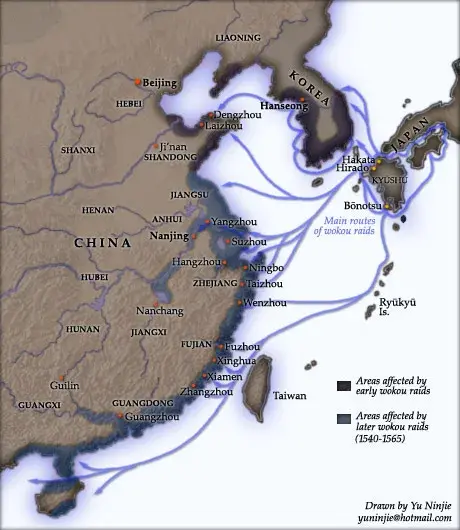
The Anti-Wokou War (抗倭战争, also known as the Jiajing Campaign against Japanese Pirates) was an extensive defensive counter-offensive fought from 1553 to 1566 (the 32nd to 45th year of the Jiajing reign) by Ming imperial forces and coastal civilian militias to eliminate armed marauders along the southeastern seaboard. In the mid-16th century, the disintegration of the Ming coastal garrison system coincided with internal chaos in Sengoku-period Japan. Destitute Japanese samurai and ronin aligned with powerful Chinese maritime smuggling syndicates headed by Wang Zhi and Xu Hai. Exploiting porous coastal defenses, these combined forces raided hundreds of coastal settlements across Zhejiang, Fujian, and Guangdong, perpetrating widespread murder, arson, and pillage. In response to national crisis, General Zhang Jing achieved the landmark victory of Wangjiangjing, while Supreme Commander Hu Zongxian orchestrated counter-espionage operations that dismantled the leadership of Wang Zhi and Xu Hai. Frontline commander Qi Jiguang raised a disciplined peasant-miner army from Yiwu, inventing the tactical "Mandarin Duck Formation" and utilizing advanced firearms. Qi's forces achieved nine consecutive victories during the Taizhou campaign, freeing Zhejiang. Marching south, Qi joined forces with veteran commanders Yu Dayou and Liu Xian to storm fortified island redoubts at Hengyu and Pinghaiwei. By 1566, allied forces annihilated the final pirate strongholds in Guangdong, securing lasting maritime peace and fostering the subsequent legalization of overseas trade under the Longqing Emperor.
Corsair leaders Wang Zhi and Xu Hai organize massive pirate fleets with Japanese ronin to ravage coastal provinces.
Minister Zhang Jing takes command of coastal defense and summons Guangxi Lang tribal infantry to reinforce the front.
Zhang Jing and Lady Wa's troops annihilate nearly two thousand pirates; Zhang Jing is subsequently executed on false charges.
Supreme Commander Hu Zongxian drives Xu Hai to suicide and lures Wang Zhi into custody, dismantling the pirate syndicate.
Qi Jiguang recruits three thousand Yiwu miners and invents the Mandarin Duck Formation, combining cold steel with firearms.
The Qi Family Army secures nine consecutive victories in Taizhou, eradicating pirate forces throughout Zhejiang Province.
Qi's army traverses tidal mudflats with straw bundles to wipe out the Hengyu pirate fortress, liberating hundreds of captives.
Qi Jiguang, Yu Dayou, and Liu Xian launch a joint offensive at Pinghaiwei, slaying over two thousand pirate combatants.
Qi Jiguang breaks the siege of Xianyou and eliminates mountain redoubts at Caipiling, pacifying inland Fujian.
Joint land and naval operations under Qi and Yu eradicate the final pirate holdouts on Nan'ao Island, concluding the war.
From the late 14th century onward, Japan was engulfed in the prolonged feudal warfare of the Northern and Southern Courts and the subsequent Sengoku civil wars. Dispossessed samurai, masterless ronin, and coastal corsairs crossed the East China Sea to conduct armed contraband trade and coastal plunder, labeled by Chinese historical chronicles as Wokou (Japanese pirates). During the early Ming Dynasty, the founding Hongwu Emperor established a comprehensive coastal defensive screen, constructing military garrisons, watchtowers, and naval squadrons that contained early pirate activity.
By the mid-Jiajing era, the hereditary weisuo garrison military system had decayed through corruption, desertion, and administrative neglect. Simultaneously, the vibrant commercial economy of the lower Yangtze created tremendous international demand for Chinese silk, porcelain, and tea. Strictly adhering to archaic dynastic ancestral bans, the Jiajing Emperor enforced draconian maritime bans (haijin), proclaiming that "not a single plank of wood shall enter the sea." The prohibition destroyed legitimate coastal merchant livelihoods, driving prominent maritime clans in Zhejiang and Fujian into illegal contraband smuggling. Smuggling magnates such as Wang Zhi and Xu Hai recruited skilled Japanese ronin as shock troops, forging heavily armed maritime cartels that operated with impunity.
Beginning in 1553 (the 32nd year of Jiajing), pirate raids escalated into large-scale warfare. Wang Zhi proclaimed himself "King of Hui", fortifying the Goto Islands of Japan and the Shuangyu and Zhoushan islands off Ningbo as forward operational bases. Mobilizing fleets carrying tens of thousands of armored fighters, the pirate coalitions penetrated deep into the inland riverways of Jiangsu and Zhejiang, advancing toward the walls of Nanjing.
The raiders wielded long Japanese two-handed katana blades and heavy composite bows, routing demoralized Ming garrison conscripts. Across coastal counties, entire urban districts were incinerated, commercial wealth was plundered, and tens of thousands of civilians were killed or abducted into servitude. Corrupt prime minister Yan Song and his son Yan Shifan embezzled frontier defense allocations while purging competent military commanders. Faced with an existential fiscal and security crisis, the Ming court was compelled to grant broad operational powers to capable provincial administrators.
In 1554, the imperial court appointed Minister of War Zhang Jing as Supreme Commander overseeing military affairs across six coastal provinces. Recognizing that local conscripts lacked combat morale, Zhang Jing garrisoned key towns with seasoned commanders like Yu Dayou while dispatching urgent requisitions for tribal Lang auxiliary troops (Zhuang and Yao warriors) from Guangxi.
In May 1555, over twenty thousand pirates advanced from Zhelin into northern Jiaxing. Zhang Jing deployed his forces in an ambush pocket at Wangjiangjing (north of modern Jiaxing), where Lady Wa's Guangxi warriors engaged the pirates in close-quarters combat with long spears and short blades. Ming forces achieved an overwhelming triumph, decapitating nearly two thousand pirates and drowning thousands more in surrounding marshes. This represented the premier military victory since the outbreak of the Jiajing raids. However, court rivals led by Zhao Wenhua falsely impeached Zhang Jing for military procrastination, leading the capricious Jiajing Emperor to execute him in Beijing.
Zhejiang Governor Hu Zongxian succeeded as Supreme Commander. Formulating an integrated strategy of covert infiltration and divide-and-rule, Hu engaged brilliant strategist Xu Wei to sow lethal discord between pirate chieftains Xu Hai and Chen Dong, driving Xu Hai to commit suicide in the Pinghu marshes. Subsequently, Hu Zongxian dispatched emissaries to Japan promising trading concessions to induce the pirate supreme commander Wang Zhi to return. In 1559, Wang Zhi sailed into Zhoushan and was captured by imperial forces, and he was publicly beheaded at Hangzhou the following year, crippling the pirates' overseas command architecture.
While pirate leadership was fractured, tactical land defense required modernizing. In the autumn of 1555, young commander Qi Jiguang was reassigned to the Zhejiang coastal front. Having witnessed the systemic cowardice of hereditary garrison conscripts during skirmishes at Cengang, Qi determined to build an entirely new fighting force.
In 1559, Qi traveled to Yiwu County in Jinhua Prefecture, recruiting three thousand miners and agrarian laborers renowned for their physical resilience and discipline. This volunteer force became famous as the "Qi Family Army". Qi instituted meritocratic promotions, collective liability penal codes, and stringent drill training, molding the recruits into an elite force.
To counter the lethal martial arts skills of pirate swordsmen in brush terrain, Qi invented the famous "Mandarin Duck Formation" (Yuanyangzhen). Designed for a twelve-man tactical team, the squad consisted of a squad leader bearing a signal flag; two vanguard skirmishers wielding multi-branched bamboo wolf-brush spears (langxian) to ensnare pirate blades and obscure their vision; two long-spearmen positioned behind to thrust and impale; two short-blade troopers carrying wicker shields to deflect arrows and strike at low angles; two trident-gunners firing fire-arrows and rockets; and two cooks handling field logistics. Integrating long and short weapons, melee defense, and projectile firepower, the formation overwhelmed individual pirate swordplay and isolated enemy units.
In April 1561 (the 40th year of Jiajing), pirate fleets carrying over ten thousand veteran warriors launched coordinated amphibious assaults against Xiangshan, Ninghai, and Taozhu, seeking to capture the prefectural capital of Taizhou.
Qi Jiguang deployed his newly trained army to meet the crisis. At the Battle of Ninghai Bridge, Qi's vanguard utilized the Mandarin Duck Formation to surround and annihilate several hundred elite pirate swordsmen. Marching rapidly through torrential mountain rains, Qi ambushed the main pirate division outside Xinhe, relieving the besieged citadel.
In the pivotal engagements at Huajie and Shangfengling, Qi forced-marched his troops over rugged peaks to assault the primary pirate camps. Firearm battalions broke the enemy lines with salvo fire from tiger-crouching cannons and hand-cannons, after which spearmen and wolf-brush fighters closed in for the kill. Over the course of a single month, Qi Jiguang fought nine consecutive pitched battles around Taizhou, winning all nine. Over 5,500 pirates were killed or captured, while the Qi Family Army suffered negligible casualties. The Taizhou Campaign shattered pirate strength in Zhejiang, pacifying the entire province.
Following their defeat in Zhejiang, remnant pirate bands fled into Fujian, capturing remote coastal redoubts at Funing, Shouning, and Zhenghe. In 1562, pirate forces fortified Hengyu Island off the coast of Ningde. Surrounded by tidal mudflats, the island fortress had repelled multiple assaults by regular troops.
Fujian Governor You Zhende requested emergency reinforcement from Qi Jiguang. In May 1562, Qi's army arrived before Hengyu. Observing that retreating tides left impassable mudflats, Qi ordered every soldier to carry a bundle of dried straw. Dropping the straw bundles onto the mud, Qi's troops charged across the surface at low tide. Storming the palisades under cannon cover, the Qi Family Army eliminated over one thousand pirates, taking more than six hundred heads and liberating over eight hundred civilian captives. Qi immediately followed up by clearing pirate lairs at Niutian and Xinghua.
In April 1563, large pirate coalitions concentrated at Pinghaiwei in Putian, anchoring themselves against coastal cliffs. The court mobilized a coordinated offensive: veteran commander Yu Dayou led the right column, General Liu Xian commanded the left column, and Qi Jiguang served as central assault commander. On April 21, the three columns launched a dawn assault. Spearheaded by Hu Shouren's firearm companies, Ming forces overran the defenses, killing over 2,200 pirates and rescuing three thousand captive civilians, securing the pacification of Fujian.
Surviving pirate remnants rallied over ten thousand fighters to besiege the county citadel of Xianyou in early 1564. Qi Jiguang rushed to the rescue, deploying deceptive feints to divide the besieging lines before striking the southeastern quadrant with the Mandarin Duck Formation. The assault broke the siege lines, routing the enemy. Qi pursued the remnants through Wangcangping and Caipiling, annihilating the remaining strongholds in Fujian.
Defeated in Fujian, the remaining pirate bands fled into the rugged coastline of Chaozhou and Nan'ao Island in Guangdong. In 1565, Qi Jiguang and Yu Dayou received imperial orders to execute a joint amphibious sweep into Guangdong. Yu Dayou deployed naval flotillas to blockade maritime exits, while Qi led infantry ashore to comb through Nan'ao Island. Trapped between naval bombardments and land assaults, the last organized pirate syndicates were wiped out. By 1566 (the 45th year of Jiajing), the protracted Anti-Wokou War concluded in absolute victory for the Ming Dynasty.
The Anti-Wokou War culminated in an absolute military and strategic victory for the Ming Dynasty. Over more than a decade of fierce campaigning, Ming forces killed tens of thousands of pirate marauders, captured and destroyed thousands of warships, and executed the supreme smuggler chieftains Wang Zhi and Xu Hai. The coastal regions of Zhejiang, Fujian, and Guangdong, which had suffered catastrophic destruction for nearly two centuries, were entirely pacified, allowing hundreds of thousands of displaced farmers and merchants to resume peaceful livelihoods.
The war fundamentally transformed Ming military strategy, domestic politics, and global economic integration. First, the conflict preserved the economic prosperity of the Jiangnan tax base, which sustained the empire's fiscal structure. Second, Qi Jiguang revolutionized Chinese military doctrine through his landmark treatises Jixiao Xinshu (New Treatise on Military Efficiency) and Lianbing Shiji (Records of Military Training), establishing standard operational doctrines for combined arms, firearm volleys, and modular squad tactics. Third, the military victory exposed the unviability of traditional sea bans (haijin), leading Emperor Muzong to officially inaugurate the "Longqing Opening" (Longqing Kaiguan) in 1567, legalizing civilian overseas trade at Yuegang in Fujian. This landmark policy shift connected Ming China with Spanish and Portuguese global maritime networks, initiating a massive influx of American silver that underpinned China's late Ming silver economy.