Abolishing Wuzhu and Minting Kaiyuan
Emperor Gaozu abolished defunct wuzhu coinage, inaugurating the Kaiyuan Tongbao with clerical script inscriptions brushed by Ouyang Xun.
Tang Dynasty (Inaugurated under Emperor Gaozu in 621; circulated throughout the Tang and Five Dynasties) · HISTORICAL EVENT
开元通宝
Kaiyuan Tongbao (开元通宝) was the imperial standard currency minted and promulgated in 621 (the fourth year of the Wude era) under Emperor Gaozu of Tang to eradicate debased private coins and consolidate imperial finance, representing a landmark transformation in Chinese monetary history. Emperor Gaozu abolished the wuzhu coin standard that had governed commerce for seven centuries since Emperor Wu of Han. Master calligrapher Ouyang Xun drafted the…
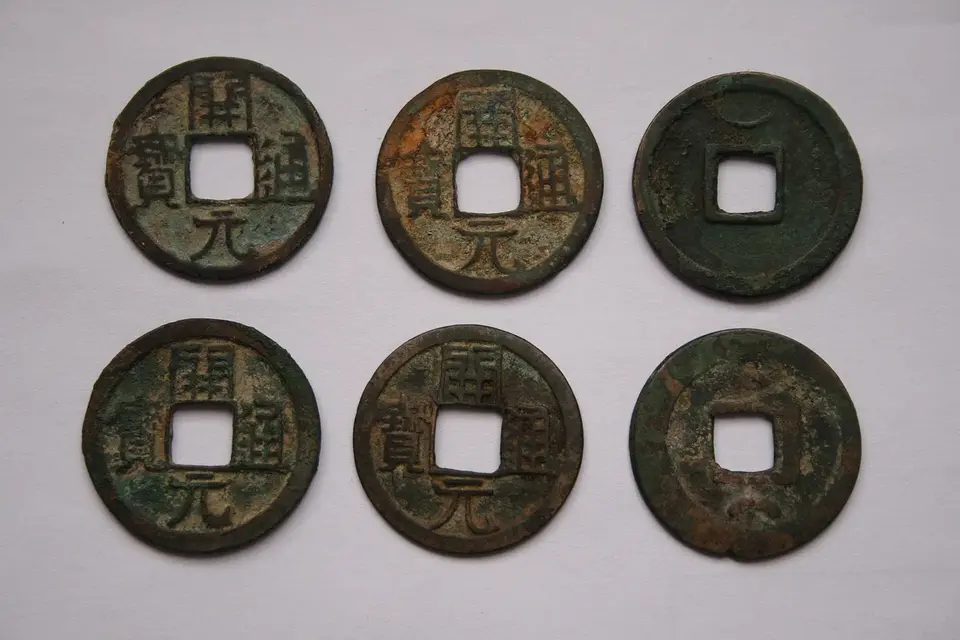
Kaiyuan Tongbao (开元通宝) was the imperial standard currency minted and promulgated in 621 (the fourth year of the Wude era) under Emperor Gaozu of Tang to eradicate debased private coins and consolidate imperial finance, representing a landmark transformation in Chinese monetary history. Emperor Gaozu abolished the wuzhu coin standard that had governed commerce for seven centuries since Emperor Wu of Han. Master calligrapher Ouyang Xun drafted the inscription and brushed the four characters in vigorous clerical script. The coin established that each piece weighed precisely two zhu and four lei, with ten coins equaling one liang, formalizing the coin unit as the decimal base of Chinese metrology. Exhibiting superior metallurgy and precise casting across early, high, middle, and late Tang variations, the Kaiyuan Tongbao served as the foundational medium of exchange throughout the Tang dynasty and into the Five Dynasties era. By replacing weight-based denominations with sovereign fiscal credit, Kaiyuan Tongbao inaugurated a monetary paradigm that endured for over a millennium and circulated along the Silk Road as a symbol of Tang commercial prestige.
Emperor Gaozu abolished defunct wuzhu coinage, inaugurating the Kaiyuan Tongbao with clerical script inscriptions brushed by Ouyang Xun.
The court formalized that each coin weighed two zhu and four lei with ten coins weighing one liang, creating the decimal qian weight standard.
Emperor Taizong revoked casting privileges previously granted to royal princes and merit ministers, centralizing all minting operations.
The Tang Legal Code codified capital penalties for counterfeiting state coinage, prescribing execution by strangulation.
Emperor Xuanzong reorganized provincial mints into ninety-nine furnaces, producing hundreds of thousands of strings annually with reverse crescent marks.
The court issued high-denomination Qianyuan coins during the An Lushan Rebellion, sparking rapid inflation before returning to the Kaiyuan standard.
Chancellor Yang Yan enacted the Double Tax reform requiring tax payments in coin, precipitating severe currency hoarding and rural cash shortages.
Emperor Wuzong melted confiscated bronze statues to cast Huichang Kaiyuan coins, introducing twenty-three distinct prefectural mint marks.
The Southern Tang court minted exquisite Kaiyuan coins in matched seal and clerical script pairs, showcasing superb numismatic artistry.
Northern Song forces pacified the Southern Tang and established Song currency, concluding three hundred and fifty-four years of official Kaiyuan minting.
Since Emperor Wu of Han established the wuzhu coin system in 118 BCE, the currency served as the standard medium of exchange across the Han, Wei, Jin, and Northern and Southern dynasties. However, the catastrophic civil wars accompanying the collapse of the Sui dynasty fractured imperial administrative controls, spurring rampant illicit minting by warlords and unscrupulous merchants. Factions melted standard imperial coins to produce paper-thin, clipped coins heavily adulterated with lead, tin, or scrap iron, colloquially known as goose-eye and thread-ring coins.
The deluge of counterfeit money depreciated purchasing power, requiring scores or hundreds of debased coins to match a single ancient piece. Rampant hyperinflation paralyzed urban commerce and market transactions. Although the late Sui court issued imperial prohibitions against private casting, fragmented military divisions rendered decrees unenforceable, thoroughly dissolving public trust in the historical wuzhu currency.
In 618, Emperor Gaozu ascended the throne in Chang'an, founding the Tang dynasty. During its inaugural years, the court was embroiled in costly military campaigns to pacify regional rivals while inheriting depleted treasuries. Compounding this challenge, market trade across the Guanzhong basin, the Central Plains, and the Yangtze delta was fragmented by mismatched currencies, including antique Sui coins, clipped southern currencies, and counterfeit issues minted by collapsed contenders like Xue Ju and Wang Shichong.
Emperor Gaozu recognized that reviving post-war agriculture and securing state revenues required reasserting absolute monetary authority. The administration needed to eradicate debased private issues and establish a standardized, trusted currency capable of circulating seamlessly across the reunited empire.
In July 621, Emperor Gaozu promulgated an imperial edict formally terminating the legal tender status of all surviving wuzhu coins and debased private currencies, mandating the nationwide issue of the Kaiyuan Tongbao. To invest the new currency with imperial dignity and aesthetic authority, Emperor Gaozu commissioned senior statesman and premier calligrapher Ouyang Xun to compose the name and brush the coin inscription.
Drawing upon classic traditions, Ouyang Xun executed the four characters in robust clerical script with subtle standard script nuances, balancing architectural discipline with kinetic vigor. Ouyang Xun arranged the inscription in a straight cross sequence from top to bottom and right to left, symbolizing the dawn of an imperial era and universal circulation. Although designed for vertical and horizontal reading, popular custom occasionally read the characters clockwise, generating scholarly debates in subsequent dynasties. This innovative naming convention severed the ancient practice of naming coins after physical weights, elevating money into an abstract unit of value backed by state fiscal sovereignty.
The central court established precise physical specifications. Preserving the traditional cosmological motif of a round coin with a square center hole, the Kaiyuan Tongbao was fixed at eight fen in outer diameter (approximately 2.4 centimeters), with an inner hole of two and a half fen and a thickness of one fen. Raised inner and outer rims protected the calligraphic face from friction during daily circulation.
Beyond transforming currency, the promulgation of the Kaiyuan Tongbao restructured the metrological framework of imperial China. Prior to 621, Chinese metrology relied on the archaic duodecimal system inherited from antiquity, wherein one liang equaled twenty-four zhu and one zhu equaled ten lei, imposing cumbersome calculations upon commerce and public accounting.
In calibrating the Kaiyuan Tongbao, Emperor Gaozu established that each coin weighed exactly two zhu and four lei, meaning that ten coins weighed precisely one liang. This calibration facilitated a transition from duodecimal divisions to a decimal weight system.
Henceforth, the standard weight of a single Kaiyuan coin became the statutory metrological unit known as the qian, generating decimal fractions downward (fen, li, and hao) and anchoring larger measures upward (ten qian to one liang, sixteen liang to one jin). The Kaiyuan Tongbao transcended its role as currency to serve as the physical benchmark for national weights and measures, providing an enduring foundation for commercial accounting and scientific measurement.
The production of Kaiyuan Tongbao revolutionized Chinese metallurgical techniques. Prior to the seventh century, ancient coinages were produced primarily using rigid clay, stone, or bronze piece-molds, which required laborious engraving and degraded rapidly under high temperatures, impairing batch consistency.
In manufacturing the Kaiyuan Tongbao, artisans under the Directorate for Palace Buildings popularized mother-coin sand casting. Craftsmen hand-carved pristine master ancestral coins from fine bronze or ivory, from which durable mother coins were replicated. These mother coins were impressed into trays of moist, fine-grained sand to yield multiple standardized mold cavities, enabling stacked vertical casting. This technique multiplied casting capacity and guaranteed crisp rim contours and legible lettering.
Simultaneously, the administration enforced strict alloy formulas. Tang historical treatises record that standard official melts combined eighty-three jin and ten liang of pure copper with seventeen jin and six liang of refined zinc, tin, and lead per ten thousand coins. This ratio lowered melting temperatures, facilitated smooth mold filling, and imparted a lustrous, durable greenish-gold surface capable of withstanding prolonged handling.
To safeguard currency credibility, the early Tang administration centralized coin manufacturing under the Directorate for Palace Buildings in Chang'an, prohibiting provincial officials and private magnates from operating private casting furnaces. Official coins were required to adhere to state alloy standards to preserve uniform intrinsic value.
Immediately following his accession, Emperor Gaozu had granted limited private casting privileges to his sons Prince Li Shimin and Prince Li Yuanji, as well as Chancellor Pei Ji. However, this exception fostered regional disparities in coin quality. Upon ascending the throne, Emperor Taizong abolished private furnace concessions, concentrating all minting authority under central treasuries and the Ministry of Revenue.
The Tang Legal Code established uncompromising penalties for monetary offenses: counterfeiting state currency carried the death sentence by strangulation, ringleaders were beheaded, and individuals knowingly circulating forged coins were sentenced to three years of penal servitude. During the Kaiyuan era of Emperor Xuanzong, the throne appointed regional coin commissioners to eliminate illegal smelting, protecting the purchasing power of official coinages.
Over three centuries of political and economic change, the Kaiyuan Tongbao evolved through distinctive stylistic phases, categorized by numismatists into Early Tang, High Tang, Middle Tang, and Late Tang periods.
Early Tang coins, minted from Wude through the reigns of Taizong and Gaozong, feature upright, muscular lettering with deep calligraphic cuts and dense bronze alloys, celebrated by collectors as Ouyang-style Kaiyuan pieces.
During the High Tang under Emperor Xuanzong, expanding commerce surged currency demand. The court operated seventy-three official furnaces in the early Kaiyuan years, expanding to ninety-nine furnaces by the Tianbao era across major industrial centers including Jiangzhou, Xuanzhou, Runzhou, and Yizhou, producing over three hundred thousand strings of cash annually. High Tang coins display broader characters, golden brass tones, and regularized rim contours.
Numerous Kaiyuan coins exhibit distinct markings on their reverse faces, notably upward or downward crescent arcs. Popular lore attributed these markings to Empress Dou or Consort Yang Guifei, alleging that an imperial lady inadvertently pressed her fingernail into a wax prototype, which obedient craftsmen cast into metal. Modern archaeology demonstrates that crescent arcs, stars, and dots functioned as internal quality-control marks identifying specific furnaces and casting shifts.
The Tang financial system operated on a dual standard combining metallic coin with silk textiles. While Kaiyuan Tongbao served everyday retail transactions and market wages, high-value domestic commerce and international acquisitions relied heavily on bolts of silk damask, which possessed official legal tender conversion rates alongside copper cash.
Following the outbreak of the An Lushan Rebellion in 755, transport corridors along the Yellow River were severed and imperial finances collapsed. To finance massive military payrolls, Emperor Suzong issued fiduciary denominations in 758, minting the Qianyuan Heavy Treasure coin valued at ten standard Kaiyuan coins, followed by larger double-rimmed issues valued at fifty. The influx of token coinage provoked devastating inflation, prompting merchants to shutter stores. The court was compelled to revalue the Qianyuan currency downward, re-anchoring monetary stability on the reliable Kaiyuan Tongbao.
In 780, Chancellor Yang Yan enacted the Double Tax reform, shifting public taxation from physical grain and labor levies to assessed household wealth denominated in cash. The sudden mandate to remit taxes in metallic coin sparked intense deflation. Peasants liquidated grain and cloth to acquire cash, prompting merchant cartels to hoard coin reserves. The resulting severe currency contraction plagued the late eighth and early ninth centuries, forcing successive emperors to issue decrees banning the hoarding of copper and the manufacture of bronze utensils.
During the Huichang era from 841 to 846, Emperor Wuzong executed a sweeping campaign against Buddhist monasteries, dismantling over forty thousand temples and secularizing hundreds of thousands of monastics. Seeking to alleviate the chronic currency shortage with confiscated bronze, Wuzong directed financial commissioner Feng Ao to melt thousands of temple bells, cauldrons, and statues to cast new Kaiyuan coinage, historically known as Huichang Kaiyuan.
Huichang Kaiyuan coins introduced a transformative numismatic convention by casting prefectural abbreviations on their reverse faces. The court required regional mints to cast a single identifying character representing the mint prefecture, producing twenty-three distinct administrative issues, such as Jing for Chang'an, Luo for Luoyang, Chang for Yangzhou, Yan for Yanzhou, and Gui for Guizhou.
Although Huichang issues exhibited mixed metallic purity due to irregular bronze sources, the introduction of reverse mint marks established an enduring administrative precedent adopted by subsequent Song, Ming, and Qing dynasties.
As the material embodiment of Tang economic strength, the Kaiyuan Tongbao circulated beyond imperial borders to become a premier international currency across Eurasia. Desert oasis states and Central Asian kingdoms placed immense trust in its metallurgical integrity, utilizing the coin as a standard medium for transcontinental settlements.
Archaeological excavations confirm this widespread circulation. Thousands of Kaiyuan coins have been unearthed across the western Silk Road, including Tokmok in Kyrgyzstan (ancient Suyab), Afrasiab in Samarkand, Panjakent in Tajikistan, Shymkent in Kazakhstan, and the Amur River basin. In Central Asia, the Turgesh nomadic confederation minted local bronze coins reproducing the round shape and square hole of Kaiyuan pieces, pairing the Chinese inscription with Sogdian legends and tribal bow insignia.
Across maritime routes, Japanese embassies and returning scholars including Abe no Nakamaro and Kibi no Makibi brought chests of Kaiyuan coins home. Impressed by Tang monetary standards, Empress Genmei modeled Japan's first indigenous imperial coin, the Wado Kaichin of 708, directly upon the Kaiyuan Tongbao in dimensions, script style, and decimal weight ratios. Silla and Bohai likewise integrated Kaiyuan coins into domestic exchange, cementing its role as the financial bedrock of the East Asian sphere.
Following the fall of the Tang in 907, rival kingdoms across the Five Dynasties and Ten Kingdoms continued casting coins modeled on the Kaiyuan prototype. Confronted with chronic copper shortages, peripheral regimes issued lead and iron versions, including the lead coins of Southern Han, Min, and Chu.
Among these fragmented realms, the Southern Tang in the Yangtze delta achieved the finest artistic continuity. Under King Li Jing, the state minted Southern Tang Kaiyuan Tongbao coins, introducing matched-pair numismatic sets: identical coins produced in parallel using contrasting calligraphic hands, one in vigorous clerical script and the other in flowing seal script.
In 975, Northern Song armies conquered Jinling, absorbing the Southern Tang into a unified realm. Emperor Taizu of Song mandated the circulation of Song monetary issues, formally retiring the Kaiyuan Tongbao from state manufacture after three hundred and fifty-four years of continuous imperial production. Nevertheless, preserved for its trusted purity, the coin remained in private circulation for centuries, serving in later Ming and Qing eras as a protective talisman against misfortune.
The inauguration of the Kaiyuan Tongbao marks a monumental watershed in Asian financial history. It severed the archaic tradition of designating coinage by physical weight, transforming metallic money into an abstract unit of exchange backed by state fiscal sovereignty. For twelve hundred and ninety years, from the founding of the Tang in 621 until the final issues of the Qing dynasty in 1911, the Tongbao and Yuanbao conventions remained the universal standard of imperial Chinese currency.
By defining the weight of each coin as two zhu and four lei with ten pieces equaling one liang, the Kaiyuan Tongbao catalyzed the transition from duodecimal divisions to decimal metrology. The weight of a single coin established the permanent decimal unit known as the qian, generating decimal fractions downward (fen and li) and anchoring commercial measures upward. This decimal structure provided the foundation for traditional East Asian pharmacology, precious metal assaying, and modern metric units.
As the material medium of Tang trade, the Kaiyuan Tongbao served as a trusted international currency along Eurasian routes. Japan modeled its earliest sovereign coinage, the Wado Kaichin of 708, directly upon the physical dimensions, clerical calligraphy, and decimal weight standards of the Tang coin. Ancient trading centers across Central Asia, including Suyab, Samarkand, and Panjakent, have yielded substantial hoards of Kaiyuan coins, confirming its status as the supreme currency of Silk Road commerce.