Accession of Emperor Wen and Founding of the Sui
Emperor Jing of Northern Zhou abdicated; Yang Jian founded the Sui dynasty, inaugurated the Kaihuang era, promulgated the Kaihuang Code, and created the Three Departments and Six Ministries.
Sui Dynasty (隋朝) · HISTORICAL EVENT
开皇之治
The Reign of Kaihuang (开皇之治) designates the transformative golden age spanning the Kaihuang era (581-600) under Emperor Wen of Sui (Yang Jian), characterized by imperial reunification, political integrity, institutional innovation, and rapid demographic growth. Following three centuries of violent political partition that had fractured China since the Yongjia Upheaval of the Western Jin, Emperor Wen established the Sui dynasty in 581. Guided by personal…
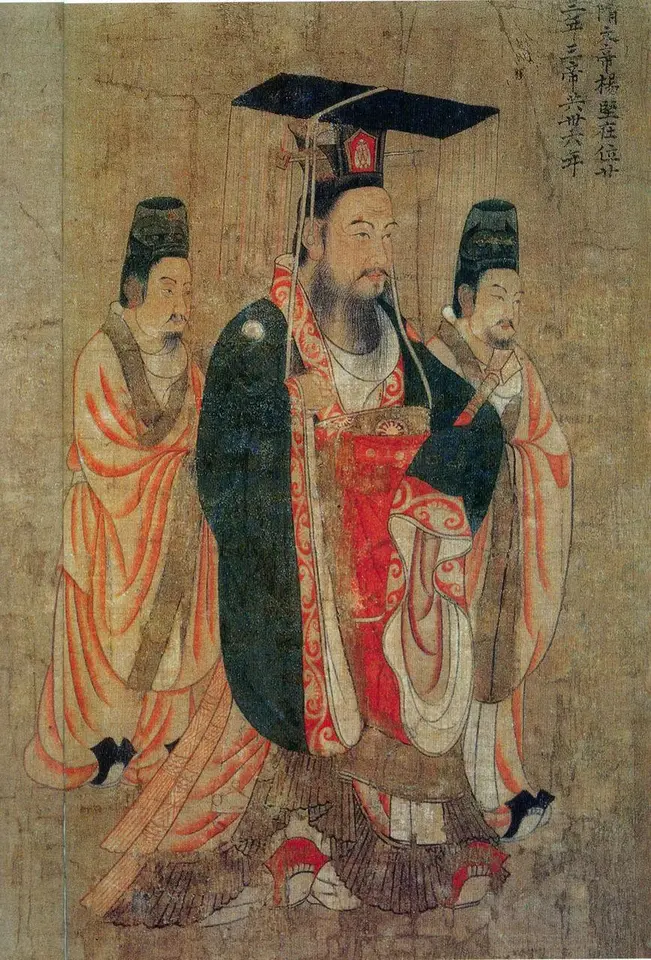
The Reign of Kaihuang (开皇之治) designates the transformative golden age spanning the Kaihuang era (581-600) under Emperor Wen of Sui (Yang Jian), characterized by imperial reunification, political integrity, institutional innovation, and rapid demographic growth. Following three centuries of violent political partition that had fractured China since the Yongjia Upheaval of the Western Jin, Emperor Wen established the Sui dynasty in 581. Guided by personal frugality and administrative dedication, Emperor Wen mobilized prominent statesmen including Gao Jiong, Yang Su, Su Wei, and Niu Hong to institute comprehensive systemic reforms. In 589, Sui armed forces marched south to extinguish the Chen dynasty, restoring universal imperial unity for the first time since the Han. Administratively, the court codified the Three Departments and Six Ministries, streamlined regional bureaucracy into a two-tier system, and introduced the Kaihuang Code. Economically, nationwide household audits recovered millions of concealed tenants, expanding registered households beyond eight million. Border security was achieved by astutely dividing nomadic Turkic factions, who hailed the emperor as the Holy Qaghan. The construction of Daxing City and vast granary networks stored food reserves sufficient for decades, laying the enduring material foundation for the Sui-Tang civilization.
Emperor Jing of Northern Zhou abdicated; Yang Jian founded the Sui dynasty, inaugurated the Kaihuang era, promulgated the Kaihuang Code, and created the Three Departments and Six Ministries.
Emperor Wen appointed Yuwen Kai to plan and construct the grand capital of Daxing City across eighty-four square kilometers, establishing an imperial urban masterpiece.
The court abolished all intermediate commanderies to establish a two-tier provincial administration; Emperor Wen promulgated the book recovery program on Niu Hong's petition.
Following proposals by Gao Jiong and Su Wei, the court instituted the Categorized Tax Baseline and nationwide audits, uncovering 1.64 million concealed taxpayers.
The court terminated the archaic Nine-Rank System, ordering prefectures to nominate scholars for central competitive examinations, laying the foundation for civil examinations.
Emperor Wen issued the military indictment against the Chen ruler; Prince Yang Guang and Chancellor Gao Jiong directed 518,000 expeditionary troops across the Yangtze.
Generals He Ruobi and Han Qinhu captured Jiankang, dethroning the Chen emperor and ending nearly three centuries of partition to achieve complete reunification.
The throne established community granaries nationwide and constructed massive state grain depots along transport rivers, accumulating decades of grain reserves.
Zhangsun Sheng's diplomatic strategy splintered the Turkic Khaganate into eastern and western divisions; northern tribes submitted and hailed Emperor Wen as the Holy Qaghan.
National households exceeded 8.7 million, tax revenues and state granaries achieved historical pinnacles, and the Kaihuang era concluded before the Renshou transition.
Since the fall of Luoyang during the Yongjia Upheaval in 311 and the southward migration of the Jin court, the Chinese world had fractured into antagonistic northern and southern realms for nearly three centuries. The north suffered through volatile transitions among Non-Han and Han dynasties across the Sixteen Kingdoms and Northern Dynasties, while the south saw the sequential rise and fall of the Song, Qi, Liang, and Chen regimes. Continuous warfare devastated agricultural plains, disrupted commerce, and forced millions into displacement. Successive warring states imposed exorbitant taxes and multiplied redundant administrations to finance endless frontier campaigns, burdening society with deep fractures.
Nevertheless, beneath prolonged military conflict, powerful unifying dynamics gathered strength. In the north, profound ethnic integration under the Northern Wei Xiaowen reforms fused diverse traditions into a cohesive cultural fabric, while the equal-field land distribution and garrison militia systems revitalized the rural economy. In 577, Emperor Wu of Northern Zhou annihilated Northern Qi, reuniting northern China and extinguishing half a century of eastern-western partition, establishing the strategic foundation for grand national reunification.
In May 580, Emperor Xuan of Northern Zhou died, leaving the seven-year-old Emperor Jing upon the throne. Grand Chancellor Yang Jian assumed imperial regency, commanding civil administration and military forces. Displaying decisive statecraft and steadfast military resolution, Yang Jian crushed conservative regional rebellions led by Yuchi Jiong, Sima Xiaonan, and Wang Qian, successfully liquidating Northern Zhou aristocratic resistance and consolidating control over the imperial heartland.
In March 581, the young sovereign formally abdicated the throne. Yang Jian ascended the imperial seat in Chang'an, naming the dynasty Sui and adopting the auspicious reign title Kaihuang. Conscious that decades of division had generated administrative disorder, Emperor Wen resolved to eradicate archaic conventions, launching sweeping structural reforms across political, legal, economic, and military spheres.
In the opening months of Kaihuang, Emperor Wen swept away the archaic administrative structures inherited from the Northern Zhou, which had attempted to replicate the idealized six offices of ancient antiquity. In their place, Emperor Wen developed the Three Departments and Six Ministries framework based upon earlier Han and Wei precedents. The central administration was organized into the Chancellery (responsible for drafting imperial decrees and formulating grand strategy), the Menxia Department (responsible for review and remonstrance), and the Department of State Affairs (the chief executive body directing national administration). Chief ministers deliberated collective policy within the imperial court, creating a balanced system of institutional oversight and executive momentum.
Subordinate to the Department of State Affairs, the administration instituted the canonical Six Ministries: Personnel, Rites, War, Justice, Revenue, and Works. Each ministry was directed by a Minister, supervising twenty-four specialized bureaus with unambiguous functional mandates. This reform eradicated overlapping jurisdictions and administrative bloat that had paralyzed preceding centuries, creating a modular bureaucratic machine capable of governing a continental empire and establishing an enduring model followed by imperial dynasties through the Qing.
Across provincial administration, the turmoil of the Northern and Southern Dynasties had created absurd administrative fragmentation. Successive contending regimes had partitioned landscapes arbitrarily to reward military retainers and incoming aristocratic clans, creating hundreds of miniature commanderies and counties. Historians noted that hamlets with barely a hundred households were elevated into prefectures, creating an unsustainable parasitic bureaucracy where tax collections were consumed entirely by local salaries.
In 583, Minister of War Yang Shangxi submitted a famous memorial warning that the realm suffered from excessive officials and depleted taxpayers, urging the complete dissolution of the commandery level. Recognizing the wisdom of the proposal, Emperor Wen promulgated a sweeping decree: abolishing the intermediate commandery tier and converting regional administration from the three-tier system (prefecture, commandery, county) into a direct two-tier framework (prefecture and county).
The throne dissolved nearly five hundred redundant commandery offices, merged depopulated counties, and dismissed tens of thousands of local sinecurists. Crucially, the court revoked the ancient privilege of local governors to recruit private personal staff, requiring all officials ranked above the ninth grade to be evaluated and appointed directly by the central Ministry of Personnel under strict regional rotation rules. This centralized stroke dismantled hereditary provincial cliques, reasserted direct central control down to the township level, and lightened the fiscal burden upon the peasantry.
In agrarian and fiscal governance, the Kaihuang administration executed two decisive programs to dismantle aristocratic tax evasion: the Great Verification Audit and the Categorized Tax Baseline. During previous centuries, landed magnates had shielded millions of tenant cultivators from state registries, transforming free peasants into private retainers who paid rent to local clans while evading imperial taxes, leaving state coffers perennially depleted.
Emperor Wen adopted the recommendations of Su Wei, Minister of Revenue and Chief Justice, mandating the Great Verification Audit across all prefectures. Regional officials were instructed to inspect every household annually in person, comparing the physical appearance and apparent age of all residents against registered documents to expose false declarations of childhood or disability. Concealing unlisted dependents resulted in severe penalties for offending households, local neighborhood chiefs, and overseeing county magistrates.
To dissolve the economic attraction of private aristocratic protection, Chancellor Gao Jiong introduced the Categorized Tax Baseline in 585. Every January, imperial commissioners assessed the property and grain wealth of rural families, assigning households into nine transparent economic tiers, each bound to a modest, standardized statutory tax rate. Because the official state rates were significantly lighter than the extortionate rents charged by private landlords, millions of unfree tenants voluntarily declared themselves to imperial authorities. Within a single year, the audit recovered 1.64 million previously unrecorded subjects, swelling imperial tax rolls from under four million households to over 8.7 million by the end of the reign.
In the legal sphere, Emperor Wen reacted against the draconian penal practices of the Northern Zhou, resolving to craft a humane, restrained legal framework. In 581, the emperor commissioned leading legal scholars, including Gao Jiong, Yang Su, Su Wei, and Niu Hong, to compile the Kaihuang Code in twelve volumes and five hundred articles, synthesizing the balanced precedents of Northern Qi jurisprudence.
The Kaihuang Code represents a towering milestone in Chinese legal history. It permanently excised archaic corporal mutilations, such as dismemberment, beheading displays, facial tattooing, and foot amputation, establishing the classic Five Punishments: light bamboo, heavy stick, penal servitude, exile, and death.
The code codified the Ten Abominations, establishing severe sanctions against treason, parricide, and destruction of ancestral shrines, while embedding Confucian clemency through the Eight Deliberations to protect the elderly and infirm. Capital sentences were subject to mandatory triple review by central tribunals and required explicit personal confirmation from the sovereign before execution. Torture in judicial proceedings was strictly circumscribed. Under these enlightened standards, court dockets cleared, and wrongful executions dropped to historical lows, establishing the foundational prototype for the celebrated Tang Code.
Following northern stabilization, the Chen dynasty remained entrenched along the southern banks of the Yangtze River. The Chen ruler, Chen Shubao, indulged in palace decadence, ignoring defensive maintenance and extorting southern populations. Emperor Wen systematically prepared the final military campaign to reunite the empire.
In the winter of 588, Emperor Wen promulgated an imperial proclamation detailing twenty capital offenses committed by the Chen ruler, printing and distributing three hundred thousand copies across southern cities to undermine enemy resolve. Prince Yang Guang was invested as supreme field commander, supported by Chancellor Gao Jiong as chief of staff. Yang Su commanded a river fleet centered on massive five-deck war galleys descending the Yangtze gorges, while Generals He Ruobi and Han Qinhu advanced across the river from Guangling and Lujiang with an expeditionary force totaling 518,000 troops.
In February 589, He Ruobi crossed the Yangtze barrier and seized Zhenjiang, while Han Qinhu led an elite cavalry strike force of five hundred riders across the river under cover of night, penetrating the Zhuque Gate of Jiankang. Southern defenses collapsed, and Han Qinhu captured the Chen emperor alongside his royal consorts within a dried palace well. The Chen dynasty dissolved, terminating two hundred and seventy years of northern-southern division since the Western Jin collapse and achieving the second grand unification in Chinese history.
The ancient capital of Chang'an had deteriorated over centuries of warfare, suffering from constricted fortifications, poor drainage, and brackish groundwater. In 582, Emperor Wen appointed the master architect Yuwen Kai as chief architect to design an expansive new imperial metropolis on the elevated plains of Longshou Plateau, named Daxing City (the direct predecessor of Tang Chang'an).
Constructed according to the classical principles of ancient urban planning, Daxing City covered eighty-four square kilometers, spanning more than twice the footprint of Han Chang'an and twice the area of Ming-Qing Beijing, standing as the largest metropolis of the medieval world. The city featured a cardinal grid, a monumental imperial boulevard over one hundred meters wide, and one hundred and eight walled residential wards flanking two grand commercial markets. Yuwen Kai integrated the six undulating ridges of the Longshou Plateau to correspond with the trigrams of the Classic of Changes, arranging palace complexes and temples to maximize sunlight, drainage, and grandeur.
To insulate the reunited empire from agricultural crises, Emperor Wen instituted public granaries on the advice of Su Wei. Colossal imperial depots, including Changping, Liyang, Guangtong, Huiluo, and Hanjia Granaries, were constructed along the Yellow and Wei Rivers. Concurrently, public community granaries were founded across all rural townships, where peasants deposited modest grain levies each autumn to finance local disaster relief. Consecutive bumper harvests filled these silos with tens of millions of bushels, providing food reserves so immense that imperial supplies remained abundant well into the early decades of the Tang dynasty.
Along the northern frontier, the Sui court confronted the formidable military power of the Turkic Khaganate. Under Ishbara Qaghan, hundreds of thousands of nomadic cavalry raided the Great Wall marchlands, vowing vengeance for the fallen Northern Zhou regime and posing an acute existential threat to the nascent dynasty.
The imperial diplomat and strategist Zhangsun Sheng submitted a masterly strategic memorandum to Emperor Wen, dissecting internal fissures among the rival Turkic khans and articulating the grand doctrine of allying with distant factions while attacking nearby foes, and weakening dominant rivals while supporting fragile allies. Emperor Wen approved the plan, entrusting Zhangsun Sheng with diplomatic missions across the steppe.
Zhangsun Sheng executed his strategy with consummate skill, exploiting suspicions between Ishbara, Tardu, and Apa Khans. His diplomacy provoked fratricidal civil war among the nomads, cleaving the great steppe confederation into hostile Eastern and Western Turkic Khaganates. Weakened by internal strife and shattered by counteroffensives, Ishbara Qaghan submitted to Sui suzerainty, dispatching tribute missions to Daxing and bestowing upon Emperor Wen the supreme nomadic title of the Holy Qaghan. The northern frontier achieved profound security, reopening transcontinental trade for decades.
Although emerging from a military lineage, Emperor Wen fostered Confucian learning and the preservation of classical literature. Horrified by the cultural losses suffered during the Western Jin collapse and Emperor Yuan of Liang's catastrophic library fire at Jiangling, Secretary Niu Hong submitted a famous memorial in 583 detailing the historic destruction of national archives and petitioning for an open book recovery program.
Emperor Wen responded with an imperial decree offering a bolt of fine silk for every ancient scroll presented to the government, transcribing authenticated copies before returning precious originals to private collectors. Scholars across the realm contributed manuscripts, recovering over thirty thousand volumes within several years. Following the conquest of Chen, the court transported the extensive archives of the southern imperial palace to Daxing, preserving the core literary legacy of classical civilization.
In official recruitment, Emperor Wen dismantled the hereditary Nine-Rank System that had allowed noble aristocratic houses to monopolize state offices for three centuries. In 587, the emperor abolished regional rank assessors, mandating that every prefecture recommend candidate scholars based upon tested competencies in governance and classical literature. These competitive examinations broke the hereditary grip of old clans, allowing talented scholars from modest backgrounds to enter imperial service, inaugurating the thousand-year history of the imperial civil service examination system.
The primary achievement of the Reign of Kaihuang was the definitive termination of the two-and-a-half-century political fragmentation that followed the fall of the Western Jin. By reuniting the Yellow and Yangtze River civilizations, the Sui dynasty established a continental market that allowed trade, technology, and population to circulate freely. The psychological and cultural identity of a unified Chinese state was resurrected with unprecedented strength, providing the indispensable geopolitical platform for the medieval imperial golden age.
The institutional innovations formulated during the Kaihuang era laid the structural foundation for the medieval Chinese state. The Three Departments and Six Ministries system provided a balanced, efficient executive model preserved by subsequent dynasties through the early twentieth century. The abolition of intermediate commanderies rationalized local governance; the Kaihuang Code humanized judicial punishments into the standard five penalties; and the introduction of competitive examinations initiated the transition from aristocratic lineage to meritocratic civil bureaucracy. These institutions were adopted directly by the Tang, cementing China's medieval administrative framework.
Through low taxation, domestic tranquility, and systematic census recovery, the Kaihuang reign triggered one of the most remarkable demographic surges in world history. Registered imperial households expanded from less than four million to over 8.7 million, encompassing more than forty-six million registered individuals—a total unsurpassed until the high Tang reign of Emperor Xuanzong. The enormous reserves stored within imperial granaries insulated the realm against famine and financed the construction of the Grand Canal in the subsequent reign.