Zhang Han Crosses the River and Encircles Julu
Zhang Han defeats Xiang Liang, crosses the Yellow River north to join Wang Li, and besieges Zhao forces at Julu as allied armies look on in fear.
Late Qin Dynasty (秦末) · HISTORICAL EVENT
巨鹿之战
The Battle of Julu (巨鹿之战) was a climactic and decisive military engagement fought in 207 BCE during the turbulent collapse of the Qin Dynasty, centered around Julu (in modern Xingtai, Hebei). Following the death of Chu commander Xiang Liang at Dingtao, Imperial Qin General Zhang Han deemed the southern theater pacified and directed his primary force across the Yellow River. Zhang Han joined forces with General Wang Li, who led a formidable 200,000-man…
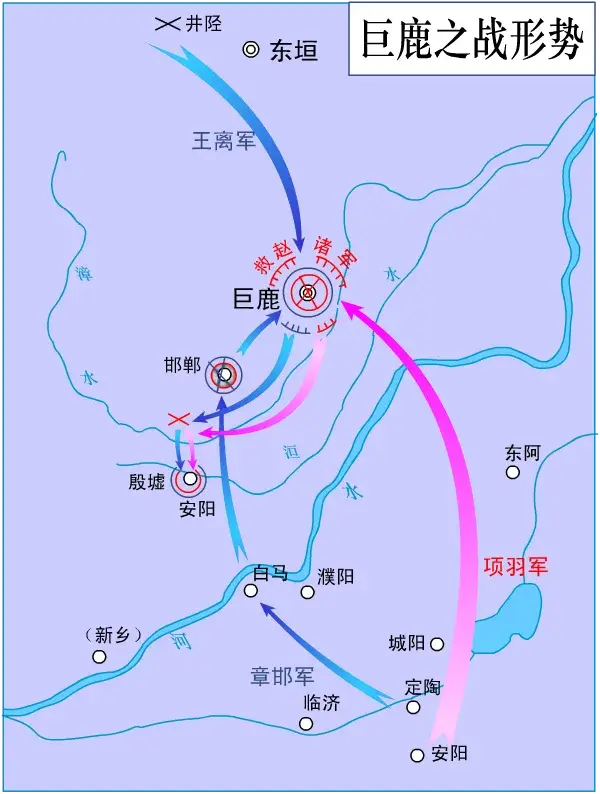
The Battle of Julu (巨鹿之战) was a climactic and decisive military engagement fought in 207 BCE during the turbulent collapse of the Qin Dynasty, centered around Julu (in modern Xingtai, Hebei). Following the death of Chu commander Xiang Liang at Dingtao, Imperial Qin General Zhang Han deemed the southern theater pacified and directed his primary force across the Yellow River. Zhang Han joined forces with General Wang Li, who led a formidable 200,000-man northern border garrison, to encircle King Xie of Zhao and Chancellor Zhang Er within the fortress of Julu. In response, King Huai of Chu dispatched a relief army commanded by Song Yi, with Xiang Yu serving as second-in-command. When Song Yi halted at Anyang for forty-six days, seeking to exploit mutual exhaustion between Qin and Zhao while soldiers starved, Xiang Yu executed Song Yi and assumed supreme command. Xiang Yu commanded his men to sink all crossing boats, shatter their cooking cauldrons, burn their shelters, and carry only three days of provisions. Driving across the Zhang River with desperate ferocity, Chu troops severed the supply corridor connecting Zhang Han to Wang Li and enveloped the besiegers. Fighting with legendary valor where one soldier matched ten, the Chu army crushed Wang Li's Great Wall legion in nine consecutive clashes, capturing Wang Li and causing regional coalition lords to grovel in submission. Shortly thereafter, abandoned and threatened by the tyrannical chancellor Zhao Gao in the imperial capital, Zhang Han surrendered his remaining 200,000 troops, fundamentally annihilating the military backbone of the Qin Empire.
Zhang Han defeats Xiang Liang, crosses the Yellow River north to join Wang Li, and besieges Zhao forces at Julu as allied armies look on in fear.
King Huai II appoints Song Yi and Xiang Yu to relieve Zhao, while sending Liu Bang westward toward Guanzhong with the pledge that whoever captures the pass shall rule it.
Disgusted by Song Yi's forty-six-day delay during freezing weather, Xiang Yu beheads him in camp and is confirmed by King Huai as Supreme Commander.
Ying Bu severs Qin supply corridors across the Zhang River, after which Xiang Yu leads the main force across, destroying boats and cooking pots with three days of rations.
Chu warriors rout Qin forces in nine fierce assaults, slaying Su Jiao, driving She Jian to self-immolation, capturing Wang Li, and lifting the siege of Julu.
Allied commanders grovel in submission at Xiang Yu's camp, establishing his uncontested hegemony over the anti-Qin coalition.
Zhang Han's envoy flees Xianyang after being targeted by Zhao Gao, advising Zhang Han that military service will yield only death.
General Pu crosses Sanhujin and Xiang Yu smashes Qin troops along the You River, shattering Zhang Han's remaining defenses.
Zhang Han surrenders 200,000 troops along the Huan River; Xiang Yu ennobles him as King of Yong, culminating in total Chu victory.
In September 208 BCE (the second year of Qin Er Shi), Imperial Qin Grand General Zhang Han achieved a string of victories against rebel forces, culminating in a nocturnal ambush at Dingtao that killed Xiang Liang, the foremost military leader of the Chu insurrection. Believing the rebel cause in Chu was shattered beyond recovery, Zhang Han pivoted his main strike force northward across the Yellow River. He linked up with General Wang Li—grandson of the celebrated unifier Wang Jian—and Vice General She Jian, who together commanded 200,000 veteran troops summoned from the northern frontier defense line.
Facing this crushing offensive, the freshly reconstituted state of Zhao suffered rapid collapse. King Xie of Zhao and Chancellor Zhang Er retreated into the fortified city of Julu. Wang Li and She Jian entrenched their forces tightly around the citadel, while Zhang Han established his main encampment to the south at Jiyuan. Zhang Han constructed a fortified, walled supply corridor (yongdao) extending from the Zhang River to supply Wang Li with an uninterrupted stream of grain. Outside the city walls, Zhao General Chen Yu gathered tens of thousands of northern soldiers but refused to engage after a reconnaissance detachment of five thousand men was utterly wiped out. Neighboring armies from Qi and Yan built heavily fortified encampments nearby but looked on passively from behind their ramparts, terrified of Qin's formidable military engine.
Facing impending destruction, Zhao emissaries arrived at the Chu court at Xuyi pleading desperately for salvation. Recognizing that Zhao's collapse would expose Chu's northern flank, King Huai II of Chu formulated a two-pronged offensive: Liu Bang was dispatched with an expeditionary force westward toward the Guanzhong heartland, while Song Yi was appointed Supreme Commander, Xiang Yu as Secondary Commander, and Fan Zeng as Vice Commander to lead the primary army northward to relieve Julu. King Huai announced that whichever commander entered Guanzhong first would be crowned King of Qin.
In late 208 BCE, Song Yi led the relief army to Anyang (in modern Henan/Shandong border), where he halted operations for forty-six days. Song Yi insisted on waiting until Qin and Zhao exhausted each other in protracted urban combat, intending to strike the depleted survivor. In the freezing winter rain, Chu soldiers suffered severe shortages of rations, while Song Yi spent his time hosting lavish banquets. When Xiang Yu passionately argued for an immediate crossing to coordinate an inner-outer assault with Zhao, Song Yi rejected his plea and issued an order threatening capital punishment against any officer who showed insubordination. Realizing Song Yi had no intention of engaging the enemy, Xiang Yu entered the commander's tent on a morning in November, decapitated Song Yi, and rallied the troops with imperial sanction. Forced to accept reality, King Huai formally confirmed Xiang Yu as Supreme Commander of the Chu Expeditionary Force.
With Xiang Yu in command, the morale of the Chu army surged. Xiang Yu recognized that with fewer than fifty thousand men facing more than four hundred thousand Qin troops, conventional warfare meant certain annihilation; victory required severing the enemy supply lifeline and forcing a decisive confrontation. In December 207 BCE, Xiang Yu led his troops to the southern bank of the Zhang River. He dispatched Vanguard Generals Ying Bu and General Pu with twenty thousand crack troops across the river to sever the walled grain corridors connecting Zhang Han's base with Wang Li's siege works, securing an initial tactical foothold.
Upon receiving urgent pleas from Zhao commanders, Xiang Yu made his historic commitment: he directed his entire army across the Zhang River. Once all units had made landfall on the northern bank, Xiang Yu issued an unyielding command: sink every boat, shatter all earthenware cooking cauldrons, incinerate the encampment shelters, and distribute strictly three days of dried rations to each soldier. By destroying all means of cooking and retreat, Xiang Yu impressed upon every warrior that death was inevitable unless they secured victory on the battlefield.
Driven by desperate survival instincts, Chu soldiers advanced toward Julu with unmatched ferocity. Xiang Yu led the vanguard in person, smashing through Zhang Han's corridor defense detachments and completely choking off grain convoys heading into Wang Li's camp. Without delay, Xiang Yu enveloped Wang Li's Great Wall garrison outside the walls of Julu, turning the besiegers into the besieged.
On the open plains around Julu, Xiang Yu fought at the front of his cavalry, roaring and carving through enemy lines. Chu soldiers attacked with unprecedented fury, shouting battle cries that echoed across the plains, each man fighting as though he possessed the strength of ten. The Chu force engaged Wang Li's veteran troops in nine fierce, continuous clashes. Although Zhang Han attempted several counter-offensives from Jiyuan, his relief detachments were blocked and repelled by Chu screening units. After nine engagements, Wang Li's northern army disintegrated. Qin Vice Commander Su Jiao was slain, Vice Commander She Jian set fire to his command post and perished in the flames rather than yield, and General-in-Chief Wang Li was captured alive. The encirclement of Julu was decisively broken.
Throughout the bloody contest beneath Julu's walls, commanders of the allied relief armies from Qi, Yan, and northern Zhao remained entrenched within ten separate fortified redoubts, paralyzed with fear. Allied officers climbed their observation towers to watch the confrontation, trembling as Chu warriors surged into the imperial legions, hacking down standards and crushing resistance.
Once the battlefield was cleared, Xiang Yu summoned the allied commanders to his headquarters. Overwhelmed by terror and reverence, the allied generals passed through the camp gates on their hands and knees, crawling toward Xiang Yu's seat without daring to lift their eyes. Through this demonstration of military supremacy, Xiang Yu subjugated all rebel commanders, cementing his uncontested position as Supreme Commander of the anti-Qin confederacy.
Following the annihilation of Wang Li's forces, Zhang Han withdrew his remaining two hundred thousand troops to Jiyuan, maintaining a defensive stalemate along the south bank of the Zhang River opposite Xiang Yu. Distressed by continuous territorial losses, the Second Emperor in Xianyang repeatedly sent imperial censors to reprimand Zhang Han. Terrified of execution, Zhang Han dispatched his Chief Clerk Sima Xin to the imperial capital to report directly. Upon reaching Xianyang, Sima Xin was kept waiting outside the palace gate for three days; Chancellor Zhao Gao refused him audience and secretly dispatched assassins to intercept him. Sima Xin fled back to the army via mountain paths and cautioned Zhang Han that whether they won or lost, Zhao Gao's faction would orchestrate their slaughter.
Simultaneously, Zhao General Chen Yu sent a letter reminding Zhang Han of the tragic fates of Bai Qi and Meng Tian, who were both executed after delivering immense conquests, urging him to turn his arms against the corrupt dynasty and divide the realm as an independent king. Hesitant and isolated, Zhang Han initiated secret peace talks. When initial terms faltered, Xiang Yu ordered General Pu to cross the Sanhujin ford and attack Qin positions south of the Zhang River, while Xiang Yu led the main body to inflict another defeat upon Zhang Han at the You River. Deprived of options, Zhang Han sent an unconditional offer of surrender. Facing his own mounting grain shortages, Xiang Yu met Zhang Han at the Yin Ruins on the south bank of the Huan River to finalize the capitulation. Zhang Han wept as he detailed Zhao Gao's treachery. Xiang Yu enfeoffed Zhang Han as King of Yong and appointed Sima Xin as Commander of the surrendered legions.
With Zhang Han's surrender, Xiang Yu incorporated the two hundred thousand Qin troops into his confederate host and marched westward toward Guanzhong. When the coalition halted at Xin'an (in modern Henan), deep-seated grievances erupted. Rebel soldiers from former eastern states, who had long endured harsh labor and mistreatment under Qin border officials, retaliated by humiliating and abusing the surrendered Qin captives. Qin soldiers began whispering amongst themselves, fearing that if the campaign failed or if they reached Guanzhong, the imperial court would slaughter their families remaining in the home commanderies.
Informed of the murmuring captives and anticipating a catastrophic mutiny within the narrow mountain defiles of Guanzhong, Xiang Yu conferred with Ying Bu and General Pu. Under cover of night, Chu forces launched a surprise assault at Xin'an, burying alive over two hundred thousand surrendered Qin troops and sparing only Zhang Han, Sima Xin, and Dong Yi. The Battle of Julu wiped out the entirety of Qin's field armies. Taking advantage of the void, Liu Bang breached the Wu Pass and captured Xianyang, bringing the Qin Dynasty to an abrupt end.
The Battle of Julu stands as one of the most consequential battles of annihilation in Chinese history. Within nine months, Xiang Yu's expeditionary force eradicated Wang Li's two hundred thousand northern border garrison troops, smashed Zhang Han's southern corps along the Zhang and You rivers, and accepted the capitulation of two hundred thousand central Qin soldiers. In a single campaign, the professional standing armies that the Qin state had refined over more than a century through Shang Yang's legalist reforms were completely erased. Deprived of its protective shield, the Qin imperial house in Xianyang found itself helpless against Liu Bang's rapid advance through the Wu Pass, leading to the surrender of King Ziying and the termination of the empire fourteen years after its unification.
The triumph at Julu elevated Xiang Yu to the unchallenged zenith of political and military power in late Qin China. His overwhelming martial display coerced the hesitation of regional lords into absolute deference, laying the foundation for his partition of the empire into eighteen kingdoms and his self-proclamation as Overlord of Western Chu. However, the massacre of over two hundred thousand surrendered Qin troops at Xin'an aroused deep resentment across the Guanzhong region. This political liability provided Liu Bang with the ideal platform to win over the hearts of the Qin populace through benevolent governance, directly triggering the five-year Chu-Han Contention.