Founding of Later Qin
Yao Chang establishes the Later Qin state in Guanzhong, laying the foundations for the Yao Qin regime.
Later Qin Dynasty (后秦) · HISTORICAL EVENT
姚秦
The Later Qin Regime and Translation of Buddhist Scriptures designates the monumental state-sponsored translation and cultural renaissance centered at Chang'an under Emperor Wenhuan of Later Qin (Yao Xing) and the Kuchean master Kumārajīva. In 401, seeking to govern his multi-ethnic realm through Mahayana Buddhist teachings, Yao Xing dispatched an army against Later Liang, welcoming Kumārajīva to Chang'an with national teacher honors. At the imperial…
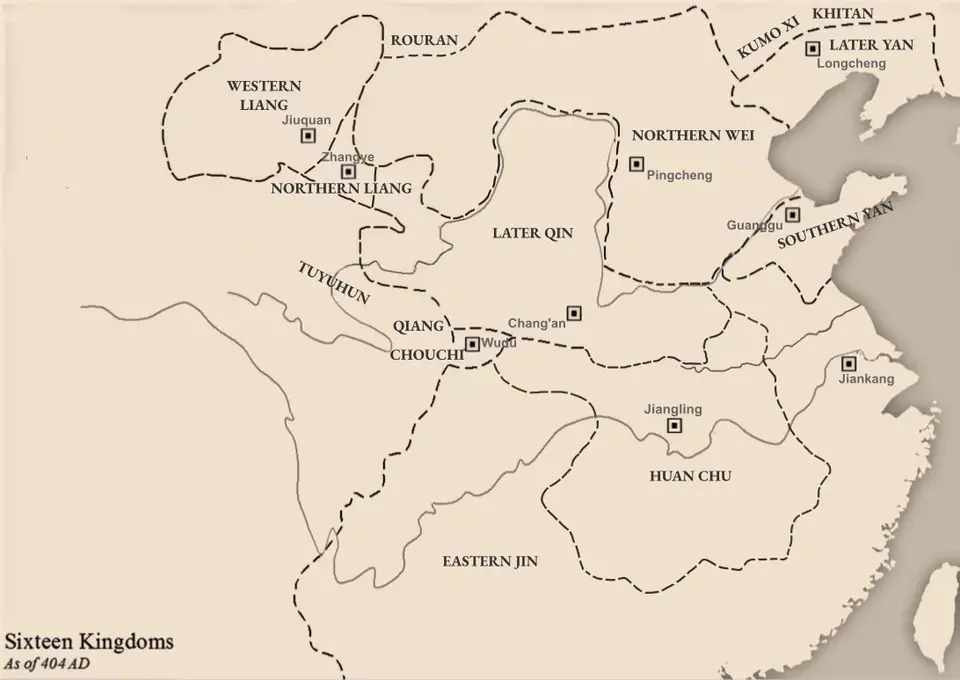
The Later Qin Regime and Translation of Buddhist Scriptures designates the monumental state-sponsored translation and cultural renaissance centered at Chang'an under Emperor Wenhuan of Later Qin (Yao Xing) and the Kuchean master Kumārajīva. In 401, seeking to govern his multi-ethnic realm through Mahayana Buddhist teachings, Yao Xing dispatched an army against Later Liang, welcoming Kumārajīva to Chang'an with national teacher honors. At the imperial Xiaoyao Garden, Yao Xing established a well-funded translation bureau, gathering over eight hundred elite scholar-monks, including Sengzhao and Sengrui. Between 401 and 413, the team produced definitive translations of foundational scriptures including the Diamond Sutra, the Lotus Sutra, the Vimalakirti Sutra, and the core Madhyamaka treatises of Nagarjuna. By moving beyond early concept-matching methods, these elegant translations established the definitive philosophical foundation for East Asian Buddhism.
Yao Chang establishes the Later Qin state in Guanzhong, laying the foundations for the Yao Qin regime.
Yao Xing dispatches general Yao Shuode with sixty thousand troops to Guzang to secure Kumārajīva.
Kumārajīva reaches the imperial capital and is received with national teacher honors by Yao Xing.
Yao Xing opens the Xiaoyao Garden bureau, personally attending translation sessions alongside eight hundred scholar-monks.
The bureau completes definitive translations of the Lotus Sutra, the Diamond Sutra, and the Vimalakirti Sutra.
Kumārajīva dies in Chang'an; his tongue remains unburnt after cremation, marking the conclusion of the Yao Qin translation enterprise.
Following the collapse of the Western Jin Dynasty during the Disaster of Yongjia, northern China fragmented into competing regional states during the Sixteen Kingdoms period. Yao Chang, an influential chieftain of the ancient Qiang people, established the Later Qin dynasty in 384, making Chang'an his capital. Because the imperial house bore the surname Yao and occupied the ancient territory of the state of Qin, the dynasty became known as Yao Qin.
Upon the death of Yao Chang, his capable son Yao Xing ascended the throne as Emperor Wenhuan. A devout patron of Confucian administration and Buddhist philosophy, Yao Xing lowered land taxes, revived irrigation systems, and established internal peace, bringing the Later Qin to the zenith of its geopolitical power. Deeply convinced that Mahayana Buddhism was vital for moral education and inter-ethnic harmony, Yao Xing resolved to make the restoration of the Buddhist dharma a national priority.
Meanwhile, the Kuchean monk Kumārajīva was renowned across Inner Asia for profound erudition in Sanskrit literature and Mahayana Madhyamaka philosophy. Earlier, Former Qin ruler Fu Jian had dispatched general Lü Guang to bring Kumārajīva to Chang'an. However, following the collapse of the Former Qin, Lü Guang established the independent state of Later Liang in the Hexi Corridor, detaining Kumārajīva in Guzang for sixteen years. The uneducated military rulers of Later Liang treated the master as a mundane political advisor, preventing him from fulfilling his translation mission.
Determined to secure the master's presence, Yao Xing repeatedly petitioned the Later Liang court for his release. When diplomatic requests were rebuffed, Yao Xing dispatched his uncle, Prince Yao Shuode, with an army of sixty thousand troops in early 401 to conquer Later Liang. In late 401, the ruler of Later Liang surrendered, allowing the imperial expedition to escort Kumārajīva eastward to Chang'an.
On January 15, 402 (the 20th day of the 12th lunar month of the 3rd year of Hongshi), Kumārajīva arrived at the gates of Chang'an. Emperor Yao Xing led his ministers outside the city walls to welcome the master, bestowing upon him the status of National Teacher and accommodating him within the imperial Ximing Pavilion.
To facilitate translation on an unprecedented scale, Yao Xing constructed a state translation bureau within the scenic imperial Xiaoyao Garden south of the capital. The court issued nationwide invitations summoning learned scholar-monks from across northern and southern China. Over eight hundred distinguished monks—including Sengzhao, Sengrui, Daorong, Tanying, and Huiyan—gathered at the bureau, creating an organized institution divided into specialized translation, recording, verification, and editorial departments.
In early 402, formal translation commenced at Xiaoyao Garden. Emperor Yao Xing personally attended sessions, holding original Sanskrit birch-bark manuscripts to verify vocabulary alongside senior ministers. Kumārajīva orally translated the Sanskrit texts into classical Chinese, explaining the nuanced philosophical meanings of each passage. Scribe-monks like Sengrui recorded the spoken translation, while doctrinal specialists like Daorong and Tanying scrutinized the correspondence between technical Sanskrit terminology and Chinese equivalents. Finally, master philosopher Sengzhao polished the syntax, creating an authoritative, standardized prose style.
Kumārajīva revolutionized Buddhist translation methodology. Earlier translators had relied on literal word-for-word renderings or borrowed Daoist terms like non-being to approximate Buddhist concepts through concept-matching, distorting core Indian philosophy. Kumārajīva embraced meaning-oriented translation, preserving the precise philosophical essence of the original Sanskrit while utilizing fluid, rhythmic, and poetic Chinese.
Between 402 and 413, the Xiaoyao Garden bureau translated seventy-four distinct Buddhist scriptures comprising nearly four hundred fascicles. Among these were the core Prajnaparamita texts, including the Large Perfection of Wisdom Sutra and the Diamond Sutra; foundational Mahayana texts like the Lotus Sutra, the Vimalakirti Sutra, and the Amitabha Sutra; and the principal Indian Madhyamaka philosophical texts authored by Nagarjuna and Aryadeva, notably the Mulamadhyamakakarika (Fundamental Verses on the Middle Way), the Hundred Verse Treatise, the Twelve Gate Treatise, and the Great Commentary on the Perfection of Wisdom.
The translations spread rapidly throughout China, replacing older, inaccurate editions. On May 28, 413 (the 13th day of the 4th lunar month of the 15th year of Hongshi), Kumārajīva passed away at Xiaoyao Garden at the age of sixty-four. Before his death, he vowed that if his translations were faithful to the Buddha's true doctrine, his tongue would remain unconsumed by fire upon cremation. Following his funeral pyre, his disciples discovered that while his body was reduced to ash, his tongue remained intact, a legendary confirmation of the enduring authenticity of his translations.
The Buddhist translation enterprise under the Yao Qin regime permanently transformed the intellectual and spiritual landscape of East Asia. Linguistically, Kumārajīva established the classical idiom of Chinese Buddhist literature. Everyday terms and philosophical idioms translated at Xiaoyao Garden—such as form is emptiness, afflictions, liberation, and conditioned arising—became foundational components of standard Chinese vocabulary and world literature.
Philosophically, the Yao Qin translations eradicated the early concept-matching distortions, providing Chinese intellectuals with direct access to Nagarjuna's Madhyamaka doctrine of dependent origination and emptiness. Sengzhao's philosophical treatises marked the maturation of an indigenous, rigorous Buddhist philosophy in China.
Institutionally, the massive corpus translated under Yao Xing served as the direct doctrinal source for the emergence of the major indigenous Chinese Buddhist traditions during the Sui and Tang dynasties: the Three Treatise school drew from the Middle Way treatises; the Tiantai school was founded on Kumārajīva's Lotus Sutra; the Pure Land tradition adopted his translation of the Amitabha Sutra; and the Chan tradition embraced his renderings of the Diamond and Vimalakirti sutras. Although the Later Qin dynasty fell to Liu Yu in 417, the spiritual civilization forged at Xiaoyao Garden endured permanently.
Standard historical annals and Buddhist chronicles have celebrated the Yao Qin translation enterprise as an unprecedented cultural milestone. The Book of Jin praised Yao Xing for gathering thousands of meditating monks in Chang'an and transforming the imperial capital into a center of continental learning.
In the Biographies of Eminent Monks, Huijiao lauded Kumārajīva for his lucid, elegant prose style that surpassed all previous translations. Modern scholar Liang Qichao observed that Chinese Buddhism truly began as an independent intellectual tradition only after Kumārajīva entered Chang'an, providing the textual foundation for all subsequent Tang Buddhist schools.
Contemporary historians of religion evaluate the Yao Qin enterprise as one of the most successful examples of cross-cultural transmission in world history. By harmonizing Indian philosophical profundity with the aesthetic eloquence of classical Chinese, Emperor Yao Xing and Kumārajīva achieved a timeless synthesis that enriched the civilization of East Asia.