Accession at Yingtianfu
Zhao Gou ascends the throne at Yingtianfu, proclaiming the Jianyan era and establishing the Southern Song.
Southern Song Dynasty (南宋) · HISTORICAL EVENT
建炎南渡
The Southward Crossing of the Jianyan Reign (建炎南渡) denotes the momentous dynastic relocation and societal migration undertaken between 1127 and 1138, in which Zhao Gou (Emperor Gaozong of Song) retreated southward to the Yangtze River basin following the destruction of the Northern Song in the Disaster of Jingkang, founding the Southern Song Dynasty and establishing its permanent capital at Lin'an (modern Hangzhou). After Jurchen Jin armies captured…
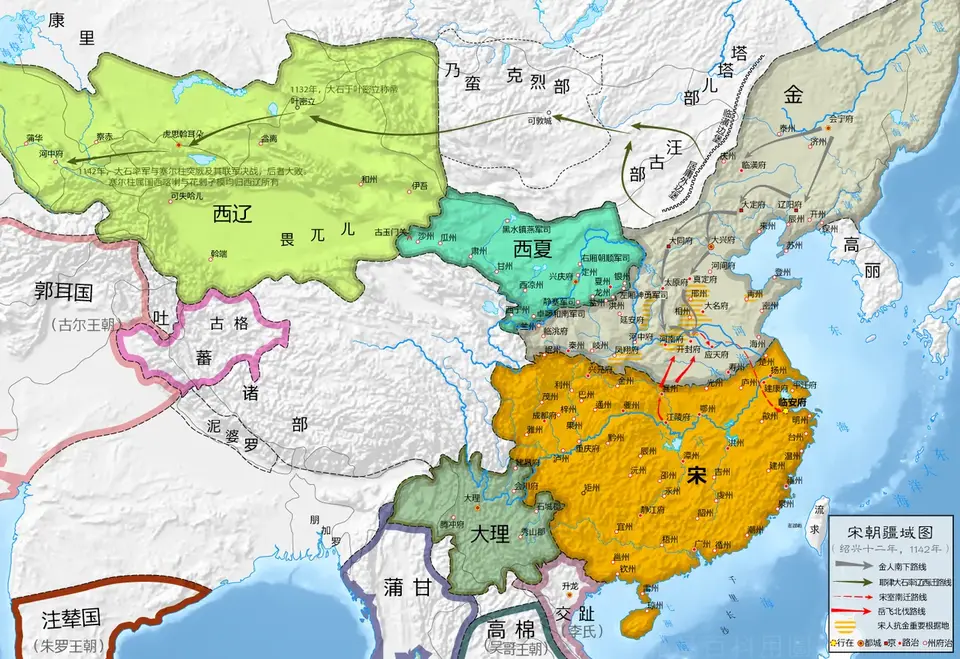
The Southward Crossing of the Jianyan Reign (建炎南渡) denotes the momentous dynastic relocation and societal migration undertaken between 1127 and 1138, in which Zhao Gou (Emperor Gaozong of Song) retreated southward to the Yangtze River basin following the destruction of the Northern Song in the Disaster of Jingkang, founding the Southern Song Dynasty and establishing its permanent capital at Lin'an (modern Hangzhou). After Jurchen Jin armies captured Kaifeng and abducted emperors Huizong and Qinzong, Prince Kang (Zhao Gou) emerged as the sole surviving direct imperial son. He assumed the throne at Yingtianfu in June 1127, inaugurating the Jianyan era. When Jin armies launched lightning pursuits to capture the monarch, the court fled precipitously across Yangzhou, Zhenjiang, and Jiankang, enduring internal mutinies and escaping capture by taking refuge aboard seafaring vessels off the Zhejiang coast for months. However, resolute defensive resistance—exemplified by Han Shizhong's naval blockade at the Battle of Huangtiandang, Yue Fei's liberation of Jiankang, and the Wu brothers' triumph at Heshangyuan—shattered the myth of Jurchen invincibility and secured the Yangtze line. In 1138, the court designated Lin'an as the dynastic capital. The crossing preserved Chinese dynastic continuity and completed the historic migration of millions of northern subjects, permanently anchoring the economic, technological, and cultural supremacy of southern China.
Zhao Gou ascends the throne at Yingtianfu, proclaiming the Jianyan era and establishing the Southern Song.
Emperor Gaozong dismisses Chancellor Li Gang, executes student Chen Dong, and retreats to Yangzhou.
Jin cavalry raid Tianchang; Emperor Gaozong flees across the Yangtze to Zhenjiang, leaving Yangzhou to be sacked.
Commanders Miao Fu and Liu Zhenggan mutiny in Hangzhou; Han Shizhong and Zhang Jun suppress the rebellion.
Jin forces breach the Yangtze; Wanyan Zongbi captures Jiankang, driving Emperor Gaozong to flee to sea off Zhejiang.
Han Shizhong traps Jin armies at Huangtiandang for forty-eight days; Yue Fei defeats Jin forces and liberates Jiankang.
The Wu brothers rout Jin armies at Heshangyuan; the court adopts the Shaoxing title and elevates Hangzhou to Lin'an.
Emperor Gaozong designates Lin'an as the official dynastic capital, cementing the long-term southern partition.
The Southward Crossing was born directly out of the catastrophic collapse of the Northern Song Dynasty before the martial cavalry of the Jurchen Jin dynasty. During the late reign of Emperor Huizong, court politics degenerated under corrupt favorites including Cai Jing and Tong Guan, whose extortionate extraction of resources exhausted the realm. In foreign policy, the court recklessly concluded the Alliance Conducted at Sea with the newly risen Jurchen Jin to attack the Khitan Liao Empire. However, the utter incompetence displayed by Song expeditionary forces revealed the military fragility of the Northern Song state to Jurchen commanders.
In late 1125, following the conquest of Liao, Jin armies invaded northern China. The vacillating court dismissed steadfast defense minister Li Gang and succumbed to magical deceptions by charlatans promising divine intervention. In January 1127 (the intercalary eleventh month of the first year of Jingkang), Jin forces breached the defensive walls of Kaifeng.
In March 1127, the Jin emperor deposed emperors Huizong and Qinzong. Jin forces abducted both monarchs alongside three thousand imperial consorts, princes, princesses, senior ministers, scholars, court musicians, and master artisans, transporting them into northern captivity in Manchuria. The imperial treasuries, ancestral regalia, historical archives, and astronomical instruments accumulated over one hundred and sixty-seven years were looted, leaving the Central Plains devastated.
Amid the catastrophic capture of the imperial clan, the twenty-one-year-old Prince Kang, Zhao Gou (the ninth son of Emperor Huizong), escaped captivity through fortunate historical contingencies. During the initial siege of Kaifeng in early 1126, Zhao Gou had been dispatched as a princely hostage to the Jin camp, where his composure impressed northern commanders. Late that year, sent once more on an embassy, he was persuaded by patriot Zong Ze to halt in Hebei, where he received an imperial commission appointing him Grand Marshal of Hebei. Establishing his headquarters at Xiangzhou and Daming, Zhao Gou remained beyond the reach of Jin forces when Kaifeng surrendered.
Before withdrawing north in April 1127, Jin forces installed Song collaborator Zhang Bangchang as emperor of a puppet buffer state named Da Chu. Paralyzed by popular hatred and universal isolation, Zhang Bangchang recognized that his puppet regime could not survive. Following the advice of senior officials, he stripped himself of imperial titles, invited Empress Dowager Meng (consort of the late Emperor Zhezong) to assume regency, and dispatched confidential envoys bearing the sacred imperial jade seal to Zhao Gou, imploring him to ascend the throne.
Receiving the imperial mandate, Zhao Gou marched south to Yingtianfu in Nanjing (modern Shangqiu, Henan). On June 12, 1127 (the first day of the fifth lunar month), Zhao Gou ascended the imperial throne as Emperor Gaozong, proclaiming the Jianyan era and officially founding the Southern Song dynasty.
In his accession edicts, the young monarch proclaimed an unyielding resolve to restore the northern capitals and rescue the captive emperors. He appointed the revered hawk Li Gang as Chancellor and named veteran commander Zong Ze as Military Commissioner of Kaifeng, gathering northern resistance fighters to the dynastic banner.
However, deeply traumatized by Jurchen cavalry supremacy, Emperor Gaozong and his close confidants, Huang Qianshan and Wang Boyan, viewed offensive resistance as hopeless folly. Rather than fortifying the Central Plains, they prioritized flight to the water-rich southern delta, setting the stage for a decade of southward retreats.
Upon ascending the throne at Yingtianfu in May 1127, the court fractured into rival factions advocating northern resistance versus southern evacuation. Chancellor Li Gang drafted comprehensive plans to reorganize the imperial armies, mobilize local militias, secure Kaifeng, and launch coordinated counteroffensives. In Kaifeng, Zong Ze recruited young officers including Yue Fei and allied with northern guerrilla hosts, submitting over twenty urgent memorials imploring the monarch to return to the capital to rally the nation.
However, Grand Councilor Huang Qianshan and Chief Military Administrator Wang Boyan actively dissuaded the emperor, arguing that Kaifeng was indefensible and urging flight to the canal crossroads of Yangzhou. Anxious to avoid Jurchen cavalry, Emperor Gaozong grew deeply resentful of Li Gang's aggressive posture. In August 1127, after only seventy-seven days in office, Li Gang was dismissed and banished from the capital. When university student Chen Dong and scholar Ouyang Che submitted memorials protesting the dismissal, Emperor Gaozong executed them in the marketplace.
With the resistance leadership dismantled, Emperor Gaozong abandoned the Central Plains in October 1127, leading his retinue south along the Grand Canal to Yangzhou. Hearing that the court had permanently retreated, Zong Ze succumbed to illness and grief in Kaifeng, dying with the triple cry of "Cross the river!" upon his lips. In Yangzhou, believing himself shielded by the Huai River and the canal network, Emperor Gaozong built palaces and indulged in pleasures, neglecting defensive mobilizations.
The temporary respite in Yangzhou collapsed in early 1129. In February, Jin commander Wanyan Zonghan dispatched elite cavalry under Wanyan Bali-su, who crossed the frozen Huai River in a lightning strike.
On March 5, 1129, Jin advance cavalry appeared at Tianchang, merely tens of miles outside Yangzhou. Caught unawares in the inner palace, Emperor Gaozong experienced severe shock, resulting in permanent physical trauma that left him childless. Abandoning court ministers, his family, and the imperial archives, the terrified emperor mounted a horse with several bodyguards and fled out the southern gate.
The flight of the sovereign ignited apocalyptic panic within Yangzhou. Tens of thousands of officials, soldiers, and fleeing refugees trampled one another attempting to escape, drowning in surrounding moats. Jin cavalry stormed the defenseless city, slaughtering thousands and burning the commercial metropolis to ashes.
Emperor Gaozong fled southward to the Yangtze River, crossing from Guazhou ferry to Zhenjiang. Deeming Zhenjiang vulnerable, he retreated southwest to Jiankang (modern Nanjing), where popular outrage forced him to dismiss Huang Qianshan and Wang Boyan. Establishing his provisional headquarters in Jiankang, the emperor designated the city his temporary imperial seat.
Before Jin armies crossed the Yangtze, internal military mutiny threatened the survival of the Southern Song dynasty. Exhausted by endless retreats and enraged by the arrogance of imperial eunuchs such as Kang Lu, frontline commanders harbored intense resentment toward the court.
On April 2, 1129 (the fifth day of the third lunar month), imperial guard commanders Miao Fu and Liu Zhenggan staged a bloody coup at the provisional palace in Hangzhou, where the emperor had briefly retreated. Mutineers murdered dozens of hated eunuchs along the Broken Bridge and executed executive minister Wang Yuan.
Surrounding the palace with armed troops, the mutineers forced their way into the imperial presence, rebuking the emperor for misrule and compelling him to abdicate in favor of his three-year-old infant son, Zhao Fu, under the regency of Empress Dowager Meng. The emperor was placed under house arrest in the Xianshong Monastery, an event known as the Miao-Liu Rebellion.
The coup provoked an immediate military counter-stroke by loyalist commanders. General Han Shizhong marched south from Yancheng, joining forces with generals Zhang Jun and Liu Guangshi under the political coordination of minister Lu Yihao. Han Shizhong assaulted and liberated the passes outside Hangzhou, routing the mutineers. Miao Fu and Liu Zhenggan fled but were captured and executed. On May 8, after twenty-six days of captivity, Emperor Gaozong was restored to the throne, though his permanent distrust of military commanders became irrevocably entrenched.
Following the suppression of the mutiny, Jin armies struck south with overwhelming force. Jin supreme commander Wanyan Zongbi (Jin Wuzhu) launched an expansive offensive explicitly designated as pursuing the Song sovereign across mountain and sea to extinguish the Southern Song realm.
In the autumn of 1129, Wanyan Zongbi's forces breached the Huai River defenses and crossed the Yangtze River at Majia Ferry after Song commander Du Chong surrendered. Jin cavalry captured Jiankang and swept through southern Jiangsu and northern Zhejiang, capturing Huzhou and Hangzhou. Emperor Gaozong fled southeast through Yuezhou (Shaoxing) to Mingzhou (Ningbo), with elite Jurchen iron cavalry pursuing in close pursuit.
By December 1129, with Jin advance cavalry storming the outskirts of Mingzhou, Emperor Gaozong faced total encirclement. In an unprecedented move in Chinese imperial annals, the emperor embarked aboard ocean-going merchant junks at Dinghai (modern Zhoushan), taking to the open sea.
For nearly four months during the winter and spring of 1130, the Southern Song court existed entirely as a maritime flotilla, navigating through storms and heavy seas along the coast of Taizhou and Wenzhou. Unaccustomed to maritime warfare and crippled by severe seasickness, Jurchen cavalry halted on the coastline, gazing across the ocean in frustration. Wanyan Zongbi's operational objective of capturing the monarch collapsed before the barrier of maritime space.
Having plundered major cities across Zhejiang for months, Wanyan Zongbi resolved to withdraw his heavily laden baggage trains northward in the spring of 1130, burdened by summer heat and spreading disease among his cavalry.
However, the retreating Jin host found its northern crossing blocked. At Mingzhou, Song commander Zhang Jun repulsed Jin assaults through fierce urban warfare, inflicting heavy casualties and forcing Wanyan Zongbi to bypass the city.
More decisively, General Han Shizhong anticipated the Jin route of withdrawal, positioning eight thousand elite marine troops aboard heavily armed war junks across the Yangtze at Jinshan and Jiaoshan near Zhenjiang.
In April 1130, Wanyan Zongbi arrived at the Yangtze with one hundred thousand troops and vast treasure fleets, only to discover Han Shizhong's warships blockading the river. Sitting aboard towering vessels while his wife Liang Hongyu beat war drums from the observation tower, Han Shizhong used iron grappling hooks and stone projectiles to crush fragile Jin boats. Outmatched on water, Wanyan Zongbi was driven into Huangtiandang, a dead-end channel northeast of Nanjing.
Han Shizhong blockaded the channel for forty-eight days, trapping the primary Jin expeditionary host. Desperate, Wanyan Zongbi offered to return all plundered treasure and surrender warhorses in exchange for passage, but Han Shizhong steadfastly refused. Only after local collaborators revealed an abandoned river canal and advised the Jurchens to use incendiary fire arrows on a windless day did Wanyan Zongbi break out, suffering immense casualties.
Concurrently, young general Yue Fei launched brilliant operations outside Jiankang, ambushing Jin rear guards at Niushou Mountain and liberating Jiankang in May 1130.
Simultaneously in the northwest, generals Wu Jie and Wu Lin entrenched at Heshangyuan in modern Shaanxi in May 1131. When Wanyan Zongbi attacked with one hundred thousand cavalry, the Wu brothers used repeating crossbows to rain arrows into the mountain gorges, routing the invaders. Wanyan Zongbi was wounded, shaved his beard, and fled in disguise. These coordinated victories permanently halted Jin southward expansion.
Having survived the maritime pursuit, Emperor Gaozong recognized that the court required a permanent administrative capital combining strategic defensibility with agrarian resources. While generals Yue Fei and Han Shizhong urged establishing the capital at Jiankang to mount offensive campaigns, the emperor and peace advocate Qin Hui feared remaining close to the front line, preferring Hangzhou.
In 1131, the court adopted the reign era Shaoxing, elevating Hangzhou to Lin'an Prefecture, signifying temporary peace while preparing for recovery. In 1132, Emperor Gaozong established his residence at Lin'an, constructing imperial halls on Phoenix Mountain, laying out the imperial avenue, and creating a picturesque lake capital.
In March 1138 (the eighth year of Shaoxing), Emperor Gaozong formally proclaimed Lin'an as the permanent capital of the Southern Song. This concluded eleven years of flight and stabilized the geopolitical partition between the Jin dynasty in the north and the Southern Song in the south, which endured for over a century along the Huai River and Qinling Mountains.
Concurrently, several million northern refugees settled across Jiangnan, Zhejiang, and Jiangxi. Northern agricultural methods, high-yield wheat varieties, and advanced metallurgy fused with southern water resources, stimulating a massive commercial boom that transformed Lin'an into an international maritime trade hub and established the permanent ascendancy of the southern economy.
The primary historical accomplishment of the Southward Crossing was the preservation of the Song imperial house and the containment of Jurchen continental expansion. Confronting total dynastic destruction, Emperor Gaozong's survival and accession prevented the fragmentation of Chinese statehood under foreign puppet regimes. Despite systemic cowardice in royal flight, the valiant resistance of commanders including Han Shizhong, Yue Fei, and the Wu brothers proved that southern waterways and mountain passes nullified northern cavalry superiority. Compelled to abandon hopes of conquest, the Jin court recognized the Southern Song as an enduring peer state, establishing a stable dual-empire structure across East Asia.
The Southward Crossing constituted the third and most consequential trans-regional migration in imperial Chinese history, following the Yongjia migration of the Jin and the An Lushan dislocation of the Tang. Millions of northern peasants, artisans, scholars, and officials relocated permanently into the Yangtze Delta, Zhejiang, Jiangxi, and Fujian. Northern agricultural expertise, draft cattle breeding, and wheat-growing techniques fused with southern irrigation networks, sparking an agrarian revolution summarized in the proverb "when Lake Tai ripens, all under heaven are fed." Craft industries including silk textiles, porcelain manufacture (exemplified by the Southern Song official kilns), and commercial printing migrated southward, establishing the permanent economic supremacy of southern China.
Severed from traditional overland Silk Road conduits by northern conquests, the Southern Song transformed into a pioneering maritime civilization. Directed from Lin'an, maritime emporia including Ningbo, Wenzhou, Quanzhou, and Guangzhou dispatched ocean-going junks across Southeast Asia, India, and the Persian Gulf, creating the wealthiest commercial maritime network of the pre-modern world. Culturally, northern scholars integrated with southern academies, catalyzing the golden age of Neo-Confucian metaphysics led by Zhu Xi, Zhang Shi, and Lu Jiuyuan, establishing the philosophical orthodoxy that governed imperial China throughout the Ming and Qing eras.
Traditional and modern historians have analyzed the Southward Crossing through deeply nuanced perspectives. The official History of Song praises Emperor Gaozong for navigating catastrophic perils and preserving dynastic sacrifices for over a century, while noting his tragic inclination toward flight and appeasement.
Neo-Confucian philosopher Zhu Xi observed that while Emperor Gaozong was intellectually gifted, his childhood trauma rendered him incapable of resisting foreign threats; nevertheless, by preserving classical civilization in the south, the crossing bestowed immeasurable benefits upon the survival of the Chinese people.
Late Ming philosopher Wang Fuzhi critically emphasized that the flight was born of absolute necessity, but condemned the monarch for abandoning northern recovery to pursue decadent tranquility, sacrificing Yue Fei to secure a fragile peace.
Contemporary historians universally evaluate the Southward Crossing as a transformative civilizational watershed. While marked by royal humiliation, it demonstrated extraordinary societal resilience, ultimately converting military dislocation into the flourishing apex of pre-modern Chinese economic, maritime, and intellectual civilization.