Relocation to Xuchang and Jian'an Inauguration
Cao Cao escorts Emperor Xian to Xuchang, inaugurating the Jian'an era, gathering scholars, and opening the golden age of late Han letters.
Eastern Han Dynasty (东汉) · HISTORICAL EVENT
建安风骨
The Jian'an Literary Style and Aesthetic Vitality (建安风骨), also known as the Han-Wei Style, refers to the profound literary revolution and aesthetic movement that flourished during the Jian'an reign period (196–220) of the late Eastern Han Dynasty, centered at Ye City and Luoyang under the leadership of Cao Cao, Cao Pi, and Cao Zhi (the Three Caos), alongside the Seven Masters of Jian'an (Kong Rong, Chen Lin, Wang Can, Xu Gan, Ruan Yu, Ying Yang, Liu Zhen)…
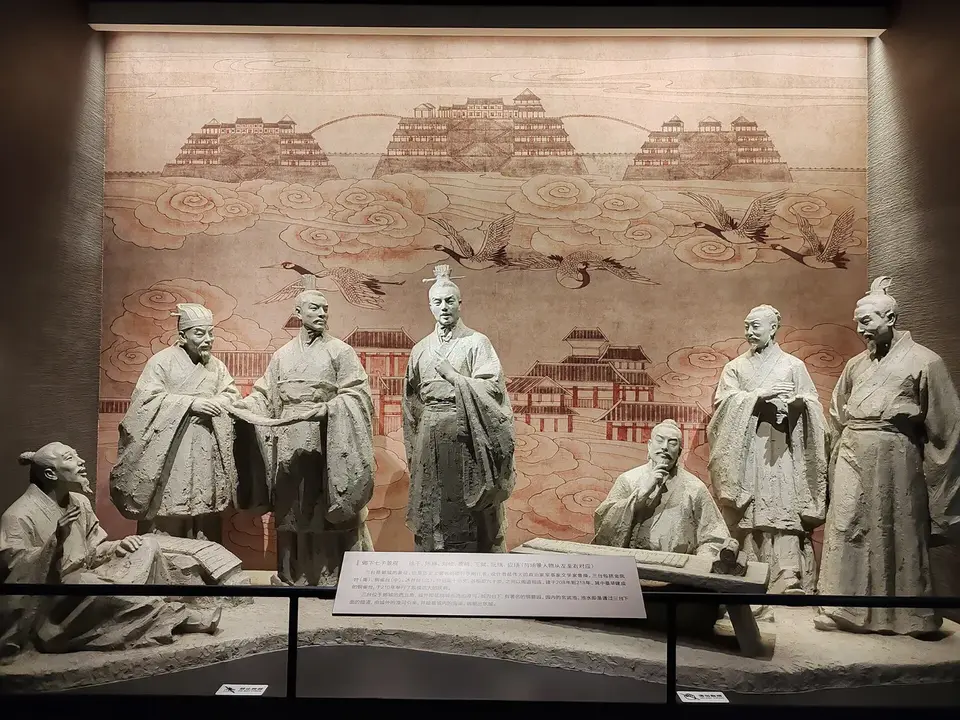
The Jian'an Literary Style and Aesthetic Vitality (建安风骨), also known as the Han-Wei Style, refers to the profound literary revolution and aesthetic movement that flourished during the Jian'an reign period (196–220) of the late Eastern Han Dynasty, centered at Ye City and Luoyang under the leadership of Cao Cao, Cao Pi, and Cao Zhi (the Three Caos), alongside the Seven Masters of Jian'an (Kong Rong, Chen Lin, Wang Can, Xu Gan, Ruan Yu, Ying Yang, Liu Zhen) and the poetess Cai Yan. Confronting devastating civil wars and widespread human devastation, Jian'an writers liberated literature from the pedantic strictures of Han apocryphal Confucianism. Inheriting the realistic ethos of Han Music Bureau folk ballads, they adopted five-character verse to document the catastrophic suffering of the populace while articulating passionate ambitions to pacify the realm alongside poignant laments over the transience of life. This movement harmonized moral inspiration (feng) with unyielding structural force (gu), producing a majestic, heroic, and sorrowfully resonant literary tenor known as Jian'an fenggu. Celebrated in Liu Xie's The Literary Mind and the Carving of Dragons and Zhong Rong's Poetic Gradings as the immortal pinnacle of Chinese poetic virtue, the movement inspired the golden age of High Tang poetry and established an enduring symbol of Chinese artistic vitality.
Cao Cao escorts Emperor Xian to Xuchang, inaugurating the Jian'an era, gathering scholars, and opening the golden age of late Han letters.
Cao Cao conquers Jizhou, establishes Ye City as his power center, constructs the Bronze Bird Terrace, and convenes the Three Caos and Seven Masters.
Cao Cao defeats the Wuhuan, ascends Mount Jieshi on his return march, and composes monumental verses including Viewing the Blue Sea and The Old Steed.
Wang Can joins Cao Cao's secretariat; Cao Cao composes Short Song Style aboard his Yangtze fleet before the Battle of Red Cliffs.
The literary circle flourishes; Cao Pi pens On Literature, establishing the independence of literary creation as an enduring imperial endeavor.
A devastating epidemic sweeps the Central Plains, claiming Xu Gan, Chen Lin, Ying Yang, and Liu Zhen in a single season.
Cao Cao passes away in Luoyang; Cao Pi accepts the abdication of Emperor Xian, establishing the Cao Wei dynasty and transitioning Jian'an literature into the Wei-Jin era.
The emergence of Jian'an fenggu was born directly out of catastrophic sociopolitical convulsions that shattered late Eastern Han society. Following the outbreak of the Yellow Turban Rebellion in 184, four centuries of centralized imperial governance disintegrated into widespread regional warlordism. The tyrant Dong Zhuo burned the imperial capital Luoyang, prompting rival warlords across the realm to wage brutal campaigns of territorial expansion. The Central Plains were plunged into apocalyptic devastation, characterized by continuous warfare, famine, and devastating epidemics.
In his landmark poem Haoli Xing, Cao Cao bore witness to this societal ruin, noting that white bones lay unburied across the plains while not a rooster crowed for a thousand li, with barely one in a hundred commoners surviving. These harrowing realities obliterated the sheltered tranquility of traditional scholars, compelling literati to abandon the superficial panegyrics of Han rhapsodies and confront the agony of the dispossessed. A profound empathy for human suffering and deep existential anxiety regarding the survival of the realm formed the collective emotional foundation of the Jian'an generation.
Concurrently, the dogmatic Confucian scriptural commentary and superstitious theological divination that sustained the Han ideological apparatus collapsed under the impact of civil chaos. Generations of Han scholars had squandered lifetimes parsing single phrases into hundreds of thousands of words, producing scholastic pedantry that offered zero practical guidance amid the clash of armies.
The shattering of dogmatic constraints triggered an unprecedented awakening of individual self-consciousness among the intelligentsia. Confronting mortality in an unpredictable world, scholars felt the fragility of existence and the rapid flight of time with acute intensity. Yet unlike later Western Jin intellectuals who sought solace in escapist nihilism, the Jian'an literati responded with robust, heroic engagement. Their sorrow over temporal brevity intensified an urgent drive to perform meritorious deeds, pacify the divided land, and achieve enduring literary immortality. This creative tension between poignant melancholy and unyielding heroic resolve imbued Jian'an literature with unprecedented vitality.
The emergence of the Jian'an literary style was directly enabled by the enlightened patronage and personal genius of the Cao family. In 196, Cao Cao escorted Emperor Xian to Xuchang, establishing effective control over the central government and systematically reunifying northern China. In 204, having conquered Jizhou, Cao Cao made Ye City his administrative center, constructing the famed Bronze Bird Terrace. As supreme commander, Cao Cao implemented meritocratic policies that recruited talented men regardless of lineage or social origin.
Both Cao Pi and Cao Zhi possessed extraordinary literary gifts and shared their father's passion for letters. Under their generous patronage, prominent scholars from across the fractured realm gathered in Ye City, forming the celebrated Ye City Literary Group. Dining together, riding in shared carriages, and composing verses on common themes, the Cao rulers and their scholar-compatriots formed an egalitarian intellectual fellowship that provided the collaborative cradle for the flowering of Jian'an literature.
Literary life during the Jian'an era pivoted around Ye City. Following the construction of the Bronze Bird, Gold Tiger, and Ice Well terraces, Cao Cao and his sons transformed the city into an intellectual sanctuary. Renowned scholars who had sought refuge across the empire converged upon the court: Wang Can arrived from Jingzhou, Chen Lin submitted from Yuan Shao's defunct secretariat, and Xu Gan, Ruan Yu, Ying Yang, and Liu Zhen took their places beneath the terrace towers, sparking an unprecedented communal renaissance.
Within the Ye City group, writers were no longer treated as court jesters or servile entertainers tasked with flattering imperial grandeur. Instead, they were honored as trusted companions and political advisors. In his famous Letter to Wu Zhi, Cao Pi recalled their shared camaraderie, describing how they rode side by side by day and shared banquets by night, listening to pipes and strings before raising goblets to recite newly brushed verses, lost in uninhibited creative joy. The group met regularly for literary symposia, composing variations on common musical titles and engaging in rigorous critical debates.
Crucially, the Jian'an circle formulated the first explicit philosophical defense of literature as an autonomous pursuit. In his treatise On Literature, Cao Pi proclaimed the immortal manifesto: "Literary composition is the paramount affair in statecraft, a glorious enterprise that never decays. A person's years have an end, and wealth and pleasure cease with the body; both must reach their appointed term, unlike the infinite endurance of letters." This bold formulation emancipated literature from its ancient subordinate status as a mere appendage to moral commentary, elevating authorship alongside ethical virtue and military triumph as a pathway to immortality and signaling what modern scholars celebrate as the age of self-conscious literary creation.
At the vanguard of the Jian'an movement stood Cao Cao and his two sons, whose political authority and artistic mastery established the foundational paradigm of the era.
Cao Cao served as the foundational architect and spiritual guiding star of the movement. Directly adopting the Music Bureau tradition of composing poems inspired by lived experience, he revitalized ancient musical titles to record contemporary history. His poetry combined sweeping martial majesty with deep historical pathos. Haoli Xing and Xielu Xing were celebrated by posterity as poetic histories, capturing the collapse of social order with unsparing realism. In his immortal Short Song Style, Cao Cao channeled existential sorrow into political resolve, moving from "Before our wine, let us sing, for what is human life? Like morning dew, its days are few" to the soaring declaration "The mountain disdains not height, the ocean disdains not depth; like the Duke of Zhou spurning food, let all under heaven turn their hearts to me."
Returning victorious from his campaign against the Wuhuan in 207, Cao Cao climbed Mount Jieshi overlooking the tempestuous Bohai Sea, composing the landmark cycle Walking Out the Summer Gate. Its opening piece, Viewing the Blue Sea, painted a cosmic panorama where the journey of the sun and moon and the splendor of the Milky Way seemed to emerge from the rolling waves, pioneering Chinese landscape poetry. In The Old Steed, his defiant declaration that an old thoroughbred stabled in twilight still dreams of running a thousand li asserted human agency against cosmic mortality. Each piece concluded with the joyful affirmation that song gave voice to the inner spirit, decisively liberating lyric verse from imperial ritual formalism.
Cao Pi contributed refined elegance and emotional introspection. His Yan Ge Xing stands as the earliest surviving fully realized seven-character lyric poem in Chinese literature, celebrated for melodic resonance and tender melancholia. Following the catastrophic plague of 217 that claimed half the Jian'an masters, Cao Pi wrote sorrowful letters memorializing Xu Gan's tranquil modesty and Ying Yang's harmonious scholarship, highlighting the deep emotional bonds that united the Ye City circle.
Cao Zhi represented the absolute artistic summit of the movement. Literary theorist Zhong Rong praised him as possessing towering moral vigor, opulent diction, balanced elegance and grievance, and harmonious synthesis of form and substance. Cao Zhi's creative life divided across his father's death and Cao Pi's imperial accession. His early masterpiece Bai Ma Pian depicted a valiant frontier youth who gladly gave his life for the nation, radiating patriotic romanticism. Following his political marginalization under the suspicious gazes of Cao Pi and Cao Rui, his later verse, exemplified by Presented to Biao, Prince of Baima, channeled profound fraternal heartbreak and existential helplessness into deeply moving pentasyllabic laments.
Around the Three Caos stood the Seven Masters of Jian'an and the poetess Cai Yan, who expanded the thematic breadth of the movement through diverse personal experiences of trauma and displacement.
Wang Can was universally recognized as the foremost of the Seven Masters. Having spent over a decade languishing in exile under Liu Biao in Jingzhou, his Five-Character Lamentations recorded the horrific sight of bleached bones covering desolate plains and starving mothers abandoning infants in roadside grass, presenting an unvarnished tragedy of war. His Rhapsody on Ascending the Tower synthesized displacement, yearning for ancestral home, and frustrated statecraft into an enduring masterpiece of melancholic prose.
Chen Lin and Ruan Yu drafted critical military proclamations for Yuan Shao and Cao Cao, renowned for thunderous rhetorical power. Chen Lin's proclamation against Cao Cao was so incisive that it famously cured Cao Cao of a blinding headache, while his ballad Watering Horses at a Long Wall Chasm exposed the misery of border conscription through dramatic dialogue between soldier and wife. Ruan Yu's direct, unornamented verse retained the pure force of Han Music Bureau ballads.
Kong Rong, a twentieth-generation descendant of Confucius, was renowned for fearless moral defiance and majestic, sweeping prose, though his unbending critique of Cao Cao ultimately brought execution. Liu Zhen was famed for lofty character and unyielding vigor; his poem Presented to My Cousin invoked the evergreen pine enduring frost and snow to symbolize unwavering moral integrity. Xu Gan composed The Balanced Discourses analyzing statecraft alongside delicate love verses, while Ying Yang contributed polished, harmonious compositions.
The poetess Cai Yan (Cai Wenji) embodied the ultimate tragedy of the era. Abducted by Southern Xiongnu cavalry during the collapse of the Han capital, she lived twelve years in nomadic captivity before Cao Cao ransomed her with gold. Drawing upon her horrific experiences, she composed the autobiographical Poetic Lamentations and the song cycle Eighteen Songs on a Nomad Flute. Comprising one hundred and eight pentasyllabic lines, Poetic Lamentations stands as the first monumental autobiographical narrative poem composed by a female writer in Chinese history, recounting the destruction of her homeland, the agony of nomadic exile, and the heartbreaking separation from her children in verses brimming with searing tears.
The historical significance of Jian'an literature lay not only in its profound thematic substance, but also in its revolutionary structural transformation of Chinese poetic form.
Prior to the Jian'an period, Chinese elite poetry had been dominated by the archaic four-character meter of the Classic of Poetry, while early five-character verse remained largely confined to anonymous folk songs and the Nineteen Old Poems. The Jian'an masters recognized that five-character meter possessed ideal syntactic flexibility and tonal variation, capable of capturing nuanced psychological shifts and complex historical narratives far better than four-character verse.
Through continuous experimentation, the Three Caos and the Seven Masters elevated five-character verse from unpolished folk singing into the premier vehicle for elite philosophical contemplation, narrative history, and lyric introspection. They synthesized the lush rhetorical beauty of ancient rhapsodies with the gritty realism of folk ballads, overcoming the pedantic stagnation of Han scholasticism while avoiding empty rhetorical embellishment. Achieving a harmonious balance of inner moral fiber (gu) and outer literary adornment (cai), the Jian'an masters established the five-character poetic form as the definitive medium that catalyzed the later golden age of Tang regulated verse.
Jian'an fenggu permanently dismantled the ancient presumption that creative writing was merely an ancillary tool for didactic moralization or flattery. By declaring through imperial prestige that literature was a glorious enterprise that never decayed, Cao Cao and Cao Pi endowed authors with unprecedented creative dignity. For the first time in Chinese cultural history, individual personality, subjective emotion, and aesthetic craft were celebrated as self-sufficient pursuits, inaugurating China's age of self-conscious literary creation. Furthermore, by elevating pentasyllabic verse into the standard expressive medium of the elite, the Jian'an writers laid the formal structural foundation for the subsequent evolution of classical Chinese poetry across the Six Dynasties and Tang eras.
The movement gifted classical Chinese literary theory with its most revered conceptual touchstone: fenggu (wind/vital spirit and bone/structural vigor). In The Literary Mind and the Carving of Dragons, Liu Xie dedicated a central chapter to defining feng as the animating moral passion that emotionally moves the reader, and gu as the muscular, unyielding structural clarity of poetic diction. Observing that the Jian'an writers composed amid catastrophic upheaval, Liu Xie praised their works for profound purpose, sweeping scope, unbending structural force, and passionate abundance of breath. Zhong Rong similarly extolled the Jian'an vigor as the fountainhead of poetic craft. Fenggu subsequently evolved beyond a historical style, becoming the ultimate qualitative yardstick for measuring an author's intellectual courage, moral integrity, and artistic power.
The legacy of Jian'an fenggu reverberated through centuries of Chinese history. When Six Dynasties poetry degenerated into the effeminate, ornamental palace style of Qi and Liang, early Tang reformer Chen Zi'ang raised the banner of literary insurrection. In his Preface to Tall Bamboo, Chen lamented that the structural vigor of Han and Wei had vanished, calling for a return to the robust bones of Jian'an to cleanse poetic decadence. This crusade inspired High Tang titans including Li Bai, Du Fu, Gao Shi, and Cen Shen. Li Bai proudly proclaimed that his work inherited the Jian'an bones, while Du Fu's poetic histories directly descended from Cao Cao's realistic chronicles. Across the Song, Ming, and Qing dynasties, whenever literature fell prey to bureaucratic formality, scholars invoked Jian'an fenggu to rekindle the moral courage, critical honesty, and indomitable life-force of the Chinese nation.
Official dynastic chronicles and classical literary criticism have universally revered Jian'an fenggu as an unmatched pinnacle of artistic achievement. In the Records of the Three Kingdoms, Chen Shou observed that while rival warlords took pride in martial force, Cao Cao alone combined military brilliance with supreme literary talent, and together with Cao Zhi and Wang Can created a cultural flourishing unprecedented since antiquity.
In The Literary Mind and the Carving of Dragons, Liu Xie summarized the era with enduring eloquence: "From the time Emperor Xian relocated his court and power devolved upon Cao Cao, the Three Caos led the literary world with majestic style. They yielded to passion with generous spirit and wielded their genius with sweeping boldness. Directing their aspirations to the rectification of the realm, their words were untrammeled and their vigor encompassed the universe; their style and bone structure remain the crown of a hundred generations."
Tang master Li Bai immortalized this reverence in his Farewell to Uncle Yun: "We all harbor soaring thoughts, eager to ascend the blue skies and grasp the moon; our writings match the bones of Jian'an, while between us your style mirrors the freshness of Xiao Xie."
Modern intellectual Lu Xun similarly observed in his renowned lecture on Wei-Jin culture: "Cao Cao was an extraordinary figure, an authentic hero. He was the founding master who transformed literary writing. Before him, literature was largely panegyric, formalistic, and balanced. Cao Cao and his sons rejected parallel formalities, speaking directly from the heart with natural vernacular power. This was a profoundly revolutionary spirit. The Wei-Jin era was truly the age of self-conscious literature, and this awakening commenced squarely in the Jian'an era."