Donghak Rebellion
The Donghak Peasant Rebellion erupts in southern Korea; the Qing court dispatches troops upon Korean request, and Japan deploys forces to occupy Seoul.
Qing Dynasty (清朝) · HISTORICAL EVENT
中日甲午战争
The First Sino-Japanese War (中日甲午战争), fought between July 1894 and April 1895, was a watershed military conflict between the Qing Empire of China and the Empire of Japan. Following the Meiji Restoration, Japan embarked on rapid industrialization and aggressive militarist expansion, formulating the Continental Policy aimed at annexing Korea and subjugating China. When the Donghak Peasant Rebellion erupted in Korea in the spring of 1894, Japan seized the…
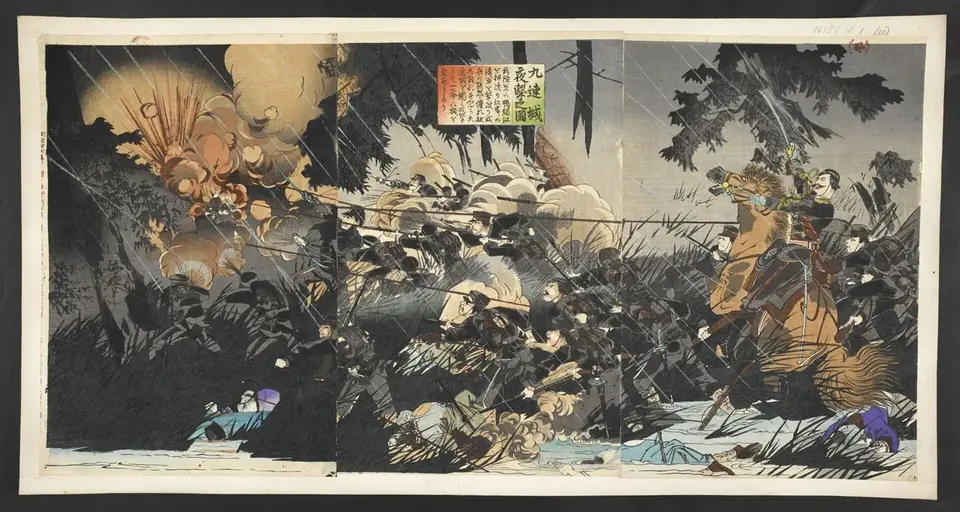
The First Sino-Japanese War (中日甲午战争), fought between July 1894 and April 1895, was a watershed military conflict between the Qing Empire of China and the Empire of Japan. Following the Meiji Restoration, Japan embarked on rapid industrialization and aggressive militarist expansion, formulating the Continental Policy aimed at annexing Korea and subjugating China. When the Donghak Peasant Rebellion erupted in Korea in the spring of 1894, Japan seized the opportunity to dispatch massive military forces to Seoul, subsequently initiating unprovoked hostilities by ambushing Qing naval transports at the Battle of Pungdo. The war spanned multiple bloody theaters, encompassing the Battle of Pungdo, the Battle of Pyongyang, the Battle of the Yalu River, the Liaodong Campaign, and the Siege of Weihaiwei. Despite the extraordinary heroism displayed by patriotic officers and soldiers such as Deng Shichang, Zuo Baogui, and Ding Ruchang, systemic corruption, strategic passivity, and fractured command within the Qing court resulted in catastrophic defeats across land and maritime frontiers, culminating in the total annihilation of the Beiyang Fleet. In April 1895, the Qing government capitulated, signing the humiliating Treaty of Shimonoseki, which ceded Taiwan and the Penghu Islands, exacted an exorbitant indemnity of two hundred million taels, and precipitated the imperialist scramble for concessions, fundamentally shattering the Self-Strengthening Movement and igniting modern China's revolutionary awakening.
The Donghak Peasant Rebellion erupts in southern Korea; the Qing court dispatches troops upon Korean request, and Japan deploys forces to occupy Seoul.
The Japanese Combined Fleet launches an unprovoked ambush against Beiyang warships and sinks the British transport Kowshing.
General Nie Shicheng mounts a tactical defense at Niujiaoshan before executing an orderly retreat; Ye Zhichao abandons Asan.
The Guangxu Emperor and Emperor Meiji officially issue mutual imperial rescripts declaring war.
General Zuo Baogui is martyred defending Peony Hill; Ye Zhichao panics and flees five hundred li back across the Yalu River.
The Beiyang Fleet clashes with the Japanese Combined Fleet in the Yellow Sea; Deng Shichang dies attempting to ram Yoshino.
The Japanese First Army breaches the Yalu River border, capturing Jiuliancheng and bringing the war onto Chinese territory.
The Japanese Second Army lands at Huayuankou, seizing Jinzhou and Dalian Bay to isolate Port Arthur.
Japanese forces capture Port Arthur and perpetrate a four-day massacre of nearly twenty thousand civilians and wounded soldiers.
Japanese troops land at Rongcheng Bay and envelop the rear batteries of Weihaiwei, trapping the fleet at Liugong Island.
Dingyuan is torpedoed and scuttled; Admiral Ding Ruchang and Captain Liu Buchan commit suicide by poison.
Japanese forces capture Niuzhuang and burn Tianzhuangtai, disintegrating imperial land resistance in Manchuria.
Li Hongzhang arrives in Shimonoseki for peace talks and survives an assassination attempt by a Japanese fanatic.
Li Hongzhang signs the humiliating Treaty of Shimonoseki, ceding Taiwan and Penghu and paying two hundred million taels.
Russia, Germany, and France compel Japan to retrocede Liaodong, forcing China to pay thirty million taels in ransom.
Taiwanese civilians and militia wage a heroic five-month armed resistance against Japanese colonial occupation.
In the late nineteenth century, the Meiji Restoration propelled Japan onto the path of rapid capitalist modernization and aggressive military expansionism. The ruling oligarchs formulated the Continental Policy, an overarching expansionist doctrine that identified the subjugation of the Korean Peninsula as the primary stepping stone for invading Manchuria, seizing Northern China, and establishing hegemony across East Asia. To finance this aggressive agenda, the Japanese state mobilized immense national resources, modernizing the army and navy while dispatching military cartographers and spies to map Chinese fortifications and waterways.
In sharp contrast to Japan's unified national war footing, the Qing Empire remained paralyzed by complacency after three decades of the Self-Strengthening Movement. Deep factional rifts divided the Emperor's faction and the Empress Dowager's faction, while institutional inertia crippled systemic modernization. Crucial naval appropriations were diverted to finance the reconstruction of the Summer Palace for Empress Dowager Cixi's sixtieth birthday. Consequently, the Beiyang Fleet received no new capital vessels or modern quick-firing armaments for over half a decade, leaving its munitions defective and its decentralized defense networks unprepared for modern warfare.
In early 1894, the Donghak Peasant Rebellion engulfed southern Korea. Incapable of suppressing the insurrection, King Gojong petitioned the Qing court for military assistance under traditional tributary obligations. Viceroy Li Hongzhang dispatched General Ye Zhichao with Huai Army garrisons to Asan, duly notifying Tokyo in accordance with the 1885 Convention of Tientsin. Viewing this intervention as the long-awaited pretext for military conquest, the Japanese cabinet deployed the elite Ninth Mixed Brigade to Incheon, seized the royal palace in Seoul, and deliberately engineered diplomatic pretexts to sabotage peaceful resolution.
In the spring of 1894, the Donghak Peasant Rebellion swept across southern Korea, capturing the provincial capital of Jeonju and threatening the Joseon monarchy. King Gojong repeatedly appealed to Beijing for military intervention. Viceroy Li Hongzhang dispatched Generals Ye Zhichao and Nie Shicheng with over two thousand Huai Army troops to Asan to restore order, formally notifying Tokyo in compliance with the Convention of Tientsin.
Capitalizing on Beijing's troop deployment, the Japanese government initiated its long-planned blueprint for continental conquest. The Japanese cabinet authorized immediate military intervention, dispatching the elite Ninth Mixed Brigade of over eight thousand heavily armed troops under Major General Oshima Yoshimasa to seize Incheon and occupy Seoul. Even after Qing mediation brokered the Jeonju peace pact, Japan adamantly rejected mutual troop withdrawal, storming Gyeongbokgung Palace and installing a puppet administration.
Foreign Minister Mutsu Munemitsu and Prime Minister Ito Hirobumi directed Minister Otori Keisuke to deliberately provoke diplomatic crises under the pretext of demanding internal Korean administrative reforms. Imperial Japanese forces disarmed the Korean Royal Palace Guards, compelled the Heungseon Daewongun to denounce centuries of Sino-Korean tributary ties, and issued ultimatums demanding the eviction of all Qing garrisons, making war completely inevitable.
At dawn on July 25, 1894, the Beiyang cruisers Jiyuan and Guangyi were returning to Weihaiwei after escorting troop transports to Asan when they were ambushed off Pungdo Island by the Japanese First Flying Squadron—Yoshino, Naniwa, and Akitsushima. Exploiting their superior speed and modern quick-firing armaments, the Japanese warships opened fire without a formal declaration of war. Guangyi was severely battered and ran aground, while the dispatch boat Chaojiang was captured.
During the engagement, the chartered British merchant steamer Kowshing, transporting over a thousand Qing soldiers of the Jiangbei Brigade, entered the combat zone. The Japanese cruiser Naniwa, commanded by Captain Togo Heihachiro, intercepted the vessel and demanded compliance. Led by Deputy General Jiang Zikang, the Qing officers and soldiers passionately refused to surrender, resolving to defend the vessel to the death. Togo ruthlessly ordered torpedoes and broadsides fired into the vessel, sending over seven hundred valiant Qing troops to a watery grave.
The sinking of the Kowshing triggered international outrage across European diplomatic and legal communities due to the destruction of a British-flagged merchantman. However, with the assistance of British legal advisors, Tokyo successfully manipulated maritime legal ambiguities to evade formal liability. This incident highlighted the cynical pragmatism of Western imperial powers regarding Far Eastern affairs while severely disrupting Qing maritime transport corridors to the Korean front.
Simultaneously with the naval assault at Pungdo, General Oshima Yoshimasa marched four thousand Japanese infantry south from Seoul to eliminate the Qing garrison at Asan and Seonghwan. Recognizing Seonghwan as the critical chokepoint guarding the approaches to Asan, General Nie Shicheng fortified the heights of Niujiaoshan, deploying intersecting entrenchments, defensive minefields, and palisades, while concealing his main force along the flanks to ambush the attackers.
Before dawn on July 29, the Japanese right wing launched a frontal assault under cover of darkness. Nie Shicheng directed blistering counterfire and detonated subterranean explosive traps, inflicting heavy casualties on the vanguard of the attacking Japanese infantry. However, superior Japanese forces executed a flanking encirclement, while General Ye Zhichao retreated from Asan without dispatching reinforcements. Facing impending encirclement, Nie executed an orderly fighting retreat, withdrawing his surviving forces northward to Pyongyang.
The Battle of Seonghwan marked the inaugural clash of arms between modern Chinese and Japanese ground forces. Despite facing overwhelming numerical odds, Nie Shicheng demonstrated superior tactical leadership, killing Japanese commander Captain Matsuzaki Naoomi and inflicting significant casualties. Tragically, Commander Ye Zhichao falsely reported a glorious triumph upon reaching Pyongyang, receiving imperial accolades and perpetuating the culture of battlefield deceit that ultimately doomed the northern defenses.
On August 1, 1894, the Guangxu Emperor of the Qing Empire and Emperor Meiji of Japan formally issued imperial declarations of war, plunging the two East Asian empires into open hostilities. The Guangxu Emperor condemned Japan for brazenly violating international treaties, occupying the Korean capital, overthrowing legitimate tributary governance, and launching perfidious ambushes against Chinese troop transports, commanding his commanders to aggressively destroy the invading forces.
Conversely, Emperor Meiji's imperial rescript framed the aggression as a noble campaign to secure Korean sovereignty and maintain permanent peace across East Asia, hypocritically depicting Qing tributary protection as an intolerable threat to regional stability. With the formal declarations announced, the struggle for East Asian preeminence escalated, as massive land armies converged on Pyongyang and the battle fleets prepared to contest command of the Yellow Sea.
The two imperial proclamations laid bare the profound systemic divide separating the two combatants. While the Qing state relied on archaic bureaucratic mobilization and fragmented regional armies, Japan functioned under a unified modern General Staff, coordinating nationwide rail logistics, war bond issuances, and total industrial mobilization fueled by intense nationalist fervor.
By early September 1894, over fifteen thousand elite Qing soldiers had gathered to defend the fortified city of Pyongyang, comprising General Zuo Baogui's Feng Army, Commander Fengshenga's Sheng Army, General Wei Rugui's forces, and Ye Zhichao's Huai Army. Pyongyang featured massive stone battlements flanked by rugged hills and rivers. The Japanese First Army, numbering nearly twenty thousand troops under Generals Oshima and Nodzu Michitsura, commenced a coordinated multi-pronged assault on September 15.
Dominating the northern battlements, Peony Hill formed the critical topographic key to Pyongyang's entire defense perimeter. Japanese mountain artillery batteries unleashed devastating bombardments upon the redoubts. General Zuo Baogui, personally commanding the Feng Army defenders, exposed himself to intense shrapnel to direct Krupp artillery fire, repeatedly repulsing human-wave Japanese assaults and littering the glacis with fallen invaders.
On the southern and western approaches, forces under Wei Rugui and Fengshenga fought tenacity, severely wounding General Oshima and pinning down Japanese assault formations. Suffering severe casualties and dwindling ammunition, the Japanese assault faltered. However, the lack of centralized coordination among Qing commanders crippled the defense, as Ye Zhichao remained paralyzed at the supreme headquarters, squandering the opportunity to launch a decisive counter-offensive.
During the climactic struggle for Peony Hill, General Zuo Baogui mounted the parapets to personally sight and fire the fortress cannons. When aides pleaded with him to remove his imperial yellow riding jacket to avoid enemy snipers, Zuo fiercely refused, proclaiming that a commanding general must inspire his men by facing death openly. Moments later, an explosive shell detonated directly against the embrasure, mortally wounding Zuo in the torso and making him the first senior Qing commander to die for the nation.
Zuo's martyrdom triggered the collapse of the Peony Hill redoubts, enabling Japanese artillery to shell the interior of Pyongyang. Panic seized the supreme commander, Ye Zhichao, who ordered white surrender flags hoisted over the ramparts before commanding a midnight evacuation. Japanese forces ambushed the retreating columns outside the gates, slaughtering over two thousand fleeing soldiers and capturing Pyongyang before dawn on September 16.
Pyongyang was stocked with dozens of Krupp field guns, millions of rifle rounds, and vast grain reserves, all of which fell intact into enemy hands due to Ye Zhichao's cowardly flight. These captured stockpiles solved the Japanese army's desperate logistical shortages, fueling their subsequent drive to the Yalu River. Zuo Baogui's supreme sacrifice was thus squandered by the cowardice of his commanding officer, delivering a catastrophic blow to the Qing defense of Korea.
Following the order to abandon Pyongyang, Ye Zhichao orchestrated no rear-guard defense, leading a panicked flight northward through torrential rains and mountain mud. Stripped of tactical coherence, the disorganized Qing columns became easy prey for Japanese ambuscades waiting along the defiles. Hundreds were trampled to death, and countless artillery pieces, supply carts, and rifles were discarded along the roads.
Ye Zhichao fled five hundred li without pause, crossing the Yalu River border into the Chinese stronghold of Jiuliancheng. His flight dismantled decades of Qing political and military authority on the Korean Peninsula, leaving all of Joseon Korea firmly under Japanese subjugation. The disaster provoked intense outrage in Beijing, prompting the Guangxu Emperor to order Ye's immediate arrest, yet the strategic damage to the imperial frontier was irreversible.
The five-hundred-li rout shattered the morale of provincial garrisons across Northern China. Local Korean populations, formerly respectful of the imperial suzerain, regarded the retreating armies with despair. Telegraph networks and supply depots built over years were obliterated, directly exposing the ancestral frontiers of Manchuria to imminent invasion.
On the afternoon of September 17, 1894, only a day after the fall of Pyongyang, the titanic Battle of the Yalu River erupted near Dagushan. Admiral Ding Ruchang, leading twelve warships of the Beiyang Fleet—including the ironclads Dingyuan and Zhenyuan—was returning from escorting reinforcements to the Yalu River when he intercepted the twelve modern warships of the Japanese Combined Fleet under Vice Admiral Ito Sukeyuki. It was the first major steam ironclad fleet clash in naval history.
Ding deployed his fleet in a wedge-shaped line abreast formation to maximize the forward-firing arcs of the heavy turrets on his flagship ironclads. In contrast, Ito formed a single line ahead, using the high speed of his First Flying Squadron to circle around and crush the vulnerable Qing flanks. At 12:50 PM, Dingyuan's massive 30.5-centimeter Krupp guns opened fire with a thunderous roar, inaugurating five hours of merciless naval carnage.
The intensity of naval artillery fire was unprecedented. Thick black powder smoke blanketed the waves as the opposing squadrons pounded one another at close range. The Japanese fleet capitalized on fast-firing Armstrong cannons, unleashing hundreds of explosive lyddite shells per minute, transforming the battle line into a blazing inferno of twisted iron and flying shrapnel.
At the outset of the engagement, the shockwave from Dingyuan's opening broadside collapsed the flying bridge, severely injuring Admiral Ding Ruchang and severing the main signal halyards, depriving the fleet of centralized tactical direction. Captain Liu Buchan of the Dingyuan and Captain Lin Taizeng of the Zhenyuan assumed independent command, standing as an unyielding bulwark amidst relentless volleys of enemy shells.
Both German-built ironclads absorbed hundreds of shell hits across their superstructures, their wooden decks repeatedly bursting into flames. Nevertheless, damage control crews extinguished the fires under blistering shrapnel, maintaining steady return fire. A heavy armor-piercing projectile from Zhenyuan scored a direct hit on the Japanese flagship Matsushima, detonating ready ammunition, killing dozens of sailors, and knocking the flagship out of action.
Surrounding the two Chinese behemoths, five Japanese cruisers unleashed thousands of rounds at point-blank range. Dingyuan absorbed 159 hits and Zhenyuan 220 hits, yet their thick compound belt armor remained impenetrable. Acting as an anchor for the fleet, the two ironclads preserved the surviving Chinese warships, writing an indelible chapter of naval fortitude.
As the engagement intensified, the Japanese flying squadron focused its fury on the unprotected Chinese cruisers. The cruiser Zhiyuan, commanded by Captain Deng Shichang, fought at the fore of the battle line, shielding the flagship Dingyuan from flanking maneuvers. Battered by relentless shellfire, Zhiyuan began listing severely, its hull breached and ammunition magazines almost exhausted.
Facing the approaching Japanese cruiser Yoshino, Deng Shichang addressed his crew with impassioned resolve, declaring that every naval officer must confront death with honor to preserve the dignity of the empire. Ordering maximum steam pressure, Deng drove the battered Zhiyuan directly toward Yoshino at full speed, attempting to ram the enemy vessel. Terrified by the charging ironclad, the Japanese squadron concentrated quick-firing broadsides upon the vessel.
Before Zhiyuan could close the distance, an enemy shell or torpedo struck its torpedo room, detonating the forward magazines. In a blinding explosion, the cruiser plunged beneath the waves. Flung into the water, Deng Shichang refused a lifebuoy thrown by rescuers, choosing to drown alongside his beloved war dog, sealing his place as one of China's most revered modern martyrs.
Throughout the five-hour clash, older and unarmored vessels in the Beiyang Fleet suffered immense devastation. The wooden-hulled cruisers Chaoyong and Yangwei were quickly set ablaze by high-explosive ordnance and sank early in the battle. The armored cruiser Jingyuan, commanded by Captain Lin Yongsheng, fought tenaciously until Lin was killed by shellfire, after which the vessel was overwhelmed and sank off the Yalu estuary.
As twilight gathered, Admiral Ito, witnessing the unyielding resistance of Dingyuan and Zhenyuan and facing heavy damage across his own fleet, broke off contact. The Beiyang Fleet lost five vessels and over a thousand sailors. The surviving warships limped into Port Arthur for emergency drydock repairs, where Li Hongzhang's conservative directive to preserve remaining vessels effectively surrendered command of the Yellow Sea to the Japanese navy.
The Battle of the Yalu River altered the geopolitical balance of power in East Asia. Although the Beiyang crews fought with exceptional bravery, Li Hongzhang's refusal to risk remaining warships confined the fleet to harbor, granting Japan undisputed maritime supremacy to land landing armies on Chinese soil.
In late October 1894, General Yamagata Aritomo's First Army assembled thirty thousand Japanese troops along the eastern bank of the Yalu River. Defending the Chinese bank was an eighty-battalion force of thirty thousand men under General Song Qing, deployed across a sprawling hundred-li front encompassing Jiuliancheng and Andong. Despite their numbers, the Qing defenders suffered from fragmented command and dispersed tactical alignments.
On the night of October 24, Japanese combat engineers bridged the Yalu River near Shuijingkou undetected, launching a surprise assault on the Qing forward redoubt at Hushan. Lacking artillery coordination, the defenders were dislodged from the heights. Utilizing Hushan as an elevated artillery platform, the Japanese subjected Jiuliancheng to heavy bombardments, precipitating a general panic among Qing regional commanders.
By October 26, Japanese columns occupied Jiuliancheng and Andong without encountering significant resistance. The breach of the natural Yalu barrier opened the gateway to southern Manchuria. General Song Qing retreated toward the mountainous passes of Haicheng, abandoning extensive artillery pieces and magazine stores, and transforming the Manchurian heartland into an active battleground.
With the Yalu frontier shattered, the Japanese Imperial General Headquarters enacted its maritime invasion plan. On October 24, General Oyama Iwao's Second Army, comprising twenty-five thousand troops, landed unopposed at Huayuankou on the eastern coast of the Liaodong Peninsula. The vast Qing coastline was entirely undefended, allowing Japanese forces to disembark siege guns and supplies with ease.
Advancing south, the Japanese assaulted the walled town of Jinzhou, the outer gateway to Port Arthur. Deputy Lieutenant General Shantai defended the town to the last breath, perishing in the breach alongside hundreds of brave troops. Upon the fall of Jinzhou, General Zhao Huaiye, commanding the formidable coastal artillery forts at Dalian Bay, fled in terror without firing a single shot, surrendering modern Krupp batteries and millions of munitions intact.
The capture of Dalian Bay handed Japan an operational deep-water harbor and dozens of heavy Krupp coastal artillery pieces. The Japanese redirected these captured heavy guns against the defenses of Port Arthur, isolating the naval stronghold and demonstrating the devastating cost of bureaucratic corruption and commander cowardice.
Port Arthur was the crowning jewel of the Self-Strengthening Movement, an impregnable coastal citadel featuring over twenty modern concrete forts and drydocks, revered as the Gibraltar of East Asia. However, fortress commanders Gong Zhaoyu and Wei Rugui fled before the enemy, leaving the defense fractured. On November 21, the Japanese First and Second Divisions stormed the outer bastions, overwhelming the defenders and capturing the citadel by dusk.
Following the capture of the city, Japanese forces unleashed a horrific four-day civilian massacre under the direction of the Second Army command. Soldiers rampaged through the streets, butchering nearly twenty thousand defenseless civilians, wounded soldiers, women, and children with bayonets and sabers. Piles of corpses choked the avenues, with only thirty-six inhabitants spared to bury the dead.
Foreign war correspondents, including Thomas Cowan of The Times and James Creelman of the New York World, documented the atrocity, exposing Japan's brutal war crimes to the international public. Creelman condemned the massacre as an indelible stain upon modern civilization, revealing the predatory militarism beneath Japan's veneer of Westernization.
Between November and December 1894, the Liaodong campaign degenerated into a grinding theater of strategic decay. The convergence of Japan's First and Second Armies threatened the transport corridors east of the Liao River. Haicheng and Gaiping occupied critical junctures guarding access to Mukden and Liaoyang. In mid-December, the Japanese Third Division under Lieutenant General Katsura Taro executed a swift winter assault, capturing Haicheng amidst blinding blizzards.
The loss of Haicheng sent shockwaves through the imperial court, as the ancestral Qing tombs at Mukden were directly imperiled. The Guangxu Emperor issued urgent rescripts commanding front-line forces to recapture the stronghold. Nearly sixty thousand troops, including Viceroy Liu Kunyi's Xiang Army, General Song Qing's Yi Army, and General Nie Shicheng's forces, concentrated around Haicheng, yet factional distrust paralyzed joint operational coordination.
At Gaiping, General Zhang Gaoyuan's Songwu Army mounted a valiant defense against the Japanese First Division, engaging in brutal hand-to-hand combat along the ramparts. Despite inflicting severe casualties, Gaiping fell due to a lack of tactical reinforcements. Qing forces fell back to Yingkou, enabling the Japanese to sever land communications between southern Manchuria and Zhili Province.
Throughout January and February 1895, Qing commanders launched three major counter-offensives to dislodge the Japanese garrison at Haicheng. In the first assault, Generals Song Qing and Iktangga converged from north and south amidst sub-zero blizzards, penetrating Japanese outer redoubts at Shuangtaizi. However, lacking siege artillery to neutralize fortified modern pillboxes, the assaults were repulsed with severe casualties.
Subsequent counter-attacks suffered from disjointed battlefield coordination. Disparate regional contingents failed to synchronize their maneuvers, allowing the entrenched Japanese defenders to defeat each assault piecemeal. By the end of February, all three counter-offensives had disintegrated, costing thousands of imperial casualties and extinguishing the offensive combat potential of Qing land forces in Manchuria.
The failure of the Haicheng operations surrendered the strategic initiative completely. The Japanese First Army, reinforced by fresh divisions from the home islands, launched a general counter-offensive toward Liaoyang. With the defense of Mukden hanging by a thread, defeatism gripped the Qing court, accelerating Beijing's shift toward an unconditional negotiated settlement.
Seeking the total destruction of the Beiyang Fleet, the Japanese Imperial General Headquarters shifted its operational focus to Weihaiwei, the final anchorage of the imperial navy on the Shandong Peninsula. On January 20, 1895, General Oyama Iwao landed twenty-five thousand troops of the Second Army at Rongcheng Bay, located fifty miles east of Weihaiwei, shielded by dozens of Combined Fleet warships.
The landing zone was virtually undefended due to the strategic blindness of Shandong Governor Li Bingheng. Confining his garrisons to inland fortifications, Li refused to reinforce coastal checkpoints, allowing the Japanese to unload siege artillery, cavalry, and munitions unchallenged, establishing an unshakeable forward base.
Advancing overland, Japanese columns enveloped the landward defenses of Weihaiwei. The fortress batteries had been engineered primarily to repel naval bombardments from seaward approaches, leaving their rear gates exposed. Paralyzed by panic, imperial land garrisons retreated without mounting a coherent defense, sealing the encirclement of the Beiyang Fleet within the harbor.
On January 30, Japanese formations launched a massive assault against the southern fort complex of Weihaiwei. General Dai Zongqian's garrison resisted fiercely, but the defenses were overwhelmed by concentrated bombardment. In desperation, Beiyang warships bombarded the captured batteries to dismantle the cannons. Retiring to Liugong Island, Dai committed suicide by swallowing gold.
By February 2, Japanese forces occupied the northern coastal batteries without serious resistance. In their haste to evacuate, the retreating land garrisons neglected to demolish the massive Krupp coastal guns. The Japanese immediately turned these heavy weapons around, bombarding the anchorage and Liugong Island in coordination with the Combined Fleet outside the harbor.
All mainland batteries and anchorages fell, confining the surviving twenty-five vessels of the Beiyang Fleet to the shallow waters off Liugong Island. Cut off from food, freshwater, and ammunition, and with no relieving army in sight, the trapped garrison confronted an unrelenting deluge of naval and artillery fire.
Capitalizing on their capture of the shoreline, the Japanese navy executed night torpedo infiltrations into Weihaiwei harbor. Severe gales had severed sections of the defensive boom, opening gaps in the harbor approaches. Before dawn on February 5, ten Japanese torpedo boats slipped into the inner anchorage under cover of a pitch-black winter blizzard.
Japanese torpedo boat No. 9 penetrated the inner screen, launching a torpedo that struck the flagship Dingyuan below the waterline on the port quarter. As icy sea water flooded the compartments, Captain Liu Buchan beached the ironclad upon the shallows of Liugong Island, transforming the immobile hull into a floating artillery redoubt to continue firing upon the enemy.
The following night, Japanese torpedo boats struck again, sinking the cruiser Laiyuan and the training ship Baofa, claiming hundreds of sailors. On February 9, Krupp shells from captured shore batteries sank the cruiser Jingyuan. Left with no operational shells, Captain Liu Buchan ordered the scuttling of Dingyuan to prevent its capture, detonating the ship's remaining magazines in a massive blast before committing suicide.
Faced with total destruction, the Beiyang high command stood at the threshold of life and death. Admiral Ito Sukeyuki had previously sent a personal letter imploring Admiral Ding Ruchang to surrender with promises of safety and prestige, which Ding adamantly rejected. Following the scuttling of Dingyuan, Captain Liu Buchan fulfilled his vow to die with his vessel, committing suicide by swallowing raw opium at age forty-three.
Liu's sacrifice was followed by Captain Yang Yonglin of Zhenyuan, who shot himself to avoid captivity. Confronting insurmountable starvation, mutinous foreign mercenaries, and the collapse of all hope for relief, Admiral Ding Ruchang refused to capitulate to the enemy, committing suicide by drinking lethal opium poison on the night of February 11.
Before his death, Ding ordered the destruction of his official seal of office, choosing death over dishonor. General Zhang Wenxuan likewise committed suicide by poison. The tragic sacrifice of Ding Ruchang, Liu Buchan, and their fellow officers demonstrated extraordinary personal valor, yet their deaths could not alter the systemic decay that condemned the imperial navy to oblivion.
Following the deaths of Ding Ruchang and the senior commanders, chaos consumed Liugong Island. Foreign mercenaries such as Tyler and Howie, colluding with Captain Cheng Biguang of the cruiser Guangbing, forged a surrender document in the late Admiral Ding's name. Cheng was dispatched aboard a training launch to Admiral Ito's flagship Matsushima to formally negotiate terms of capitulation.
On February 17, 1895, the Japanese Combined Fleet steamed into Weihaiwei harbor to disarm the surviving imperial garrison. The ironclad Zhenyuan, along with nine other surviving cruisers and gunboats and all naval base facilities, were seized as trophies of war. Zhenyuan was subsequently towed to Yokosuka as a war trophy, marking the complete annihilation of the Beiyang Fleet.
Admiral Ito permitted the unarmed training vessel Kangji to transport the coffins of Ding Ruchang, Liu Buchan, and Yang Yonglin back to Yantai. As the vessel departed the devastated harbor with its horn sounding a solemn dirge, the maritime bulwark of the Qing Empire officially ceased to exist, leaving the approaches to Beijing completely undefended.
While the fleet perished at Weihaiwei, the Manchurian land theater reached its bloody finale. In early March 1895, the Japanese First and Second Armies converged on the commercial hub of Niuzhuang. General Wei Guangtao's Wuwei Army defended the perimeter, engaging the Japanese Third Division in the war's most ferocious urban combat. For twenty-four hours, Chinese soldiers contested every dwelling with bayonets, killing hundreds of invaders before being overwhelmed.
Following the fall of Niuzhuang, imperial forces retreated to their final redoubt on the Liao River at Tianzhuangtai, where twenty thousand troops under Song Qing, Wu Dacheng, and Liu Kunyi assembled. However, successive routs had shattered morale. On March 9, nearly one hundred Japanese field artillery pieces unleashed a carpet bombardment, setting the entire town ablaze.
Under relentless artillery fire, the Qing lines collapsed into a stampede across the frozen Liao River. Japanese troops torched the city, destroying warehouses and massacring wounded soldiers and civilians. The rout at Tianzhuangtai eradicated organized Qing military resistance in Manchuria, leaving the road to Beijing completely open to invasion.
The simultaneous collapse of the Liaodong front and the destruction of the navy plunged the imperial court into abject panic. Preoccupied with her upcoming sixtieth birthday celebrations, Empress Dowager Cixi feared a Japanese advance on the Forbidden City. Facing military paralysis, the Guangxu Emperor and Prince Yikuang resolved to sue for peace at any cost.
Initial peace missions led by Zhang Yinhuan and Shao Youlian were rejected by Japan on the pretext of insufficient credentials. Tokyo demanded the dispatch of Viceroy Li Hongzhang, the sole statesman endowed with the authority to negotiate territorial cessions. The Guangxu Emperor granted Li full plenipotentiary powers, dispatching the aged statesman to sue for peace.
On March 13, 1895, the seventy-two-year-old Li Hongzhang boarded a steamship at Daku Fort bound for Japan. Prior to his departure, imperial audiences had granted him broad latitude to concede indemnities and territorial partitions. Li undertook the journey fully conscious that he was destined to shoulder the infamy of modern China's most humiliating capitulation.
On March 19, 1895, Li Hongzhang arrived in Shimonoseki, opening negotiations at the coastal pavilion of Shunpanro. Prime Minister Ito Hirobumi and Foreign Minister Mutsu Munemitsu treated the Chinese embassy with disdain, demanding the immediate surrender of Daku, Tianjin, and Shanhaiguan as preconditions for a temporary armistice—terms that Li flatly refused.
On March 24, following the third plenary session, a Japanese ultranationalist fanatic named Koyama Rokunosuke ambushed Li's palanquin, firing a revolver bullet into the viceroy's left cheekbone. Bleeding profusely, Li collapsed unconscious. The assassination attempt provoked a global diplomatic scandal, embarrassing the Japanese government and prompting fears of European military intervention.
Emperor Meiji dispatched personal physicians to attend to Li, and Ito consented to an unconditional armistice covering the Manchurian and Zhili fronts. Despite his advanced age and facial wounds, Li Hongzhang resumed negotiations from his bed, engaging in painful diplomatic sparring in an effort to minimize the scale of territorial partition.
On April 10, Ito Hirobumi submitted an ultimatum containing the finalized peace terms, threatening an immediate march on Beijing if the Qing court refused to accept the draft in its entirety. Under direct telegraphic instructions from Beijing, Li Hongzhang and his son Li Jingfang signed the Treaty of Shimonoseki on April 17, 1895, formalizing the most devastating diplomatic defeat in modern Chinese history.
The eleven articles of the treaty extracted catastrophic concessions: Qing recognition of Korea's full independence, enabling Japanese annexation; the permanent cession of the Liaodong Peninsula, Taiwan, and the Penghu Islands to Japan; a staggering war indemnity of two hundred million taels of silver; the opening of Shashi, Chongqing, Suzhou, and Hangzhou to foreign trade; and the right for Japanese subjects to establish manufacturing facilities inside treaty ports.
The indemnity of two hundred million taels exceeded three years of total Qing imperial revenue, financing Japan's adoption of the gold standard and future military expansion. Furthermore, granting foreigners the right to establish factories shifted imperialist exploitation from commercial trade to direct capital export, crippling China's infant domestic industries.
The Japanese acquisition of the Liaodong Peninsula directly conflicted with the strategic ambitions of Imperial Russia, which sought ice-free naval bases in southern Manchuria. Tsar Nicholas II enlisted Germany and France in a diplomatic coalition. On April 23, 1895, the ministers of the three powers presented a joint ultimatum in Tokyo, demanding that Japan surrender the Liaodong Peninsula in the interest of permanent Far Eastern peace.
Confronted with the overwhelming naval might of the three European empires, the Japanese cabinet reluctantly consented to retrocede Liaodong. However, Tokyo demanded an additional ransom of thirty million taels of silver from China as compensation for relinquishing the territory.
In November 1895, Li Hongzhang signed the Convention of Retrocession of the Liaodong Peninsula, forcing China to incur an additional debt burden. The intervention exposed the predatory nature of imperialist geopolitics. Posing as China's protector, Tsarist Russia subsequently extracted concessions to construct the Chinese Eastern Railway and leased Port Arthur, initiating the scramble for concessions.
News of Taiwan's cession to Japan was met with profound anguish and fury throughout the island. Taiwanese gentry, merchants, and commoners gathered at the provincial yamen in Taipei, weeping bitterly and proclaiming that every citizen would fight to the death rather than surrender to foreign rule. Although Governor Tang Jingsong established the Republic of Formosa, he fled to the mainland upon the arrival of Japanese invasion forces, leaving the defense in civilian hands.
In late May 1895, the Imperial Japanese Guards Division landed at Aodi, seizing Taipei and Keelung. General Liu Yongfu commanded the Black Flag Army in Tainan, coordinating with local militias across the island. Hakka leaders such as Wu Tangxing, Xu Xiang, and Jiang Shaozu waged a relentless five-month guerrilla campaign known as the Yiwei War, exploiting rugged terrain to ambush Japanese regular infantry.
At the Battle of Baguashan, thousands of defenders fought to the last man in desperate hand-to-hand combat. Prince Kitashirakawa Yoshihisa and Major General Yamane Nobunari both perished from wounds and disease during the campaign. Although Tainan fell in late October, the armed struggle demonstrated the unbreakable national identity of the Taiwanese people, keeping alive the flame of anti-colonial resistance for fifty years.
The crushing defeat of the Qing Empire in the First Sino-Japanese War brought a catastrophic conclusion to the thirty-year Self-Strengthening Movement. It obliterated the illusion of the Zhongti Xiyong doctrine, demonstrating that modern weaponry alone, unmoored from systemic political and social transformation, could not guarantee national sovereignty or defense against modern imperialist aggression.
In the wake of the war, the apparent helplessness of the Qing dynasty triggered an aggressive wave of imperialist partitioning. Western powers rushed to carve China into spheres of influence: Russia leased Port Arthur, Germany seized Jiaozhou Bay, Britain leased Weihaiwei and the New Territories, and France occupied Guangzhouwan, placing Chinese sovereignty under existential threat.
Yet, this unprecedented national humiliation served as the catalyst for modern Chinese political awakening. Kang Youwei and Liang Qichao mobilized over a thousand scholars in the Gongche Shangshu movement, sparking the Hundred Days' Reform. Simultaneously, Sun Yat-sen established the Revive China Society in Honolulu, issuing the historic call to rejuvenate China and inaugurating the modern Chinese revolution.
The First Sino-Japanese War concluded with the total defeat of the Qing Empire and the annihilation of the Beiyang Fleet. The Qing government was forced to sign the humiliating Treaty of Shimonoseki, ceding Taiwan, the Penghu Islands, and the Liaodong Peninsula (the latter retroceded for thirty million taels), alongside a massive indemnity of two hundred million taels of silver. The defeat dismantled the centuries-old tributary framework across East Asia, reducing Korea to a Japanese protectorate and extinguishing China's historic preeminence in the region.
The disaster exposed the inadequacy of the Self-Strengthening Movement, proving that superficial technological imitation without fundamental institutional restructuring could not achieve national rejuvenation. The total indemnity of 230 million taels forced Beijing to contract massive foreign loans at ruinous interest rates, mortgaging maritime customs and railway revenues to European banking syndicates. By granting foreign enterprises the right to establish factories in treaty ports without internal levies, the treaty accelerated imperialist capital penetration and severely stunted China's domestic industries.
Perceiving the profound military weakness of the Qing Empire, European powers launched the scramble for concessions, leasing naval bases and carving out exclusive spheres of influence across the country. Russia leased Port Arthur, Germany seized Jiaozhou Bay, Britain acquired Weihaiwei and the New Territories, and France occupied Guangzhouwan. However, this existential crisis ignited modern Chinese nationalism: Kang Youwei and Liang Qichao launched the Hundred Days' Reform, while Sun Yat-sen established the Revive China Society, initiating the revolutionary quest for national rebirth.
Modern historians regard the First Sino-Japanese War as a decisive turning point in East Asian and global history, marking China's descent into existential peril and the dawn of modern national awakening. Scholars conclude that the conflict was fundamentally a collision between an integrated modern capitalist-militarist state and a corrupt, fragmented feudal autocracy. The primary cause of Qing defeat lay not merely in tactical weaponry, but in systemic administrative paralysis, divided military commands, and archaic strategic doctrines. Concurrently, the heroic sacrifice of Deng Shichang, Zuo Baogui, and Ding Ruchang is revered as an enduring symbol of Chinese patriotic resistance.