Death of Möngke Khan
Möngke dies at Diaoyu Fortress; Ariq Böke prepares to seize the khanship in Karakorum, prompting Kublai to march north from the Yangtze.
Yuan Dynasty (元朝) · HISTORICAL EVENT
忽必烈定国号为元
Kublai Khan's Proclamation of the Dynastic Name Great Yuan (忽必烈定国号为元) denotes the historic event in December 1271 (the eleventh lunar month of the eighth year of the Zhiyuan era), wherein Kublai Khan (Emperor Shizu of Yuan) discarded the traditional tribal designation "Yeke Monggol Ulus" (Great Mongol State) and formally instituted the dynastic title "Great Yuan" (Da Yuan) on the advice of his chief Han advisor, Liu Bingzhong. Following the death of…
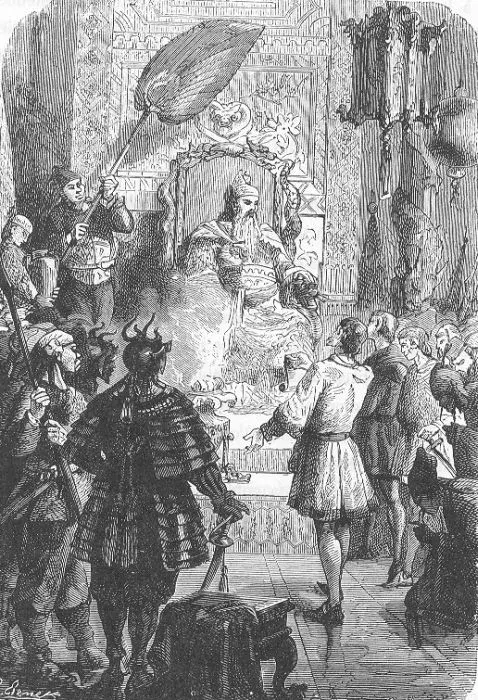
Kublai Khan's Proclamation of the Dynastic Name Great Yuan (忽必烈定国号为元) denotes the historic event in December 1271 (the eleventh lunar month of the eighth year of the Zhiyuan era), wherein Kublai Khan (Emperor Shizu of Yuan) discarded the traditional tribal designation "Yeke Monggol Ulus" (Great Mongol State) and formally instituted the dynastic title "Great Yuan" (Da Yuan) on the advice of his chief Han advisor, Liu Bingzhong. Following the death of Möngke Khan and his subsequent victory over Ariq Böke, Kublai established his administrative center in Kaiping and Dadu, implementing policies to govern China according to classical Chinese institutional models. To validate his imperial sovereignty over all of China and claim unbroken continuity with the classical dynasties of Yao, Shun, Xia, Shang, Zhou, Han, and Tang, Kublai drew upon the phrase "Great indeed is Qian-Yuan, the originator of all things, uniting Heaven" from the Book of Changes (I Ching), issuing an imperial edict that formally established the Great Yuan. This reform broke fundamentally with the historical convention of deriving dynastic names from regional feudal fiefs, ancestral homelands, or geographic features, establishing the unprecedented precedent of deriving a state title directly from classical Confucian philosophical texts. Politically and ideologically, the proclamation consolidated the Yuan Dynasty's legitimacy as a universal Chinese empire, expedited the formation of centralized ministries—the Central Secretariat, Bureau of Military Affairs, and Censorate—and won the political allegiance of the northern literati, laying the indispensable ideological and institutional cornerstone for the conquest of the Southern Song and the realization of unprecedented continental unification.
Möngke dies at Diaoyu Fortress; Ariq Böke prepares to seize the khanship in Karakorum, prompting Kublai to march north from the Yangtze.
Kublai ascends the throne at Kaiping, establishing the reign title Zhongtong and creating the Central Secretariat to govern through Chinese institutions.
Utilizing the logistical resources of northern China, Kublai defeats Ariq Böke, though the western khanates drift into autonomous separation.
Kublai commissions Liu Bingzhong to design a new imperial capital adjacent to former Jin Zhongdu according to classical Rites of Zhou urban canons.
Kublai consults Liu Bingzhong on adopting an imperial title; Liu recommends "Great Yuan" from the Book of Changes.
Kublai issues the Edict on the Establishment of the Dynastic Title, formally adopting "Great Yuan" and transforming the steppe state into a Chinese imperial realm.
The new capital is named Dadu and Kaiping becomes Shangdu, establishing the Dual-Capital System and completing the central ministries.
Yuan armies breach the defenses of Fancheng, compelling Lü Wenhuan to surrender Xiangyang and opening the Yangtze waterway.
Bayan's forces invest Lin'an; Grand Empress Dowager Xie and Emperor Gong surrender the imperial seal, ending primary Song resistance.
Zhang Hongfan annihilates the Song fleet at the Battle of Yamen; Lu Xiufu drowns with the child emperor, securing nationwide unification.
In the early thirteenth century, Genghis Khan (Temüjin) united the pastoral tribes across the Mongolian plateau, establishing the Great Mongol State (Yeke Monggol Ulus). Through three successive trans-continental campaigns directed by Genghis Khan and his descendants, Mongol cavalry conquered expansive territories across Eurasia. However, the imperial political structure remained anchored in nomadic tribal confederations and territorial appanages, lacking formalized legal mechanisms for dynastic succession, which remained dependent on consensus achieved at the kurultai assemblies of nomadic princes.
In July 1259, during the siege of Diaoyu Fortress in Hezhou against the Southern Song, the fourth supreme khan, Möngke, died in battle without leaving an appointed heir. His younger brother, Ariq Böke, remaining at Karakorum in the ancestral steppe, prepared to summon a conservative kurultai to claim the supreme khanship. Meanwhile, Kublai, who was besieging Ezhou (modern Wuhan) along the Yangtze, received intelligence of the crisis and rapidly led his divisions northward. Möngke's death unleashed a civil war within the Toluid lineage regarding the political future of the empire.
During Möngke's reign, Kublai had been entrusted with managing civilian and military administration across northern China, establishing his headquarters at Kaiping in the Jinlianchuan grasslands. An astute statesman, Kublai assembled a celebrated retinue of northern Confucian scholars and administrative specialists. Prominent thinkers including Liu Bingzhong of Xingtai, Neo-Confucian master Xu Heng, and statecraft strategists Yao Shu and Dou Mo joined his entourage alongside mathematicians and hydrologists such as Guo Shoujing.
This intellectual circle advocated classical Chinese statecraft doctrines, urging Kublai to "govern Han territories according to Han methods." They reminded the prince that while the empire might be won on horseback, it could not be governed from horseback; enduring governance over an expansive agrarian populace required replacing nomadic plunder with bureaucratic administration, light agricultural taxation, and Confucian state ceremonies. Embracing this counsel, Kublai promoted military agricultural colonies, hydraulic engineering, and fiscal discipline, constructing an embryonic civil administration that provided the ideological and institutional groundwork for dynastic transformation.
In May 1260, Kublai convened an assembly of princes and generals at Kaiping, enthroning himself as supreme Great Khan, establishing the reign era "Zhongtong" (Central Continuity), and creating the Central Secretariat (Zhongshu Sheng). Simultaneously, Ariq Böke proclaimed himself khan at Karakorum, initiating a four-year civil war. Leveraging the agricultural resources, metallurgical production, and logistical supplies of northern China, Kublai severed grain shipments to the northern steppe, starving the rebel army and compelling Ariq Böke's unconditional surrender in 1264.
Nevertheless, victory in the civil war did not resolve the regime's existential crisis of legitimacy. Across Central and Western Asia, the three western Mongol khanates—the Golden Horde, the Chagatai Khanate, and the Ilkhanate—gradually drifted toward autonomous independence, fracturing imperial unity. Nomadic leaders like Qaidu openly attacked Kublai for abandoning nomadic traditions and adopting Chinese ways. Concurrently, across China, the Han literati viewed the regime as an alien conquest enterprise, while the Southern Song in Lin'an claimed to be the sole legitimate heir to Chinese civilization. To overcome this dual challenge, Kublai needed to transcend steppe tribal origins and project universal imperial sovereignty rooted in classical Chinese statecraft traditions.
By 1271, with the strategic siege of Xiangyang and Fancheng advancing toward a climax, Kublai's enterprise to conquer the Southern Song and achieve continental unification entered its final phase. Kublai recognized that the original Mongolian title Yeke Monggol Ulus denoted the collective body of a single nomadic ethnos, projecting an exclusively steppe tribal identity. Utilizing this title to govern a complex agrarian empire comprising Han, Khitan, Jurchen, and southern populations was ideologically insufficient to cultivate universal political allegiance.
Kublai convened his inner council, consulting Grand Tutor Liu Bingzhong regarding the formal adoption of an imperial dynastic title. A scholar versed in the Book of Changes and Shao Yong's numerological philosophy, Liu Bingzhong submitted a proposal. He argued that since the Qin and Han eras, dynastic titles had been derived from ancestral fiefdoms, founding geographic territories, or initial noble titles—such as Han from the Han River, Sui from Suizhou, Tang from the Duke of Tang, and Song from Songzhou. Liu characterized these as regional designations lacking cosmic universality. To establish legitimate sovereignty over all under Heaven, a universal monarch should emulate ancient sage-kings by deriving the dynastic title from supreme metaphysical philosophy.
Liu recommended adopting the character "Yuan" from the opening commentary of the Book of Changes: "Great indeed is Qian-Yuan, the originator of all things, uniting Heaven!". In classical Chinese cosmology, "Yuan" signifies the cosmic origin of Yin and Yang, the vital source of material creation, embodying supreme virtue, inception, and boundless moral rectitude. Recognizing its majesty, Kublai approved the recommendation, resolving to inaugurate the dynastic title "Great Yuan" (Da Yuan).
On December 18, 1271 (the fifteenth day of the eleventh lunar month in the eighth year of Zhiyuan), Kublai Khan summoned the imperial court at Kaiping to promulgate the Edict on the Establishment of the Dynastic Title, composed by Hanlin scholars Wang Pan and Xu Heng based on Liu Bingzhong's conceptual design. Written in ornate, classical parallel prose, the edict declared the official establishment of the Great Yuan Dynasty.
The edict articulated the philosophical foundation of the new title: "Receiving the auspicious mandate of Heaven, We govern the ten thousand realms. The glorious deeds of Our ancestors shine brightly... In antiquity, when emperors and kings arose, each adopted a dynastic name; some derived them from ancestral seats, others followed inherited custom... While these adhered to historical precedents, they failed to express the profound universal principles of the great canons. How can an empire that unites all deities, spirits, and peoples under Heaven restrict itself to a regional title?"
The proclamation concluded: "Drawing upon the sublime meaning of 'Great indeed is Qian-Yuan' from the Book of Changes, We hereby establish the dynastic name 'Great Yuan', reverently responding to the Mandate of Heaven and harmonizing with popular aspirations. Henceforth, may the myriad states enjoy lasting peace and the administrative offices operate in harmony, laying the foundation for ten thousand generations of prosperity!" This act elevated the regime from a steppe nomadic realm into an orthodox Chinese imperial dynasty.
Accompanying the adoption of the dynastic title, Kublai accelerated the construction of a new imperial capital. In 1264, he had selected the northeastern area adjacent to the former Jurchen Jin capital of Zhongdu as the foundation for the new city, entrusting Liu Bingzhong with the master architectural and cosmological planning.
Adhering to the classical urban planning canons preserved in the Rites of Zhou (Zhou Li: Kaogong Ji)—which dictated that an imperial capital feature nine longitudinal and nine latitudinal grand avenues, with ancestral temples on the left, altars of soil and grain on the right, the imperial audience palace in the front, and bustling commercial markets in the rear—Liu designed a strictly symmetrical metropolitan center. Scholar Guo Shoujing engineered an extensive hydraulic network, channeling water from Yuquan Mountain into Jishuitan to facilitate Grand Canal transport barges reaching the heart of the city.
In March 1272, three months after proclaiming the dynastic name, Kublai officially designated the newly completed capital as "Dadu" (Great Capital, known in Mongolian as Daidu or Khanbaliq), while renaming Kaiping as "Shangdu" (Upper Capital). This established the "Dual-Capital System," wherein the emperor resided at Dadu during the winter to oversee national civilian governance and moved to Shangdu in the summer to maintain connections with nomadic princes.
The establishment of the dynastic name accelerated comprehensive bureaucratic reforms, replacing early nomadic military overseers (darughachi) with a tripartite central administrative structure. The Central Secretariat (Zhongshu Sheng) functioned as the premier civilian executive organ, nominally headed by Crown Prince Jingim as Grand Chancellor, directing the Six Ministries of Personnel, Revenue, Rites, War, Justice, and Works to supervise taxation, civil administration, and bureaucratic appointments.
Militarily, the Bureau of Military Affairs (Shumi Yuan) exercised direct command over the armed forces and garrison deployments, reporting directly to the monarch independently of civilian ministries. The Censorate (Yushi Tai) directed surveillance commissioners across the circuits to investigate bureaucratic malfeasance.
Regionally, Kublai instituted the Branch Secretariat system (Xing Zhongshu Sheng, abbreviated as Xingsheng or Provinces), dispatching plenipotentiary central executive councils to govern regional prefectures, circuits, and counties. This administrative innovation created the provincial structure that has endured through subsequent dynasties into modern Chinese governance.
The ideological and institutional consolidation achieved through the dynastic title provided the momentum for the final conquest of the Southern Song. Kublai appointed Mongol general Bayan as supreme commander, supported by seasoned Han commanders including Zhang Hongfan. In March 1273, after a six-year siege, Yuan forces breached the defenses of Fancheng utilizing counterweight trebuchets (counterweight mangonels), forcing Song defender Lü Wenhuan to surrender Xiangyang and breaching the central Yangtze line.
In 1274, Kublai ordered a massive offensive. Bayan led two hundred thousand troops along the Han River into the Yangtze, shattering the primary Song fleet under Chancellor Jia Sidao at the Battle of Dingjiazhou. In February 1276, Yuan armies surrounded Lin'an (Hangzhou); Grand Empress Dowager Xie and the child Emperor Gong of Song surrendered the imperial seal, yielding the Song capital.
In March 1279, at the naval Battle of Yamen off the coast of Guangdong, Zhang Hongfan eradicated the remaining Song maritime forces. Prime Minister Lu Xiufu drowned himself in the sea carrying the child emperor Zhao Bing, terminating the Song Dynasty. This victory ended over four centuries of regional division and multi-state rivalry that had persisted since the late Tang and Five Dynasties periods, establishing the vast unified empire of the Great Yuan.
The promulgation of the dynastic title "Great Yuan" in 1271 established a multi-ethnic empire integrating nomadic steppe traditions with sedentary agrarian statecraft. Kublai discarded the tribal naming convention of nomadic confederations in favor of classical Confucian political philosophy. Coupled with the construction of Dadu, the centralization of the Six Ministries, and the introduction of the Branch Secretariat provincial system, the Yuan realm completed its formal transformation into an orthodox Chinese imperial dynasty.
Kublai Khan's adoption of the dynastic name Great Yuan exerted enduring influences on Chinese political civilization. First, it established the ideological legitimacy of the Yuan as the rightful successor to the Han, Tang, and Song dynasties, dismantling the psychological barrier that viewed northern nomadic regimes as uncivilized conquerors and facilitating the cultural integration of northern and southern China. Second, it ended more than four centuries of geopolitical division that had persisted since the late Tang and Five Dynasties periods, consolidating an empire encompassing Tibet, Yunnan, and the maritime frontier under a single central administration. Third, it created the institutional precedent of selecting abstract, philosophically evocative dynastic titles—a model subsequently inherited by the Great Ming and Great Qing dynasties.