Abortive Rebellion of Ashide Wenfu
Turkic tribes revolt under Ashina Nishufu; General Pei Xingjian crushes the insurrection at Heishan.
Tang Dynasty (唐朝) · HISTORICAL EVENT
后突厥汗国复兴
The Restoration of the Second Turkic Khaganate (后突厥汗国复兴, 682 CE–744 CE), also known as the Second Turkic Khaganate or Qutlugh's Uprising, was a major historical transformation in Inner Asian history wherein Turkic noble Ashina Qutlugh and the statesman Tonyukuk led nomadic tribes in rebellion against the Tang Dynasty, re-establishing an independent steppe empire across the Mongolian Plateau. Following the destruction of the Eastern Turkic Khaganate by…
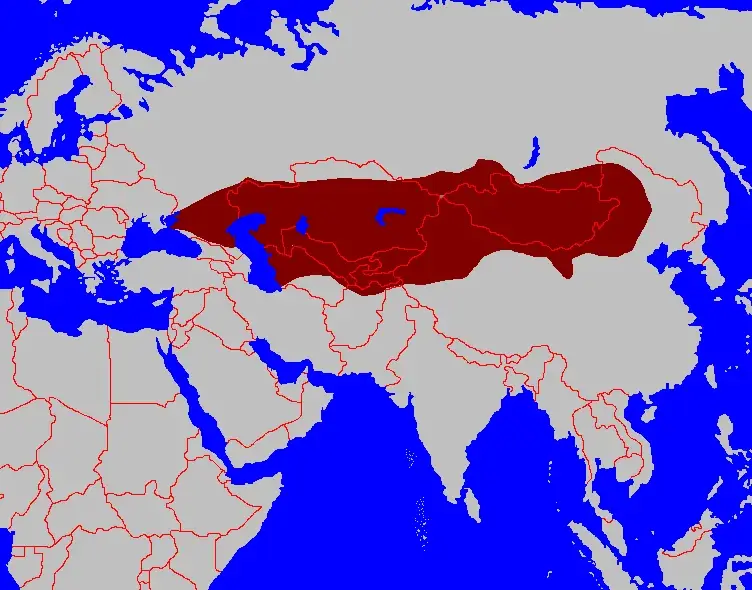
The Restoration of the Second Turkic Khaganate (后突厥汗国复兴, 682 CE–744 CE), also known as the Second Turkic Khaganate or Qutlugh's Uprising, was a major historical transformation in Inner Asian history wherein Turkic noble Ashina Qutlugh and the statesman Tonyukuk led nomadic tribes in rebellion against the Tang Dynasty, re-establishing an independent steppe empire across the Mongolian Plateau. Following the destruction of the Eastern Turkic Khaganate by Tang Taizong in 630 CE, hundreds of thousands of Turkic pastoralists were settled within loose-rein (jimi) prefectures along the Yin Mountains for over fifty years. In 682 CE, taking advantage of Tang military distractions against the Tibetan Empire, Qutlugh gathered seventeen loyal riders, allied with the veteran advisor Tonyukuk, and seized Heisha City as a base, assuming the title Ilterish Khagan ("He who gathers the realm"). Advancing north across the Gobi Desert, the Turks captured sacred Mount Ötüken, subjugating the Nine Tiele tribes. Under Qapaghan Khagan and Bilge Khagan, the restored empire reached its zenith, frequently raiding northern Tang provinces and contending for supremacy across Eurasia until its eventual destruction by the Uyghurs and Tang armies in 744 CE.
Turkic tribes revolt under Ashina Nishufu; General Pei Xingjian crushes the insurrection at Heishan.
Qutlugh and Tonyukuk seize Heisha City, launching the uprising that initiates the Second Turkic Khaganate.
Qutlugh assumes the title Ilterish Khagan, subdues the Nine Tiele tribes, and moves his capital to Mount Ötüken.
Qutlugh raids Daizhou and Bingzhou; Wu Zetian executes defensive general Cheng Wuting, exposing northern defenses.
Qutlugh dies; his brother Qapaghan seizes power and embarks upon sweeping imperial expansion across Inner Asia.
Exploiting the Khitan uprising, Qapaghan ravages Dingzhou and Zhao Prefecture, abducting thousands of Chinese captives.
Tang commander Zhang Renyuan erects three stone citadels north of the Yellow River, blocking nomadic crossing routes.
Qapaghan is slain in battle; Kül Tigin leads a coup installing Bilge Khagan, who restores Tonyukuk as advisor.
Emperor Xuanzong dispatches imperial artisans to Ötüken to carve the bilingual Chinese-Turkic Kül Tigin Stele.
Allied Uyghur forces under Qutlugh Bilge Qaghan capture Ötüken, extinguishing the Second Turkic Khaganate.
In 630 CE (the fourth year of Zhenguan), Emperor Taizong of Tang dispatched generals Li Jing and Li Ji with massed imperial armies, crushing the Eastern Turkic Khaganate along the Baidao Pass of the Yin Mountains and capturing Illig Khagan.
Following this victory, Taizong adopted the far-sighted counsel of Grand Councilor Wen Yanbo to "preserve their tribal integrity and respect their customary traditions," choosing not to force cultural assimilation. Instead, the Tang court organized hundreds of thousands of submitted nomads into loose-rein (jimi) commanderies and prefectures along the Ordos loop and the Yin Mountains, such as Shunzhou, Youzhou, and Changzhou.
Turkic royals such as Tolis Khagan and Ashina Simo were appointed hereditary commandery governors. Throughout the prosperous Zhenguan era, Turkic nobles served in the imperial guard in Chang'an, while nomadic horsemen fought alongside Tang expeditions in Korea and the Western Regions. Taizong was universally acclaimed across Inner Asia as the "Heavenly Khagan" (Tian Kehan), establishing decades of northern border peace.
Beginning in the late 670s, the Tibetan Empire (Tubo) expanded aggressively across the Tibetan Plateau into the Tarim Basin (Four Garrisons of Anxi) and Qinghai. In 678 CE, a major Tang counter-offensive led by Grand Councilor Li Jingxuan suffered catastrophic defeat near the Dafei River in Qinghai.
To counter the existential threat to Chang'an, Emperor Gaozong and Empress Wu Zetian transferred elite veteran border armies from the northern Great Wall frontier toward the Tibetan front, leaving the Shanyu Protectorate severely understrength.
Concurrently, regional Tang administrators in the northern protectorates imposed heavy livestock requisitions and corvée burdens upon pastoral subjects. Furthermore, consecutive years of severe droughts and blizzards decimated tribal herds in the Ordos region, fostering explosive resentment and dreams of independence among Turkic tribal elders.
Prior to Qutlugh's successful insurgency, multiple armed rebellions had erupted. In late 679 CE, Turkic chieftains Ashide Wenfu and Ashide Fengzhi mutinied within the Shanyu Protectorate, crowning Ashina Nishufu as khagan; over 300,000 pastoralists across twenty-four prefectures joined the insurrection.
Emperor Gaozong commissioned General Pei Xingjian with an army of 300,000 men to suppress the revolt. Pei Xingjian routed the rebels at Mount Heishan; Nishufu was assassinated by his own subordinates, while Wenfu was captured and executed in Chang'an.
Although these early rebellions were suppressed, they galvanized anti-Tang solidarity. Rather than quelling dissent, the executions entrenched an unyielding determination among the Ashina elite to dismantle Tang imperial oversight and restore the sacred nomadic khaganate.
In 682 CE (the first year of Yongchun), Ashina Qutlugh, a distant clansman of Illig Khagan, was accused of conspiracy by Tang officials and fled into the rugged canyons of the Yin Mountains.
Endowed with martial courage and strategic acumen, Qutlugh initially gathered only seventeen devoted horsemen, living as outlaws in the southern desert. Soon after, he established an alliance with Ashide Tonyukuk. Educated in Chang'an and possessing profound mastery of both Chinese administration and nomadic warfare, Tonyukuk was celebrated as the "Wise Sage" of the steppe.
Recognizing Qutlugh's charismatic leadership, Tonyukuk utilized his tribal prestige to mobilize dispersed clans of the Ashide and Ashina lineages, alongside veterans of Nishufu's failed rebellion.
To secure an operational sanctuary, Qutlugh launched a surprise nocturnal assault against Heisha City (northeast of modern Hohhot), wiping out the Tang garrison and seizing its arsenals. Hearing of Qutlugh's defiance, nomadic families crossed the Yellow River to join him, expanding his forces to over 5,000 veteran horsemen within months.
Following his capture of Heisha City, tribal chieftains assembled to invest Qutlugh with the supreme imperial title Ilterish Khagan ("He who gathers the realm"). He appointed Tonyukuk as supreme chancellor and military marshal (Apa Tarqan), his brother Qapaghan as chief army commander (Shad), and his younger brother Duxifu as Yabghu, completing the administrative framework of the Second Turkic Khaganate.
At the time, the vast pastures of the northern Mongolian Plateau were dominated by the Nine Tiele tribes (including the Bayirqu, Uyghurs, and Tongra), who had submitted to Tang protectorate administration since the Zhenguan era and viewed Qutlugh as a dangerous renegade.
Tonyukuk offered crucial strategic advice: "The southern desert lies too near the Tang border, where their heavy armies can strike us at will. Mount Ötüken is the ancestral mountain of the Turks, shielded by rugged ranges and endowed with rich pastures. Only by conquering Ötüken can we establish an enduring empire!"
Qutlugh led his cavalry north across the vast Gobi Desert. In a series of fierce engagements along the Orkhon River, Turkic shock cavalry routed the Tiele coalition, subduing the Pugu and Tongra tribes. Qutlugh established his imperial headquarters at sacred Mount Ötüken (the Khangai Mountains of modern Mongolia), cementing the restoration of the Turkic imperial state.
Having consolidated his northern capital, Qutlugh launched annual raids against Tang border commanderies beginning in 683 CE to capture livestock, iron weaponry, and artisans. Turkic cavalry struck the Shanyu Protectorate, Bingzhou (Taiyuan), Daizhou, Shuozhou, and Youzhou along the Great Wall frontier.
Emperor Gaozong appointed General Cheng Wuting as Grand Pacification Commissioner of the Shanyu Circuit to direct defenses. A stern and beloved commander, Cheng Wuting fortified mountain passes and repelled several major incursions, causing Turkic horsemen to avoid his garrisons. However, in 684 CE, amid court intrigues following Gaozong's death, Empress Wu Zetian executed Cheng Wuting on fabricated treason charges. Learning of Cheng's death, Turkic commanders celebrated in their camps and launched sweeping invasions deep into Hedong.
Amid protracted border warfare, Tang general Zhang Renyuan executed an engineering breakthrough. Serving as Commander-in-Chief of Shuofang, Zhang recognized that mobile nomadic cavalry could not be checked by static garrisons south of the river. Overcoming intense court skepticism, he crossed the Yellow River in 708 CE and constructed three fortified stone citadels—the Eastern, Central, and Western Shouxiang Fortresses—along the northern shore, supplemented by beacon networks blocking the passes of Mount Niutou. These outposts created an unbroken line of defense that barred Turkic armies from watering their horses in the Yellow River.
In 692 CE (the third year of Tianshou), Qutlugh died of illness. As his son Mojilian was still young, Qutlugh's brother Qapaghan seized the throne. Reigning with boundless ambition and military vigor, Qapaghan propelled the Second Turkic Khaganate to its historical apex.
Qapaghan exploited the rise of Wu Zetian's Zhou Dynasty and the Khitan rebellion under Li Jinzhong in 696 CE. Presenting himself as an ally to Wu Zetian, he demanded hundreds of thousands of bushels of seed grain, iron farm implements, and silk textiles in exchange for crushing the Khitan rear. Having eliminated the Khitans, Qapaghan immediately turned against the Tang, invading Hebei in 698 CE, sacking Dingzhou and Zhaozhou, massacring thousands, and advancing to the gates of Youzhou.
Simultaneously, Qapaghan campaigned across Inner Asia: marching north across the Sayan Mountains to crush the Yenisei Kyrgyz, and driving west through the Dzungarian basin to defeat the Turgesh and Western Turkic tribes in the Seven Rivers region. His cavalry penetrated as far as the Iron Gate Pass in modern Uzbekistan, skirmishing with Umayyad Arab armies and reviving the imperial borders of the First Turkic Khaganate.
In his final years, Qapaghan's cruelty alienated subject tribes, provoking widespread insurrections across the northern steppe. In 716 CE, Qapaghan was ambushed and slain by Bayirqu warriors during a punitive northern expedition, his severed head sent to Chang'an.
In the aftermath, Qutlugh's son Kül Tigin staged a palace coup, eliminating Qapaghan's heirs and installing his elder brother Mojilian as Bilge Khagan. Bilge appointed Kül Tigin as supreme generalissimo and recalled the venerable Tonyukuk as chief advisor.
Bilge Khagan and Tonyukuk abandoned Qapaghan's aggressive warmongering, pursuing domestic consolidation and peaceful coexistence with the Tang. During the Kaiyuan era of Emperor Xuanzong, Bilge dispatched regular tributary missions to Chang'an, requesting frontier trade markets and securing two decades of peace along the northern border.
When Kül Tigin died in 731 CE, Emperor Xuanzong expressed deep grief, dispatching imperial envoys and court artisans to the Orkhon River to construct an elaborate memorial shrine. Xuanzong personally composed an imperial commemorative text inscribed in classical Chinese alongside ancient Turkic runic scripts, creating the famous Kül Tigin Stele. Together with the Tonyukuk Stele and Bilge Khagan Stele, these monuments recorded the heroic epic of the restoration of the Turkic state.
In 734 CE, Bilge Khagan was poisoned by a treacherous courtier. Following his death, the Second Turkic Khaganate spiraled into fratricidal succession struggles, with rival claimants assassinating one another in rapid succession.
Observing this structural paralysis, subject Tiele tribes—specifically the Uyghurs, Qarluqs, and Basmyls—formed an alliance to throw off Ashina dominance.
In 744 CE (the third year of Tianbao), Tang Xuanzong ordered Military Commissioner Wang Zhongsi of Shuofang to support the northern coalition. Uyghur leader Qutlugh Bilge Qaghan (Bone Pei Luo) captured the imperial camp at Mount Ötüken, killing the last rulers, Özmish Khagan and Bomei Khagan. Surviving Ashina nobles fled south to seek asylum in Tang China. The Uyghurs established the Uyghur Khaganate over the Mongolian Plateau, bringing the sixty-two-year history of the Second Turkic Khaganate to an end.
The restoration of the Second Turkic Khaganate permanently dismantled the direct administrative protectorate system established over the Mongolian Plateau by Emperor Taizong.
The resurgence of the Ashina royal house proved that mobile nomadic confederations retained profound cultural and political cohesion in their steppe environment. For over six decades, the Second Turkic Khaganate stood as an equal imperial rival opposite the Tang, establishing a bilateral geopolitical dynamic that defined early medieval Inner Asian relations.
The relentless cavalry raids conducted by Qutlugh and Qapaghan compelled the Tang military to abandon passive garrison deployments and adopt forward offensive postures.
Zhang Renyuan's engineering of the Three Shouxiang Fortresses pioneered fortified forward defense networks north of the Yellow River. Furthermore, to counter nomadic mobility, the Tang court instituted permanent regional military commands (Shuofang, Hedong, and Fanyang), granting commissioners (Jiedushi) sweeping administrative, fiscal, and operational powers. This defensive decentralization directly incubated the frontier warlordism that culminated in the An Lushan Rebellion.
The most enduring legacy of the Second Turkic Khaganate is the creation and dissemination of the ancient Turkic runic alphabet, preserved upon the celebrated Kül Tigin, Tonyukuk, and Bilge Khagan stelae in the Orkhon valley.
Authored in vivid prose poetry, these inscriptions chronicle the epic struggle of the Turkic people to break Tang vassalage and recover their sacred homeland. Beyond their immense archaeological and linguistic value, the inscriptions conveyed a distinct nomadic identity warning future generations against cultural assimilation, providing the foundational textual monument of ancient Turkic civilization.