Imperial decree to conquer Shu
Emperor Taizu orders Wang Quanbin and Liu Guangyi to launch a converging two-pronged invasion of Later Shu.
Northern Song Dynasty (北宋) · HISTORICAL EVENT
剑门之战
The Battle of Jianmen (剑门之战) was the climactic engagement fought between November 964 and January 965 during the Northern Song dynasty's conquest of the Later Shu kingdom. Following the pacification of the middle Yangtze valleys, Emperor Taizu of Song orchestrated a converging offensive, directing northern field armies under Wang Quanbin and eastern riverine forces under Liu Guangyi to envelop Sichuan. Alarmed by the invasion, Later Shu sovereign Meng…
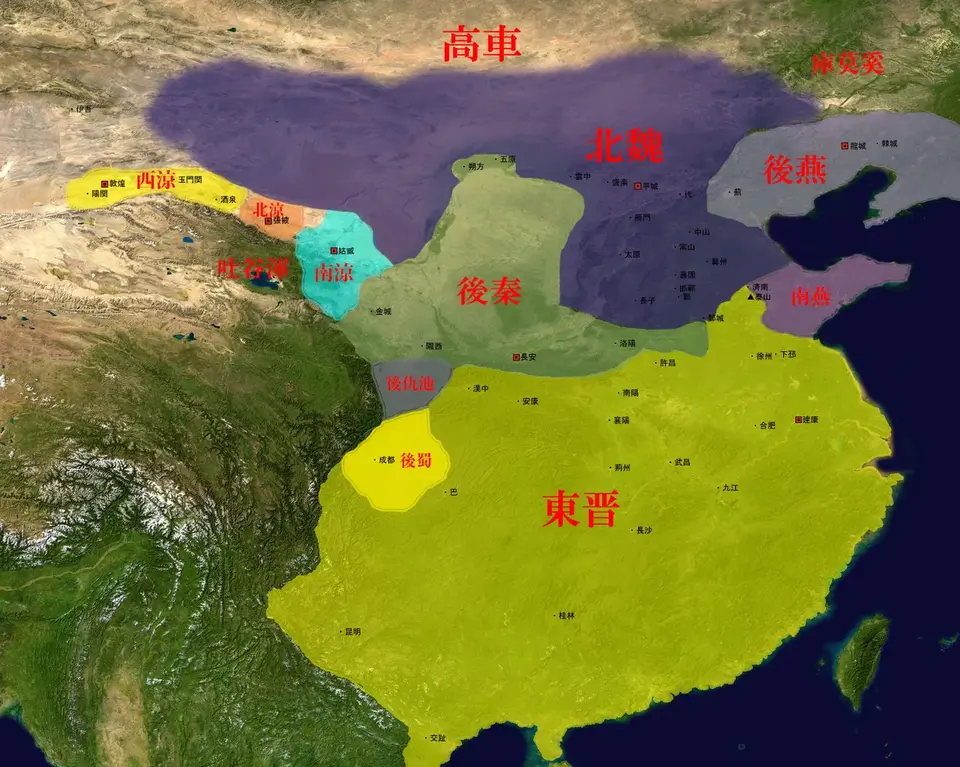
The Battle of Jianmen (剑门之战) was the climactic engagement fought between November 964 and January 965 during the Northern Song dynasty's conquest of the Later Shu kingdom. Following the pacification of the middle Yangtze valleys, Emperor Taizu of Song orchestrated a converging offensive, directing northern field armies under Wang Quanbin and eastern riverine forces under Liu Guangyi to envelop Sichuan. Alarmed by the invasion, Later Shu sovereign Meng Chang dispatched his confidant, Commissioner of Military Affairs Wang Zhaoyuan, to command thirty thousand elite palace guards to block the Shu Road passes. Wang Quanbin's northern force advanced with relentless momentum, seizing Xingzhou, routing Shu defenders at Sanquan, and outflanking destroyed mountain trestle roads via Luochuan to smash Shu garrisons at the Great Mantian Stockade. Demoralized by successive defeats, Wang Zhaoyuan burned the Jubaijiang bridge and retreated into Jianmen Pass, a legendary precipice celebrated as a fortress where a single warrior could hold off myriad invaders. Recognizing the perils of a direct frontal assault, Wang Quanbin dispatched cavalry commander Shi Yande with elite shock troops to cross the river at Laisu, infiltrating mountainous trails to seize Qingqiangdian directly behind the pass. Terrified by this encirclement, Wang Zhaoyuan abandoned the fortress and retreated to Hanyuanpo. Wang Quanbin launched a fierce frontal storming, joining Shi Yande in a crushing pincer that destroyed over ten thousand Shu troops and captured Wang Zhaoyuan and vice commander Zhao Chongtao. With its natural shield broken and its main army eliminated, Later Shu collapsed, and Meng Chang surrendered shortly thereafter, as recorded in the Long Draft of the Continuation of the Comprehensive Mirror in Aid of Governance.
Emperor Taizu orders Wang Quanbin and Liu Guangyi to launch a converging two-pronged invasion of Later Shu.
Wang Quanbin captures Xingzhou, smashes Han Baozheng at Sanquan, and captures three hundred thousand piculs of grain.
Song forces bypass burned trestle bridges via Luochuan, cross the river, and shatter Shu counterattacks at Mantian.
Wang Zhaoyuan burns the Jubaijiang bridge and retreats inside Jianmen Pass; Song armies arrive at Yiguang.
Shi Yande leads elite shock troops across the river at Laisu, infiltrating mountainous trails to seize Qingqiangdian.
Alarmed by the encirclement, Wang Zhaoyuan abandons Jianmen Pass to flee toward Hanyuanpo, destroying garrison morale.
Song forces storm Jianmen Pass, execute a pincer assault at Hanyuanpo, slaughter ten thousand troops, and capture both commanders.
Deprived of defensive barriers, Emperor Meng Chang surrenders in Chengdu; Later Shu falls after thirty-one years of existence.
Following the founding of the Northern Song dynasty in 960, Emperor Taizu adopted the grand strategic program formulated by Chancellor Zhao Pu: pacifying the south before subduing the north, and subjugating weaker states before tackling formidable rivals. After crushing domestic rebellions in Shanxi and Henan and absorbing Jingnan and Hunan in 963, the Song court fixed its ambitions upon the wealthy Later Shu kingdom in the Sichuan basin.
Later Shu had enjoyed decades of peace and prosperity, accumulating colossal agricultural wealth and abundant state treasuries. However, sovereign Meng Chang had succumbed to luxurious indulgence, allowing military preparedness to decay.
Anxious over Song advances along the upper Yangtze, Meng Chang dispatched covert emissaries in 964 to forge an anti-Song alliance with Northern Han in Taiyuan. Song frontier patrols intercepted the courier and discovered the treasonous correspondence. Rejoicing at this pretext, Emperor Taizu immediately issued the imperial edict to launch a punitive expedition against Later Shu.
In November 964, Emperor Taizu commissioned Military Commissioner Wang Quanbin as supreme commander of the northern expeditionary army, accompanied by vice commander Cui Yanjin, leading thirty thousand elite imperial guards and provincial infantry out of Fengzhou via the Dashan Pass.
Concurrently, General Liu Guangyi and Commissioner Cao Bin commanded twenty thousand amphibious troops westward up the Yangtze gorges from Guizhou. The overarching operational plan called for northern armies to batter down mountain passes while eastern flotillas penetrated the river narrows, staging a coordinated pincer upon Chengdu.
In Chengdu, Meng Chang mobilized thirty thousand elite metropolitan guards and appointed his favored courtier, Commissioner of Military Affairs Wang Zhaoyuan, as commander-in-chief, with Zhao Chongtao as his deputy. Wang Zhaoyuan had risen from the sovereign's childhood attendants; though articulate in literary composition, he possessed zero command experience and was blinded by extreme arrogance.
At the farewell banquet in Chengdu, Wang Zhaoyuan brandished an iron sceptre before the assembled court, boasting that he would not merely crush the invaders at the border, but lead his victorious legions across the Central Plains to capture Emperor Taizu in Kaifeng. Knowledgeable civil and military officials recognized his incompetence and despaired. Upon reaching the northern border, Wang Zhaoyuan dispersed his garrisons across frontier passes, relying passively upon the natural terrain of the Qinling and Daba mountain ranges.
In mid-December 964, Wang Quanbin launched the northern offensive from Fengzhou with lightning speed. The Song vanguard overran Xingzhou, Shannan, and Xixian, systematically dismantling more than twenty fortified border stockades.
At Sanquan Pass, Shu general Han Baozheng assembled tens of thousands of troops to resist. Wang Quanbin personally led a cavalry charge into the enemy ranks, shattering the defensive line, capturing Han Baozheng and vice commander Li Jin, and seizing three hundred thousand piculs of military grain. Fleeing in panic, retreating Shu soldiers set fire to hundreds of miles of mountain trestle bridges clinging to vertical cliffs, seeking to arrest the invasion.
Confronted by scorched mountain passes, Wang Quanbin demonstrated remarkable logistical flexibility. Leaving a detachment of military engineers to fell timber and repair the trestles day and night, he led the main army on a treacherous detour along the wilderness trails of Luochuan.
After several days of arduous mountain marching, the two wings reunited at the Jialing River, successfully forcing a river crossing at Shendu. At the Great Mantian Stockade, Wang Quanbin and Cui Yanjin mounted a three-pronged coordinated assault, smashing Shu elite forces and capturing Yizhou prefect Wang Shenchao.
Wang Zhaoyuan and Zhao Chongtao attempted three desperate counterattacks to reclaim the stockade, but were repulsed with severe losses each time. In despair, Wang Zhaoyuan fled toward Lizhou, burning the bridge over the Jubaijiang before sealing himself inside Jianmen Pass. Song armies occupied Lizhou without further resistance.
In January 965, Wang Quanbin led his victorious forces to Yiguang. Towering before them was the most formidable natural barrier in western China: Jianmen Pass. Flanked by the Great and Little Jian Mountains, the pass was bounded by precipitous cliffs extending for hundreds of miles, cut by a single narrow defile barely wide enough for carts.
Wang Zhaoyuan concentrated over ten thousand veteran troops along the battlements, stockpiling boulders, timber, and heavy ballistas. The narrow approaches precluded mass infantry deployment; any direct frontal assault threatened to produce catastrophic Song casualties.
Surveying the terrain from surrounding heights, Wang Quanbin convened his commanders. He observed that storming the pass frontally would play directly into the enemy's hands. The only viable path to victory lay in fixing the garrison's attention with a frontal demonstration while launching an audacious flanking maneuver through forgotten wilderness trails to sever the pass from behind.
Wang Quanbin assigned cavalry commander Shi Yande to execute the flanking maneuver. Leading an elite strike detachment, Shi Yande guided his troops through dense bamboo thickets, scaling sheer gorges and traversing unmarked animal tracks east of the pass.
Arriving at the Laisu river crossing, Song warriors crossed the rushing waters undetected, emerging suddenly onto the main post road at Qingqiangdian, situated several miles south of Jianmen Pass. Shi Yande immediately entrenched his force across the road, cutting off the pass from communications, provisions, and reinforcements from Chengdu.
Inside the fortress, news that Song soldiers had appeared in the rear triggered complete panic. Deprived of composure, Wang Zhaoyuan concluded that he was trapped in a pocket. Instead of defending the battlements, he made the fatal error of leaving a subordinate officer with several thousand disheartened troops to guard the gate, while leading the bulk of his retinue on a disorderly retreat southward to Hanyuanpo. This abdication shattered defensive morale across the pass.
Observing chaotic movement and dispersing smoke atop the pass, Wang Quanbin recognized that the moment had arrived. Drawing his sword, he ordered a general assault. Song soldiers charged the narrow defile under cover of shields, hacking through timber palisades and storming the parapets. The remaining Shu defenders offered negligible resistance before breaking; Song troops occupied the gatehouse within hours.
Without pausing to reorganize, Wang Quanbin led his victorious cavalry through the captured pass, descending upon Hanyuanpo in coordination with Shi Yande's detachment advancing from the south. Trapped between two converging Song columns, the demoralized Shu forces collapsed.
Vice commander Zhao Chongtao mounted his warhorse and attempted a desperate countercharge with his bodyguards, but was unhorsed and captured alive. Seeing his deputy captured and his lines obliterated, Wang Zhaoyuan crawled into the underbrush, weeping uncontrollably until Song search parties dragged him from hiding. Over ten thousand Shu soldiers were killed, and thousands more surrendered. Wang Quanbin consolidated the victory by immediately occupying Jianzhou.
The Battle of Jianmen concluded with total victory for the Song expeditionary army. At minimal cost, Song forces liquidated over ten thousand elite Shu soldiers, captured thousands of prisoners, seized the vital bastion of Jianzhou, and took both supreme commanders captive. Later Shu's mobile defense force was utterly extinguished.
The fall of Jianmen Pass removed the final geographic obstacle shielding the Chengdu plain. From Jiange south to Chengdu, no defensible terrain remained, and cities along the post road surrendered without resistance.
Concurrently, Liu Guangyi's eastern amphibious army forced the Yangtze gorges, creating an unassailable vice around the capital. On January 13, 965, Emperor Meng Chang surrendered unconditionally in Chengdu. The entire campaign lasted merely sixty-six days, incorporating forty-six prefectures and 240 counties into the Song empire, providing immense wealth to support the subsequent conquests of Southern Han and Southern Tang.