Hou Jing Defection
Eastern Wei commander Hou Jing defects with thirteen commanderies, accepted by Emperor Wu of Liang.
Liang Dynasty (梁) · HISTORICAL EVENT
侯景之乱
The Hou Jing Rebellion was a catastrophic military insurrection that shattered the Southern Liang dynasty and remade the geopolitical landscape of medieval China. Following the death of Northern Wei regent Gao Huan, his formidable general Hou Jing fell out with Gao's heir Gao Cheng and offered thirteen provinces of Henan to the Southern Liang. Blinded by the ambition of territorial expansion, the aging Emperor Wu of Liang accepted Hou Jing's surrender…
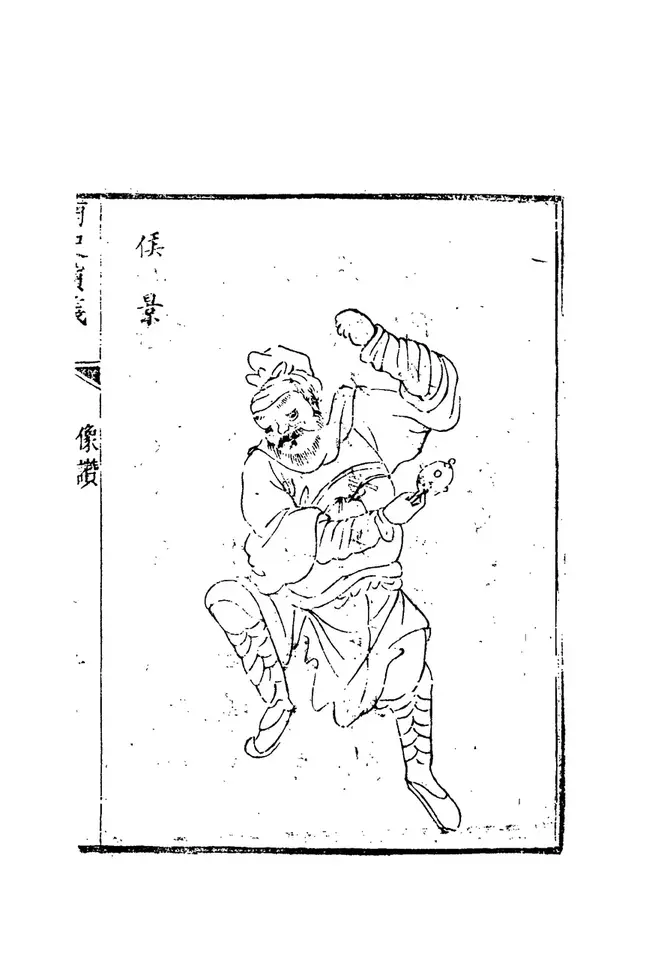
The Hou Jing Rebellion was a catastrophic military insurrection that shattered the Southern Liang dynasty and remade the geopolitical landscape of medieval China. Following the death of Northern Wei regent Gao Huan, his formidable general Hou Jing fell out with Gao's heir Gao Cheng and offered thirteen provinces of Henan to the Southern Liang. Blinded by the ambition of territorial expansion, the aging Emperor Wu of Liang accepted Hou Jing's surrender against the warnings of senior ministers. When Eastern Wei crushed the Liang expeditionary force at Hanshan, Emperor Wu entered into covert negotiations to extradite Hou Jing in exchange for captive imperial kin. Discovering the plot, Hou Jing launched an armed rebellion from Shouyang in 548, conspired with traitorous imperial prince Xiao Zhengde, crossed the Yangtze at Caishi, and laid siege to the imperial palace complex of Taicheng in Jiankang. Despite massive mobilization, provincial princes prioritized dynastic ambition over imperial salvation. Taicheng fell in 549, and Emperor Wu was starved to death in confinement. Hou Jing unleashed horrific purges and slaughtered the aristocratic lineages of the lower Yangtze before briefly declaring himself emperor of Han in 551. The rebellion was finally suppressed in 552 through a concerted naval and ground counter-offensive led by Wang Sengbian and Chen Baxian, culminating in Hou Jing's death, though Liang was left terminally partitioned and vulnerable to northern conquest.
Eastern Wei commander Hou Jing defects with thirteen commanderies, accepted by Emperor Wu of Liang.
Routed at Guoyang, Hou Jing takes refuge in Shouyang and launches armed rebellion after discovering Liang-Wei extradition talks.
Xiao Zhengde ferrets Hou Jing's rebels across the Yangtze; insurgent forces encircle the imperial citadel of Taicheng.
Taicheng falls after a four-month siege; Emperor Wu is starved to death in confinement, and Xiao Gang is enthroned.
Hou Jing murders Emperor Jianwen and deposes Xiao Dong, declaring himself Emperor of Han amidst widespread famine.
Allied forces under Wang Sengbian and Chen Baxian recapture Jiankang; Hou Jing is assassinated while fleeing.
Western Wei invades and sacks Jiangling, executing Emperor Yuan, annexing Sichuan, and breaking Liang power permanently.
During the mid-sixth century, northern China stood divided between Eastern Wei and Western Wei, while the southern Liang dynasty enjoyed nearly five decades of uninterrupted peace and cultural opulence under Emperor Wu, Xiao Yan. The Jie general Hou Jing had risen through raw martial prowess to become Minister over the Masses and Commander-in-Chief of Henan in Eastern Wei, commanding large veteran garrisons across the strategic Central Plains. When Eastern Wei paramount ruler Gao Huan lay dying, he presciently warned his heir Gao Cheng that Hou Jing was recalcitrant and unmanageable. Following Gao Huan's death in 547, Gao Cheng summoned Hou Jing to the capital of Ye. Anticipating imminent execution, Hou Jing revolted in Henan, first seeking alliance with Western Wei paramount Yuwen Tai, and subsequently tendering his allegiance to the court of Southern Liang.
When news reached Jiankang that Hou Jing offered thirteen northern commanderies to Liang, Emperor Wu viewed the defection as divine intervention fulfilling his lifelong dream of reclaiming the northern heartland. The imperial court fractured into bitter debate. Court flatterer Zhu Yi zealously endorsed the annexation to please the emperor, whereas seasoned commanders such as Yang Kan and veteran secretariat officials argued passionately that Hou Jing was an untrustworthy opportunist whose reception would inevitably provoke Eastern Wei retaliation and invite calamity. Seduced by grand delusions, Emperor Wu dismissed all dissent, appointed Hou Jing Grand General and Prince of Henan, and dispatched an army under Zhenyang Marquis Xiao Yuanming to support the northern frontier.
In February 547, Hou Jing found himself trapped between approaching Eastern Wei punitive columns and Western Wei's calculated indifference. To break free from isolation, Hou Jing dispatched urgent memorials to Jiankang, offering all thirteen commanderies under his control, including Yu, Guang, Ying, and Luozhou. Emperor Wu, having reportedly dreamed that northern governors bowed before his throne, considered the overture an omen of dynastic revival. Disregarding the impassioned warnings of military counselors, the emperor issued edicts officially confirming Hou Jing's princely titles and command over Henan military affairs, dispatching imperial envoys with insignia to consummate the alliance.
Despite these grand imperial declarations, the civilian bureaucracy in Jiankang mobilized resources with sluggish inefficiency, failing to provide timely logistical support or garrisons to reinforce the fragile Yellow River front. Observing Hou Jing's duplicity, Western Wei chancellor Yuwen Tai quickly withdrew his vanguard forces back into the Guanzhong passes. Capitalizing on the operational vacuum, Eastern Wei regent Gao Cheng mobilized veteran armies, appointing Prince Gao Yue and legendary general Murong Shaozong to lead a formidable combined-arms force of one hundred thousand troops to encircle Hou Jing in Henan.
In September 547, Emperor Wu ordered his nephew Xiao Yuanming, Marquis of Zhenyang, to advance with more than one hundred thousand infantry and naval forces to Hanshan, where they dammed the Si River to flood the fortress of Pengcheng in coordination with Hou Jing. Murong Shaozong, recognizing the lax discipline and operational ineptitude of the Liang commanders, waited for the expeditionary troops to grow negligent before launching a devastating surprise assault. The Liang army collapsed in complete panic; Xiao Yuanming and thousands of officers were captured, while tens of thousands of soldiers were slaughtered or taken prisoner, choking the flow of the Si River with corpses.
Having crushed the southern relief column at Hanshan, Murong Shaozong wheeled his forces south to confront Hou Jing's main army entrenched at Guoyang. Plagued by chronic food shortages and facing overwhelming Eastern Wei armored cavalry, Hou Jing suffered an annihilating defeat in January 548. His veteran divisions were virtually eradicated. With only a few hundred personal retainers remaining, Hou Jing fled south across the Huai River into Liang sovereign territory, securing refuge within the fortified city of Shouyang, where he began recruiting disaffected elements and exploiting local grain reserves.
Following the disaster at Guoyang, Emperor Wu adopted an increasingly distant and distrustful posture toward Hou Jing, though he still appointed him Regional Inspector of South Yuzhou to garrison Shouyang. In Ye, Gao Cheng sought to neutralize the southern border in order to focus Eastern Wei military resources entirely against Western Wei, offering to repatriate Xiao Yuanming and captive Liang officers in exchange for renewed peace. Emperor Wu, desperate to recover his captured nephew and fearful of further northern incursions, initiated secret diplomatic correspondence with Eastern Wei envoys without Hou Jing's knowledge.
Stationed in Shouyang, Hou Jing maintained an extensive espionage network and learned of the covert diplomatic exchanges between Jiankang and Ye. Paralyzed by fear of being delivered back to Eastern Wei for execution, Hou Jing devised a stratagem to test Emperor Wu's loyalty. He fabricated an official letter from Gao Cheng proposing to trade Xiao Yuanming directly for Hou Jing and sent an operative to deliver it to the Liang court. In his written reply, Emperor Wu foolishly agreed, remarking that if Xiao Yuanming returned in the morning, Hou Jing would be returned in the evening. Infuriated by this betrayal, Hou Jing gathered his lieutenants and resolved to launch an all-out rebellion.
Having committed to rebellion, Hou Jing accelerated military preparations at Shouyang, hoarding regional tax revenues, casting weapons, and enrolling local vagrants and tribal mountaineers into his ranks. To guarantee swift victory, Hou Jing looked for collaborators inside the Liang imperial clan and focused on Xiao Zhengde, Prince of Linhe. Xiao Zhengde had once been adopted as Emperor Wu's designated successor, but was demoted back to a peripheral princedom following the birth of the crown prince Xiao Tong, nursing venomous resentment for decades. Hou Jing dispatched secret couriers to Jiankang, promising to install Xiao Zhengde on the imperial throne in exchange for military betrayal.
Blinded by dynastic greed, Xiao Zhengde leveraged his office as Governor of Danyang to stockpile weapons within the capital, recruit criminals, and map out every tactical vulnerability and garrison deployment of Jiankang. In August 548, Hou Jing staged a formal oath-taking ceremony at Shouyang, declaring an armed crusade under the pretense of purging corrupt court sycophants such as Zhu Yi and Xu Mian. The rebel army marched swiftly south, capturing Qiaozhou and threatening Liyang on the north bank of the Yangtze, sending shockwaves through the imperial court.
When Hou Jing arrived at Liyang, the wide Yangtze River remained the ultimate natural defensive bulwark protecting the southern capital. The prefect of Liyang surrendered immediately, while the strategic ferry crossing of Caishi on the southern bank was entrusted to the personal guards of Xiao Zhengde. Veteran general Yang Kan urgently petitioned the court to dispatch mobile strike forces to blockade Caishi and launch an upstream naval intercept against Liyang. However, Chief Minister Zhu Yi ridiculed Hou Jing as an inconsequential nuisance, insisted the river was impassable, and flatly rejected Yang Kan's defensive proposals.
On October twenty-second, Xiao Zhengde ordered his loyalist commanders to dispatch large private transport barges across the river under cover of darkness to ferry the rebel army across. Hou Jing's eight thousand elite cavalry and infantry crossed the natural moat of Caishi without firing a single arrow, establishing a firm beachhead at Cihu. News of the river crossing triggered widespread hysteria in Jiankang. Hou Jing marched directly on the capital, where Xiao Zhengde opened the outer Zhuque Gate to welcome the rebel army, kneeling in submission outside the portal as insurgent troops surrounded the inner palace complex of Taicheng.
Taicheng, the imperial palace of the Liang emperors, was protected by formidable brick battlements and moats. Upon breaching the outer perimeter, Hou Jing unleashed his mercenaries to plunder and burn the surrounding administrative offices and residential quarters, reducing the metropolitan center to a sea of fire. Awakening from complacency, Emperor Wu ordered Crown Prince Xiao Gang to supervise palace security and summoned the veteran commander Yang Kan into the inner citadel. Yang Kan immediately fortified defensive bastions, dismantled timber bridges, and organized scholars, courtiers, and guards into a resilient garrison of several thousand troops.
The rebels compelled captured commoners to fill the defensive moats with dirt and constructed siege towers and battering rams to assault the walls. Yang Kan directed counter-artillery operations with exceptional skill, employing stone-throwing trebuchets and heavy repeating crossbows to decimate insurgent assault parties and counter-mining rebel tunnels. Rebel casualties mounted severely over weeks of futile assaults. Outside the walls, Xiao Zhengde proclaimed himself emperor, while Hou Jing, frustrated by the operational stalemate, converted the siege into a prolonged blockade to starve out the imperial defenders.
As news of the capital's siege spread, Liang regional governors and imperial princes mobilized substantial relief armies. Chancellor Liu Zhongli advanced south from Sizhou, joining forces with Prince of Shaoling Xiao Lun, Prince of Poyang Xiao Fan, and other commanders, concentrating an imposing host of over three hundred thousand soldiers outside Jiankang. Their encampments stretched along Qingxi, Baixia, and Xuanwu Lake, surrounding Hou Jing's insurgent force with overwhelming numerical superiority.
However, the imperial princes were paralyzed by mutual suspicion and viewed the rebellion as a golden opportunity to seize supreme power for themselves. Field marshal Liu Zhongli was wounded in early skirmishes and lost all offensive will, spending his days drinking, feasting, and entertaining concubines within his fortified stockades while allowing his troops to pillage nearby villages. Meanwhile, Xiao Yi, Prince of Xiangdong, held back his formidable army in Jiangling. The relief forces refused to mount a coordinated assault, engaging in petty recriminations and passively watching Taicheng starve.
Following the arrival of the relief forces outside the capital, Chancellor Liu Zhongli established his headquarters at Zhongxing Temple, assuming supreme tactical direction over the allied armies. In January 549, Liu Zhongli and his younger brother Liu Jingli engaged Hou Jing's elite shock divisions in a savage battle at the timber bridges of Qingxi and Zhuque Navigation Channel. Liu Zhongli, donning heavy armor, led cavalry charges into the rebel ranks, personally cutting down enemy champions and temporarily reviving the spirits of the loyalist army.
However, Hou Jing unleashed his concealed cavalry reserve to execute a devastating flank envelopment. In the ferocious melee, Liu Zhongli was struck through the shoulder blade by an enemy lance and thrown from his warhorse, barely escaping death as his subordinate officers dragged him from the field. Shattered by this defeat, Liu Zhongli suffered a total collapse of nerve; he secluded himself in his tent, refused all operational appeals, and indulged in debauchery, leaving the trapped garrison in Taicheng without any hope of salvation.
By February 549, Hou Jing, confident that the relief armies had no intention of attacking, committed all available manpower to take the palace by storm. Rebel engineers demolished the levees of Xuanwu Lake, directing floodwaters to undermine the northern ramparts of Taicheng, and built two massive earth mounds rising above the battlements, raining down incendiary missiles into the palace day and night. Inside the besieged citadel, conditions deteriorated into an unimaginable nightmare; defenders and court ladies were reduced to boiling leather armor for sustenance, and corpses were left to decompose where they fell as lethal pestilence swept the halls.
On March twelfth, Yang Kan, the linchpin of the defense, succumbed to physical exhaustion and illness. The garrison lost its unifying soul. Days later, rebel assault units breached the Taiyang Gate and poured into the palace complex. After a heroic defense of one hundred and thirty days, Taicheng fell. Rebel mercenaries ransacked the ancestral halls, murdered imperial attendants, looted the priceless imperial library and treasury, and brought centuries of civilized rule in the southern capital to a violent end.
Following the fall of Taicheng, Hou Jing put on full armor and walked into the grand throne room to confront the eighty-six-year-old Emperor Wu. Sitting serenely upon the imperial dais, Emperor Wu addressed the rebel chieftain calmly: Have you not grown fatigued after campaigning so long in the field? Hou Jing, struck by imperial dignity, trembled with guilt and dropped to his knees, unable to look the sovereign in the eye. Once outside the audience hall, however, Hou Jing threw off all restraint, placing Emperor Wu under house arrest in Jingju Palace and reducing imperial rations to starvation levels.
By May 549, Emperor Wu was emaciated, ill, and suffering from agonizing thirst. Repeated imperial requests for honey water were callously rejected by rebel guards. On May second, the founder of the Liang dynasty died in utter destitution and grief at the age of eighty-six. Hou Jing concealed the emperor's death for days before enthroning Crown Prince Xiao Gang as Emperor Jianwen, while appointing himself Grand Commander and seizing absolute control of the military and civilian administration.
Having consolidated power over the imperial court, Hou Jing had no further use for his co-conspirator Xiao Zhengde. Furious at being sidelined while Xiao Gang was crowned emperor, Xiao Zhengde smuggled secret appeals to Xiao Lun, Prince of Shaoling, urging him to bring loyalist troops into the capital to assassinate Hou Jing. The correspondence was intercepted by rebel guards. Hou Jing promptly arrested Xiao Zhengde, had him strangled with a bowstring in Yong'an Ward, and cast his body into the gutter.
Emperor Jianwen, Xiao Gang, was a celebrated man of letters but completely powerless against rebel tyranny. Hou Jing compelled the emperor to appoint him Chancellor, Director of the Imperial Secretariat, and Prince of Taiqing, granting himself imperial ceremonial privileges. Rebel guards were stationed throughout the inner palace, executing loyal officials and subjecting the emperor to ceaseless surveillance. Jianwen spent his reign in tears, lamenting in his poetry that he would have preferred to be born an ordinary commoner.
To replenish provisions and eliminate localized resistance, Hou Jing dispatched his predatory commanders to conquer the fertile Sanwu region, seizing Wujun, Kuaiji, and Jiaxing. The rebel forces, largely composed of northern nomadic turncoats and desperate outlaws, subjected the peaceful agricultural heartland of the southern empire to unprecedented terror, systematically burning market towns, massacring peasant populations, and enslaving tens of thousands of women and children.
The campaign resulted in the catastrophic destruction of the southern aristocratic establishment. Elite lineages such as the Wang of Langya and Xie of Chenliu, who had dominated southern cultural and political life since the Eastern Jin, were systematically exterminated. Accustomed to refined scholarly leisure, aristocratic scions were incapable of armed defense; they were herded together, stripped of their finery, executed in mass purges, or locked in storage sheds to starve to death. The aristocratic social fabric that had anchored the southern regimes for two centuries was wiped out forever.
By August 551, Hou Jing resolved to cast aside the pretense of imperial regency. He had Emperor Jianwen murdered with poisoned wine and temporarily enthroned Emperor Wu's great-grandson Xiao Dong, Prince of Yuzhang, as a puppet. Two months later, Hou Jing forced Xiao Dong to abdicate, formally declaring himself Emperor of Han and establishing the Taiqing reign era in Jiankang.
Hou Jing's brief reign as emperor was marked by extreme paranoia and arbitrary cruelty. To suppress peasant uprisings and escape attempts, he instituted Draconian collective punishment laws that exterminated whole families for a single offense, even setting fire to forests where runaway serfs were suspected of hiding. By this time, the lower Yangtze was reduced to a desolate wasteland of smoke and skeletons. The rebel regime was completely isolated, bankrupt, and surrounded by hostile loyalist armies.
Between the winter of 549 and early 551, having secured Jiankang, Hou Jing attempted to advance up the Yangtze to conquer the prosperous middle river basin and extinguish the power base of Xiao Yi in Jiangling. Hou Jing dispatched his chief lieutenant Ren Yue to invade Jiangzhou, capturing its regional inspector, while Hou Jing personally led tens of thousands of naval and ground troops westward, laying siege to the strategic fortress of Baling.
Confronting this formidable rebel offensive, loyalist commander Wang Sengbian established deeply entrenched defense works outside Baling, supported by naval commander Xu Wensheng. The insurgents launched continuous night-and-day assaults using battering rams and incendiary fire-ships, but Wang Sengbian directed his men with resolute skill, inflicting heavy casualties with catapult artillery. Stranded far from his supply depots and ravaged by an outbreak of dysentery, Hou Jing was forced to burn his encampments and retreat eastward, his western expansion permanently halted.
During Hou Jing's western campaign, loyalist courtiers in occupied Jiankang organized a clandestine conspiracy to liberate the capital. Xiao Huili, Prince of Nankang, teamed up with Liu Jingli to recruit several hundred committed retainers, intending to ambush rebel garrison commanders and seize Taicheng during an imperial inspection. However, an uncommitted conspirator betrayed the plot to rebel officers.
In retribution, Hou Jing arrested Xiao Huili, Liu Jingli, and hundreds of their associates, subjecting them to public torture and execution. Capitalizing on the incident, Hou Jing instituted widespread kangaroo trials, arresting wealthy merchants and aristocratic remnants across Jiankang, slaughtering more than ten thousand innocent men, women, and children. This reign of terror extinguished the last remnants of aristocratic leadership within the capital, reducing the once glittering metropolis to silence.
While Hou Jing rampaged across the eastern seaboard, Xiao Yi systematically eliminated domestic rivals in Jiangling and mobilized a massive counter-offensive. He appointed the distinguished strategist Wang Sengbian as Supreme Commander of an expeditionary fleet sailing down the Yangtze. Simultaneously, Chen Baxian, who had pacified the Lingnan borderlands, marched thirty thousand elite southern veterans north across the Dayu Ridge to join the campaign.
In October 551, the armies of Wang Sengbian and Chen Baxian joined forces at Bamao Bay near Xunyang. The two commanders swore a blood oath at a public altar, dedicating their armies to the destruction of Hou Jing and the restoration of the Liang dynasty. Combining Wang Sengbian's formidable naval flotillas with Chen Baxian's seasoned infantry and cavalry, the allied army advanced inexorably down the Yangtze, liberating Yingzhou and Jiangzhou.
In February 552, the allied fleet sailed toward the capital, its war banners darkening the sky. Hou Jing panicked and dispatched his best commander, Hou Zijian, with tens of thousands of elite troops to fortify the crags and naval passages of Dangtu and Gushu. Wang Sengbian deployed specialized incendiary attack craft against the rebel flotilla, setting the rebel fleet ablaze, while Chen Baxian led an amphibious charge to seize the surrounding high ground.
The Battle of Gushu ended in a devastating rout for the insurgents. Chen Baxian's troops fought with extraordinary valor, killing numerous rebel generals in close combat. More than ten thousand rebel soldiers drowned or were decapitated, and Hou Zijian fled back to Jiankang in a small skiff. The fall of Gushu eliminated Hou Jing's final defensive bastion, opening the river approaches to Jiankang.
In March 552, the allied armies arrived at the outskirts of Jiankang, with Wang Sengbian anchoring at the Stone Fortress and Chen Baxian deploying his battle lines at Luoxinggang. Desperate to avoid annihilation, Hou Jing assembled his remaining ten thousand veteran troops outside Ximing Temple, taking personal tactical command of the vanguard. Chen Baxian feigned a tactical retreat to disrupt the rebel formation, then launched a devastating cavalry and crossbow charge into Hou Jing's flanks while Wang's naval infantry attacked from the rear.
Trapped between two converging forces, the rebel army disintegrated into utter chaos. Realizing his cause was lost, Hou Jing abandoned his palace and fled eastward with barely one hundred personal cavalrymen. Allied forces recaptured the Stone Fortress, extinguished the fires burning in the ruins of Taicheng, and restored imperial control over the capital after three years and eight months of brutal rebel occupation.
Hou Jing fled eastward toward the coast, hoping to escape across the Yellow Sea to Guangling or northern Qi. Chen Baxian dispatched mobile cavalry under general Du You'an to maintain relentless pursuit. In April 552, as Hou Jing hid aboard a vessel off the coast of Hudou Island, his own despairing lieutenants, led by Yang Kun, recognized that their master's head was their only ticket to imperial clemency and assassinated him in his cabin.
Hou Jing's corpse was sent to Jiangling. Wang Sengbian exposed Hou's severed head in the marketplace of Jiankang, severed his hands to send to Northern Qi emperor Gao Yang, and delivered the remains to Jiangling, where the populace and court ladies boiled and consumed his flesh with vengeance. His bones were ground into ash and drunk by the embittered survivors, bringing a gruesome end to the rebel warlord.
Although the rebellion was crushed, the Liang dynasty had suffered fatal wounds. Rather than rebuilding Jiankang, Xiao Yi ascended the throne as Emperor Yuan in Jiangling. During the conflict, Liang imperial princes had engaged in fratricidal bloodbaths; to eliminate his rival brother Xiao Ji in Sichuan, Emperor Yuan had invited Western Wei to intervene, effectively surrendering the fertile Sichuan Basin to northern conquest.
In 554, Western Wei regent Yuwen Tai launched a surprise invasion of Jiangling under general Yu Jin. The city fell rapidly; Emperor Yuan was captured and suffocated to death, tens of thousands of southern scholars and artisans were dragged into northern slavery, and the grand imperial library of Liang was reduced to ash. Western Wei established the rump Western Liang puppet regime, Northern Qi annexed the territory north of the Yangtze, and the southern empire was reduced to a fragile coastal strip, setting the stage for Chen Baxian to overthrow Liang and establish the Chen dynasty.
The four-year rebellion ended with the death and dismemberment of Hou Jing, but at a catastrophic cost to the Liang dynasty. Emperor Wu starved to death, Emperor Jianwen was murdered, and the imperial family was decimated by fratricidal slaughter. The imperial capital of Jiankang was leveled, and hundreds of thousands of civilians perished from slaughter and starvation. Western Wei annexed the rich Sichuan Basin and Jiangling, while Northern Qi seized the Huai River valley, stripping the southern empire of more than two-thirds of its territory and wealth.
The Hou Jing Rebellion represented a monumental watershed in medieval Chinese history. In socioeconomic terms, it physically obliterated the entrenched northern emigre aristocracy (such as the Wang and Xie clans), permanently ending the oligarchic aristocratic dominance that had shaped Chinese statecraft since the third century and elevating plebeian military commanders to political dominance. Geopolitically, the destruction of the southern economic base and the loss of the upper Yangtze irrevocably tilted the balance of power toward northern China. The Southern Dynasties were permanently reduced to a defensive posture, directly enabling the northern dynasties (culminating in Sui) to conquer the south and reunify China.