Murder of Forebears and Mobilization with Thirteen Suits of Armor
Giocangga and Taksi are slain at Gule; Nurhaci takes up arms at Turun with thirteen suits of armor.
Ming Dynasty (明朝) · HISTORICAL EVENT
后金建立
The Founding of the Later Jin (后金建立, 1616 CE) was an epochal dynastic foundation and geopolitical transformation in late imperial Chinese history. In 1583 CE (the 11th year of Wanli), Jianzhou Jurchen chieftain Nurhaci took up arms with thirteen inherited suits of armor after his father and grandfather were killed in a Ming assault on Gule. Over three decades of relentless military campaigns and astute diplomacy, Nurhaci unified the Jianzhou tribes,…
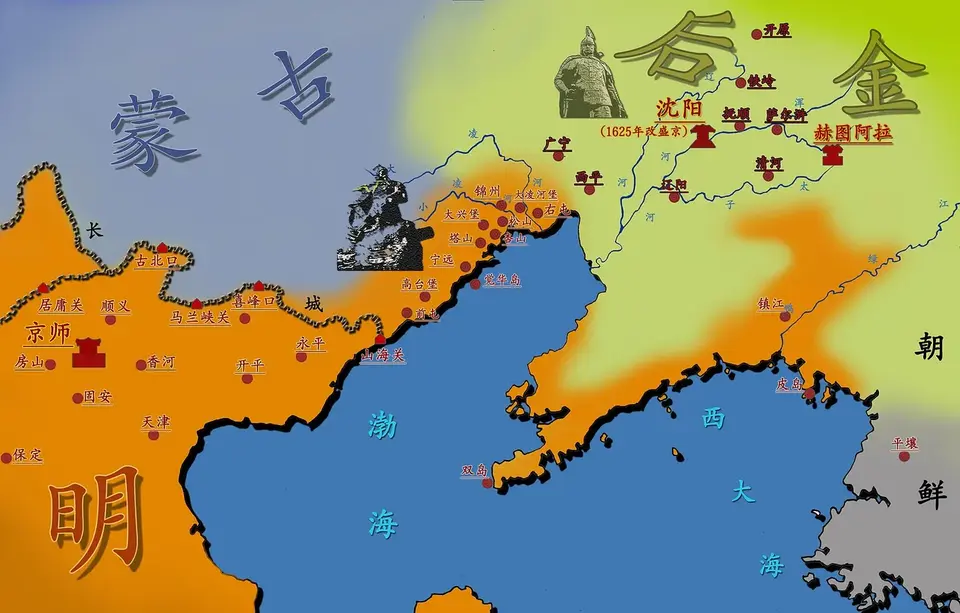
The Founding of the Later Jin (后金建立, 1616 CE) was an epochal dynastic foundation and geopolitical transformation in late imperial Chinese history. In 1583 CE (the 11th year of Wanli), Jianzhou Jurchen chieftain Nurhaci took up arms with thirteen inherited suits of armor after his father and grandfather were killed in a Ming assault on Gule. Over three decades of relentless military campaigns and astute diplomacy, Nurhaci unified the Jianzhou tribes, routed a nine-tribe coalition at Mount Gule, and systematically annexed the Haixi Jurchen chiefdoms of Hada, Huifa, and Ula. Concurrently, he commissioned the creation of the uncircled Manchu script, instituted the combined socio-military Eight Banners system, and erected the stone citadel of Hetu Ala. On New Year's Day of 1616 CE (the first year of Tianming), Nurhaci was proclaimed Khan at Hetu Ala, declaring the founding of the Great Jin Dynasty (Later Jin) with the era title Tianming and adopting the title "Brilliant Emperor Who Nurtures All Nations." The emergence of the Later Jin severed Ming suzerainty over Manchuria, creating a formidable imperial adversary that laid the institutional, cultural, and military foundation of the Qing Dynasty.
Giocangga and Taksi are slain at Gule; Nurhaci takes up arms at Turun with thirteen suits of armor.
Nurhaci subdues the Suksuhu and Dong'e divisions, completing the unification of the Jianzhou Jurchens.
Nurhaci shatters Bujai's 30,000-strong coalition at Mount Gule, establishing military supremacy.
Erdeni and Gagai adapt the Mongolian alphabet to create the Manchu script; Hada is annexed.
Nurhaci relocates his capital to Hetu Ala, constructing massive stone fortifications and administrative centers.
The Four Bordered Banners are created alongside the Four Plain Banners, completing the Eight Banners structure.
Nurhaci ascends the throne as Khan, establishes the Great Jin Dynasty, and adopts the era name Tianming.
Nurhaci proclaims the Seven Grievances against the Ming, capturing Fushun and Qinghe.
Operating on interior lines, Nurhaci crushes four Ming columns in five days, cementing Later Jin survival.
Nurhaci captures Liaoyang and Shenyang, establishing Mukden as the permanent imperial capital.
In 1371 CE (the fourth year of Hongwu), the Ming Dynasty established the Liaodong Regional Military Commission in the fertile Liao River plain to direct northeastern border defenses. To pacify and monitor the dispersed Jurchen tribes across the Changbai Mountains and river valleys, the Ming court instituted the loose-rein (jimi) guard and battalion system.
In 1404 CE (the second year of Yongle), Emperor Chengzu established the Jianzhou Guard along the Tumen and Mudan rivers, investing chieftain Ahachu as commander; in 1416 CE, the Jianzhou Left Guard was created under Mengtemu (Nurhaci's sixth-generation ancestor); subsequently, the Jianzhou Right Guard was organized, forming the "Three Jianzhou Guards."
The Ming government maintained its hegemony through imperial patents, honorary titles, and market licenses (chishu) that monopolized the lucrative horse and ginseng trade at border markets like Fushun. By intentionally stoking rivalries and playing factions against each other, the Ming prevented northeastern tribes from uniting. Consequently, Jurchen clans remained fragmented in perpetual blood feuds.
During the Wanli era, renowned general Li Chengliang served as Regional Commander of Liaodong for nearly thirty years. Utilizing elite cavalry squadrons, Li played border chieftains against one another, supporting Wanggao of the Jianzhou Right Guard and Nikan Wailan of Turun to balance regional power.
In February 1583 CE, Li Chengliang led Ming assault columns against the fortified redoubt of Atai at Gule. Nurhaci's grandfather Giocangga and father Taksi entered the citadel to secure the safety of kin and negotiate surrender. However, guided by Nikan Wailan, Ming assault troops set fire to the citadel, and both Giocangga and Taksi were killed in the chaos.
Consumed by grief and rage, twenty-five-year-old Nurhaci confronted Ming border magistrates over the unjust slaying of his forebears. Recognizing their error, Ming authorities returned the corpses alongside thirty imperial trade patents and thirty horses. In May 1583, Nurhaci mobilized his kin with thirteen inherited suits of armor, vowing to avenge his slain forebears and initiating the unification of the Jurchen realm.
Under two centuries of Ming interaction, northeastern Jurchen society progressed from hunting and foraging toward sedentary agriculture and advanced metallurgy. Intercourse through the Fushun and Kaiyuan border markets channeled thousands of iron plows, draft oxen, and iron implements into the valleys, expanding agricultural productivity.
However, primitive tribal structures and hereditary blood feuds constrained broader economic growth. Dispersed agrarian communities suffered chronic pillaging by rival raiding bands, creating a widespread popular desire for unified legal governance.
Possessing fluent literacy in spoken and written Chinese and conversant with classical historical novels such as Romance of the Three Kingdoms, Nurhaci recognized that only an integrated, centralized state apparatus could harness the demographic and military energy of the Jurchen people to overturn Ming domination.
In May 1583 CE, Nurhaci initiated operations by assaulting his mortal enemy Nikan Wailan at Turun, taking the stronghold. Over the next decade, Nurhaci campaigned across the river valleys of southern Manchuria, systematically subjugating the Sarhū, Dong'e, Suksuhu, and Hunehe divisions, achieving total unification of the Jianzhou Jurchens.
During these ferocious sieges, Nurhaci repeatedly braved front-line combat. While assaulting Ongkolo, he was struck in the neck by two arrows, bleeding profusely, yet severed the shafts and fought on to victory. Beyond personal valor, he enforced strict military discipline, prohibiting the slaughter of non-combatants and enlisting captured warriors into his household units, winning the allegiance of rival clans.
Jianzhou's rapid rise alarmed the Haixi Jurchens (the Hūlun confederation: Yehe, Ula, Hada, and Huifa) and neighboring Mongol principalities. In September 1593 CE, Bujai of Yehe assembled a coalition of nine tribes totaling 30,000 warriors to crush Jianzhou at Mount Gule.
Confronting overwhelming numbers, Nurhaci deployed marshals Eidu and Fiongdon to hold the narrow defiles while feigning retreat. When coalition cavalry fell into disarray, Nurhaci spearheaded a downhill shock charge. Bujai was unhorsed by wooden barricades and slain, throwing the allied army into total rout. The Gule triumph cost the coalition over 4,000 casualties and established Nurhaci's military supremacy across Manchuria.
Following this victory, Nurhaci dismantled Haixi resistance piecemeal: annexing Hada in 1599, Huifa in 1607, and Ula in 1613, leaving only Yehe sheltered behind Ming diplomatic intervention. Concurrently, his commanders campaigned along the Ussuri, Amur, and Songhua rivers, incorporating northern hunting tribes into his expanding state.
With his population and territorial boundaries expanding rapidly, traditional tallies and knotted cords proved wholly inadequate for state administration. In February 1599 CE (the 27th year of Wanli), Nurhaci commissioned scholar Erdeni Baksi and minister Gagai to adapt the vertical Mongolian alphabet to the phonology of the Jurchen language, creating the uncircled Manchu script (laomanwen). The Manchu script provided an official medium for legislation, tax records, and imperial edicts, catalyzing national consciousness.
Simultaneously, Nurhaci reorganized tribal hunting parties (niru) into the Eight Banners (Jakūn Gūsa), an enduring military-administrative framework.
In 1601 CE, he established the Four Plain Banners: Yellow, White, Red, and Blue. In 1615 CE, anticipating nationwide mobilization, he added the Four Bordered Banners, creating the complete Eight Banners apparatus.
The system operated under total integration of civil, agricultural, and military duties: every male was enrolled under a specific company (niru, 300 men); five companies formed a regiment (jalan); five regiments formed a banner (gūsa). Troops farmed in peacetime and deployed during war. The Eight Banners superseded traditional clan loyalties, forging a disciplined standing army that became the premier fighting force in East Asia.
To establish an unassailable capital and administrative hub, Nurhaci abandoned his former seat at Fe Ala in 1603 CE (the 31st year of Wanli), relocating to the strategic river plateau of Hetu Ala ("broad hillcrest," later known as Xingjing, modern Xinbin, Liaoning).
Mobilizing thousands of artisans, Nurhaci constructed an elaborate dual-walled fortress. The inner citadel (five li in circumference) housed the Octagonal Council Hall, the Khan's residential palaces, and the mansions of the Four Senior Beiles; the outer perimeter (ten li in circumference) accommodated government offices, armories, blacksmith workshops, and thousands of civilian households.
Surrounded by stone ramparts and natural ravines, Hetu Ala served as the military cradle of the Later Jin state and the bustling economic hub of the northeastern frontier.
Surrounding fields were cleared for intensive agriculture using northern oxen and iron plows, while state foundries manufactured armor, lances, and recurve bows around the clock, overcoming Ming trade embargoes and providing the economic foundation for dynastic independence.
By the winter of 1615 CE, with neighboring rivals subdued and regional administration consolidated, conditions were ripe for formal imperial founding.
On New Year's Day of 1616 CE (the first year of Tianming), amid crisp winter snows and celebratory banners, Nurhaci convened the Four Senior Beiles, Five Founding Ministers, and banner lords at the Octagonal Council Hall of Hetu Ala.
Amid acclamations from his commanders, Nurhaci mounted the throne as Khan, formally proclaiming the founding of the Great Jin Dynasty (historically designated the Later Jin), adopting the era title Tianming ("Mandate of Heaven"), and assuming the sacred title "Brilliant Emperor Who Nurtures All Nations" (Geren Gurun-be Ujire Genggiyen Han).
Nurhaci distributed imperial promotions: appointing his eldest surviving son Daišan as Senior Beile overseeing the Plain and Bordered Red Banners; nephew Amin as Second Beile over the Bordered Blue Banner; son Manggūltai as Third Beile over the Plain Blue Banner; and eighth son Hong Taiji as Fourth Beile overseeing the Plain and Bordered White Banners. These "Four Senior Beiles" managed state governance alongside the Five Founding Ministers (Eidu, Fiongdon, Hohahe, Ampinggu, and Hūrhada).
Following his coronation, Nurhaci minted sovereign currency—the Tianming Han Coin and the Tianming Manchu Coin—symbolizing economic autonomy and repudiating Ming tributary dependency. While modern historians use the term "Later Jin" to distinguish it from the 12th-century Jurchen Jin Dynasty, contemporary Manchu records and diplomatic dispatches to Korea exclusively used the title "Great Jin State" (Aisin Gurun).
Upon ascending the throne, Nurhaci formally revoked all Ming-conferred titles and patents, asserting complete sovereignty.
The new state codified its first written statutes, decreeing capital punishment for theft, treason, and fraud, and enforcing strict field discipline. Economically, Nurhaci implemented per-capita land allotments (jiding shoutian), distributing reclaimed arable acreage among banner warriors and bondsmen to stimulate agrarian output.
Politically, the state functioned as a collective aristocratic council, where the Eight Banners met to deliberate major state policies under the Khan's supreme leadership. Furthermore, Nurhaci initiated permanent marital alliances with the Khorchin and Khalkha Mongols, marrying his sons and daughters into prominent nomadic ruling clans and integrating Mongolian cavalry into the Jin military apparatus.
Concurrently, surrendered Han commanders like Li Yongfang were integrated through aristocratic marriages—Li married Prince Abatai's daughter and was styled the "Fushun Imperial Son-in-Law." Surrendered Chinese literati provided crucial administrative, diplomatic, and metallurgical expertise, accelerating the transformation of the state from a tribal confederation into a bureaucratic empire.
The founding of Later Jin shattered Ming security across the northeast. In response, Ming officials tightened economic embargoes and coordinated with the Yehe clan to suppress the new state.
On May 7, 1618 CE (the third year of Tianming), Nurhaci convened a sacred gathering at Hetu Ala, proclaiming the famous "Seven Grievances" (Nadan Gūsa) against the Ming throne, enumerating the murder of his forebears, border encroachments, and imperial favoritism toward Yehe. Leading 20,000 banner cavalry, Nurhaci initiated hostilities, rapidly overrunning the frontier bastions of Fushun and Qinghe.
In the spring of 1619 CE, Ming Imperial Commissioner Yang Hao mobilized an imperial coalition of over 100,000 troops, advancing in four converging columns to surround Hetu Ala. Deciding to engage the enemy sequentially, Nurhaci formulated his classic operational doctrine: "Let them come in as many routes as they please; I shall advance along a single route."
In a five-day running engagement across Mount Sarhū, Eight Banners shock cavalry annihilated the Western, Northern, and Eastern Ming columns in succession, slaying top imperial commanders Du Song, Wang Xuan, and Liu Ting, and inflicting nearly 60,000 casualties. The Sarhū triumph broke Ming offensive capacity across the northeast, establishing Later Jin's undisputed mastery beyond the Great Wall.
Subsequently, Nurhaci conquered Yehe, overran Kaiyuan and Tieling, and captured Shenyang and Liaoyang. In 1625 CE, he relocated the imperial capital to Shenyang (renamed Mukden), transforming Later Jin into the supreme power of northeastern Asia.
The founding of the Later Jin state terminated centuries of bloody internecine warfare among fragmented northeastern clans.
By forging disparate Jurchen groupings, allied Mongol banners, and Chinese communities into the cohesive Eight Banners system under a single Manchu language and script, Nurhaci created the unified national identity of the "Manchu" (Manju). This transformation forged one of the most formidable demographic and military forces in early modern world history.
The formal establishment of Later Jin and its triumph at Sarhū shattered the Ming Dynasty's two-century-old defense apparatus in the northeast.
The Ming lost strategic initiative, retreating behind the Shanhai Pass and the Ningyuan-Jinzhou defensive line. The staggering financial burden of funding the Liaodong campaigns forced the Ming court to levy ruinous nationwide agricultural surcharges ("Liaodong Taxes"), sparking widespread rural destitution that catalyzed the peasant rebellions of Li Zicheng and Zhang Xianzhong, fatally undermining the Ming regime.
The Later Jin state served as the direct institutional, military, and conceptual crucible of the Qing Dynasty. The administrative structures forged by Nurhaci—specifically the Eight Banners, the Manchu-Mongol marital alliances, and the integration of Chinese literati and gunners—provided Hong Taiji and Dorgon with the exact state apparatus required to transform a regional border realm into a universal empire.
Through the foundation laid at Hetu Ala, the Manchu leadership mastered the dual traditions of Inner Asian nomadic warfare and Chinese bureaucratic statecraft, culminating in the conquest of 1644 and the establishment of three centuries of Qing imperial rule over China.