Bailuzhuang Oath
Han Shantong and Liu Futong mobilize river workers at Bailuzhuang through the White Lotus sect; Han is martyred, Liu captures Yingzhou, igniting the Red Turban Rebellion.
Yuan Dynasty (元朝) · HISTORICAL EVENT
元末农民大起义
The Late Yuan Peasant Uprisings (元末农民大起义) were a monumental nationwide epochal movement that erupted during the Zhizheng era of the late Yuan Dynasty. By the mid-fourteenth century, Yuan imperial rule had devolved into rampant decadence, ruthless fiscal extortion, and systemic discrimination under the four-class status system, which exacerbated deep-seated ethnic and class enmities. Coupled with unprecedented droughts, locust plagues, the catastrophic…
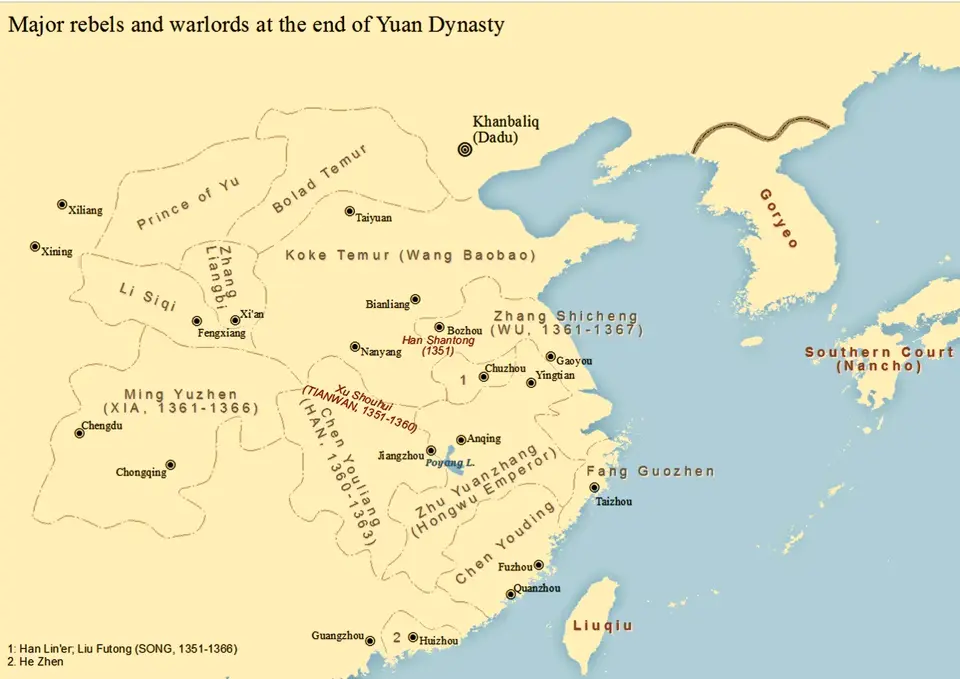
The Late Yuan Peasant Uprisings (元末农民大起义) were a monumental nationwide epochal movement that erupted during the Zhizheng era of the late Yuan Dynasty. By the mid-fourteenth century, Yuan imperial rule had devolved into rampant decadence, ruthless fiscal extortion, and systemic discrimination under the four-class status system, which exacerbated deep-seated ethnic and class enmities. Coupled with unprecedented droughts, locust plagues, the catastrophic inundation of the Yellow River, runaway hyperinflation caused by the reckless printing of Zhizheng paper currency, and the forced conscription of hundreds of thousands of river workers, popular indignation boiled over. In 1351, Han Shantong and Liu Futong mobilized the masses through the White Lotus movement at Bailuzhuang in Yingzhou, igniting the Red Turban Rebellion that swept like wildfire across the Huai River and the Central Plains. Concurrently, Xu Shouhui founded the Tianwan regime in Qizhou, Guo Zixing rose in Haozhou, and Zhang Shicheng and Fang Guozhen carved out independent maritime and commercial strongholds along the southeastern coast. Amidst intense internecine warfare among regional factions, Zhu Yuanzhang distinguished himself through iron military discipline and visionary grand strategy. He annihilated Chen Youliang's Great Han regime at the battles of Longwan and Lake Poyang, subsequently suppressed Zhang Shicheng's Great Zhou realm, and unified the prosperous south. In 1368, Zhu Yuanzhang proclaimed the Ming Dynasty in Yingtian, dispatching generals Xu Da and Chang Yuchun on a massive Northern Expedition that captured the Yuan capital Dadu, driving the Mongol court into the northern steppes and bringing an end to Yuan dominion over China proper.
Han Shantong and Liu Futong mobilize river workers at Bailuzhuang through the White Lotus sect; Han is martyred, Liu captures Yingzhou, igniting the Red Turban Rebellion.
Xu Shouhui, Zou Pusheng, and Peng Yingyu revolt at Tiantangzhai in Qizhou, defeating imperial armies and founding the Tianwan regime with the era name Zhiping.
Zhima Li and Zhao Junyong seize Xuzhou, dominating the Grand Canal and severing the Yuan imperial grain transport lifelines.
Guo Zixing captures Haozhou; Buddhist novice Zhu Yuanzhang enlists, quickly distinguishing himself through valor and strategic acumen.
Zhang Shicheng and eighteen fellow salt peddlers revolt in Taizhou, capturing Gaoyou and establishing the Great Zhou regime.
Yuan Chancellor Toghto besieges Gaoyou with hundreds of thousands of troops; court intrigues cause Toghto's sudden dismissal, triggering total imperial collapse.
Liu Futong enthrones Han Lin'er at Bozhou as the Lesser Radiant King, establishing the Great Song dynasty and uniting northern Red Turbans.
Crossing the Yangtze, Zhu captures Jiqing (renamed Yingtian), adopting Zhu Sheng's counsel to build high walls, store grain, and delay claiming kingship.
Liu Futong launches three simultaneous expeditions, raiding Dadu's suburbs, burning Shangdu, and campaigning across Guanzhong.
Liu Futong captures the ancient Northern Song capital of Kaifeng, conducting Han Lin'er into the city at the summit of Red Turban power.
Chen Youliang murders Xu Shouhui, establishes the Great Han dynasty, and attacks Yingtian, suffering a catastrophic defeat at Longwan.
Ming Yuzhen proclaims the Great Xia dynasty in Chongqing, establishing the era name Tiantong and governing Sichuan in regional peace.
Zhu relieves Nanchang and destroys Chen Youliang's fleet in a thirty-six-day naval battle; Chen dies in combat, and Great Han collapses.
Xu Da captures Pingjiang, forcing Zhang Shicheng's surrender; Zhu issues the Manifesto to the Central Plains and launches the Northern Expedition.
Zhu Yuanzhang proclaims the Ming Dynasty at Yingtian; Xu Da enters Dadu as Emperor Shundi flees to the steppes, ending Yuan rule.
During the mid-to-late Yuan Dynasty, imperial princes, Mongol nobles, and Semu dignitaries seized immense tracts of fertile agricultural land throughout northern and southern China, transforming cultivated fields into private pastures and feudal estates. Dispossessed Han and Southern Chinese peasants were reduced to destitute tenants or hereditary serfs, subjected to crushing rents, exorbitant miscellaneous levies, and oppressive corvee labor. Systemically, the Yuan court enforced a rigid four-class hierarchy that legally segregated society into Mongols, Semu people, Han people (northern Chinese), and Southern people. This institutional caste system overtly favored the upper two groups in official appointments, legal proceedings, taxation, and judicial sentencing. Native southern elites were systematically disenfranchised, while common laborers suffered profound dehumanization, generating explosive socio-ethnic animosity across all tiers of agrarian society.
Under Emperor Shundi of Yuan (Toghontemur), imperial governance collapsed into wholesale venality. Offices and honors were openly bought and sold, regional officials engaged in unbridled extortion, and arbitrary fiscal requisitions multiplied incessantly. The court squandered massive state revenues on wasteful palace construction and lavish esoteric Buddhist rituals, leaving the imperial treasury exhausted. To alleviate the catastrophic deficit, the court in 1350 mandated a radical currency reform, printing vast quantities of Zhizheng Jiaochao without metallic reserves. Within months, rampant hyperinflation eroded public confidence; commodity prices surged hundreds of times over, rendering paper currency worthless wastepaper. Urban commerce halted, regional markets reverted to primitive barter, and countless farmers and townspeople were plunged into destitute ruin.
Throughout the 1330s and 1340s, catastrophic climatic extremes and natural disasters devastated the empire. Severe droughts persisted for months in Henan, unseasonal snowdrifts eight feet deep froze millions of cattle across Hezhou, and violent earthquakes struck near the capital, collapsing mountains and forming lakes. Famine swept Jiangzhe, leaving hundreds of thousands starving. Beginning in 1344, the Yellow River repeatedly burst its dikes at Baimao and flooded several provinces, submerging thousands of square miles of arable land in Henan, Shandong, Hebei, and Anhui. Millions of refugees starved, with reports of cannibalism widespread. The imperial authorities exhibited utter indifference toward disaster relief, instead accelerating coercive tax collection, driving the suffering populace to desperation.
In 1351, to restore the Grand Canal grain transport lifelines vital to sustaining Dadu, the Yuan court appointed Minister of Works Jia Lu to supervise an immense hydraulic diversion project. The court forcibly drafted 150,000 peasants from Henan and Shandong, alongside 20,000 garrison soldiers, to reconstruct the breached embankments under brutal penal duress. On the dikes, workers laboured under grueling heat and torrential rains, subjected to ruthless beatings by imperial overseers while their grain rations were embezzled by corrupt officials. Thousands perished from exhaustion and disease, their bodies discarded unburied along the riverbanks. The assembly of such immense, aggrieved masses provided an unprecedented fertile ground for underground religious networks to ignite coordinated nationwide rebellion.
Amidst intensifying class and ethnic tensions, popular underground religious traditions, notably the White Lotus and Maitreya sects, provided the vital institutional and ideological framework for organizing peasant resistance. In the early Zhizheng years, northern White Lotus master Han Shantong and his family preached covertly across Henan and Anhui. Han claimed descent from Emperor Huizong of the Song Dynasty, asserting that the Central Plains legitimately belonged to the Chinese Zhao royal house, while prophesying the descent of Maitreya and the advent of the Radiant King to deliver mankind from suffering. Liu Futong, a wealthy and martial native of Yingzhou claiming descent from Song general Liu Guanshi, formed a close alliance with Han to orchestrate open revolt.
In the spring of 1351, learning of the conscription of 150,000 laborers for the Yellow River works, Liu Futong recognized the decisive moment had arrived. He secretly commissioned the carving of a stone effigy depicting a one-eyed man, inscribing on its back the prophetic rhyme: The stone man with one eye stirs the Yellow River to ignite nationwide revolt. Agents buried the statue in the mudflats near Huanglinggang. When river laborers excavated the artifact during dredging, the prophecy spread like wildfire across the entire workforce, electrifying the masses and creating unstoppable momentum for insurrection.
In May 1351, Han Shantong and Liu Futong gathered over 3,000 river workers and disciples at Bailuzhuang in Yingshang. They sacrificed a white horse and a black ox, swore solemn blood oaths to heaven and earth, and acclaimed Han as the Radiant King. However, before the rituals concluded, local officials surrounded the encampment with imperial troops. Han Shantong was captured and executed, while his wife and young son Han Lin'er escaped into the Wuan Mountains. Liu Futong fought his way out, rallied the remnants, and captured Yingzhou. The insurgents wrapped red kerchiefs around their heads as identification, officially launching the Red Turban Rebellion.
Upon capturing Yingzhou, Liu Futong opened the state granaries to feed starving peasants. Impoverished farmers, dismissed river laborers, and roaming refugees flocked to his banner by the tens of thousands. Liu enforced strict martial order, reorganizing the insurgents and capturing Zhugao, Luoshan, Shangcai, Zhenyang, and Quexhan. By autumn 1351, Liu's army took Runing, Xizhou, and Guangzhou, swelling to over 100,000 men. Wherever they marched, the Red Turbans executed abusive Mongol governors and corrupt magistrates, incinerated tax registers and land deeds, and dissolved local Yuan administrations.
Terrified by the rebellion's rapid expansion, Emperor Shundi ordered Assistant Bureau Director Lao Zhang and Prince Esen Temur to march south with elite Asud guards and imperial shock cavalry. Boasting they would leave nothing alive, the imperial army confronted Liu Futong outside Yingzhou. Liu exploited the boggy plain terrain, luring the imperial vanguard into coordinated ambushes that fractured their formations. Fighting with desperate valor, the Red Turbans routed the imperial forces, shattering the myth of Mongol military invincibility and dealing a crushing blow to the dynasty's prestige.
Although the Yuan counterattacked locally and Esen Temur temporarily retook Shangcai, the rebellion could no longer be contained. Operating with high mobility across the vast Huai plains, Liu Futong raided Ye and Wuyang, directly threatening Kaifeng and Luoyang. His northern Red Turbans gained deep popular devotion through their uncompromising anti-Yuan stance and suppression of landlord abuses, serving as the main strategic anvil that pinned down central Yuan armies and sheltered fledgling rebel movements nationwide.
While Liu Futong campaigned across Henan, a powerful uprising erupted at the strategic hub of Xuzhou. Li Er, a native of Xiaoxian known as Zhima Li for distributing his personal sesame reserves to starving neighbors during famine, despised Yuan cruelty and the dredging levies. Swearing blood brotherhood with Zhao Junyong and Peng Da, he mobilized several thousand famished peasants armed with farm tools and spears in August 1351, storming Xuzhou and slaying its Mongol governor.
Following the capture of Xuzhou, Zhima Li distributed grain and enlisted recruits, rapidly amassing over 100,000 followers. He dispatched Zhao Junyong and Peng Da to seize Suzhou, Wuhe, Xuyi, and Lingbi, establishing complete control over the Grand Canal and Huai River water junctions. This severed the vital maritime and canal grain transport routes sustaining Dadu, cutting off southern grain and tax revenues. Food prices in the capital skyrocketed, and the economic lifeline of the Yuan court was fatally disrupted.
The Xuzhou uprising provided crucial strategic support to the Yingzhou Red Turbans, forming a dual threat along the Huai River. However, the force lacked unified political direction and strict discipline. In autumn 1352, Yuan Grand Councilor Toghto besieged Xuzhou with advanced counterweight trebuchets, bombarding its ramparts day and night. After three months of bloody defense, the city fell. Zhima Li perished during the breakout, while Peng Da and Zhao Junyong led several thousand survivors south to Haozhou to join Guo Zixing.
In August 1351, as northern Red Turbans advanced, the southern slopes of the Dabie Mountains ignited. Xu Shouhui, a cloth vendor of imposing stature and generous temperament from Luotian, joined blacksmith Zou Pusheng and Jiangxi monk Peng Yingyu. Peng had spent years proselytizing Maitreya doctrines across the Yangtze basin. Gathering followers at Tiantangzhai in the Dabie Mountains, they wrapped their heads in red kerchiefs and launched the southern Red Turban movement.
The rebels rapidly stormed Qichun and captured Qizhou. In September, Xu Shouhui took Huangzhou, routing the imperial garrison under Prince Kuanchebuhua. Rebel general Ni Wenjun captured and executed Prince Kuchunger and his sons. In the wake of this sweeping victory, Xu Shouhui proclaimed himself Emperor at Qishui, adopting the dynastic name Tianwan (signifying the total eclipsing and destruction of the Yuan) and the era name Zhiping. He instituted ministries and appointed Zou Pusheng as Grand Preceptor and Peng Yingyu as Military Counselor.
The Tianwan regime was the first revolutionary peasant state established during the late Yuan uprisings. Xu Shouhui minted Tianji and Zhiping copper coins, promulgated laws, abolished oppressive Yuan levies, and redistributed seized lands. The insurgent army enforced strict moral codes forbidding looting, murder, rape, or arson. Winning widespread popular adoration, Tianwan emerged as a magnetic rallying banner across the southern provinces, providing a legitimate political counterweight to Mongol rule.
Following its inauguration, the Tianwan regime mounted aggressive multi-pronged campaigns throughout the middle and lower Yangtze valleys. In January 1352, general Lu Faxing captured Anlu, slaying its prefect Cholu, while Jiang Han took Mianyang and Zhongxing (Jingzhou). Utilizing immense naval flotillas spanning miles along the Yangtze waterways, the Red Turbans swept past Yuezhou, Lizhou, and Changde. Yuan provincial authorities fled in disarray, bringing vast territories of Huguang under Tianwan governance.
Concurrently, another Tianwan force led by Xiang Puluo advanced from Huizhou and Raozhou, forced Yuling Pass, and made a lightning assault on Hangzhou. The unprepared Yuan vice-governor Fan Zhijing fell in combat, and insurgent forces seized the metropolis. However, imperial general Dong Tuanxiao mounted a fierce counterattack, and Chancellor Jiahui set fire to Hangzhou while counterattacking. After brutal street fighting at Yans Bridge, the rebels withdrew into western Zhejiang, having severely fractured Yuan regional defenses.
In Jiangxi and southern Anhui, Peng Yingyu and Ni Wenjun campaigned relentlessly, taking Nankang, Jiangzhou, Fuzhou, and Yuanzhou. Li Fu, general director of Jiangzhou, died resisting the assault. Wherever he went, Peng Yingyu established public granaries and provided famine relief, embedding the rebellion deeply within the peasantry. However, in late 1353, imperial armies under Jia Lu and Dong Tuanxiao encircled Ruizhou, where Peng was struck by an arrow and killed. His loss deprived Tianwan of its most visionary leader, sowing seeds for later factional strife.
By February 1352, the conflagration along the Huai River intensified. Guo Zixing, a wealthy and public-spirited merchant of Dingyuan, organized several thousand local fighters alongside Sun Deya and three other associates. They staged a night attack that overwhelmed the Yuan garrison at Haozhou. Proclaiming himself Grand Marshal, Guo established independent divisional commands within the fortress, successfully repulsing multiple imperial counteroffensives and turning Haozhou into a redoubt of anti-Yuan resistance.
Two months later, Zhu Yuanzhang, an ordained Buddhist novice at Huangjue Monastery, stood at a life-altering crossroad. Born Zhu Chongba into an impoverished peasant family, he had witnessed his parents and eldest brother perish from starvation and pestilence during the catastrophic famine of 1344. Left destitute, he entered the monastery, but when supplies failed, he wandered as an itinerant mendicant across Henan and Huaihe for three years, learning the misery of the peasantry firsthand. Receiving a letter from his childhood friend Tang He urging him to enlist, and fearing capture by imperial troops hunting suspects for bounties, Zhu journeyed to Haozhou in April 1352.
Upon joining the ranks, Zhu distinguished himself through exceptional courage, tactical acumen, and incorruptibility. He distributed all battlefield spoils among his fellow soldiers and consistently led from the front. Highly impressed, Guo Zixing promoted him to commander of his personal bodyguard and arranged his marriage to Lady Ma, the orphaned daughter of his comrade Zhang Fanzhi. Renamed Zhu Yuanzhang with the courtesy name Guorui, Zhu entered the core leadership of the insurgent army, embarking on his historic ascension from destitute peasant to imperial sovereign.
Despite mustering tens of thousands of troops, Haozhou suffered from debilitating internal rivalries. Guo Zixing was proud and suspicious, Sun Deya was narrow-minded, and the arrival of Peng Da and Zhao Junyong from Xuzhou exacerbated tensions. During one dispute, Sun Deya's faction seized Guo Zixing and threw him bound into an underground cellar, plotting his death. Zhu Yuanzhang acted decisively, leading his bodyguards into Sun's compound and securing Guo's release with Peng Da's backing. The episode convinced Zhu that remaining in Haozhou would lead only to destruction.
To break free from internal paralysis, Zhu received permission from Guo Zixing in 1353 to return to his native Dingyuan and recruit independent troops. Returning to his home village, Zhu recruited twenty-four trusted, valiant associates, including Xu Da, Tang He, Wu Liang, Wu Zhen, Hua Yun, Zhou Dexing, and Fei Ju. These men would form the elite inner core of the founding Ming military leadership. Around this nucleus, Zhu rapidly assembled thousands of capable fighters across Dingyuan and Zhongli.
Shortly thereafter, Zhu outmaneuvered Miao Daheng, commander of a local gentry militia at Hengjianshan, persuading his 20,000 troops to incorporate peacefully into his forces. Soon after, Dingyuan scholar Li Shanchang presented himself. In their private councils, Li cited Han Gaozu Liu Bang's rise from commoner to emperor through benevolence, broad-mindedness, and reluctance to kill. Zhu embraced this advice wholeheartedly, appointing Li as chief administrative officer in charge of military planning and logistics, thereby crystallizing his sovereign governing apparatus.
At the mouth of the Yangtze River, two distinctive autonomous movements expanded rapidly. In 1353, Zhang Shicheng, a salt peddler at Baijuchang in Taizhou, conspired with his three brothers and fourteen fellow boatmen to resist extortionate salt tax officials. Armed with carrying poles and daggers, the eighteen men assassinated the supervisory guards, incinerated tax registers, and distributed seized salt stocks to the poor. Thousands of salt workers and impoverished boatmen joined the revolt, swelling the insurgent force to immense numbers within days.
Zhang captured Taizhou, Xinghua, and Gaoyou. In January 1354, he erected an altar at Gaoyou, proclaimed himself Prince Cheng, and established the Great Zhou regime under the era name Tianyou. Enforcing modest taxation and fostering civic stability, Zhang earned widespread support from salt workers, regional merchants, and landed gentries. His occupation of Gaoyou severed the central artery of the Grand Canal, choking off all southern revenue to Dadu. Crossing the Yangtze, Zhang captured Changzhou, Pingjiang (Suzhou), Jiaxing, and Hangzhou, mastering the wealthiest economic heartland of China.
Simultaneously, Fang Guozhen established uncontested mastery along the southeastern seaboard. Taking to the sea in 1348 after killing an abusive official, Fang commanded hundreds of vessels and tens of thousands of skilled mariners based in Taizhou, Wenzhou, and Qingyuan. Familiar with coastal tides, his naval squadrons repeatedly routed imperial fleets. The Yuan court alternately appeased and attacked him, while Fang adopted an opportunistic strategy of nominal submission punctuated by swift rebellion, monopolizing coastal grain lanes and maritime smuggling as an autonomous coastal potentate.
Zhang Shicheng's establishment of the Great Zhou and his blockade of the Grand Canal brought catastrophic grain shortages and hyperinflation to Dadu. In September 1354, Emperor Shundi appointed Grand Councilor Toghto supreme commander of an immense punitive expedition. Mobilizing Mongol cavalry, northern Han infantries, Western Regions shock troops, Tibetan monastic forces, and Korean auxiliaries, the army numbered hundreds of thousands, claiming a strength of one million. Toghto advanced relentlessly, recapturing Liuhe and laying total siege to Gaoyou.
Toghto ringed Gaoyou with concentric palisades, deploying over a hundred heavy trebuchets and gunpowder cannons that battered the city walls day and night. With buildings reduced to rubble, food running out, and no relief in sight, Zhang Shicheng mounted desperate personal defense from the battlements, but the fall of the city appeared imminent. If Gaoyou fell, imperial forces would sweep across the Yangtze and extinguish all southern insurgencies. At this critical juncture, court intrigue within the Yuan palace intervened to deliver the rebels from destruction.
Court minister Hama and Crown Prince Ayushiridara, envious of Toghto's rising prestige and fearful of his overwhelming military power, fabricated charges claiming Toghto was harboring treasonous ambitions while exhausting the state treasury. Emperor Shundi foolishly accepted these slanders and issued urgent imperial decrees in November stripping Toghto of all commands, titles, and property, ordering his exile to Yunnan. When the decree was read, Toghto yielded his seal of office with a deep sigh, while his generals and soldiers wept openly in despair.
Deprived of their revered leader, the multi-ethnic imperial army dissolved into catastrophic panic. Allied contingents and mercenary commanders fought one another for baggage and supplies, triggering an uncontrolled rout. Observing the chaos from the walls, Zhang Shicheng launched a furious all-out sally. Hundreds of thousands of imperial troops were slaughtered, drowned in canals, or scattered across the countryside, abandoning mountains of armaments. The Battle of Gaoyou proved the decisive turning point of the entire late Yuan war; the central dynasty lost its last organized regular army, permanently forfeiting the capacity to suppress the rebellion.
Capitalizing on the imperial rout at Gaoyou, Liu Futong launched a sweeping counteroffensive across northern China. In February 1355, his agents located Han Lin'er and his mother in the Wuan Mountains. Escorting them to Bozhou, Liu formally enthroned the youth as Emperor, styling him the Lesser Radiant King. He founded the Great Song Dynasty, established the era name Longfeng, and posthumously honored Han Shantong as the Radiant King. Liu assumed office as Chancellor of the Central Secretariat, establishing central executive ministries and regional marshal commands.
The establishment of the Longfeng regime provided scattered Red Turban commands across Henan, Jianghuai, and the central plains with a recognized, unified imperial banner. Great Song minted Longfeng Tongbao coinage and issued imperial proclamations summoning all insurgent leaders to expel the northern barbarians and restore Song territory. The regime transformed northern peasant resistance from fragmented guerrilla operations into an official sovereign counter-state waging open warfare against the Yuan Dynasty.
To strike at the heart of Mongol power, Liu Futong launched the ambitious Three-Route Northern Expedition in 1357. The Eastern Route, commanded by Mao Gui, advanced through Shandong, taking Qingzhou and Jinan, before driving to Liulin just miles outside Dadu, sending the imperial court into panic. The Central Route, under Guan Xiansheng and Pan Po, traversed Shanxi, crossed the Great Wall, and sacked the Yuan summer capital Shangdu, putting Kublai Khan's ancestral palaces to the torch. The Western Route under Bai Buxin campaigned across Shaanxi, Ningxia, and Gansu, unsettling the northern frontiers.
In May 1358, Liu Futong personally captured Kaifeng, the ancient capital of the Northern Song Dynasty. He conducted Han Lin'er in state into the imperial palaces, establishing Kaifeng as the imperial seat. After a century of foreign rule, Chinese banners flew once more above the Central Plains capital, marking the zenith of northern Red Turban power. However, the three expeditionary armies were overextended, isolated from one another, and operating without unified logistics, leaving them vulnerable to coordinated counterattacks by northern landlord militias.
In response to the Red Turban Northern Expeditions, northern Han and Mongol gentry formed fortified leagues and private landlord militias to resist the peasant armies. The most formidable of these warlords were Chaghan Temur (a sinicized Naiman nobleman) and Li Siqi. Skilled in mounted tactics, Chaghan assembled elite gentry cavalry to defend their ancestral estates against peasant incursions. Desperate for military salvation, Emperor Shundi granted Chaghan vice-chancellorships and supreme military command over the central plains.
In autumn 1358, Chaghan counterattacked into Shanxi and the Guanzhong plains, ambushing isolated Red Turban contingents in rugged mountain defiles. Advancing eastward into Henan in concert with Li Siqi, he severed Kaifeng's supply arteries. In August 1359, Chaghan laid total siege to Kaifeng with hundreds of thousands of allied militia troops, encircling the city with iron cavalry. Starving and exhausted, Liu Futong broke through the perimeter with a few hundred horsemen, escorting Han Lin'er south to refuge at Anfeng.
The loss of Kaifeng dealt a mortal blow to the Great Song regime. Chaghan captured tens of thousands of Song courtiers and concubines, dispatching them to Dadu, before sweeping through Shandong. In 1361, he besieged Yidu, where Eastern Route general Mao Gui had earlier been assassinated in factional infighting. Although insurgent commanders Tian Feng and Wang Shicheng assassinated Chaghan during peace talks in June 1362, Chaghan's nephew Wang Baobao (Kökö Temür) quickly assumed command and crushed the garrison. Northern Red Turban main forces were effectively annihilated, leaving the anti-Yuan mantle to southern factions.
Concurrently in the Upper Yangtze basin, the peasant movement opened an autonomous theater. Ming Yuzhen, a native of Suizhou who served as a naval marshal under Xu Shouhui, was dispatched up the Yangtze Gorges in 1357 to secure grain supplies for hard-pressed Tianwan forces. Maintaining impeccable discipline, Ming's troops treated the populace with benevolence, winning widespread civilian allegiance. His army overwhelmed the Yuan garrison in Sichuan, seizing Chongqing and rapidly capturing Chengdu and Jiading, expelling Yuan authority from the Sichuan basin.
In 1360, when Chen Youliang murdered Xu Shouhui, Ming Yuzhen broke all relations with Chen, condemning his regicide and erecting ancestral shrines to honor the fallen Tianwan sovereign. In 1362, Ming proclaimed himself Emperor at Chongqing, establishing the Great Xia dynasty under the era name Tiantong. He instituted civil governance, revived imperial examinations, limited agricultural taxation to a modest one-tenth levy, founded public academies, and stabilized the southwestern frontiers extending into Yunnan and Guizhou. The Mingxia state afforded the southwest a decade of peace insulated from the brutal wars raging across eastern China.
Ming Yuzhen prudently refrained from intervening in the destructive factional struggles of the lower Yangtze, focusing instead on internal consolidation. Following his death in 1366, his young son Ming Sheng succeeded him, but court governance deteriorated amid bitter bureaucratic and military factionalism. Although Mingxia was eventually incorporated into the Ming Empire in 1371, its initial creation opened a second vital front against the Yuan, immobilizing imperial forces in the southwest and fostering regional reconstruction.
While consolidating his base at Yingtian, Zhu Yuanzhang recognized that eastern Zhejiang and the Lake Tai basin represented the wealthiest agricultural and textile centers in China, as well as the heavily garrisoned western flank of Zhang Shicheng. To secure his eastern perimeter, Zhu dispatched generals Hu Dahai, Deng Yu, and Geng Bingwen in 1358 to pacify Huizhou, Jiande, Jinhua, and Quzhou. Geng Bingwen was assigned to garrison the vital frontier fortress of Changxing, situated on the western shore of Lake Tai directly facing Zhang's primary offensive routes. Geng held Changxing for nearly a decade, defeating repeated massive amphibious sieges through ingenious fortifications and resolute defense.
Simultaneously, general Hu Dahai fought repeated campaigns against Zhang Shicheng's top commander Lyu Zhen around Zhuquan (Zhuji). Recognizing Zhuquan as the strategic gateway to eastern Zhejiang, Zhang launched multiple assaults with tens of thousands of troops. Hu Dahai fought at the vanguard alongside Xie Zaixing, exploiting rugged mountainous defiles to mount devastating counter-ambushes that inflicted massive casualties on the Great Zhou army. Hu maintained rigorous discipline, forbidding any harassment of civilians. The victory at Zhuquan permanently blunted Zhang Shicheng's westward expansion and secured Yingtian's eastern flank, enabling Zhu Yuanzhang to concentrate his full resources against Chen Youliang.
While northern Red Turbans and imperial armies tore each other apart in the north, Zhu Yuanzhang methodically advanced his strategic position in the south. In spring 1355, Guo Zixing passed away. When Guo's son Guo Tianxu and brother-in-law Zhang Tianyou were killed in an ambush during an assault on Yingtian (Nanjing), Zhu became supreme military commander. Recognizing that the war-ravaged Huai region could no longer support his growing forces, Zhu made the pivotal strategic decision to cross the Yangtze and establish a permanent base in the rich Jiangnan plains.
In June 1355, Zhu integrated the naval forces of Chao Lake commanders Liao Yong'an and Yu Tonghai. Exploiting favorable seasonal monsoons, his fleet crossed from Hezhou, captured Caishiji, and seized Taiping. Upon entering Taiping, Zhu posted public proclamations strictly forbidding looting, murder, or the abduction of women under penalty of summary execution. In March 1356, Zhu launched a coordinated amphibious assault that captured Jiqing, where Yuan inspector-general Fushou committed suicide. Renaming the metropolis Yingtian, Zhu established his sovereign administrative capital.
At Yingtian, Zhu exhibited grand strategic patience surpassing all contemporary warlords. In 1358, Huizhou scholar Zhu Sheng presented him with the immortal nine-character maxim: Build high walls, store abundant grain, and be slow to claim kingship. Embracing this counsel, Zhu avoided premature imperial titles that would attract hostile coalitions. Instead, he outwardly recognized the Longfeng calendar, fortified city walls, initiated massive agrarian colonies, restored irrigation canals, and encouraged farming, building an unassailable economic and military reserve.
Having secured his base at Yingtian, Zhu Yuanzhang focused on enlisting prominent Confucian literati to guide his administrative architecture and grand strategy. In 1360, he sent formal delegations to recruit the four revered scholars of eastern Zhejiang: Liu Ji (Liu Bowen), Song Lian, Zhang Yi, and Ye Chen. Liu possessed unparalleled mastery of military strategy and celestial divination, while Song was the preeminent classical essayist of the age. Zhu built the Hall of Worthies to accommodate them, seeking their daily counsel on statecraft.
Liu Ji presented his famous Eighteen Strategy Proposals, analyzing geopolitical dynamics with extraordinary clarity. Liu emphasized that Zhang Shicheng was passive and sought only self-preservation, whereas Chen Youliang was aggressive, ruthless, and an immediate existential peril. Liu urged Zhu to concentrate all offensive military might against Chen Youliang first, turn to extinguish Zhang Shicheng second, and finally launch an irresistible Northern Expedition to reunify the empire. This grand design became Zhu's master strategy. Meanwhile, Song Lian drafted civil codes, codified ritual standards, and educated the heir apparent, transforming Zhu's movement into a disciplined, orthodox dynastic administration.
Simultaneously, Zhu reorganized his command structure. He appointed Xu Da as senior general, instituted strict bans against private servitude or mistreatment of captives, and established the Central Secretariat and Chief Military Commission to separate civil governance from military command. Across the countryside, he instituted military-agrarian colonies where garrison troops divided their time between drilling and farming, achieving fiscal self-sufficiency. Zhu established regional inspection offices that ruthlessly prosecuted official corruption, demonstrating unmatched institutional coherence and morale.
In the middle and upper Yangtze, the Tianwan regime descended into fratricidal violence. Following Peng Yingyu's death, commander Ni Wenjun's failed coup forced him to flee to Chen Youliang, who summarily executed him and absorbed his troops. Born to a fishing family in Mianyang, Chen was cunning, ambitious, and militaristic. In June 1360, Chen assassinated top general Zhao Pusheng, then had his henchmen murder Emperor Xu Shouhui with iron hammers at Caishi. Usurping the throne, Chen proclaimed the Great Han dynasty under the era name Dayi, establishing his capital at Wuchang.
Commanding hundreds of thousands of veteran troops and massive multi-decked warships armed with battering rams and heavy trebuchets, Chen sailed east down the Yangtze to crush Zhu Yuanzhang. He took Taiping, where defender Hua Yun died a martyr's death, and advanced directly upon Yingtian, inviting Zhang Shicheng to stage a joint pincer attack. Panic swept Yingtian; many generals advocated abandoning the city or surrendering. Only Liu Ji stood firm, fiercely rebuking the defeatists and urging Zhu to exploit Chen's overconfidence through a coordinated ambush.
Adopting Liu's plan, Zhu persuaded defector Kang Maocai, an old acquaintance of Chen, to send forged letters promising to betray Yingtian by welcoming Han ships at the wooden Jiangdong Bridge. Chen took the bait, sailing his armada into the narrow Longwan channel on May 21. Reaching the bridge, Chen found a newly built stone span with no welcoming force. Realizing he had been duped, Chen attempted to retreat, but the tide receded swiftly, stranding his immense galleys in deep mudflats.
Zhu's concealed armies under Xu Da and Chang Yuchun attacked from high ground, raining artillery, fire arrows, and stone bolts on the trapped fleet. Over 20,000 Han troops were slain and another 20,000 captured, while hundreds of giant warships fell into Zhu's hands. Chen escaped in a small skiff to Jiangzhou. The Battle of Longwan broke Chen's naval dominance, delivered advanced capital ships to Zhu's navy, and permanently transferred the strategic initiative to Yingtian.
Following Longwan, dramatic shifts occurred in the north. In February 1363, Zhang Shicheng dispatched general Lyu Zhen with 100,000 elite troops to besiege Anfeng, intending to destroy the remnants of the Great Song regime under Han Lin'er and Liu Futong. Starving within the fortress, Han Lin'er sent desperate appeals to Zhu Yuanzhang. Liu Ji strongly advised against intervention, warning that Anfeng was strategically indefensible and that marching north would leave Yingtian exposed to Chen Youliang. However, Zhu determined that Han Lin'er was the rightful sovereign of the Red Turbans, and that abandoning him would allow Zhang Shicheng to dominate the Huai valley.
In March 1363, Zhu personally marched north with Xu Da and Chang Yuchun to relieve Anfeng. The armies clashed in vicious hand-to-hand combat outside the walls. Chang Yuchun spearheaded cavalry charges that broke enemy lines, while Xu Da encircled Lyu Zhen's forces, lifting the siege after days of savage fighting. However, in the chaos of battle, Liu Futong fell in combat. Zhu escorted Han Lin'er and his court to Chuzhou, housing him in an imperial villa. The nominal authority of the Song state was now entirely under Zhu's custody.
While saving the Lesser Radiant King, the battle cost the northern Red Turbans their last independent army, marking the effective close of their twelve-year northern crusade. Moreover, as Liu Ji had predicted, Chen Youliang seized the opportunity of Zhu's absence in the north to mobilize a massive 600,000-man amphibious host and lay siege to the critical southern stronghold of Nanchang, precipitating the climactic confrontation of the civil war.
In April 1363, Chen Youliang invested Nanchang with his vast fleet. Chen intended to take the city and sweep downstream toward Yingtian. However, commanders Zhu Wenzheng and Deng Yu mounted an epic defense, holding out against relentless assaults for eighty-five days. In July, Zhu Yuanzhang led 200,000 naval troops upstream to relieve the siege. Chen withdrew into the sprawling waters of Lake Poyang, where the two armadas engaged in the greatest naval battle in medieval East Asian history.
Initially, Chen's towering vessels, bristling with artillery and linked by iron chains, dominated the engagement through raw mass and elevated firepower. Zhu's lighter vessels suffered heavy losses in frontal collisions, though Xu Da succeeded in ramming and sinking the enemy vanguard. On the second day, Chen's artillery scored a direct hit on Zhu's flagship; Liu Ji pulled Zhu onto an escort vessel moments before the flagship was blown apart. On the fourth day, fierce northeast gales whipped across the lake. Zhu seized the moment, launching seven fire-ships laden with reeds, gunpowder, and sulfur into Chen's chained fleet.
Wind-driven flames engulfed the Great Han armada, transforming the lake into a roaring inferno visible for leagues. Tens of thousands of Han soldiers burned or drowned, and Chen's capital fleet was reduced to cinders. Chen fled with remnants to Zuoli, but Zhu blocked all exits to the Yangtze. On August 26, attempting to break out at Jingjiangkou, Chen exposed his head from a cabin window and was struck through the skull by an arrow, dying instantly. Fifty thousand surviving Han troops surrendered. Zhu took Wuchang, accepted the submission of Chen's young heir Chen Li, and absorbed Huguang and Jiangxi into his domain.
The thirty-six-day Battle of Lake Poyang permanently eliminated Zhu Yuanzhang's most dangerous rival, conquered the entire middle Yangtze, and established his unchallenged military supremacy over southern China.
With Chen Youliang extinguished, Zhu turned his sights toward Zhang Shicheng in the east. In January 1364, Zhu assumed the title of King of Wu in Yingtian. Meanwhile, Zhang's court in Suzhou had devolved into luxury, indolence, and bureaucratic corruption, with its military effectiveness badly compromised. Planning the campaign, Xu Da proposed pruning the wings before striking the trunk: isolating Pingjiang by systematically capturing its perimeter fortresses of Huzhou, Jiaxing, and Hangzhou first.
In August 1366, Xu Da and Chang Yuchun marched with 200,000 troops. At Jiuguan, west of Lake Tai, they shattered Zhang's premier field general Li Bosheng, capturing 60,000 men. Huzhou and Hangzhou quickly capitulated, allowing Xu Da to completely encircle Pingjiang. Xu constructed wooden siege towers three stories high and mounted heavy bronze cannons that bombarded the city day and night, severing all external communications.
Pingjiang endured a horrific ten-month siege. Rice prices soared to astronomical heights; civilians ate tree bark, weeds, and vermin, with cannibalism rampant. In September 1367, Xu Da ordered a coordinated assault across all gates. Chang Yuchun scaled the ramparts first, and the city fell. Captured after an abortive suicide attempt, Zhang was taken to Yingtian, where he hanged himself in defiance. Great Zhou was dissolved. Seeing the collapse of all resistance, Fang Guozhen formally surrendered his coastal prefectures of Qingyuan, Wenzhou, and Taizhou. All of southern China was unified under Zhu's banner.
As he prepared for the Northern Expedition, Zhu faced the sensitive political question of Han Lin'er, the Lesser Radiant King residing in Chuzhou. While Zhu had long operated as the de facto master of southern China, he nominally retained the Longfeng calendar, and Han remained the formal sovereign of the Red Turban movement. For Zhu to declare himself Emperor, the puppet monarch's institutional existence posed a constitutional obstacle.
In December 1366, Zhu dispatched naval commander Liao Yongzhong to Chuzhou to escort Han Lin'er downstream to Yingtian. Near Guabu on the Yangtze River, the imperial barge suddenly capsized in turbulent waters, and Han Lin'er drowned alongside his attendants. While official chronicles attributed the sinking to an accidental storm, contemporary and later historians generally concluded that Zhu covertly ordered the assassination, an interpretation reinforced by Zhu's later rebukes of Liao Yongzhong during noble title distributions. Regardless of culpability, Han's demise officially ended the Great Song Longfeng regime, clearing the path for Zhu to claim the Mandate of Heaven.
In October 1367, having pacified the south, Zhu Yuanzhang held a grand military review at Baitian outside Yingtian, launching the historic Northern Expedition. He appointed Xu Da as Senior General and Chang Yuchun as Vice General, placing them in command of 250,000 elite troops. Song Lian drafted the famous Manifesto to the Central Plains, proclaiming the stirring declaration: Drive out the barbarian nomads, restore China, re-establish moral governance, and rescue the suffering people. Crucially, the manifesto promised equal protection and civil rights to all Mongols and Semu people who submitted peacefully, drastically eroding northern resistance.
Zhu laid down a rigorous grand strategic plan: conquer Shandong first to sever the capital's eastern flank, secure Henan and Luoyang to anchor the central plains, advance into Tongguan and Shaanxi to eliminate western threats, and finally converge on Dadu. Executing this strategy flawlessly, Xu Da's armies crossed the Yellow River; Shandong garrisons surrendered en masse. On January 23, 1368 (Hongwu 1, 1st month, 4th day), Zhu Yuanzhang formally ascended the throne at Mount Zijin in Yingtian, proclaiming the Great Ming Dynasty and establishing the Hongwu era.
By spring 1368, Xu Da took Kaifeng and Luoyang, pacifying Henan. In August, the 250,000-man northern army converged at Linqing and advanced directly on Dadu. In the north, Wang Baobao and rival warlords Li Siqi and Bolad Temur had spent years in internecine civil war, leaving the imperial court stripped of defensive reserves. On the night of September 10, 1368 (Zhizheng 28, 7th month, 28th day), Emperor Shundi abandoned Dadu, fleeing through the Jiande Gate into the northern steppes with the crown prince and imperial entourage.
On September 14, 1368 (Hongwu 1, 8th month, 2nd day), Xu Da entered Dadu through the Anzhen Gate. He enforced iron military discipline, executed any soldier guilty of looting or unauthorized violence, and sealed the imperial archives and treasuries. Mongol rule over China proper, which had lasted ninety-eight years, was officially brought to an end. The remnants of the Mongol court retreated to the Mongolian plateau, becoming the Northern Yuan. The seventeen-year Late Yuan Peasant Uprisings had achieved their ultimate historical goal: the overthrow of the Yuan Dynasty and the founding of the Ming Empire.
Following the capture of Dadu, Ming forces launched vigorous campaigns to eliminate remaining hostile warlords across the northern frontiers. In autumn 1368, Wang Baobao led tens of thousands of elite cavalry from Shanxi to retake Beiping (Beijing). Xu Da executed a brilliant flanking maneuver, bypassing Beiping and striking directly at Wang's home base of Taiyuan. Rushing back in desperation, Wang was routed in a night assault outside Taiyuan, fleeing north with a handful of retainers. Shanxi was secured, and Chang Yuchun took Datong, neutralizing threats south of the Yan Mountains.
In 1369, Xu Da advanced into Shaanxi, securing the submission of Li Siqi. In 1370, Xu Da mounted the expedition from Dingxi, shattering Wang Baobao's 100,000 troops at the Battle of Shen'eryu and capturing over a thousand imperial nobles and officers. Concurrently, general Feng Sheng advanced into the Hexi Corridor, capturing Liangzhou, Ganzhou, and Suzhou, and founding the Jiayuguan garrison. By securing Shaanxi, Shanxi, and Gansu, the Ming Dynasty consolidated an unshakeable northern and northwestern defense system along the Great Wall line.
While northern campaigns raged, Ming armies systematically pacified remaining autonomous enclaves across the south. In 1368, generals Yang Jing, Liao Yongzhong, and He Zhen advanced into Guangdong, Guangxi, and Fujian, securing the peaceful submission of local administrations and bringing Lingnan into the imperial fold. In 1371, Tang He and Fu Youde launched a coordinated amphibious and overland campaign against the Great Xia regime in Sichuan. Young Emperor Ming Sheng opened the gates of Chongqing, peacefully surrendering the province after a decade of autonomy.
In 1381, Zhu Yuanzhang commissioned Fu Youde, Lan Yu, and Mu Ying with 300,000 troops to conquer Yunnan. The army crushed the forces of Yuan Prince of Liang Basalawarmi at Baishijiang; the Prince committed suicide, and the centuries-old Duan clan rule in Dali ended. The Ming court established military garrisons and civil administrations across Yunnan, instituting the tusi native chieftain system and agricultural colonies that bound the southwest irrevocably to China proper. From the Mongolian steppes to the South China Sea, the fragmented warlord factions spawned by the Late Yuan Peasant Uprisings had been forged into the unified expanse of the Great Ming Empire.
The seventeen-year Late Yuan Peasant Uprisings concluded with the overthrow of the Mongol Yuan aristocracy, the liberation of the Central Plains, and the establishment of the Great Ming Empire. Originating from localized revolts of conscripted river laborers and impoverished tenant farmers in Henan and Hubei, the rebellion evolved into an irresistible nationwide movement against feudal exploitation and ethnic subjugation. The northern Red Turbans broke the military strength of the Yuan central government through exhausting regional wars and the Three-Route Northern Expedition. In the south, Zhu Yuanzhang distinguished himself through iron discipline, civilian protection, and the strategic doctrine of building high walls, storing grain, and delaying claims to kingship. Eliminating Chen Youliang and Zhang Shicheng, he consolidated the southern economy. In 1368, Xu Da led 250,000 troops north to capture Dadu, sending the Mongol court fleeing into the steppes and permanently terminating Yuan rule over China.
The Late Yuan Peasant Uprisings exerted a profound, transformative influence on Chinese history. Politically, the movement completely abolished the oppressive four-class status system, dismantled Mongol aristocratic privileges, and restored classical bureaucratic, legal, and ritual systems rooted in Han, Tang, and Song traditions. Economically, the war shattered the expansive aristocratic manorial estates of northern and southern China, reallocating arable lands to millions of freeholder peasants and enabling the early Ming Hongwu Reign to institute light taxes, land reclamation, and demographic recovery. Geopolitically, the Ming recovery of the Sixteen Prefectures of Yan and Yun and the Hexi Corridor reconstructed an integrated multi-ethnic state defended by the Great Wall frontier, redefining the balance of power across continental East Asia for the subsequent three centuries.