Birth of the Eldest Son
Lady Wang gives birth to Zhu Changluo; under dowager insistence, she is named Consort Gong while the emperor remains aloof.
Ming Dynasty (明朝) · HISTORICAL EVENT
国本之争
The Struggle over the Fundamental Base (国本之争) was a fifteen-year political confrontation (1586–1601) during the reign of the Wanli Emperor over the succession to the imperial throne. In 1581, the emperor casually favored a palace maid, Lady Wang, who bore his first son, Zhu Changluo. Embarrassed by her humble birth, the emperor treated the boy with cold neglect. In 1586, his favored consort, Noble Consort Zheng, gave birth to his third son, Zhu Changxun.…
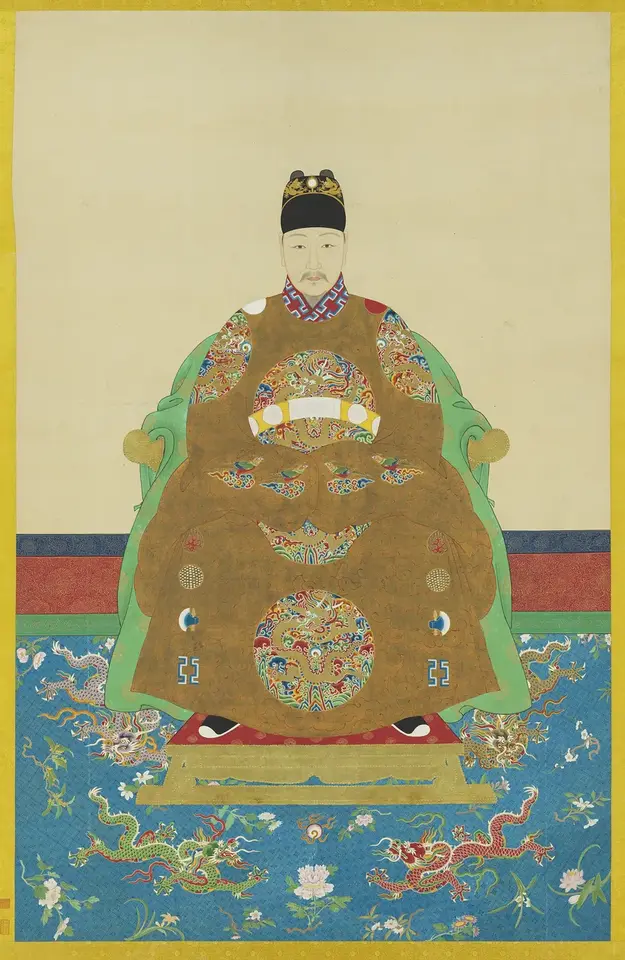
The Struggle over the Fundamental Base (国本之争) was a fifteen-year political confrontation (1586–1601) during the reign of the Wanli Emperor over the succession to the imperial throne. In 1581, the emperor casually favored a palace maid, Lady Wang, who bore his first son, Zhu Changluo. Embarrassed by her humble birth, the emperor treated the boy with cold neglect. In 1586, his favored consort, Noble Consort Zheng, gave birth to his third son, Zhu Changxun. Overjoyed, the emperor promoted Zheng to Imperial Noble Consort, signaling an intention to displace the eldest son and name Zhu Changxun as heir apparent. This scheme violated the ancestral house rule of primogeniture established by the dynastic founder, triggering fierce resistance from cabinet grand secretaries and investigating censors. Hundreds of memorials flooded the throne, causing the dismissal or resignation of four chief grand secretaries and the severe flogging and banishment of dozens of officials. Pressed by the unshakable moral unity of the bureaucracy and a stern reprimand from his mother, Empress Dowager Cisheng, the emperor yielded and formally invested Zhu Changluo as crown prince in October 1601. The episode exemplified the institutional resilience of Confucian civil governance while precipitating imperial negligence and toxic factional strife.
Lady Wang gives birth to Zhu Changluo; under dowager insistence, she is named Consort Gong while the emperor remains aloof.
Lady Zheng gives birth to Zhu Changxun and is elevated to Imperial Noble Consort, sparking fears of succession alteration.
Jiang Yinglin submits the first memorial protesting imperial favoritism and is banished, inaugurating the fifteen-year dispute.
Shen Shixing leads a collective ministerial petition requesting the investment of the nine-year-old prince; the emperor defers the decision.
A leaked private memorandum reveals Shen Shixing's compromising stance, leading to his resignation amidst fierce censorate attacks.
Grand Secretary Wang Jiaping rejects imperial delaying decrees and returns the sealed edict before resigning in protest.
Wang Xijue drafts the three-princes enfeoffment scheme, triggering massive outrage and forcing its immediate withdrawal.
An anonymous pamphlet accusing Noble Consort Zheng of murder plots circulates in Beijing, escalating inner court tensions.
Empress Dowager Cisheng severely reprimands the emperor, who formally invests Zhu Changluo as crown prince on October 15.
In the winter of 1581, the nineteen-year-old Wanli Emperor visited the Cining Palace to pay respects to his mother, Empress Dowager Cisheng. While the dowager was briefly absent, a young attendant maid surnamed Wang served water to the emperor. Moved by sudden impulse, the young ruler had relations with her. Considering the incident an embarrassing youthful indiscretion with an ordinary maid, the emperor departed without bestowing any gifts and kept silent about the matter.
When Lady Wang became pregnant the following year, Empress Dowager Cisheng discovered the truth and confronted her son. The emperor initially blushed and denied any involvement. The dowager ordered eunuch clerks to produce the imperial diary of daily activities, where the exact date and hour were indisputably recorded. Confronted with archival evidence, the emperor admitted the deed. In August 1582, Lady Wang gave birth to the emperor's eldest son, Zhu Changluo. Under the dowager's insistence, the emperor reluctantly invested Lady Wang as Consort Gong, but harbored lasting resentment toward both mother and son.
In 1582, during imperial consort selections, a commoner daughter from Daxing named Zheng entered the palace. Beautiful, sharp-witted, and daring, Lady Zheng possessed rare verbal agility and defied court formality to engage the emperor as an equal companion. Captivated by her charm, the emperor elevated her to Consort in 1583 and Noble Consort in 1584, showering her with unparalleled affection.
In February 1586, Noble Consort Zheng gave birth to the emperor's third son, Zhu Changxun. Ecstatic with joy, the emperor promptly promoted her to Imperial Noble Consort, placing her above all women in the inner court except the empress. Under Ming institutional hierarchy, Lady Wang had borne the eldest son yet remained a modest Consort Gong, whereas Lady Zheng was promoted above her. The civil bureaucracy immediately recognized the move as a transparent maneuver to install the younger son as imperial heir, igniting one of the most contentious political storms in Ming history.
Following the elevation of Lady Zheng, Jiang Yinglin, Supervising Secretary of the Office of Scrutiny for Revenue, submitted a blistering memorial directly to the throne. Jiang argued that elevating Lady Zheng while neglecting Lady Wang, and favoring the third son over the eldest, elevated personal passion above dynastic law and universal righteousness. He demanded the immediate designation of Zhu Changluo as crown prince to secure eternal imperial tranquility.
Jiang Yinglin's remonstrance resonated across the court, prompting concurring memorials from officials such as Shen Jing and Sun Rufa. Enraged by what he termed insolent meddling in inner palace matters, the Wanli Emperor demoted Jiang Yinglin by three ranks and banished him to an obscure county post in Guangchang, while exiling other vocal supporters. Far from silencing the outer court, these harsh punishments galvanized the bureaucratic elite into an organized movement dedicated to defending ancestral succession laws.
Rather than ceding ground after Jiang Yinglin's banishment, supervising secretaries and censors mobilized further remonstrance. Luo Yuren, an official in the Court of Judicial Review, submitted the famous Memorial on Wine, Sex, Avarice, and Wrath, openly castigating the sovereign for wallowing in domestic indulgence and putting personal infatuation above ancestral altars. Although deeply offended, the emperor dared not execute Luo Yuren amidst widespread bureaucratic solidarity, choosing instead to strip him of office. The outer court had forged an unbreakable consensus that dynastic primogeniture could not be compromised under any circumstances.
Confronted by relentless petitions, the Wanli Emperor deployed delay tactics, pleading that the eldest son was too young to endure rigorous ceremonial duties or that early investment might provoke family discord. Senior Grand Secretary Shen Shixing found himself caught between an intractable monarch and an unyielding bureaucracy. Shen attempted a conciliatory approach, publicly requesting the designation of the heir while privately submitting secret notes reassuring the emperor and urging patience.
Shen Shixing's compromising stance alienated the fiery censorate and failed to move the emperor. In 1590, when Zhu Changluo reached the age of nine—well past the prescribed age for imperial princes to commence formal schooling—the cabinet and senior ministers submitted a joint memorial threatening collective resignation unless the emperor fulfilled an earlier pledge to settle the succession. Annoyed by this ultimatum, the emperor arbitrarily postponed the decision by another two years to 1592.
Minister of Rites Yu Shenxing vigorously protested the delay. Meanwhile, a confidential memorandum authored by Shen Shixing was accidentally leaked to the court. Investigating censors furiously denounced Shen Shixing for covertly pandering to imperial desires and betraying administrative trust. Discredited and exhausted by relentless accusations, Shen Shixing resigned his post in autumn 1591.
Upon Shen Shixing's departure, the unbending Wang Jiaping became Senior Grand Secretary. Renowned for unyielding moral integrity, Wang considered ancestral dynastic law an inviolable boundary. He submitted six successive memorials urging the emperor to establish the heir without delay. When the emperor petulantly issued an edict delaying the investment for another three years, Wang Jiaping refused to draft the decree, sealed the imperial edict, and returned it directly to the throne before resigning his post after only a few months in office.
In late 1592, the veteran statesman Wang Xijue was recalled to head the Grand Secretariat. Desperate to overcome the chronic deadlock, the Wanli Emperor proposed a convoluted compromise in early 1593: simultaneously enfeoffing the eldest son Zhu Changluo, the third son Zhu Changxun, and the fifth son Zhu Changhao as imperial princes of the first rank, deferring the ultimate choice of crown prince until Empress Wang proved definitively childless.
Wang Xijue recognized that this scheme degraded Zhu Changluo to parity with his younger brothers, effectively dismantling the priority of primogeniture. However, eager to end the dispute and relying on a private royal pledge that Zhu Changluo would be named crown prince the following year, Wang consented and drafted the edict. The announcement sparked universal outrage across the empire. Minister of Rites Li Shida flatly refused to execute the decree, and bureau director Gu Xiancheng penned a scathing denunciation accusing Wang Xijue of sycophancy and betrayal.
Overwhelmed by blistering memorials and public condemnation, Wang Xijue recanted his agreement and petitioned the throne to cancel the simultaneous enfeoffment. Recognizing the unbreakable resistance of the outer court, the emperor withdrew the edict. Wang Xijue's reputation was thoroughly shattered, and he was forced to resign in disgrace in May 1594.
Beyond the constitutional title of heir, the civil bureaucracy grew increasingly alarmed over Zhu Changluo's intellectual tutelage. Under Ming dynastic practice, imperial sons were required to begin formal education at age six under the guidance of esteemed Hanlin scholars. Yet the Wanli Emperor systematically neglected Zhu Changluo, refusing to open the lecture halls for the eldest prince.
Between 1593 and 1598, Hanlin compilers and officials assigned to the heir apparent repeatedly risked their careers by petitioning the emperor. They argued that the welfare of the empire rested on the crown prince, whose character depended entirely on moral education. When the emperor finally permitted sporadic lessons, he withheld supplies, reduced salaries for instructors, and repeatedly suspended classes on flimsy pretexts, provoking renewed protests from the academy and censorate.
The succession impasse inflicted grave moral fractures across the Ming state. Investigating censors came to treat the succession controversy as the ultimate test of ministerial loyalty. Any grand secretary who attempted conciliation was instantly condemned as a court flatterer. Senior officials found themselves caught between a paranoid monarch who viewed his ministers as insolent conspirators and a bureaucracy that viewed the throne as derelict and corrupt.
Following the collapse of the simultaneous enfeoffment proposal, the Wanli Emperor initiated a policy of systemic non-cooperation. He secluded himself within the inner quarters of the Forbidden City, refused to grant audiences, ignored official memorials, and declined to hold court assemblies. When vocal officials continued to remonstrate, the emperor responded with brutal floggings in open court. Dozens of censors and secretaries were stripped of clothing, beaten within an inch of their lives, and permanently banished.
In 1598, an anonymous seditious pamphlet entitled Sequel to the Anxious Discussion on State Peril circulated widely in Beijing, alleging that Noble Consort Zheng was plotting to harm Zhu Changluo and seize the throne for her son. The emperor ordered the Eastern Depot to conduct sweeping inquisitions, throwing scholars and officials into terror. However, judicial officials such as Zhao Qing and Zhao Canlu handled the investigation with restraint, preventing broad persecutions of court moralists. The episode further hardened court determination to settle the succession immediately.
The ultimate breakthrough came from Empress Dowager Cisheng. A devout and principled matriarch, she summoned the emperor to the Cining Palace to address the succession crisis. When the emperor muttered that Zhu Changluo was merely the son of a palace maid and unfit to rule, the dowager rose in fury and pointedly rebuked him: You too are the son of a palace maid; how dare you despise him! Shaken by the realization that his own legitimacy stemmed from a palace maid, the emperor collapsed to his knees in terror.
The dowager's rebuke extinguished the emperor's final resistance. Chief Grand Secretary Shen Yiguan utilized auspicious omens and astrological warnings to urge immediate compliance. Deprived of matriarchal blessing and facing unanimous opposition from his ministers, the emperor finally surrendered. On October 15, 1601, the throne promulgated an imperial proclamation formally investing the nineteen-year-old Zhu Changluo as crown prince, while creating Zhu Changxun Prince of Fu and Zhu Changhao Prince of Rui, bringing fifteen years of exhausting factional struggle to a formal conclusion.
The Struggle over the Fundamental Base concluded with the decisive triumph of the civil bureaucracy and the formal confirmation of Zhu Changluo as heir apparent. The ancestral principle of primogeniture was preserved intact against imperial prerogative, demonstrating the formidable collective authority of Confucian administrative institutions.
However, the victory came at immense cost to governance. Deeply humiliated and resentful of what he perceived as ministerial coercion, the Wanli Emperor retreated into permanent domestic seclusion. For nearly three decades, the monarch refused to hold morning audiences, neglected memorial processing, and left vital cabinet and ministerial posts unfilled. The central administrative apparatus of the Ming empire drifted into chronic paralysis and decay.
Although the succession was officially settled, lingering imperial favoritism toward the Prince of Fu fueled continuous intrigue. In 1615, an intruder armed with a club penetrated the crown prince's residence in the Wooden Club Case, followed after Zhu Changluo's accession by the Red Pill Case and Palace Eviction Case. These Three Palace Cases represented the violent domestic aftershocks of the succession struggle.
Institutionally, the controversy catalyzed the formation of organized bureaucratic factions, most notably the Donglin partisans led by figures dismissed during the dispute. The struggle transformed political discourse from policy debates into uncompromising moral inquisitions. The ensuing vendettas between Donglin reformers and rival coalitions—later weaponized by eunuch factionalism under Wei Zhongxian—hollowed out Ming governance and contributed decisively to the fall of the dynasty.
The Struggle over the Fundamental Base demonstrated both the remarkable institutional strength and the tragic operational dysfunction of the late Ming political structure. Tan Qian observed in the Guoque that throughout fifteen years of intense confrontation, hundreds of officials endured flogging and exile not out of personal ambition, but out of uncompromising fidelity to dynastic law and constitutional order. He noted that the empire remained intact precisely because courageous ministers refused to compromise sacred ancestral precedents.
Conversely, late Ming and Qing historians emphasized the catastrophic administrative paralysis born of the conflict. In his Northern Record of the Ming Dynasty, Ji Liuqi reflected that the Wanli Emperor's decades-long withdrawal from court assemblies and state sacrifices originated directly in the succession impasse. This chronic absenteeism bred venomous factionalism, gave rise to the Three Palace Cases, and dismantled imperial authority, leading to the widely endorsed historical verdict that the fall of the Ming dynasty was fundamentally sealed during the reign of Wanli.