Accession at Qianqiu Pavilion
Liu Xiu ascends the throne at Hao and captures Luoyang, establishing the capital and opening the Jianwu era.
Eastern Han Dynasty (东汉) · HISTORICAL EVENT
建武之治
The Governance of the Jianwu Reign (建武之治), historically celebrated as the Restoration of Guangwu (光武中兴), denotes the golden age of political pacification, institutional reconstruction, and demographic resurgence achieved under Emperor Guangwu (Liu Xiu) of the Eastern Han Dynasty between 25 and 57. Following decades of devastating warfare triggered by the collapse of Wang Mang's Xin dynasty, which left the Central Plains desolate, Liu Xiu mobilized forces…
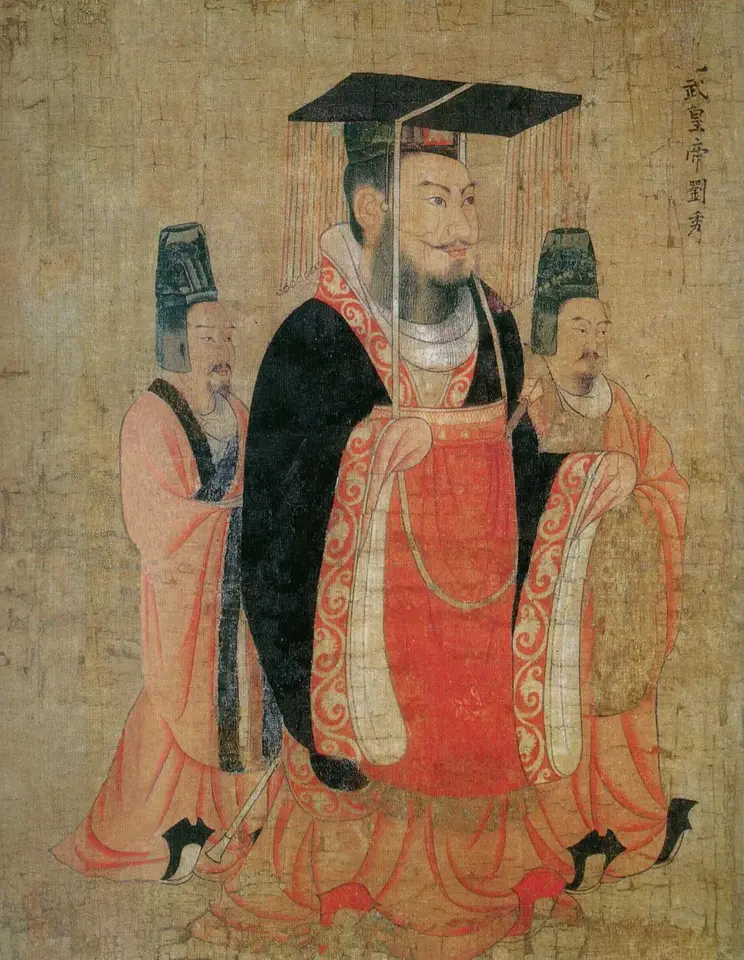
The Governance of the Jianwu Reign (建武之治), historically celebrated as the Restoration of Guangwu (光武中兴), denotes the golden age of political pacification, institutional reconstruction, and demographic resurgence achieved under Emperor Guangwu (Liu Xiu) of the Eastern Han Dynasty between 25 and 57. Following decades of devastating warfare triggered by the collapse of Wang Mang's Xin dynasty, which left the Central Plains desolate, Liu Xiu mobilized forces from Nanyang, achieved fame at the Battle of Kunyang, and ascended the imperial throne at Hao in 25, establishing Luoyang as the national capital. Over twelve grueling years of military campaigns, he eradicated rival regional warlords across northern and southwestern China, restoring continental unification. Guided by the philosophy of governing through benevolent forbearance, Emperor Guangwu retired martial commanders with generous pensions, concentrated executive authority within the Imperial Secretariat, and merged over four hundred redundant counties. He repeatedly issued decrees emancipating millions of slaves, instituted a low tax quota of one-thirtieth on agricultural yields, enforced nationwide land surveys against aristocratic evasion, and founded the Luoyang Imperial Academy. The Jianwu era doubled registered households, restored economic vitality, and established an enduring standard of civil governance.
Liu Xiu ascends the throne at Hao and captures Luoyang, establishing the capital and opening the Jianwu era.
The emperor decrees that all commoners enslaved during Wang Mang's reign are restored to free status.
Surrounded at Yiyang, the main Chimei host under Fan Chong and Liu Penzi surrenders to the emperor.
The court constructs the grand Imperial Academy outside the Kaiyang Gate, appointing fourteen Classical Erudites.
The land tax is restored to one-thirtieth; over four hundred redundant counties are merged nationwide.
Local commandants and compulsory autumn military drills are abolished, ending regional militarization.
Wu Han captures Chengdu; Gongsun Shu is killed in battle, completing the twelve-year reunification of China.
The emperor orders nationwide audits of concealed land and households, executing corrupt officials.
Emperor Guangwu performs the Feng and Shan sacrifices atop Mount Tai, celebrating dynastic restoration.
The emperor passes away in Luoyang, passing the throne to Emperor Ming after thirty-two years of transformative rule.
The historical genesis of the Jianwu Restoration lay in the profound socioeconomic breakdown of the late Western Han and the subsequent collapse of Wang Mang's Xin dynasty. In the early first century, unchecked land monopolization by powerful magnates stripped millions of freeholding peasants of their lands, forcing dispossessed farmers into debt bondage or predatory tenancy. Upon usurping the throne in 9 CE, Wang Mang enacted dogmatic antiquarian reforms, arbitrarily revoking the standard wuzhu coinage, attempting to nationalize all land under the Wangtian system, and banning transactions in slaves and real estate.
Rather than alleviating societal distress, these impractical edicts paralyzed commerce and ruined agrarian production. Compounded by catastrophic seasonal floods and course changes of the Yellow River, devastating famines swept the Central Plains, driving desperate populations into famine cannibalism. Between 17 and 18 CE, the Green Forest (Lulin) uprising in Jingzhou and the Red Eyebrows (Chimei) rebellion in Shandong mobilized hundreds of thousands of impoverished peasants, plunging the Xin dynasty into terminal military collapse.
In October 23 CE, Green Forest insurgent forces stormed Chang'an and executed Wang Mang. However, their proclaimed monarch, the Gengshi Emperor (Liu Xuan), proved incompetent and suspicious, abandoning governance to indulge in debauchery while his undisciplined armies plundered the capital.
Concurrently, rival warlords seized imperial titles across the fractured provinces: the Red Eyebrows crowned Liu Penzi and marched on Chang'an; Wang Lang usurped the throne in Hebei; Liu Yong and Li Xian dominated the eastern commanderies; while Wei Xiao in Longyou and Gongsun Shu in Bashu maintained fortified regional states. Decades of unceasing civil war decimated the population, reducing the imperial census from nearly sixty million under Western Han Emperor Ping to fewer than twenty million. The civilized heartland lay scorched, and the surviving populace desperately yearned for unified peace.
Emperor Guangwu (Liu Xiu) was a ninth-generation descendant of Han founder Liu Bang, belonging to a modest branch of the imperial clan in Nanyang. Studious, prudent, and widely respected by local scholar-gentry, Liu Xiu and his elder brother Liu Yan took up arms alongside the Green Forest coalition. In June 23 CE, at the historic Battle of Kunyang, Liu Xiu led three thousand elite cavalry in a legendary counteroffensive, annihilating Wang Mang's primary army of over four hundred thousand men and sealing the fate of the Xin regime.
Following the tragic execution of his elder brother by the jealous Gengshi court, Liu Xiu exercised profound strategic discipline. Submitting humbly to the Gengshi Emperor, he obtained an imperial commission to pacify the chaotic territories north of the Yellow River. In Hebei, Liu Xiu abolished punitive statutes, rehabilitated political prisoners, and co-opted influential local clans. Aided by talented strategists including Deng Yu, Feng Yi, and Geng Yan, Liu Xiu crushed the pretender Wang Lang and absorbed several hundred thousand peasant insurgents known as the Copper Horses, securing the martial moniker of the Copper Horse Emperor.
On August 5, 25 CE (the twenty-second day of the sixth lunar month of the first year of Jianwu), surrounded by assembled commanders at Qianqiu Pavilion in Hao, Liu Xiu ascended the imperial throne, retaining the Han dynastic title and establishing his capital at Luoyang, inaugurating the Jianwu era.
Upon establishing his court at Luoyang, Emperor Guangwu faced an empire shattered into rival warlord territories. Central authority was confined to portions of Henan and Hebei, encircled by hostile regimes: the Chimei host occupied the Guanzhong basin, Liu Yong and Zhang Bu held Shandong and the eastern seaboard, Wei Xiao maintained fortified cavalry armies in Longyou, and Gongsun Shu reigned over the opulent Chengdu plain.
Consulting with chief strategists Deng Yu and Geng Yan, the emperor formulated the overarching grand strategy of securing the interior first, conquering the eastern seaboard next, and subduing the remote western redoubts last.
In the autumn of 25 CE, the Chimei army captured Chang'an, but chronic supply failures compelled several hundred thousand starving fighters to retreat eastward toward Luoyang. Anticipating their trajectory, Emperor Guangwu positioned General Feng Yi to pursue them through Guanzhong while deploying the main imperial host at Yiyang. In the spring of 27 CE, exhausted and surrounded without provisions, Chimei leaders Fan Chong and Liu Penzi surrendered their remaining legions to the emperor, who granted them clemency and dismantled the largest armed threat in northern China.
Concurrently, the emperor directed campaigns across the eastern seaboard. Commanders Gai Yan, Wu Han, and Geng Yan systematically defeated Liu Yong, captured Suiyang, destroyed Li Xian in Anhui, and accepted the submission of Zhang Bu in Shandong. By 30 CE, eastern China was fully pacified.
Turning westward, the court confronted Wei Xiao in Longyou, who feigned submission while collaborating with Gongsun Shu. Between 30 and 33 CE, generals Feng Yi and Wu Han conducted four grinding mountain campaigns through severe climatic conditions, ultimately crushing Wei Xiao's forces and securing the northwest passes.
The final bastion was Gongsun Shu's empire of Chengjia in Sichuan, defended by the natural mountain fortresses of the Three Gorges. In 35 CE, Grand Marshal Wu Han led an imperial naval armada through the Yangtze gorges while General Cen Peng advanced along overland corridors. Despite Cen Peng's assassination by hostile infiltrators, Wu Han pressed the campaign relentlessly, laying siege to Chengdu. In December 36 CE, Gongsun Shu led a desperate cavalry sortie outside the walls and was mortally impaled, prompting the city to surrender the following day.
Spanning twelve years from his accession in 25 CE to the conquest of Sichuan in 36 CE, Emperor Guangwu's tactical resilience and strategic patience successfully reunified the fractured realm.
Recognizing that two decades of continuous slaughter had brought society to the brink of exhaustion, Emperor Guangwu repudiated draconian legalism in favor of humanitarian recovery, codifying the supreme guiding philosophy: "In ordering the realm, I choose to proceed through benevolent forbearance."
Central to this philosophy was the systematic liberation of agricultural labor through nine successive imperial emancipation edicts. The civil wars had enabled rural magnates to force millions of destitute freeholders into private servitude or debt peonage.
These measures dismantled millennia-old legal distinctions that denied bondsmen human protection, restoring millions of agricultural laborers to freeholder status, expanding the state tax base, and reviving agrarian productivity.
Simultaneously, the emperor reinstated the historic Western Han taxation standard of one-thirtieth on agricultural yields, abandoning the heavy levies of the Xin era. During seasons of drought or locust infestation, the court repeatedly issued blanket exemptions of regional land and poll taxes, distributing grain from state granaries to prevent peasant displacement and encouraging private reclamation of abandoned fields.
To avoid the dynastic subversion that plagued the late Western Han, Emperor Guangwu engineered a radical restructuring of the central executive apparatus.
Toward his victorious founding generals—celebrated as the Yuntai Twenty-Eight Generals—the emperor pursued the wise policy of retiring martial commanders with generous honors and revenues. Rather than purging military titans, he granted extensive marquisates and gold stipends to commanders like Deng Yu, Wu Han, and Feng Yi, but systematically relieved them of active territorial commands and central administrative portfolios. The generals retained supreme aristocratic prestige without maintaining autonomous standing forces, completely eliminating the historic danger of warlordism.
In their stead, the emperor elevated erudite civilian scholars trained in Confucian classics and administrative jurisprudence. Luminaries such as Fu Zhan, Song Hong, and Du Lin were entrusted with administrative direction. When the emperor offered his widowed sister Princess Huyang in marriage to Song Hong, the virtuous minister famously declined, declaring that friends made in poverty must never be forgotten and a wife who shared adversity must never be discarded, establishing an enduring standard of civil ethics.
To prevent imperial ministers from eclipsing monarchical rule, Emperor Guangwu concentrated supreme executive, legislative, and personnel authority within the Imperial Secretariat (Shangshu Tai), reducing the traditional Three Excellencies (Chancellor, Grand Commandant, and Imperial Counselor) to ceremonial figureheads. Directed by the Prefect of the Masters of Writing and six specialized administrative sections, all memorial petitions and imperial decrees flowed directly through this compact royal bureau, ensuring rapid administrative execution and consolidating monarchical authority.
To eliminate the fiscal burdens of bureaucratic overexpansion, the court launched unprecedented administrative consolidations. In 30 CE, the emperor ordered imperial commissions to review local registries, abolishing and merging over four hundred counties, marches, and administrative divisions across the empire—representing more than a third of the national total. Redundant regional bureaucratic posts were slashed by over sixty percent, substantially reducing administrative salaries and eliminating predatory local exactions.
Furthermore, in 31 CE, the court abolished the commandery commandants (duwei) and eliminated the compulsory annual autumn military drills (qiushe) across interior provinces. Interior commanderies were forbidden from maintaining permanent standing armies; local policing fell to civilian magistrates, while frontier defense was entrusted to specialized central expeditionary divisions (the Northern Army). This demobilization liberated millions of young men from burdensome corvee soldiering, allowing rural households to dedicate their complete energies to farming.
As the recovery matured, Emperor Guangwu confronted the most dangerous domestic impediment to centralized statehood: the systematic concealment of agricultural land and bonded dependents by powerful rural clans. Nanyang and Guandong magnates held thousands of mou of fertile fields while sheltering tens of thousands of unregistered dependents, depriving the treasury of tax revenue and creating independent feudal enclaves.
In July 39 CE, the emperor promulgated the historic Land Surveying Edict, commanding all provincial inspectors and commandery administrators to conduct rigorous cadastral measurements of arable land and verify the ages and numbers of all local households.
Confronting this assault on their wealth, regional officials—themselves drawn from prominent clans—colluded with magnates to sabotage the surveys. Corrupt magistrates aggressively surveyed impoverished smallholders while shielding vast aristocratic estates. In 40 CE, the emperor inspected memorial rolls from Chenliu Commandery and discovered a confidential letter hidden within the bindings stating: "Yingchuan and Hongnong may be interrogated; Henan and Nanyang must not be investigated."
When the emperor demanded an explanation, the twelve-year-old Prince of Donghai, Liu Zhuang (the future Emperor Ming), perceptively explained that Henan was the seat of metropolitan aristocrats and Nanyang was the ancestral home of imperial in-laws, where local officials dared not probe extensive encroachments.
Enraged by this systemic betrayal, Emperor Guangwu demonstrated unyielding resolve, ordering the arrest and public execution of more than ten corrupt commandery administrators and inspectors, including the Governor of Henan, Zhang Ji.
This uncompromising enforcement provoked armed insurrections across Qingzhou, Xuzhou, Youzhou, and Jizhou, where magnate clans allied with armed bandits to murder imperial magistrates. The emperor combined ruthless military suppression of insurgent ringleaders with generous pardons for peasant retainers. Within several years, the central government broke magnate resistance, successfully registering millions of mou of concealed land and enrolling hundreds of thousands of hidden dependents as taxpayers. By 50 CE, national registered households had surged to over thirty million people, doubling state revenues and breaking aristocratic monopolization of agrarian resources.
In cultural governance, Emperor Guangwu broke completely with early Han legalist practices, dedicating state resources to the institutionalization of classical Confucian ethics.
In 29 CE, while military campaigns still raged in the west, the emperor founded the grand Imperial Academy (Taixue) outside the Kaiyang Gate of Luoyang. He appointed fourteen Erudites of the Five Classics, reconstructed ancestral texts lost during wartime, and provided halls that accommodated over thirty thousand resident scholars. The emperor frequently presided over academic disputations, personally interrogating scholars and promoting victorious debaters to administrative office.
Beyond institutional education, the emperor revered scholars who prioritized moral integrity above political advancement. When his former schoolmate Yan Guang (Yan Ziling) refused imperial appointments to live as a recluse fisherman along the Fuchun River, the emperor visited him personally, treating him with the intimacy of a fellow scholar and respecting his choice to decline office.
This veneration of principled recluses fostered an unprecedented ethos of personal integrity, civic responsibility, and moral courage across Eastern Han intellectual circles. Late Ming philosopher Gu Yanwu observed that in no historical era was moral character revered more highly than under the Eastern Han, a direct legacy of Emperor Guangwu's patronage.
In 56 CE, surrounded by peace and prosperity, Emperor Guangwu ascended Mount Tai to perform the sacred Feng and Shan sacrifices, proclaiming the completion of dynastic restoration. In March 57 CE, the emperor died peacefully in the Southern Palace of Luoyang at sixty-two, passing an orderly empire to Crown Prince Liu Zhuang. The Governance of the Jianwu Reign endured as an immortal model of national resurrection following profound crisis.
The foremost historical accomplishment of the Jianwu era was the miraculous resurrection of the unified Han state from the ashes of widespread destruction. Twelve years of campaign eradicated autonomous warlordism, reuniting the Chinese world under centralized authority. Combined with the low tax rate of one-thirtieth, frequent tax remissions, and the emancipation of millions of bonded laborers, agrarian cultivation surged across the Central Plains and the Yangtze River valley. Registered population doubled over thirty years, rescuing Chinese civilization from demographic collapse and securing the material foundation for two centuries of Eastern Han prosperity.
Institutionally, the Jianwu era established an enduring model of centralized autocratic governance. Repudiating the punitive legalism of the Qin and Western Han, Emperor Guangwu pioneered the practice of retiring founding generals with generous pensions, averting the violent purges that stained earlier dynasties and civilizing the ruling elite. The creation of the Imperial Secretariat streamlined imperial decision-making directly beneath the throne, pioneering the executive structures that later evolved into the Three Departments and Six Ministries of the Sui and Tang dynasties. His statecraft demonstrated that post-war stabilization is achieved through societal compassion rather than coercive repression.
Culturally, the Jianwu era solidified Neo-Confucian ethics as the undisputed social fabric of Chinese civilization. By establishing the Luoyang Imperial Academy, institutionalizing Classical Erudites, and personally revering moral exemplars like Yan Guang and Song Hong, Emperor Guangwu fostered an intellectual culture that venerated upright character, personal integrity, and civic duty. This distinctive Eastern Han scholar-gentry culture nurtured a generation of fearless officials who laid down their lives to defend ethical governance during the later Disasters of the Partisan Prohibitions, bequeathing an enduring legacy of moral courage to Chinese civilization.
Official chronicles and renowned historians have universally celebrated Emperor Guangwu and the Jianwu era as the zenith of enlightened Chinese statecraft. In the Book of the Later Han, Fan Ye lauded the emperor for matching the feats of ancient sage kings, observing that he conquered with martial brilliance but governed with modesty, frugality, and deep compassion for the populace.
In the Comprehensive Mirror for Aid in Governance, Northern Song historian Sima Guang concluded that among all monarchs who restored fallen dynasties, none surpassed Emperor Guangwu, who substituted benevolence for cruelty, rewarded integrity, and governed four corners of the realm with gentle restraint.
Late Ming scholar Gu Yanwu famously pronounced in the Record of Daily Knowledge that in no period since antiquity was public morality purer than under the Eastern Han, praising Emperor Guangwu for cultivating a societal reverence for ethical character.
Modern historians similarly evaluate the Jianwu Restoration as the supreme historical example of structural civil self-healing, demonstrating how enlightened leadership can revive a shattered civilization and construct a durable, prosperous empire through administrative wisdom and ethical governance.