Yuan Shao Marshals Southern Offensive
Having crushed Gongsun Zan, Yuan Shao mobilizes 100,000 elite infantry and 10,000 cavalry to invade Xu City, initiating the Guandu campaign.
Eastern Han Dynasty (东汉) · HISTORICAL EVENT
官渡之战
The Battle of Guandu was a watershed strategic clash fought in 200 during the late Eastern Han dynasty between the forces of Cao Cao and Yuan Shao at Guandu. Holding four vast provinces north of the Yellow River, Yuan Shao mobilized over one hundred thousand elite troops in an ambitious southern offensive. In contrast, Cao Cao, operating under the imperial authority of Emperor Xian, mustered roughly twenty thousand soldiers to form a resolute defensive…
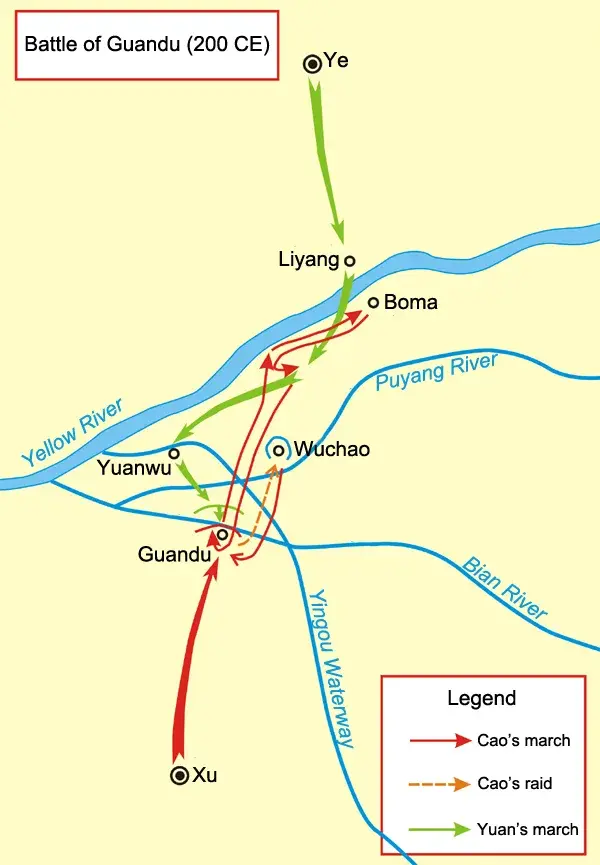
The Battle of Guandu was a watershed strategic clash fought in 200 during the late Eastern Han dynasty between the forces of Cao Cao and Yuan Shao at Guandu. Holding four vast provinces north of the Yellow River, Yuan Shao mobilized over one hundred thousand elite troops in an ambitious southern offensive. In contrast, Cao Cao, operating under the imperial authority of Emperor Xian, mustered roughly twenty thousand soldiers to form a resolute defensive barrier. Confronting severe numerical inferiority, Cao Cao adopted brilliant maneuvers suggested by strategists Xun Yu, Xun You, and defector Xu You. Cao Cao first defeated vanguard generals Yan Liang and Wen Chou at Baima and Yanjin, before falling back to entrench behind deep fortifications at Guandu. In the tenth lunar month of 200, Cao Cao personally led five thousand elite cavalrymen in a nocturnal assault that incinerated Yuan Shao's logistical base at Wuchao, prompting the wholesale disintegration and northern flight of Yuan Shao's massive host. As one of China's most renowned engagements where the few overcame the many, Guandu decisively broke the Yuan clan's hegemony and established Cao Cao as the preeminent master of northern China.
Having crushed Gongsun Zan, Yuan Shao mobilizes 100,000 elite infantry and 10,000 cavalry to invade Xu City, initiating the Guandu campaign.
Capitalizing on Yuan Shao's hesitation, Cao Cao launches a swift preemptive campaign into Xu Province, routing Liu Bei and securing his rear.
Adopting Xun You's diversionary plan, Cao Cao feigns an attack at Yanjin and relieves Baima; Guan Yu charges the lines and slays Yan Liang.
Cao Cao lures Yuan cavalry into disorder with abandoned supply carts at Nanpo, launching a countercharge that kills general Wen Chou.
Yuan Shao builds earthen mounds with wooden towers to rain arrows into the camp; Cao Cao counters with catapults and counter-tunnels.
Embittered by the arrest of his kin, Yuan Shao's adviser Xu You defects to Cao Cao, revealing Wuchao as the vulnerable supply depot.
Cao Cao personally leads 5,000 elite troops disguised as Yuan patrols, successfully burning the Wuchao depots and executing Chunyu Qiong.
Slandered by Guo Tu, Zhang He surrenders at Guandu; Yuan Shao's army collapses completely as Yuan flees with only 800 horsemen.
In the closing decades of the Eastern Han dynasty, although the widespread Yellow Turban Rebellion was quelled by imperial forces, central administrative authority collapsed entirely. Regional governors, warlords, and powerful local families seized independent command of armies and territories, triggering protracted internecine warfare. In 196, Cao Cao escorted Emperor Xian to Xu City, securing paramount political legitimacy by issuing decrees in the name of the sovereign. Over subsequent years, Cao Cao successively vanquished Lu Bu and Yuan Shu, consolidating firm administrative and military grip across Yan, Yu, and Xu provinces south of the Yellow River.
Concurrently north of the Yellow River, General-in-Chief Yuan Shao waged relentless campaigns, culminating in the complete destruction of Gongsun Zan at Yijing in 199. Yuan Shao thereby unified the four fertile northern provinces of You, Ji, Qing, and Bing. Ji Province in particular possessed dense agrarian populations, abundant harvest surpluses, and immense military reserves, enabling Yuan Shao to muster over a hundred thousand veteran infantry and cavalry. Cao Cao occupied the Central Plains but was encircled by potential adversaries: Liu Biao to the south, Sun Ce across Jiangdong to the southeast, and uncommitted warlords across the western passes. A climactic confrontation between the two northern leviathans across the Yellow River became completely inevitable.
In the summer of 199, Yuan Shao marshaled one hundred thousand elite infantry and ten thousand warhorses, preparing a full-scale southward thrust against Xu City. Advisers Tian Feng and Ju Shou vigorously advocated a Fabian strategy of attrition, urging Yuan to leverage northern agricultural abundance while deploying light cavalry detachments to conduct continuous border raids, exhausting Cao Cao without incurring excessive risk. However, civil administrator Shen Pei and strategist Guo Tu favored an immediate knockout blow, arguing that their overwhelming superiority would crush Cao Cao effortlessly. Yuan Shao favored Guo Tu's aggressive plan and ordered an all-out offensive crossing of the Yellow River.
Facing unprecedented military pressure, Cao Cao consulted key advisers Xun Yu and Guo Jia, who thoroughly contrasted the political, moral, and command faculties of both commanders, instilling unyielding confidence across Cao Cao's staff. In the autumn of 199, Cao Cao deployed forward garrisons along the southern bank of the Yellow River, establishing defensive outposts at Guandu, Baima, and Yanjin. In the winter of that year, Liu Bei revolted in Xu Province in coordination with Yuan Shao. Recognizing Yuan Shao's chronic indecisiveness, Cao Cao executed an audacious preemptive strike eastward, shattering Liu Bei's rebel force before swiftly redeploying his veterans to the Guandu front before Yuan Shao could react.
In the second lunar month of 200, Yuan Shao advanced his primary army to Liyang and dispatched his vanguard commander Yan Liang alongside Chunyu Qiong and Guo Tu across the Yellow River to besiege the strategic outpost of Baima, held by Eastern Commandery Administrator Liu Yan. Liu Yan sent frantic pleas for immediate relief. Prior to the crossing, Ju Shou had cautioned Yuan Shao that Yan Liang was impetuous and lacked broad tactical judgment despite his personal bravery, but Yuan Shao disregarded the warning.
Cao Cao personally marched north to relieve Baima. While en route, strategist Xun You proposed a classic diversionary maneuver: since Cao Cao's forces were numerically inferior, direct engagement would prove perilous; Cao Cao should instead march openly west toward Yanjin, feigning an assault across the river to threaten Yuan Shao's rear. This would compel Yuan Shao to divert substantial detachments westward to guard the crossing, creating an opening for a swift, lightly equipped strike force to catch Yan Liang off guard at Baima.
Cao Cao approved the stratagem and moved ostentatiously toward Yanjin. Yuan Shao fell for the ruse and dispatched significant contingents westward. Seizing the opportunity, Cao Cao wheeled his elite cavalry eastward in a forced march toward Baima. Arriving within ten li of the besieged fortress before Yan Liang detected their approach, Cao Cao unleashed advance commanders Guan Yu and Zhang Liao to charge the enemy battle lines. Spotting Yan Liang's command canopy amidst the throng, Guan Yu spurred his charger into the dense ranks, struck down Yan Liang, and severed his head before riding back unharmed. Deprived of their commander, the vanguard forces dissolved in chaos. Having successfully relieved Baima, Cao Cao evacuated its civilian population and provisions westward along the river to avoid being trapped in open plains.
Infuriated by the death of Yan Liang and the loss of Baima, Yuan Shao ferried his grand army across the Yellow River to the southern bank near Yanjin, directing cavalry general Wen Chou and Liu Bei to pursue Cao Cao with over five thousand elite horsemen. Cao Cao's detachment, escorting slow-moving supply wagons and evacuated civilians, halted at the foot of Nanpo. Lookout riders repeatedly warned of swarming hostile cavalry with endless infantry behind them. Cao Cao's officers nervously urged an immediate defensive formation.
Cao Cao remained composed and strictly forbade panic, commanding his cavalrymen to unsaddle their mounts and turn them loose to graze. Furthermore, he ordered supply carts laden with grain, armor, and treasure to be strewn casually along the roadway as bait. When Wen Chou's vanguard horsemen crested the rise and witnessed discarded baggage and scattered horses, tactical discipline vanished instantly; the cavalry broke rank to loot wagons and round up mounts. Watching the enemy dissolve into disarray, Cao Cao abruptly ordered his troopers to mount and attack.
With fewer than six hundred elite riders, Cao Cao unleashed a devastating countercharge down the slope into the disordered mass. The surprised enemy cavalry suffered heavy casualties and trampled one another in frantic retreat. In the ensuing clash, Wen Chou was slain on the field. The back-to-back losses of Yan Liang and Wen Chou—the two most celebrated champions of the northern army—dealt a severe psychological blow to Yuan Shao's ranks. Aware that overall parity had not yet been attained, Cao Cao prudently withdrew his victorious detachments into heavily fortified positions at Guandu to commence a war of attrition.
By the eighth lunar month of 200, Yuan Shao's main columns concentrated at Yangwu before pushing directly against Guandu, erecting an expansive network of camps along sand ridges stretching dozens of li from east to west. Cao Cao entrenched behind deep moats and earthen bastions, holding the line in direct opposition. Unable to breach Cao Cao's works through direct assault, Yuan Shao ordered his men to construct dozens of artificial earthen mounds fronting the lines, mounting tall timber towers upon them. Expert archers were stationed atop these towers to rain armor-piercing arrows into Cao Cao's interior lines, forcing soldiers to carry shields overhead even while walking between tents.
Cao Cao counteracted this tactical threat by constructing massive counterweight stone throwers, known as thunder-clap carts. These catapults hurled heavy boulders across great distances, smashing the wooden towers and wooden breastworks on the mounds and crushing the sharpshooters perched within. Thwarted above ground, Yuan Shao ordered specialized sappers to excavate subterranean tunnels toward Cao Cao's encampments. Cao Cao countered by digging long, deep transverse trenches inside his ramparts, intercepting and collapsing every subterranean advance.
Despite these tactical triumphs, a catastrophic logistical crisis threatened Cao Cao's army as autumn progressed. With barely twenty thousand men facing a relentless siege, food reserves dwindled toward zero, leaving soldiers exhausted and emaciated. Widespread panic erupted across the rear; local bandits and regional gentry rebelled in sympathy with Yuan Shao, and many officials in Xu City secretly established contact with the northern camp. Under crushing strain, Cao Cao drafted a confidential dispatch to Xun Yu proposing a tactical withdrawal. Xun Yu replied with passionate firmness, likening the situation to the historic struggle at Xingyang and Chenggao between Chu and Han; he maintained that whoever retreated first would suffer total annihilation, whereas Yuan Shao's sprawling coalition was fragile and prone to fatal errors if Cao Cao held firm. Greatly heartened, Cao Cao resolved to hold the line at all costs.
In the tenth lunar month of 200, the decisive turning point arrived. Yuan Shao detached General Chunyu Qiong with over ten thousand infantry and cavalry to escort an enormous grain convoy from the north, stationing the entire supply train at Wuchao, forty li north of Yuan Shao's main headquarters. Tactical adviser Ju Shou recognized the vulnerability of an isolated depot and begged Yuan Shao to dispatch general Jiang Qi to patrol the flanks and prevent raids, but Yuan Shao dismissed the precaution.
Concurrently, strategist Xu You—an influential member of Yuan Shao's inner circle—received word that his relatives in Ye City had been arrested for breaking the law by administrator Shen Pei. Embittered by internal factional betrayal, Xu You fled the camp in the dead of night and defected to Cao Cao. When notified of Xu You's arrival, Cao Cao was overjoyed, leaping from his couch and running barefoot out of his tent to welcome his visitor with open arms. Xu You asked pointedly about remaining rations, and seeing through Cao Cao's evasions, revealed the critical secret: Yuan Shao's entire grain reserve was concentrated at Wuchao under the complacent guard of Chunyu Qiong. If Cao Cao launched an elite raid to burn the depot, Yuan Shao's army would disintegrate within three days.
Recognizing the fleeting window of opportunity, Cao Cao acted with utmost decisiveness. Entrusting camp defense to Cao Hong and Xun You, Cao Cao personally led five thousand elite foot and horse under the cover of night. Disguising his men in Yuan army uniforms, issuing mouth-gags to silence troops, and binding horse bits, each soldier carried a bundle of kindling. Moving silently along secluded trails, the force evaded border checkpoints by claiming to be northern supply patrols.
At dawn, Cao Cao's assault force encircled Wuchao and hurled firebrands onto the sprawling grain stockpiles. Enormous flames engulfed the warehouses as Chunyu Qiong rushed to organize a defense outside the palisades. When Yuan Shao received reports of the attack, he arrogantly assumed Cao Cao had marched into a trap. Rather than committing his full force to relieve Wuchao, Yuan Shao adopted Guo Tu's advice: he sent only light cavalry to Wuchao while ordering generals Zhang He and Gao Lan to launch a frontal assault on Cao Cao's fortified camp at Guandu, believing that seizing Cao Cao's headquarters would leave the raiders stranded.
General Zhang He forcefully protested, warning that the loss of Wuchao meant immediate starvation for the grand army, whereas Cao Cao's camp was virtually impregnable. Yuan Shao dismissed his plea and commanded the assault. Meanwhile at Wuchao, as Yuan relief cavalry closed in on Cao Cao's rear, subordinates pleaded to turn and fight them. Cao Cao roared that they should report again only when the enemy reached their immediate backs. Spurred by desperation, Cao Cao's men charged through the barricades, butchered Chunyu Qiong's defenders, severed Chunyu's nose and limbs before execution, and incinerated thousands of cartloads of provisions.
Back at Guandu, Zhang He and Gao Lan launched repeated assaults against Cao Cao's fortifications, but Cao Hong and Xun You maintained an iron defense, repelling every charge with heavy crossbow barrages. When news arrived that Wuchao had been burned to the ground, Guo Tu feared execution for his disastrous council and maliciously slandered Zhang He before Yuan Shao, accusing the general of disloyalty and deliberate sluggishness. Recognizing that their lives were forfeited either way, Zhang He and Gao Lan resolved to surrender, opening negotiations and marching their heavy infantry into Cao Hong's camp.
The defection of two top front-line generals, coupled with the catastrophic loss of all grain supplies, triggered an immediate and total psychological collapse throughout Yuan Shao's ranks. Over one hundred thousand soldiers broke formation in a frantic, unorganized rout. Cao Cao, returning at the head of his victorious cavalry, joined forces with the Guandu garrison to launch a merciless pursuit across the floodplain. Yuan Shao and his eldest son Yuan Tan, abandoning headgear and ceremonial regalia, fled across the Yellow River with barely eight hundred personal cavalrymen.
Cao Cao captured all of Yuan Shao's military equipment, grain, armor, official archives, and private treasures, while taking tens of thousands of prisoners. In the process of sorting through captured headquarters documents, Cao Cao discovered hundreds of confidential letters written by court officials and officers in Xu City pledging clandestine fealty to Yuan Shao during the dark days of the siege. Displaying remarkable political magnanimity, Cao Cao ordered every single letter burned before the assembly without inspection, declaring that when Yuan Shao was at the height of his power, even he could not guarantee his own survival, let alone others. This profound clemency consolidated unconditional military loyalty, bringing the year-long campaign of Guandu to an awe-inspiring strategic victory.
The Battle of Guandu concluded with a crushing, total triumph for Cao Cao. Yuan Shao's veteran force of over one hundred thousand men was virtually obliterated within days; tens of thousands were slain or captured, while the entire logistical apparatus, arms, steeds, and official seals of the northern grand army fell into Cao Cao's hands. Yuan Shao and his son Yuan Tan escaped with barely eight hundred horsemen across the Yellow River. The catastrophe permanently broken Yuan Shao's capacity to dictate imperial politics, leaving his coalition morally and physically devastated.
Guandu fundamentally reversed the political and military balance of power across northern China, initiating the irreversible unification of the Central Plains under Cao Cao. In 202, Yuan Shao died in despair, triggering bitter fratricidal civil war among his sons Yuan Tan, Yuan Xi, and Yuan Shang. Cao Cao exploited these internal fractures with masterful diplomacy and military force, capturing the northern stronghold of Ye City in 204. By 207, following his triumphant expedition against the Wuhuan at White Wolf Mountain, Cao Cao had fully absorbed You, Ji, Qing, and Bing provinces, consolidating undisputed mastery over northern China and laying the durable political and economic foundation for the Cao Wei dynasty.