Palace Coup and Dong Zhuo's Entry
He Jin was assassinated by eunuchs, Yuan Shao purged the palace, and Dong Zhuo occupied Luoyang with Liangzhou cavalry.
Eastern Han Dynasty (东汉) · HISTORICAL EVENT
十八路诸侯
The Eighteen Regional Warlords Coalition, historically known as the Guandong Coalition against Dong Zhuo, was a massive military uprising launched between 190 and 191 CE by regional governors and commandery administrators across eastern China to overthrow the tyrannical dictatorship of Dong Zhuo. After seizing the imperial capital of Luoyang in 189 CE, Dong Zhuo deposed the legitimate young emperor, terrorized the populace, and plundered royal tombs. In…
The Eighteen Regional Warlords Coalition, historically known as the Guandong Coalition against Dong Zhuo, was a massive military uprising launched between 190 and 191 CE by regional governors and commandery administrators across eastern China to overthrow the tyrannical dictatorship of Dong Zhuo. After seizing the imperial capital of Luoyang in 189 CE, Dong Zhuo deposed the legitimate young emperor, terrorized the populace, and plundered royal tombs. In response, Qiao Mao, Administrator of Dong Commandery, forged imperial dispatches urging regional leaders to take up arms. Major figures including Yuan Shao, Yuan Shu, Cao Cao, and Sun Jian gathered over one hundred thousand soldiers. Yuan Shao was acclaimed coalition leader at Suanzao. While Cao Cao suffered an early defeat at the Bian River, Sun Jian achieved a brilliant victory at Yangren, decapitated Dong Zhuo's commander Hua Xiong, and reoccupied the devastated capital. Intimidated by the advancing forces, Dong Zhuo burned Luoyang to ashes and forcibly moved the imperial court to Chang'an. Internal divisions, grain shortages, and territorial ambition rapidly eroded the coalition, which disintegrated into open warfare among its own members, permanently breaking Han imperial cohesion.
He Jin was assassinated by eunuchs, Yuan Shao purged the palace, and Dong Zhuo occupied Luoyang with Liangzhou cavalry.
Dong Zhuo deposed Emperor Shao, enthroned Emperor Xian, murdered Empress Dowager He, and instituted tyrannical control.
Qiao Mao circulated forged imperial dispatches, rallying regional leaders including Yuan Shao, Cao Cao, and Sun Jian.
Allied commanders took blood oaths at Suanzao and elected Yuan Shao supreme leader of the Guandong Alliance.
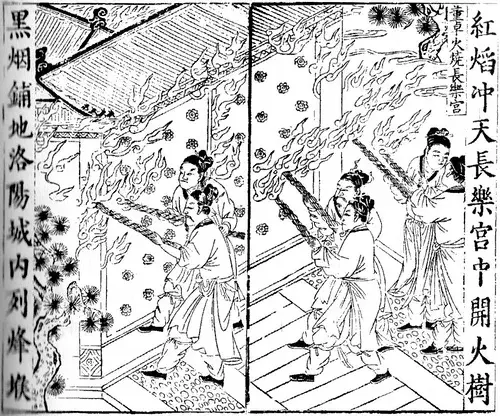
Dong Zhuo decided to abandon Luoyang, burned the palaces, desecrated imperial tombs, and moved the capital westward.
Cao Cao and Bao Xin launched an independent advance but were routed by Xu Rong near Xingyang.
Sun Jian defeated Hu Zhen and Lu Bu at Yangren, decapitated Hua Xiong, and forced Dong Zhuo into retreat.
Sun Jian entered the ruined capital, repaired imperial tombs, recovered the Imperial Jade Seal, and withdrew south.
Liu Dai murdered Qiao Mao over supplies, the alliance disintegrated, and warlords initiated territorial civil war.
During the late Eastern Han dynasty, imperial administration was severely compromised by recurring conflicts between powerful consort clans and influential palace eunuchs. Following the demise of Emperor Ling in April 189 CE, his fourteen-year-old son Liu Bian ascended the throne as Emperor Shao. General-in-Chief He Jin, supported by prominent scholar-officials, sought to eliminate the entrenched eunuch faction known as the Ten Attendants.
Colonel of the Sili Commandery Yuan Shao advised He Jin to summon frontier generals to march toward the imperial capital to pressure Empress Dowager He into consenting to the eunuchs' execution. Despite strong objections from Registrar Chen Lin and Cavalry Commandant Cao Cao, He Jin secretly summoned Dong Zhuo, Governor of Bing Province, whose formidable Liangzhou cavalry marched rapidly toward Luoyang.
In September 189 CE, the eunuchs discovered He Jin's plan and ambushed him inside the Changle Palace. In retaliation, Yuan Shao and Yuan Shu led imperial guards into the palaces and slaughtered more than two thousand eunuchs. The young emperor and his younger brother, Liu Xie, Prince of Chenliu, fled north toward Mang Mountain amid chaotic street fighting. Dong Zhuo encountered the fleeing imperial retinue at Bei Mang and escorted them back to the capital, quickly assuming military command over Luoyang.
Consolidating He Jin's former troops into his own army, Dong Zhuo boldly deposed Emperor Shao and installed the nine-year-old Prince of Chenliu as Emperor Xian. Dong Zhuo assumed the titles of Excellency of Works, Grand Commandant, and Chancellor of State, claiming the privilege of entering court without unfastening his sword or removing his shoes, effectively monopolizing all imperial governance.
Dong Zhuo's regime quickly degenerated into brutal military despotism. Liangzhou soldiers were permitted to pillage civilian homes throughout Luoyang under the pretext of searching for concealed wealth. Royal tombs and aristocratic burial vaults were plundered for precious metals, and Empress Dowager He along with the deposed Emperor Shao were executed by forced poisoning, generating universal dread and outrage across China.
Faced with Dong Zhuo's ruthless repression, key court officers fled the capital to organize armed resistance. Yuan Shao openly clashed with Dong Zhuo during a palace assembly, declaring that bold men were not limited to Dong Zhuo alone, before abandoning his office and fleeing northeast to Ji Province. Cao Cao rejected Dong Zhuo's overtures and appointments, dispersing his family estate to raise volunteer troops in Chenliu, while Yuan Shu fled south to Nanyang. Although Dong Zhuo attempted reconciliation by granting official commandery titles, the gentry-officials of eastern China were determined to destroy his regime.
In the first month of 190 CE, Qiao Mao, Administrator of Dong Commandery, fabricated imperial letters purporting to originate from the Three Excellencies in Luoyang. These dispatches detailed Dong Zhuo's heinous atrocities and called upon all loyal officials across the empire to form an alliance and restore the dynasty.
The call provoked immediate mobilization across eastern and central provinces. Provincial governors and commandery administrators raised independent armies: Yuan Shu mobilized in Nanyang; Han Fu and Yuan Shao gathered forces in Ji Province and Bohai; Kong Zhou assembled troops in Yingchuan; Liu Dai, Zhang Miao, Zhang Chao, Qiao Mao, Yuan Yi, Bao Xin, and Cao Cao gathered at Suanzao; Wang Kuang encamped at Henei; and Sun Jian marched north from Changsha.
Later romanticized in popular literature as the eighteen warlords, this powerful coalition deployed tens of thousands of infantry and cavalry in a vast arc surrounding Luoyang from the east, north, and south.
In the first month of 190 CE, regional armies assembled at forward staging grounds across Henan. To coordinate combined operations, provincial leaders gathered at Suanzao in Chenliu Commandery. Because the assembled commanders held comparable bureaucratic ranks, they selected Zang Hong, an officer of exceptional eloquence and moral standing serving under Zhang Chao, to preside over the sacred altar ceremony.
The allied generals constructed a three-tiered earthen altar surrounded by battle banners and sacrificial beasts. Zang Hong ascended the altar in ceremonial vestments and read the solemn oath of alliance: The Han dynasty has met misfortune, and imperial order has collapsed. The treasonous minister Dong Zhuo has exploited the crisis to unleash cruelty upon the imperial sovereign and torment the common populace. We, the provincial governors and administrators, have united righteous soldiers to deliver our state from peril. All members of our league shall exert their utmost loyalty and valor, sacrificing life and limb without faltering. May heaven and earth, along with ancestral spirits, bear witness to our covenant!
Zang Hong's impassioned reading moved the assembled hosts to tears, and tens of thousands of warriors brandished their weapons and shouted their devotion. Following the rites, the alliance commanders debated supreme leadership. Because the Yuan family had produced top imperial officials for four generations and commanded unrivaled prestige among the landed aristocracy, and because Yuan Shao had been the first to confront Dong Zhuo in court, the commanders unanimously acclaimed Yuan Shao as overall Alliance Leader with the title of General of Chariots and Cavalry.
The coalition established strategic deployments: Yuan Shao and Wang Kuang garrisoned Henei north of the Yellow River, menacing Luoyang's rear flank; Han Fu managed military provisions from Ye; Liu Dai, Zhang Miao, Qiao Mao, Yuan Yi, Bao Xin, and Cao Cao held Suanzao to threaten the eastern approaches at Xingyang and Chenggao; Kong Zhou secured Yingchuan; and Yuan Shu and Sun Jian positioned their forces at Luyang to advance against Luoyang from the south. The confederacy established a wide encirclement encompassing over one hundred thousand soldiers.
Dong Zhuo responded to the encircling threat with seasoned tactical calculation. Capitalizing on the mobility and combat power of his Liangzhou veteran cavalry, he garrisoned critical mountain passes and fortified choke points around the capital basin. Dong Zhuo deployed his most capable general, Xu Rong, to fortify Xingyang and block the eastern corridors; assigned General Hu Zhen and Cavalry Commander Lu Bu to hold the southern route through Liang County and Dagu Pass; and retained imperial guards and elite units in Luoyang under his direct command.
During the winter of 190 CE, Sun Jian initiated an offensive from Luyang, advancing toward Liang County. Xu Rong detected the maneuver and arranged an ambush along the marshy valleys of Liangdong. When Sun Jian's forward columns entered the constricted terrain, Xu Rong unleashed his heavy cavalry in a devastating flank charge.
Caught off guard in freezing weather, Sun Jian's infantry lines fractured. Encircled by hostile horsemen, Sun Jian fought desperately, suffering multiple wounds while cutting down enemy combatants. His distinctive red felt headdress made him an unmistakable target for Liangzhou archers. His trusted subordinate Zu Mao urged Sun Jian to exchange headgear with him and rode off in an opposite direction, drawing the enemy cavalry away.
Sun Jian escaped along mountain trails with a small escort. Zu Mao, pursued relentlessly to a sheer cliff, affixed the red headgear to a charred wooden post beside an ancient grave mound and concealed himself in dense brush. The pursuing horsemen showered the headgear with arrows from a distance before discovering the ruse. Sun Jian regrouped his survivors at Luyang, recognizing the exceptional lethality of Liangzhou cavalry in open field engagements and modifying his tactical preparations accordingly.
While immense allied forces remained assembled at Suanzao, the coalition commanders grew paralyzed by mutual distrust and fear of Dong Zhuo's military prowess. For several months, commanders such as Yuan Shao, Liu Dai, and Zhang Miao held lavish banquets within their camps, refusing to advance toward Luoyang and allowing critical opportunities to slip away.
Infuriated by this indecision, Cao Cao urged immediate offensive action: We mobilized our armies in the name of righteousness, yet lingering hesitation destroys popular confidence and brings shame upon our cause! Dong Zhuo has set fire to palaces, abducted the sovereign, and thrown the empire into turmoil. This is the very moment of his downfall! If we seize Ao Granary, block the defiles of Chenggao, and close the southern passes, imperial order will be restored in a single campaign! Nevertheless, the assembled lords offered only excuses.
Realizing the allied leaders would not move, Cao Cao resolved to advance independently. Accompanied by his close ally Bao Xin, Administrator of Jibei, and Bao Xin's brother Bao Tao, Cao Cao led approximately five thousand newly recruited soldiers westward toward the vital fortress of Chenggao.
In February 190 CE, Cao Cao's vanguard reached the Bian River southwest of Xingyang. General Xu Rong had established entrenched positions along the western bank, anticipating an allied probe. As Cao Cao's troops began crossing the river, Xu Rong initiated a coordinated trap, unleashing crossfire from concealed crossbowmen and launching flanking charges with heavy cavalry against the disordered ranks.
A desperate engagement raged until twilight. Cao Cao's recruits, lacking veteran discipline, were routed by Xu Rong's battle-hardened cavalry. Bao Tao fell in the melee, and Bao Xin was severely wounded. Cao Cao's mount was slain by arrows, leaving him dismounted and encircled by pursuing riders.
At this critical moment, Cao Cao's cousin Cao Hong dismounted and offered his own horse, declaring that the world could manage without Cao Hong but could not survive without Cao Cao. Armed with a long sword, Cao Hong escorted Cao Cao on foot through hostile fire, guiding him across the icy waters of the Bian River in darkness. Returning to Suanzao with barely several hundred survivors, Cao Cao observed the continuing apathy of the coalition commanders, denounced their cowardice, and departed eastward to recruit new forces in Yang Province.
Amid widespread hesitation across the northern and eastern fronts, Sun Jian proved to be the decisive military champion of the campaign. In February 191 CE, Sun Jian reformed his army and marched north from Luyang, establishing fortified headquarters at Yangren west of Liang County to threaten Dagu Pass, the southern gateway to Luoyang.
Alarmed by Sun Jian's proximity, Dong Zhuo dispatched Senior Inspector Hu Zhen as commander and Lu Bu as cavalry leader with five thousand veteran troops to mount a nighttime assault on Yangren. However, Hu Zhen's overbearing attitude provoked resentment among his subordinates. Upon departure, Hu Zhen boastfully declared that he would execute a high-ranking officer to enforce military discipline, deeply alienating Lu Bu.
After an exhausting forced march, Hu Zhen's army arrived beneath the walls of Yangren late at night. Finding the fortress strongly garrisoned, Lu Bu deliberately spread false alarms through the encampment, shouting that Sun Jian's troops were launching a sally. Panic rippled through Hu Zhen's lines; soldiers abandoned armor and trampled one another in darkness. Sun Jian observed the enemy chaos from the ramparts and kept his men fully armed in formation.
At dawn, Sun Jian ordered the fortress gates thrown open and led his elite shock infantry and cavalry in a vigorous assault against the disordered camp. The Liangzhou forces collapsed under the sudden onslaught. In the center of the engagement, Sun Jian's troops surrounded and decapitated Dong Zhuo's commanding general Hua Xiong, routing the entire army and capturing vast stores of horses and equipment. The victory at Yangren shattered the myth of Liangzhou invincibility and revived allied momentum.
Following this triumph, Yuan Shu withheld grain shipments out of suspicion that Sun Jian might grow too autonomous. Sun Jian rode one hundred li through the night back to Luyang to confront Yuan Shu personally, arguing that he fought solely for the restoration of the dynasty and to avenge Yuan family members murdered in the capital. Overcome with remorse, Yuan Shu immediately released full provisions.
Sun Jian advanced directly toward Luoyang. Panicked by these reverses, Dong Zhuo sent his general Li Jue to propose a marital alliance, offering his daughter in marriage to Sun Jian's son and promising commandery governorships for Sun Jian's kin. Sun Jian sternly rejected the offer, proclaiming that he would not rest until Dong Zhuo's entire clan was exterminated.
Dong Zhuo then personally led his main cavalry contingent to confront Sun Jian before the imperial ancestral tombs outside Luoyang. Sun Jian engaged the Chancellor's forces in a pitched battle, defeating Dong Zhuo's center and forcing him to withdraw toward Mianchi. Sun Jian subsequently routed Lu Bu at the Xuanyang Gate, entering Luoyang in April 191 CE as the first coalition leader to reoccupy the imperial capital.
Confronted by Sun Jian's relentless advance and allied presence to the east, Dong Zhuo concluded that Luoyang was untenable. He adopted a total scorched-earth strategy proposed by his advisor Li Ru, resolving to relocate Emperor Xian and the entire government apparatus to Chang'an, protected by the formidable Hangu and Tong passes.
Beginning in early 190 CE, Dong Zhuo enforced the mass relocation of millions of residents from Luoyang to the west. Liangzhou cavalry drove civilian populations, imperial concubines, and court officials onto muddy roadways under severe hardship, resulting in hundreds of thousands dying from exhaustion, starvation, and trampling along mountain defiles.
Before abandoning the capital, Dong Zhuo ordered the total destruction of Luoyang. His soldiers systematically torched imperial palaces, ancestral shrines, governmental bureaus, and hundreds of thousands of civilian residences. Fires raged across the basin for months, reducing the monumental capital of two centuries into a desolate expanse of blackened ruins.
To finance his military garrison at Chang'an, Dong Zhuo commanded Lu Bu to exhume Western and Eastern Han imperial tombs and noble sepulchers. Sarcophagi were cracked open, and jade funerary treasures, bronzes, and gold relics were looted, leaving royal remains exposed to scavenging beasts. Wealthy merchants and scholars throughout the region were executed on trumped-up charges of treason to confiscate their private fortunes, leaving hundreds of square li uninhabited.
Upon entering Luoyang in April 191 CE, Sun Jian found only charred rubble and desecrated cemeteries where once stood the great metropole. Deeply grieved, Sun Jian ordered his soldiers to halt military advances and perform solemn memorial rites for the ancestral emperors amidst the ashes of the imperial temple.
Sun Jian organized military labor to reseal and repair the desecrated imperial tombs, reburying royal remains with proper ritual honors. During the cleanup of the Jianzhang Palace grounds, soldiers discovered an imperial concubine's corpse within an abandoned well; around her neck hung a small casket containing the legendary Imperial Jade Seal, carved by Li Si under Qin Shi Huang. Sun Jian reverently secured the relic.
Because all infrastructure and provisions around Luoyang were obliterated, Sun Jian could not maintain his forward army indefinitely and was forced to withdraw south to Luyang after garrisoning key remnants.
Simultaneously, the coalition dissolved from within. At Suanzao, food supplies ran out, and regional leaders turned against one another. Governor Liu Dai of Yan Province demanded grain from Administrator Qiao Mao of Dong Commandery; when refused, Liu Dai attacked and murdered Qiao Mao, absorbing his troops and triggering the panic-stricken dispersal of the Suanzao forces.
In the north, Yuan Shao and Han Fu conspired to depose Emperor Xian in Chang'an and enthrone Liu Yu, Governor of You Province, to establish a rival court. Cao Cao and Yuan Shu vehemently opposed this move, and Liu Yu indignantly rejected the proposal. Soon after, Yuan Shao utilized tactical deception to compel Han Fu to surrender Ji Province, making himself master of the northern plain, while Yuan Shu established an autonomous power base in the Huai River basin. The noble vows of the Suanzao covenant were abandoned as allied warlords engaged in direct territorial wars against each other, concluding the coalition campaign in mutual bloodshed.
The campaign of the Guandong Coalition was the catastrophic turning point in the collapse of the Eastern Han dynasty. By coercing the young emperor, butchering high ministers, and burning the ancestral palaces of Luoyang, Dong Zhuo dismantled two centuries of dynastic authority.
Crucially, although the regional governors marched under the nominal banner of defending the throne, they raised private armies and ceased remitting tax revenues to the imperial treasury. The traditional administrative structure of commanderies and counties dissolved into decentralized armed camps, leaving the imperial court reduced to a powerless prize contested by rival warlords.
The collapse of the coalition signaled the beginning of unrestricted warlord fragmentation across China. The commanders who had taken solemn oaths at Suanzao immediately turned their arms against neighboring territories: Yuan Shao annexed Ji Province and conquered Gongsun Zan; Cao Cao secured Emperor Xian at Xuchang to expand across the central plains; Sun Ce and Sun Quan consolidated the southern Yangtze basin; and Liu Bei campaigned through shifting alliances.
The illusion of preserving a united Han empire through aristocratic consensus was shattered, initiating the multi-decade military struggles that formed the Three Kingdoms of Cao Wei, Shu Han, and Eastern Wu.
The conflict brought unprecedented devastation to the agricultural heartland of the lower Yellow River valley. Dong Zhuo's deliberate burning of Luoyang and its surrounding perimeter converted the once-flourishing metropolitan territory into a deserted wilderness.
Unchecked requisitions by dormant allied armies caused widespread famines and economic collapse throughout Henan, Shandong, and Hebei. Millions of dislocated refugees fled south across the Huai and Yangtze rivers toward Jing Province, Jiangdong, and Sichuan, inadvertently accelerating the agricultural colonization of southern China and reshaping the economic geography of the medieval era.